Google Documents Its Search Referer Values; 28% of Top-Site Redirects Dropped gclid
Google published a help page on 12 November explaining how to identify Google Search visits in analytics and server logs from the HTTP Referer header. Our crawl of 502 top-site homepages found that 108 of 389 redirect chains dropped a gclid parameter, one of the causes Google lists for mismatched data.
 Vibhu Dhariwal
Cofounder & CTO, Digital Gratified
- Published
- Section
- Updates
- Reading time
- 7 minutes
Ras Al Khaimah, United Arab Emirates, .
Google added a new page to its Search Central documentation on 12 November, Identify Google Search traffic in your web analytics or server logs, which lists the HTTP Referer values Google Search sends when someone clicks a result and explains why those visits often fail to match Search Console clicks. The Search documentation changelog logs it as a new page about identifying traffic from Google Search with Referer headers.
The page is short, but it is the first time Google has put the exact Referer formats for the web, the Android app and the iOS app in one official place. It also names redirects as a cause of lost data. We tested that claim against 1,000 of the web's most popular domains.
What Google's new page says
Google Search uses the origin referrer policy, so the Referer header carries only the scheme and host of the Google page, never the path or the query string. Google says plainly that the header does not include the search query and points site owners to the Performance report in Search Console for query data.
| Where the click happened | Referer value Google lists |
|---|---|
| Google Search on the web | https://www.google.com/ or a local Google domain such as https://www.google.co.uk/ |
| Google app on Android | android-app://com.google.android.googlequicksearchbox/https/www.google.com when the app opens the link in a browser tab, otherwise https://www.google.com/ or a local domain |
| Google app on iOS | https://www.google.com/ or a local Google domain |
| Discover | The same value as the surface where Discover was viewed |
The page adds three practical points:
- Images and other Google services served from the same origins, such as Google Images, send the same values, so a Referer match counts that traffic too.
- Blank Referers are normal. Private browsing, anti-fingerprinting protections, some new-tab behaviour, native search widgets that hand off to a browser, and privacy extensions can all remove the header.
- Only count landing pages. Browsers also send a Referer for images, CSS and JavaScript, but that value is your own page URL, so log analysis should look at document requests only.
On mismatches with Search Console, Google lists privacy settings and consent choices, client-side redirects that replace the Referer with your own URL, redirects that drop query parameters such as gclid, redirects that send a stricter Referrer-Policy header, different measurement methods (a click versus a page that loaded and ran its tag) and paid traffic mixed into analytics totals.
What we checked
We confirmed two details on Google's own pages and then measured the two redirect problems the new page describes.
- The policy is live. The google.com homepage we fetched on 12 November carries a
<meta name="referrer" content="origin">tag, matching the documentation. - "A local Google domain" covers a lot of hosts. Google's own supported domains list held 187 entries when we pulled it, from
.google.comto.google.ad. A log filter written only forwww.google.comwill miss most of them; matching any host that starts withwww.google.and appears on that list is safer. - Stricter policies on redirects are rare. Across 517 redirect responses in our crawl, only 6 sent
no-referrerorsame-origin, the two values that strip a cross-site Referer. They came from 4 of the 389 homepages that redirected. - Dropped parameters are not rare. 108 of those 389 redirect chains (27.8%) ended on a URL that no longer carried the
gclidvalue we sent.
To check that a stripping header really hides Google as the source, we loaded the four stripping homepages in headless Chromium with a Google Referer. On three of them (gandi.net, lencr.org and threema.ch) document.referrer came back empty after the redirect. The fourth, trendyol.com, served the browser a shorter redirect path and kept the Google value, as did our controls, wikipedia.org and github.com.
Longer redirect chains lose more parameters
Most redirecting homepages (287 of 389) needed only one hop, typically from the bare domain to www or to a language path. Losses rose sharply once a second hop was involved.
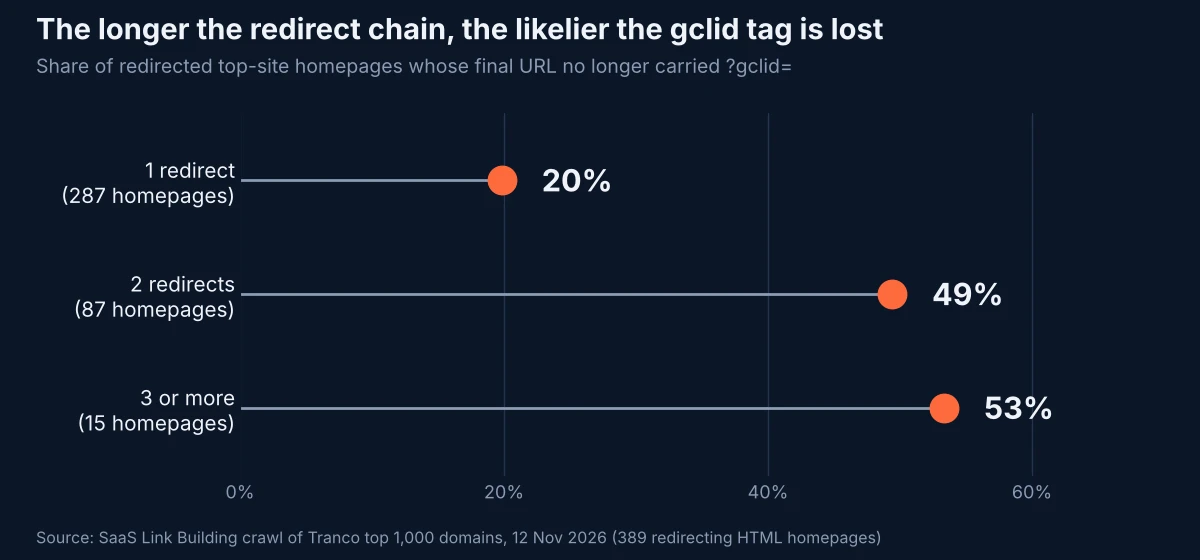
Even the simplest case is not safe: 39 of the 258 homepages that ended on the www version of the same domain still lost the parameter on the way.
| Referrer-Policy sent on the redirect response | Redirect responses | Strips a Google Referer? |
|---|---|---|
| No header | 467 | No (browser default applies) |
| strict-origin-when-cross-origin | 22 | No, keeps the origin on HTTPS |
| no-referrer-when-downgrade | 14 | No, on HTTPS |
| strict-origin, origin, origin-when-cross-origin, unsafe-url | 8 | No, on HTTPS |
| same-origin | 3 | Yes |
| no-referrer | 3 | Yes |
How each value behaves is defined in the W3C Referrer Policy specification, which also lets a policy delivered on a redirect response change the Referer the browser sends to the next URL.
Why it matters now
Referer-based attribution has come under pressure from several directions in recent weeks. We reported when Gemini dropped its utm_source tag after three weeks, and covered a Search Console click spike in which 82% of one site's clicked queries ranked beyond page two. Google's new page does not change how Search sends traffic; it documents behaviour that analytics teams have had to reverse-engineer, and it gives them an official reference when explaining gaps between Search Console and analytics to clients. For the analytics side of that explanation, Google keeps a separate guide to data discrepancies between Google Analytics and Search Console.
The page also follows Google's warning that CDN moves can swamp origin servers, another piece of monitoring advice rather than a policy change.
What SEO teams should do
- Fix the host match in log filters. Match the Referer host against Google's supported domains list plus the
android-app://com.google.android.googlequicksearchbox/prefix, and count only HTML document requests. - Audit redirect chains on landing pages. Request your top landing URLs with a test parameter (for example
?gclid=test) and confirm it survives every hop. Two-hop chains, such as the bare domain towwwand then to a language folder, lost the parameter about half the time in our sample; collapse them into one hop. - Check the Referrer-Policy on redirects, not just pages. A
no-referrerorsame-originheader on a 301 or 302 hides Google as the source on the next request. Security headers added at the CDN or load balancer are the usual culprit. - Replace client-side redirects. JavaScript and meta refresh redirects can swap the Google Referer for your own URL. Use server-side 301 or 308 redirects instead.
- Set expectations. Treat Search Console as the source of truth for clicks and queries, and expect analytics to show fewer organic sessions, with some landing in direct.
Methodology
On 12 November 2026 (17:17 UTC) we took the top 1,000 domains from the Tranco list (ID PY2NJ) and requested https://[domain]/?gclid=slbtest123 with a desktop Chrome user agent and a https://www.google.com/ Referer, following up to ten redirects by hand and recording each hop's status code and Referrer-Policy header. 502 domains returned an HTML page with status 200; the rest failed, blocked us or returned errors and were excluded. A chain counted as losing the parameter when the final URL's query string no longer held gclid=slbtest123 as its own parameter (cases where it survived only inside another encoded parameter count as lost). The browser check used Playwright with Chromium, loading each homepage with a Google Referer and reading document.referrer. Google's referrer meta tag and the supported domains list were fetched the same day.
Conclusion
Google's new page confirms what many log analysts assumed: Search sends only its origin, never the query, and plenty of legitimate visits arrive with no Referer at all. The part site owners control is what happens after the click. In our crawl, stripping Referrer-Policy headers on redirects were rare, but lost parameters were common, and a second hop more than doubled the risk. A redirect audit is the cheapest way to narrow the gap between Search Console and analytics.
Questions and answers
What Referer does Google Search send?
Google Search uses the origin referrer policy, so the Referer contains only the scheme and host, such as https://www.google.com/ or a local Google domain. Clicks from the Google app on Android can arrive as android-app://com.google.android.googlequicksearchbox/https/www.google.com, according to Google's documentation.
Does the Google Referer include the search query?
No. Google's documentation says the Referer header does not include the query the user typed and directs site owners to the Search Console Performance report for query data.
Why do analytics sessions not match Search Console clicks?
Google lists privacy settings, consent choices and ad blockers, client-side redirects, redirects that drop query parameters, redirects that send a stricter Referrer-Policy, different measurement methods and paid traffic as common reasons.
How often do redirects drop tracking parameters?
In our 12 November crawl of 502 top-site homepages, 108 of the 389 that redirected (27.8%) lost a gclid test parameter. The rate was 20% for one redirect and 49% for two.
More releases
-
Updates
Gemini 4 Hydrogen Reaches All Searchers; Multi-Part AI Mode Queries Cited 24 Sources vs 14
Google made Gemini 4 Hydrogen the model behind Search for all users on 12 November, promising better handling of multi-part questions and a wider query fan-out. In 24 AI Mode searches we ran on launch day, detailed queries cited 24 non-Google sources against 14 for short ones, though the median answer cited just two.
-
Studies
YouTube Out-Cites Dictionaries in Google's 'Define' AI Overviews, 66 to 60 in 31 Searches
Google now shows AI Overviews on definition searches fully expanded, according to an 11 November report. In our pull of 31 US 'define' searches, every result page carried an AI Overview, and YouTube drew 66 of 271 citations against 60 for dictionary sites, even though dictionaries held 32% of the organic top 10.
-
Updates
Google Adds Things to Do to EEA Aggregator Units; 45 of 50 Attraction Links Left Google
Google extended its EEA aggregator and supplier units to things-to-do searches on 9 November. In our ten-city check, EEA results showed attraction cards linking to official sites on five pages, while US results showed Google's own Top sights module on all ten, with every entry linking back to Google.
Tell us the site and the goals.
Rankings in Google and visibility in AI answers, from one monthly plan. One call is enough to say which one fits. Email works just as well.