Search Console Click Spike: 82% of One Site's Clicked Queries Ranked Beyond Page 2
A click spike in Google Search Console around 1 November hit one of five properties we checked: clicks jumped fivefold to 379 with flat impressions, 93% from desktop, and 156 of 190 clicked queries ranked beyond position 20, a pattern that points to automated traffic rather than people.
 Vibhu Dhariwal
Cofounder & CTO, Digital Gratified
- Published
- Section
- Industry news
- Reading time
- 8 minutes
Ras Al Khaimah, United Arab Emirates, .
Search Console users began reporting a sudden jump in clicks in the Performance report over the weekend of 31 October and 1 November, with impressions flat and, according to some of those reporting, no matching rise in site visits. Search Engine Roundtable and Search Engine Land have both covered the reports, and practitioners posting on X described clicks running at up to 10 times a normal day on some properties while others showed nothing unusual. Google had not published an explanation, and its Search Console data anomalies page listed no entry for the period when we checked it.
To see what the spike looks like from the inside, we pulled query, page, country and device data from the Search Console API for five properties we can read, including this site. One of them, a B2B SaaS blog that averages roughly 29,000 web impressions a day, shows the spike clearly. The detail inside it points away from a reporting glitch and towards automated activity being counted as clicks.
Key findings
- Only 1 of the 5 properties showed a clear spike. It landed on the Search Console date of 1 November: 379 web clicks against a 15-day median of 76, with impressions slightly below normal at 26,714.
- Nearly all of the extra clicks came from one country and one device. United States clicks rose to 332, from 10 on 31 October and 18 on 2 November. Desktop clicks reached 352, while mobile stayed at 27, in line with the days either side.
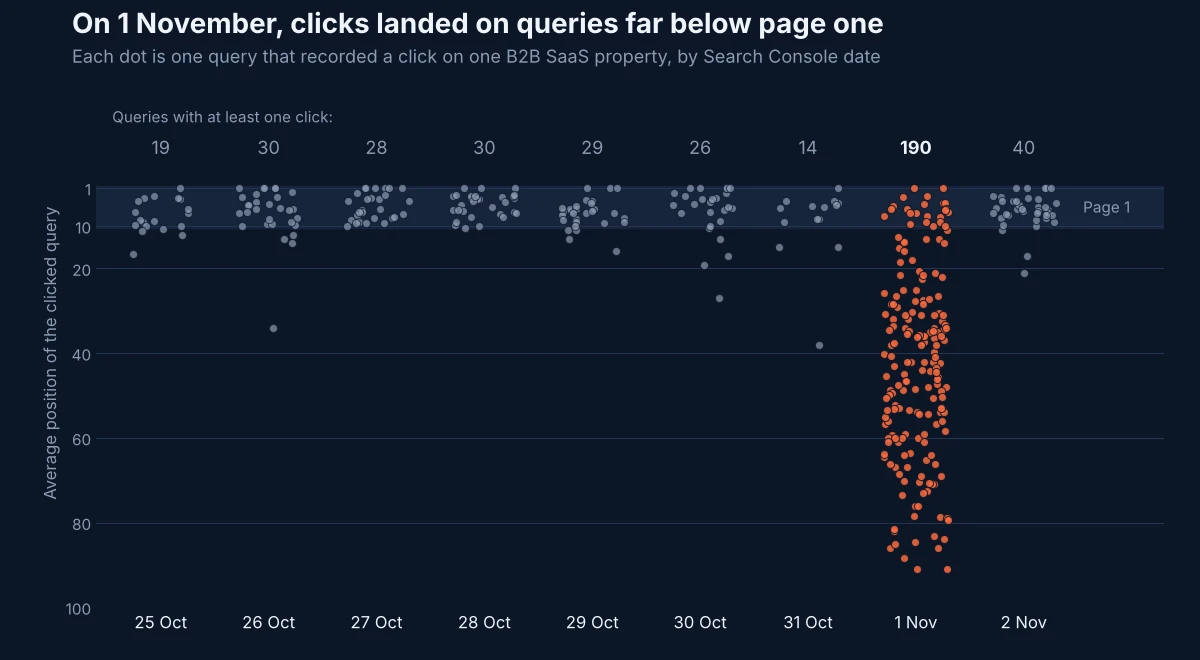
- The clicks were recorded on queries where the site barely ranks. 156 of the 190 queries that drew a click on 1 November (82%) had an average position beyond 20, and 74 were beyond position 50. In the seven days before, only 3 of 176 clicked queries ranked beyond position 20.
- The pattern looks machine-made: 61 of the 190 clicked queries recorded exactly as many clicks as impressions, and 71 recorded exactly 2 clicks.
- The next day the property returned to normal: 98 clicks at a 0.25% click-through rate.
What the spike looks like
The clearest signal is position. On an ordinary day, almost every query that earns this site a click ranks on page one, which is what anyone would expect from human searchers. On 1 November the clicked queries spread down to average positions in the 80s, a depth that few people scroll to, let alone click from.
The concentration in single pages is just as stark. The property's most-clicked page on 1 November logged 123 clicks from 460 impressions at an average position of 37.5. In the eight surrounding days in our pull, the same page never logged more than 3 clicks in a day. The queries behind the spike were long-tail how-to searches, many of them phrased as full questions, possibly the kind an AI research tool generates when it breaks a prompt into sub-queries, though we cannot confirm that.
How the five properties compared
| Property | Median daily clicks, 17 to 31 Oct | 31 Oct | 1 Nov | 2 Nov |
|---|---|---|---|---|
| A: B2B SaaS blog, about 29,000 impressions a day | 76 | 42 | 379 | 98 |
| B: agency site, about 1,000 impressions a day | 3 | 2 | 3 | 7 |
| C: SaaS tool site, about 200 impressions a day | 0 | 0 | 0 | 5 |
| D: SaaS tool site, about 40 impressions a day | 1 | 1 | 1 | 0 |
| E: saaslinkbuilding.com | 0 | 0 | 0 | 0 |
Source: Search Console API, web search type, daily clicks by Search Console date.
Property C is worth a second look. Its 5 clicks on 2 November came after 16 days with at most 1 click a day, and all 5 were on queries with average positions between 36 and 90. The volume is too small to call a spike, but it carries the same signature: clicks recorded far below the point where people normally click.
Why this matters: Search Console says it filters robots
Google's help documentation on Search Console data says the tool processes its source data to remove duplicates "and visits from robots", which is one reason its numbers can differ from other analytics tools. The Performance report help page defines a click as the number of times a user clicked through to a site from Google Search results.
If the spike is automated traffic, it slipped through that filter on some properties for at least one day. One commenter said the extra clicks did not seem to translate into visits on site, one consultant said the click-through patterns pointed to bot traffic, and another suggested AI agents researching products or services. A further commenter raised the possibility that rank trackers resolving Google's /goto redirect links are being logged as clicks, a format we covered when most top-100 organic results moved behind /goto links. Both explanations are unconfirmed. Search Engine Roundtable, citing Search Engine Land, reported that three sites showed the spike through the Search Console API while the web interface showed it for only one of them, which, if it holds, would point to a processing difference rather than a single logging fault.
Our data cannot separate those theories, but it does narrow them. The extra clicks were almost entirely US and desktop, landed on deep long-tail queries, and lasted one Search Console day before stopping. Our reading, which is speculation until Google comments, is that this fits a single automated workload running from one location better than a broad logging error. The logging errors on Google's anomalies page this year, such as several that lowered Discover clicks and impressions, were each described as a logging error in the report itself, with no mention of individual sites.
Context: a busy autumn for Search Console data
This is the latest in a run of Search Console reporting problems this year. In October we counted 10 issues logged in Google's own anomalies record during 2026, along with a long data delay and a broken date picker. Separately, rank trackers have been dealing with altered results served to automated scrapers, a sign of how much automated querying now passes through Google Search. And log files are starting to show AI agents that browse, compare and even reach checkout, as we found when we looked at how to spot Google-Agent in server logs.
What SEO teams should do
- Check 31 October to 2 November in the Performance report. Compare clicks with impressions. A click jump with flat impressions and a sharp rise in click-through rate is the signature to look for.
- Break it down by country and device. Search Engine Roundtable reported on 4 November that the Performance report now lets you select several device types at once, which makes it quicker to isolate a desktop-only anomaly. If one country and one device carry the spike, treat it as suspect.
- Sort clicked queries by position. Export the queries for the spike day and count how many clicks sit beyond position 20. Real searchers rarely produce clicks there in volume.
- Reconcile with analytics before reporting. If organic sessions in your analytics did not rise, annotate the day and exclude it from month-on-month comparisons and client reports.
- Check API exports as well as the interface. If the reports that the two differ are right, dashboards built on the API may carry an inflated day that the web report does not show.
- Do not change anything on the site because of it. Nothing in the data suggests the clicks reflect ranking changes: impressions on the spike day stayed inside their normal range.
Methodology
On 4 November 2026 we queried the Search Console API (web search type) for five domain properties the newsroom can read: saaslinkbuilding.com and four small B2B SaaS and marketing sites, which we have anonymised. For each we pulled daily totals from 17 October to 2 November, the latest complete date available. For the affected property we also pulled clicks by date and country, date and device, page, and date and query for 25 October to 2 November (up to 5,000 rows, sorted by clicks, so every query row with a click was included). Positions are Search Console's average position for each query on each day. Baseline medians cover 17 to 31 October. Search Console does not show anonymised queries, so query-level clicks (261 on 1 November) are lower than the property total (379). We did not have access to analytics data for the affected property, so we cannot confirm independently that the clicks produced no visits.
Conclusion
The click spike is real in the data, but in the one property where we found it, the detail points to something other than people: clicks almost entirely from one country and one device, most of them on queries ranked beyond page two, and click counts that matched impressions exactly on a third of the clicked queries. Until Google explains it, the safest course is to flag 31 October to 2 November as unreliable for click reporting, check your own breakdowns, and keep it out of performance comparisons.
Questions and answers
Why are Search Console clicks spiking without more traffic?
Google has not explained it. Users reported click jumps with flat impressions around 31 October and 1 November. In the one affected property we examined, the extra clicks came almost entirely from US desktop searches on queries ranked beyond position 20, which points to automated activity rather than people.
Does Search Console filter out bot clicks?
Google's help documentation says Search Console processes its source data to eliminate duplicates and visits from robots. The late October spike suggests some automated activity may have been counted anyway on some properties.
Has Google listed the click spike as a data anomaly?
No. Google's Search Console data anomalies page had no entry covering 31 October to 2 November 2026 when we checked it on 4 November.
How can I tell if my site was affected?
Compare clicks with impressions for 31 October to 2 November in the Performance report, then break the spike day down by country, device and query position. A jump concentrated in one country and one device, with clicks on queries ranked beyond position 20, matches the pattern we found.
Should I change anything on my site because of the spike?
There is no sign the clicks reflect ranking changes. The practical step is to annotate the affected days and keep them out of performance comparisons and reports until Google comments.
More releases
-
Studies
Does Schema Markup Help You Rank? 186 Top-10 Pages Show No Edge, Only Richer Snippets
Schema markup sat on 90.3% of the 186 top-10 Google pages we fetched across 36 searches, yet pages with and without it ranked almost identically (average position 4.48 against 4.50). Its measurable payoff was display: 15 of 17 recipe pages with Recipe markup showed stars or cook times.
-
Explainers
Gemini and AI Mode Fetch as Google and Google-Lens; 397 of 534 Fetcher Ranges Lack rDNS
Gemini and Google's AI Mode fetch pages with user agents Google has not documented, a 3 November test found. Our check of five Google crawler pages and 798 published IP prefixes shows the tokens are unlisted and that 397 of 534 ranges in one Google fetcher file have no reverse DNS record.
-
Updates
Google Lifts EEA Site Reputation Penalties; Publisher Coupons Took 21% of Irish Results
Google is emailing site owners that site reputation abuse manual actions no longer affect search results shown in the European Economic Area, a change in force since 30 August. In our check of 11 coupon searches, publisher-hosted coupon pages took 21% of Irish organic results against 13% in the UK.
Tell us the site and the goals.
Rankings in Google and visibility in AI answers, from one monthly plan. One call is enough to say which one fits. Email works just as well.