Google Lifts EEA Site Reputation Penalties; Publisher Coupons Took 21% of Irish Results
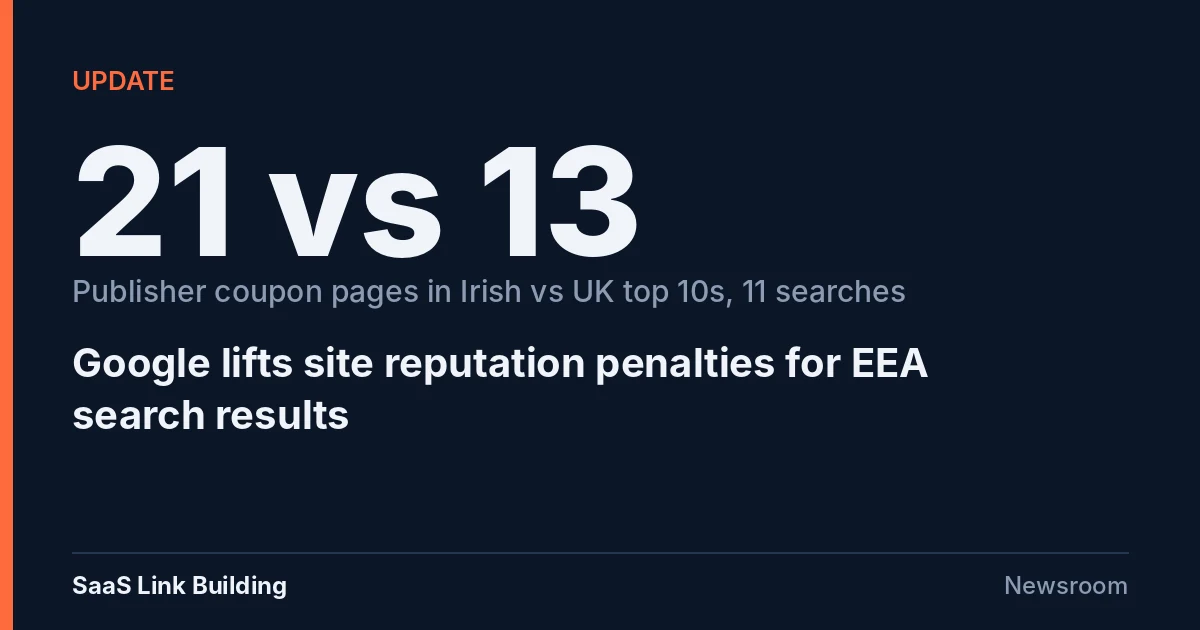
Google is emailing site owners that site reputation abuse manual actions no longer affect search results shown in the European Economic Area, a change in force since 30 August. In our check of 11 coupon searches, publisher-hosted coupon pages took 21% of Irish organic results against 13% in the UK.
 Vibhu Dhariwal
Cofounder & CTO, Digital Gratified
- Published
- Section
- Updates
- Reading time
- 7 minutes
Ras Al Khaimah, United Arab Emirates, .
Google has started emailing site owners whose pages were once hit by a site reputation abuse manual action to say those penalties no longer affect search results shown to users in the European Economic Area (EEA). The notices went out through Search Console on 4 November, according to a copy shared on X by an SEO consultant and reported by Search Engine Roundtable. The change itself is not new: Google's Search Central blog announced it on 28 August, effective 30 August, after discussions with the European Commission. The emails arrive 66 days after the change took effect.
To see what the split looks like in practice, we pulled the same 11 retailer coupon searches on Google in the UK, which is outside the EEA, and in Ireland, which is inside it. Publisher coupon sections are a category Google has addressed by name, in its March 2024 FAQ and as a worked example on the current policy page. In our snapshot, publisher-hosted coupon pages took 21 of 101 organic results in Ireland against 13 of 99 in the UK.
What changed
Google's spam policies page, last updated on 28 August, now describes two enforcement regimes for the same policy:
- Outside the EEA: pages found to break the policy may receive a manual action that affects how they appear in results shown to users outside the EEA. The rest of the site is not affected.
- Inside the EEA: the same pages "won't be subject to the impact of manual action". Instead, Google may categorise them as separate from the main domain so each part ranks independently, with casino content competing against other casino content, to use Google's own example.
- Past EEA penalties: Google says it will lift all previous site reputation manual actions for pages shown to EEA users, and that a past action is not used as a ranking signal.
- No noindex obligation: sites do not have to noindex content under a non-EEA manual action, and not doing so is not treated as circumvention inside the EEA.
- Appeals: EEA sites get a reconsideration process with a committed short response time, and eligible sites can take disputes to the Google Search mediation scheme run by CEDR.
The new email, as published, tells site owners that a previous site reputation manual action "will no longer impact search results shown to users within the EEA". According to the consultant who shared it, it also reached sites whose manual actions were already resolved, not only sites with an active penalty.
Our check: coupon results in the UK and Ireland
We counted coupon or voucher directory pages hosted on news, magazine and technology publisher domains in the organic top 10 for "[brand] discount code" on google.co.uk and google.ie. Pages from dedicated coupon sites, cashback services, retailers, forums and social platforms were not counted, and neither were dated editorial articles that happened to mention a code.
| Measure | UK (outside EEA) | Ireland (inside EEA) |
|---|---|---|
| Organic results checked | 99 | 101 |
| Publisher-hosted coupon pages | 13 | 21 |
| Share of organic results | 13.1% | 20.8% |
| Searches with at least one | 9 of 11 | 10 of 11 |
| Publisher coupon pages in positions 1 to 3 | 8 | 8 |
| Excluding The Irish Times' discounts section | 12 | 17 |
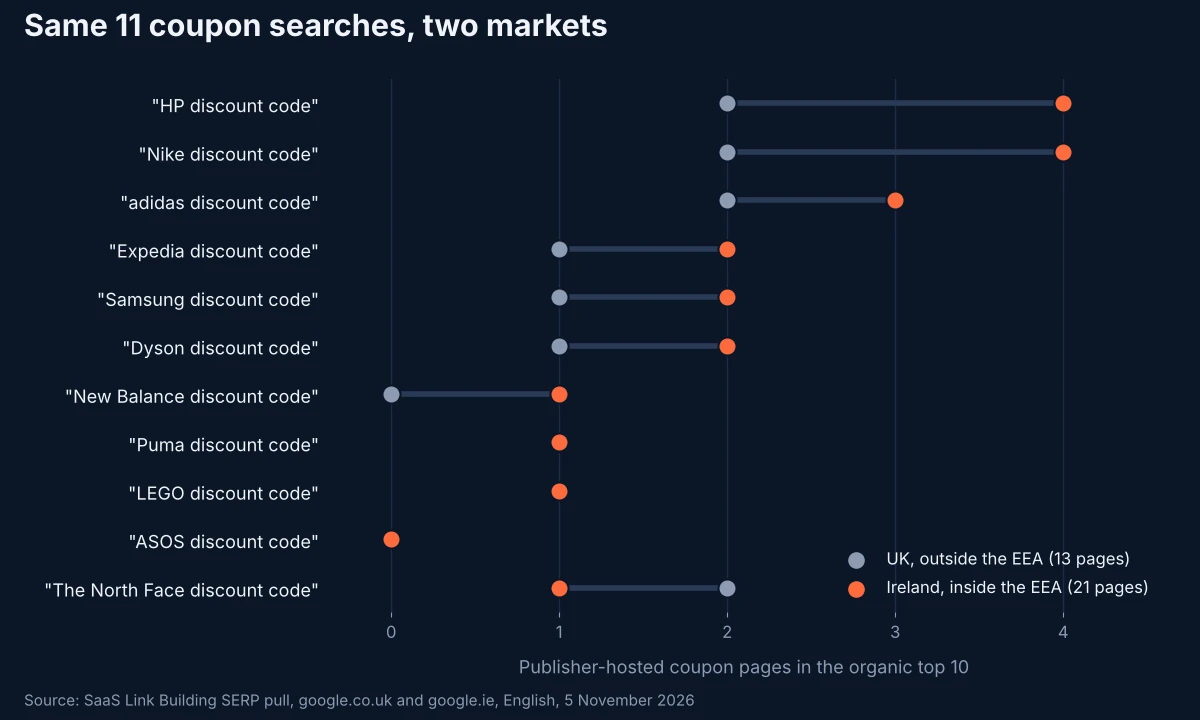
Three readings matter. First, the gap is real but modest, and it sits below the top three: both markets had exactly eight publisher coupon pages in positions 1 to 3, so the extra Irish results landed further down page one. Second, part of the gap is plain localisation. The Irish Times' discounts section ranked for four of the Irish searches, which you would expect in its home market. Strip it out and the count is 17 against 12. Third, the coupon sections we saw in Ireland were mostly the same ones visible in the UK: 8 of the 13 publisher domains we counted in Irish results also appeared in the UK results.
What our check cannot show is cause. We have no pre-August baseline, Google does not publish which sections received manual actions, and UK and Irish results differ for many reasons unrelated to spam enforcement. Nor does a publisher coupon page breach the policy by existing: Google's policy page says it is unlikely to act on a coupon section that a publisher genuinely integrates and curates. Treat the figures as a picture of how the two regimes look side by side today, not proof that the EEA change produced them.
Timeline
- 5 March 2024: Google adds site reputation abuse to its spam policies, alongside expired domain abuse and scaled content abuse, per its documentation changelog.
- 19 November 2024: Google rewrites the policy so that third-party content published to exploit a host's ranking signals breaks it regardless of first-party involvement.
- 21 January 2025: Google folds its site reputation FAQ into the policy page, describing it as an editorial change.
- 28 August 2026: Google announces the EEA enforcement change and updates the policy page.
- 30 August 2026: The split takes effect.
- 4 November 2026: Search Console emails reach sites with past site reputation manual actions.
The August post points to the EU's Digital Markets Act: Google says it remains concerned that "an overbroad application of the DMA" could stop it tackling manipulation. The same regulation was behind the €460M fine after which we tested Google's EU results for self-preferencing, and Brussels is also the venue for the French publishers' complaint about AI Overviews.
What this means for SEO teams
- Check where rankings are measured. A section under a manual action can now rank in Germany or Ireland while staying suppressed in the US or UK. Rank tracking from one country will miss that. Track affected sections in at least one EEA market and one non-EEA market.
- Read the email against the Manual actions report. The notice does not mean a non-EEA penalty has gone. Open the Manual actions report in Search Console and confirm what still applies outside the EEA.
- Do not remove noindex in a hurry. Google says noindex is not required, but if you noindexed a section to deal with a manual action, removing the tag exposes it everywhere, including in markets where the action still applies.
- Expect EEA competition in parasite-prone niches. If you compete on coupons, casinos, payday loans or similar terms in Europe, recheck those results. Google's own policy text says such sections may be categorised separately and ranked against other content of the same type.
- Use the EEA appeal routes if they apply. Google says EEA sites get a reconsideration process with a committed short response time, plus alternative dispute resolution.
For the wider pattern of Google's 2026 enforcement, our analysis of this year's spam and core updates sets out the calendar.
Methodology
On 5 November 2026 we collected Google organic results through a SERP API for 11 queries in the form "[brand] discount code" (Nike, adidas, ASOS, Dyson, LEGO, Puma, New Balance, Samsung, The North Face, HP and Expedia). Each query ran once on google.co.uk with UK geolocation (London) and once on google.ie with Irish geolocation (Dublin), English interface, top 10 requested. The API returned 99 organic results for the UK and 101 for Ireland; ads, AI Overviews and other features were excluded. We counted a result as a publisher-hosted coupon page when it sat in a coupon, voucher, deals or discount-code directory on the domain of a news, magazine or technology publication. Dedicated coupon and cashback sites, retailers, student discount services, forums, social networks and dated editorial articles were not counted. This is a single snapshot with no earlier baseline, and it does not identify which pages, if any, have received manual actions.
Conclusion
Google's site reputation policy now works differently on either side of the EEA border, and the November emails now put that change in front of the sites it touches. Our UK and Ireland snapshot found more publisher coupon pages in Irish results, though the gap is partly local and cannot be pinned on the policy change alone.
The practical effect is that one page can carry a manual action in one market and rank freely in another. Teams running or competing with third-party sections on large domains should measure both, and read the Manual actions report rather than the email alone.
Questions and answers
Do site reputation abuse manual actions still apply outside the EEA?
Yes. Google's spam policies page says pages found to break the policy may still receive a manual action affecting results shown to users outside the European Economic Area. Only results shown to users inside the EEA are exempt.
When did the EEA change take effect?
Google announced it on its Search Central blog on 28 August 2026 and said it would apply from 30 August 2026. Search Console emails explaining it to affected sites went out on 4 November 2026.
What happens to policy-breaking pages inside the EEA instead?
Google says it may categorise the relevant pages as separate from the main domain, so they rank independently on their own signals rather than benefiting from the host site's reputation. It says this is not automatic and that a past manual action is not used as a ranking signal.
Do I need to noindex content that has a manual action outside the EEA?
No. Google's policy page says there is no obligation to noindex such content, and that not doing so is not treated as an attempt to circumvent the policy in the EEA.
Is a publisher coupon section automatically site reputation abuse?
No. Google's policy page gives an integrated, publisher-curated coupons and deals section as an example where it is unlikely to take action.
More releases
-
Studies
Does Schema Markup Help You Rank? 186 Top-10 Pages Show No Edge, Only Richer Snippets
Schema markup sat on 90.3% of the 186 top-10 Google pages we fetched across 36 searches, yet pages with and without it ranked almost identically (average position 4.48 against 4.50). Its measurable payoff was display: 15 of 17 recipe pages with Recipe markup showed stars or cook times.
-
Explainers
Gemini and AI Mode Fetch as Google and Google-Lens; 397 of 534 Fetcher Ranges Lack rDNS
Gemini and Google's AI Mode fetch pages with user agents Google has not documented, a 3 November test found. Our check of five Google crawler pages and 798 published IP prefixes shows the tokens are unlisted and that 397 of 534 ranges in one Google fetcher file have no reverse DNS record.
-
Industry news
Search Console Click Spike: 82% of One Site's Clicked Queries Ranked Beyond Page 2
A click spike in Google Search Console around 1 November hit one of five properties we checked: clicks jumped fivefold to 379 with flat impressions, 93% from desktop, and 156 of 190 clicked queries ranked beyond position 20, a pattern that points to automated traffic rather than people.
Tell us the site and the goals.
Rankings in Google and visibility in AI answers, from one monthly plan. One call is enough to say which one fits. Email works just as well.