French Publishers Take AI Overviews to Brussels; Press Got 3 of 218 Citations in Our Test
Five French publisher groups have asked the European Commission to examine Google's AI Overviews and AI Mode, adding evidence to its December 2025 probe. Our 31-search check of google.fr found an AI Overview on every query, with press sites supplying 3 of 218 citations and YouTube 53.
 Vibhu Dhariwal
Cofounder & CTO, Digital Gratified
- Published
- Section
- Industry news
- Reading time
- 7 minutes
Ras Al Khaimah, United Arab Emirates, .
Five French publisher organisations, the CPA, FNPS, GESTE, SEPM and SPIIL, have filed a complaint with the European Commission over Google's AI Overviews and AI Mode, according to a joint statement dated 29 October 2026 and posted by GESTE on 30 October. The groups call it the broadest coalition of French publisher bodies ever assembled before the EU competition authority, and they want their evidence folded into the formal investigation the Commission opened into Google in December 2025.
To see what French searchers are actually shown, we ran 31 informational searches on google.fr from a Paris location on 3 November. Google returned an AI Overview on every one. In the 27 overviews whose sources loaded, news and magazine publishers supplied 3 of 218 citations, while YouTube alone supplied 53.
What the complaint says
- Who filed: the CPA (a digital marketing trade body), FNPS (specialised press), GESTE (online content and service publishers), SEPM (magazine publishers) and SPIIL (independent online press). SPIIL also published the statement on its own site.
- The grievance: Google launched AI Overviews and AI Mode in France on 22 July 2026 unilaterally and without consultation, the groups say, using publisher content to generate answers that can replace visits to their sites, with no real transparency or control for publishers.
- The ask: the Commission should assess the effects on competition, on publishers' control over how their content is used, and on the economic viability of their digital businesses. The statement does not request interim measures or name a payment model.
- Why now: the groups argue France's late launch, close to two years after other markets, let them document effects seen abroad before the features arrived.
- What is not public: the complaint text itself has not been published, and neither the statement nor the coverage we reviewed carried a response from Google.
The same three founding groups (CPA, GESTE and SPIIL) had already objected on launch day. Their 22 July release said publishers learned of the rollout at the same time as users, that their questions on content use and opt-out terms had gone unanswered, and that Google remains bound by commitments it gave France's Autorité de la concurrence over neighbouring rights.
Our check: who French AI Overviews cite
The complaint centres on substitution: answers built from publisher content that keep the reader on Google. We could not measure traffic, but we could measure which sources Google credits. Across 31 everyday French informational queries (energy prices, pensions, flu symptoms, passports, heat pumps, job interviews and similar), we compared the sources cited inside each AI Overview with the organic top 10 beneath it.
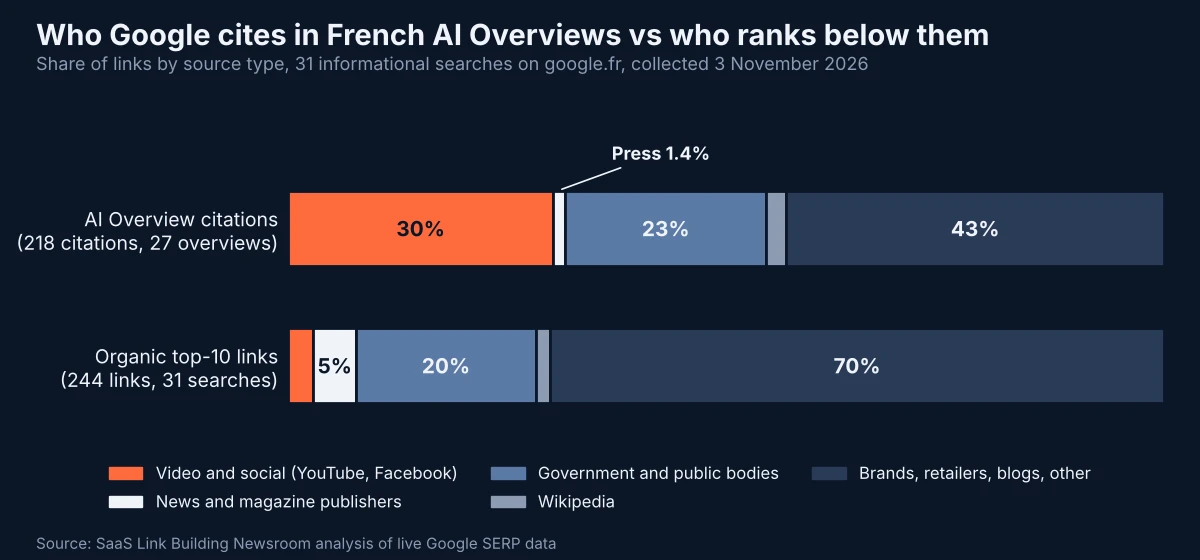
Four patterns stood out:
- Overviews everywhere. All 31 searches showed an AI Overview. Four loaded their sources in a second request that our collection did not capture, so citation figures cover 27 overviews.
- Press is close to absent from citations. Only three citations came from news or magazine sites: a Moroccan news site on the flu query, a French business magazine on the passport query and a Paris daily on the property price query. Press titles held 12 organic top-10 positions across 11 of the 31 results pages.
- YouTube is the single biggest source. It was cited 53 times and appeared in 20 of the 27 overviews, yet ranked in the organic top 10 for only 4 of the 31 searches. Video and social platforms combined took 66 citations.
- Overviews draw on a different pool. Only 34 of the 218 citations pointed to a domain that also ranked in that search's own top 10.
That last point matters for the complaint. If the overview were a summary of the ten blue links below it, publishers who rank would be credited in it. On these queries, most of the sources Google credits are not the sites that rank, and very few are press. An earlier newsroom pull found the same YouTube pattern, with YouTube cited in all 30 AI Overviews we collected.
Two limits apply. These were evergreen information queries, not breaking news searches, where press would expect to do better. And 31 queries is a snapshot, not a census of French search.
How the French complaint fits the EU timeline
| Date | Event | Venue |
|---|---|---|
| Early July 2025 | The Independent Publishers Alliance reportedly files a complaint over AI Overviews (Siècle Digital) | European Commission |
| October 2025 | Italian newspaper federation FIEG complains that AI Overviews hurt publisher traffic (Génération NT) | Agcom, Italy |
| 9 December 2025 | Commission opens a formal antitrust investigation into Google's use of publisher and YouTube content for AI (Eunews) | European Commission |
| 10 February 2026 | European Publishers Council files its own complaint; Google calls the claims inaccurate (Yahoo Finance) | European Commission |
| 22 July 2026 | Google launches AI Overviews and AI Mode in France (Google France blog) | Google Search |
| 29 to 30 October 2026 | CPA, FNPS, GESTE, SEPM and SPIIL announce their joint complaint | European Commission |
When the Commission opened its case, Executive Vice-President Teresa Ribera said Google "may have imposed unfair terms and conditions on publishers and content creators", Eunews reported. The French filing adds market evidence to that file rather than opening a new case, so it does not by itself start a new legal clock.
What Google offers French sites today
Google's French launch post said a new Search Console control, available in France, lets site owners decide whether their site appears in Search's generative AI features, and that the setting is not used as a ranking signal for results outside those features. We covered how that control works when Google added it to its core blocking guide. The French groups said in July that the opt-out only partly answers their concerns, and the European Publishers Council made a similar argument in February.
Separately, Google said on 30 October that it intends to honour a shared machine-readable AI training preference, a change we covered in our report on the shared AI training opt-out. That control concerns model training, not whether a page is cited in an AI Overview, which is the issue in this complaint.
What this means for SEO teams
- Audit French AI Overview presence now. If you publish in French, run your top informational queries on google.fr and record whether you are cited, ranked, or both. In our sample, only 34 of 218 citations went to domains that also ranked in the top 10.
- Treat YouTube as a citation surface. With YouTube supplying close to a quarter of citations in our French sample, a short explainer video on your core topics is one of the few ways a publisher can appear inside the overview.
- Decide on the generative AI control with data. Opting out removes your content from AI features but, per Google, not from ranking. Compare impressions for AI-heavy queries in Search Console before and after any change, and test on a section rather than a whole site.
- Watch the Commission case, not just the complaints. Any remedy, such as compensation or a stronger opt-out, would come from the December 2025 investigation. Complaints like this one shape its evidence but do not set its timetable.
Methodology
On 3 November 2026 we pulled live Google results through a SERP API for 31 French-language informational queries, using google.fr, French interface language, country France and a Paris location. For each query we recorded whether an AI Overview appeared, every domain in the overview's reference list, and the domains of up to ten organic results (244 organic links in total, since some pages showed fewer than ten). Four overviews loaded their references asynchronously and were counted as present but excluded from citation counts, leaving 218 citations from 27 overviews. We classed each domain by hand as news and magazine press, video and social, Wikipedia, government and public bodies (including public health, research and statistics bodies), or other. Consumer associations, trade unions and brand content hubs were classed as other. Each query was run once, so results can vary by time and user.
Conclusion
The French complaint does not open a new front so much as add weight to one the Commission opened eleven months ago. What it adds is a market where AI Overviews arrived late and fast. Our snapshot of google.fr suggests the core grievance is easy to see: overviews appear on every everyday query we tried, they draw mostly on sources other than the pages that rank, and French press titles are almost missing from them.
For publishers, the practical questions are whether to use Google's opt-out and how to earn citations in the meantime. For the Commission, the question is whether a control that removes content from AI answers without affecting rankings is enough. Neither has been settled yet.
Questions and answers
Who filed the French complaint against Google's AI Overviews?
Five French organisations: the CPA, FNPS, GESTE, SEPM and SPIIL. Their joint statement is dated 29 October 2026 and was posted by GESTE on 30 October.
Is this a new EU investigation?
No. The groups say their complaint adds French evidence to the formal antitrust investigation the European Commission opened into Google in December 2025 over its use of publisher and YouTube content for AI.
When did AI Overviews and AI Mode launch in France?
Google announced the French launch of AI Overviews and AI Mode on its French blog on 22 July 2026.
Can French sites opt out of AI Overviews?
Google's French launch post says a Search Console control, available in France, lets site owners choose whether their site appears in Search's generative AI features, and that the setting is not used as a ranking signal outside those features.
How often did press sites appear in French AI Overviews in the newsroom's test?
In 27 AI Overviews from 31 informational google.fr searches collected on 3 November 2026, news and magazine sites supplied 3 of 218 citations. YouTube supplied 53.
More releases
-
Explainers
23 of 489 Top Sites Still Use NoArchive or NoCache, Tags Bing Drops for AI on 1 March
Bing will stop reading NoArchive and NoCache as AI controls on 1 March 2027, replacing them with separate AI Training and AI Grounding preferences. Our 2 November check of the Tranco top 1,000 found 23 of 489 sites still use the old tags, 11 aimed at Bingbot alone, including the BBC and The Guardian.
-
Studies
Google Put Top Stories Inside AI Overviews on 8 of 60 Trending Searches, None Political
Google placed its Top Stories news carousel inside the AI Overview on 8 of 60 trending US searches we pulled on 2 November, mostly sports, and on none of 18 political and government searches. Every embedded carousel listed 10 stories, against an average of 5.5 in standalone Top Stories boxes.
-
Industry news
Google Has 31 Days to Give UK Publishers AI Engagement Metrics; Illyes Says No News Yet
A UK competition rule requiring Google to give publishers clear engagement metrics for content in AI Overviews and AI Mode takes effect on 3 December, 31 days away. Search Console's AI report still shows impressions only, and Gary Illyes says Google has nothing to announce on extra data.
Tell us the site and the goals.
Rankings in Google and visibility in AI answers, from one monthly plan. One call is enough to say which one fits. Email works just as well.