23 of 489 Top Sites Still Use NoArchive or NoCache, Tags Bing Drops for AI on 1 March
Bing will stop reading NoArchive and NoCache as AI controls on 1 March 2027, replacing them with separate AI Training and AI Grounding preferences. Our 2 November check of the Tranco top 1,000 found 23 of 489 sites still use the old tags, 11 aimed at Bingbot alone, including the BBC and The Guardian.
 Vibhu Dhariwal
Cofounder & CTO, Digital Gratified
- Published
- Section
- Explainers
- Reading time
- 8 minutes
Ras Al Khaimah, United Arab Emirates, .
Microsoft Bing will stop treating the old NoArchive and NoCache tags as AI controls on 1 March 2027, and the sites still relying on them include some of the web's biggest publishers. Bing set out the change in a 30 October blog post by principal product manager Krishna Madhavan and a new AI preferences FAQ: separate AI Training and AI Grounding preferences replace the 2023 tags, which Bing says treated training and grounding as a single decision.
To see who has work to do, we checked the homepages of the 1,000 most popular domains on the Tranco list, plus one internal page per site where we could reach one, on 2 November 2026. Of 489 unique sites that returned a page, 23 (4.7%) send NoArchive or NoCache in a robots meta tag or an X-Robots-Tag header. Eleven of them aim the tag at Bingbot alone, among them the BBC, The Guardian, CNET, The Verge, HuffPost, Nikkei, El País, Instagram and Threads. None of the pages we checked carries the new page-level AI preferences yet.
What changed
- Two preferences instead of one tag. AI Training covers using content to change a generative model's parameters. AI Grounding covers using content as input for AI answers in products such as Copilot, Microsoft 365 and Bing's AI Mode and AI Overview. Each can be set independently, and both default to Allow.
- A third grounding option.
DisallowExtendedkeeps content available for grounding in Microsoft's own products but excludes the grounding services Microsoft provides to third parties, which the FAQ names as Web IQ and grounding API access in Microsoft Foundry. - Training can live in robots.txt; grounding cannot. Training uses the shared
__usage_ai-trainingrobots.txt token from an IETF Internet-Draft, with a page-level override. Grounding is page level only, set with a meta tag or HTTP header. - Search eligibility does not change. Bing's FAQ says limiting training or grounding does not affect eligibility for traditional Bing results, and an Allow does not override a robots.txt rule that blocks Bingbot from crawling.
We first reported the shared robots.txt token when Google and Bing said they would honour a common AI training opt-out from 2027. This piece covers the part that needs action sooner: the migration away from the legacy tags.
Who still uses NoArchive and NoCache
News and media publishers dominate the list: 14 of the 23 sites are news outlets or publishers, four are social or streaming platforms, and five are other businesses. Two Russian domain registrars pair NoArchive with noindex on their homepages, so the tag does little there.
| How the tag is sent | Sites | Count |
|---|---|---|
| Bingbot meta tag, NoArchive | CNET, El País, HuffPost, Instagram, Nikkei, Threads | 6 |
| Bingbot meta tag, NoCache | The Verge, Tumblr | 2 |
| X-Robots-Tag header for Bingbot, NoArchive | BBC (bbc.com and bbc.co.uk), The Guardian | 3 |
| Robots meta tag for all crawlers, NoArchive | NPR, Le Monde, Der Spiegel, Ozon, Magnite, Consultant.ru, nic.ru, reg.ru | 8 |
| Robots meta tag for all crawlers, NoCache | Kick | 1 |
| X-Robots-Tag header for all crawlers | Daily Mail and La Repubblica (NoArchive), Nature (NoCache on an article page) | 3 |
| Total | 23 of 489 |
Source: SaaS Link Building check of homepages and one internal page per site across the Tranco top 1,000 (list V354N), 2 November 2026. Each site is counted once.
The Bingbot-specific group matters most. A site that writes <meta name="bingbot" content="noarchive"> or sends X-Robots-Tag: bingbot: noarchive signals a deliberate choice about Microsoft's use of its pages. Under Bing's plan, that choice stops counting for training after 1 March 2027 unless the site publishes the new preference. For grounding, Bing's FAQ says pages without a recorded temporary preference "default to Allow" until they are recrawled with the new tag.
The all-crawler group is murkier. A generic NoArchive in the robots meta tag may be a leftover from the days of Google's cached pages. Google's robots meta tag documentation now lists NoArchive among rules it no longer uses because the cached link feature no longer exists, and says Google Search does not use NoCache. Those sites should decide whether they ever meant it as an AI control.
The timeline
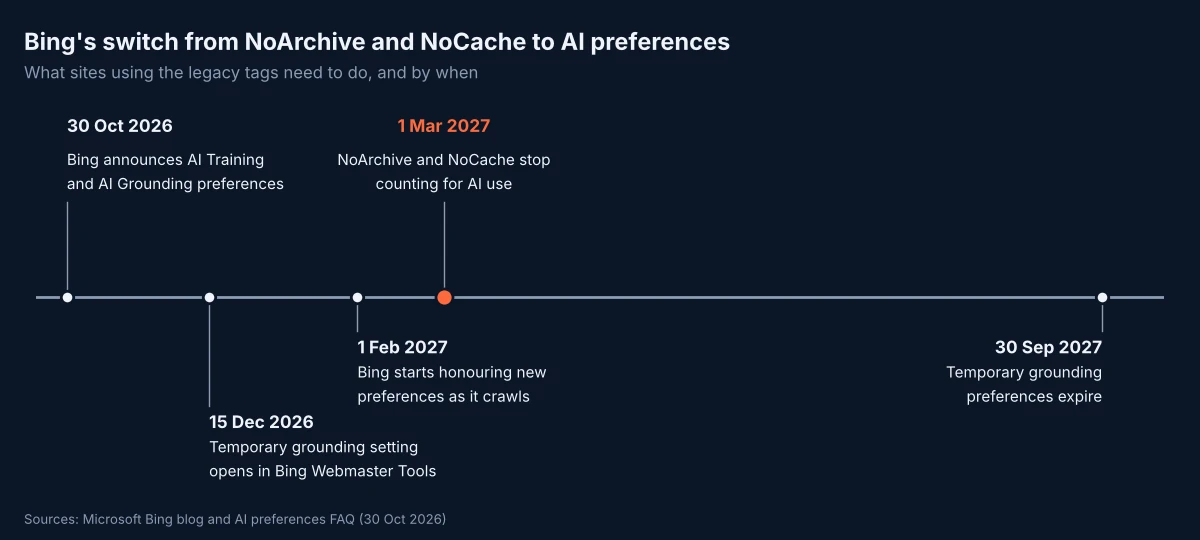
The transition has two tracks. Training has no temporary setting: a site publishes its training preference in robots.txt or on pages by 1 March 2027, and Bing reads it as it crawls from 1 February. Grounding has a bridge. From 15 December 2026, sites that use NoArchive or NoCache on that date can record a temporary grounding preference in Bing Webmaster Tools. Bing asks for it because it may not recrawl every page between February and the March deadline. Each temporary setting lasts until Bing finds the new tag on that page or until 30 September 2027, whichever comes first.
What to do: a worked example
Take a publisher that sends X-Robots-Tag: bingbot: noarchive on every article, as the BBC and The Guardian do on the pages we checked, and wants to keep its content out of Microsoft's model training and out of third-party grounding services while still appearing in Copilot answers.
- Training, site wide. Add a robots.txt group under the shared token. Bing will read it, and Google has said it plans to map the same token to Google-Extended in 2027 when a site does not name Google-Extended itself:
User-Agent: __usage_ai-training Disallow: / - Grounding, per page. Change the header on article templates from NoArchive to the new value:
The meta tag equivalent isX-Robots-Tag: Bingbot: ai-grounding:disallowextended<meta name="Bingbot" content="ai-grounding:disallowextended">. Useai-grounding:disallowinstead to opt out of Copilot and Bing's AI answers too, which Microsoft warns will significantly reduce visibility in AI experiences. - Bridge the gap. Between 15 December 2026 and 1 March 2027, record the matching temporary grounding preference in Bing Webmaster Tools. Publishing the tag alone does not take effect before Bing recrawls the page.
- Keep or drop the old tag. Bing says that once it detects the new preferences on a site, it ignores remaining NoArchive and NoCache tags there for AI purposes and reverts them to their original search meanings.
A site that wants the opposite outcome, full participation, needs to do nothing: both preferences default to Allow. A site that wants to block training only can skip the grounding tag entirely. Our earlier study of AI crawler blocking among 465 top sites showed how many teams already manage per-company rules; this change moves Bing out of that list for training and into its own page-level system for grounding.
Early adopters
Robots.txt adoption has started. Of 492 robots.txt files we retrieved across the same 1,000 domains, two sites already disallow the whole site under __usage_ai-training: X (served at both twitter.com and x.com) and IMDb. X's file includes a comment noting that the token is not a crawler and that a wildcard group never matches it, which mirrors the draft's own rules. No page in our sample used the Bingbot ai-training or ai-grounding values.
What this means for SEO teams
- Search your templates for NoArchive and NoCache, including CDN or server rules that add X-Robots-Tag headers, which do not show up in page source. Six of the 23 sites in our check sent the tag only as a header.
- Find out why the tag is there. If it was added to block cached copies in Google, it has done nothing in Google for some time, and Bing will soon only read it for search caching.
- Decide training and grounding separately. The two settings now carry different trade-offs: training has no visibility upside, while grounding feeds citations in Copilot and Bing's AI answers, which Bing reports in its Webmaster Tools AI performance reports.
- Put 15 December and 1 March in the calendar. The temporary grounding setting is only open to sites using the legacy tags on 15 December.
- Use IndexNow for templates you change late. Bing's blog says IndexNow may prompt a recrawl but does not guarantee one.
Methodology
On 2 November 2026 we took the top 1,000 domains from the Tranco list (ID V354N) and requested https://<domain>/, then the www host if that failed, with a desktop Chrome user agent. 541 domains returned an HTML page with HTTP 200; after merging domains that redirected to the same host, 489 unique sites remained. For 323 of them we also fetched one internal link from the homepage (same host, at least two path segments, excluding login, legal and file links). On each page we recorded robots, bingbot, msnbot and googlebot meta tags and every X-Robots-Tag header, and flagged NoArchive, NoCache, ai-training and ai-grounding values. A site counts once if any checked page carries the value. We also requested each domain's robots.txt and searched it for the __usage_ai-training token; 492 returned a usable file. Our check covers at most two pages per site, so it undercounts sites that use the tags only on deeper sections, and it reflects the pages on that date only.
Conclusion
Bing's change retires a 2023 control that only a small share of top sites still use, 23 of 489 in our check, but those sites include major news publishers that set it for Bingbot on purpose. For them the deadline is real: after 1 March 2027 the old tag no longer limits training, and grounding limits depend on a temporary setting in Bing Webmaster Tools until the new page-level tag is crawled.
Everyone else can treat the update as a chance to separate two decisions that used to be one. Training and grounding now have their own switches at Bing, and the robots.txt training switch is one Google has said it plans to read too.
Questions and answers
Will Bing still honour NoArchive and NoCache for AI use?
Only until the transition ends. Bing says it begins honouring the new AI Training and AI Grounding preferences on 1 February 2027, and after 1 March 2027 NoArchive and NoCache are no longer honoured for training or grounding.
What is the difference between AI Training and AI Grounding?
In Bing's definitions, AI Training is using content to change a generative model's parameters, while AI Grounding is using content as input to inform AI-generated answers in products such as Copilot, Microsoft 365, AI Mode and AI Overview. They are set independently and both default to Allow.
What does DisallowExtended do?
It is a grounding option that keeps content available for Microsoft-operated experiences but excludes grounding services Microsoft provides to third parties, which Bing names as Web IQ and grounding API access in Microsoft Foundry.
Can AI Grounding be set in robots.txt?
No. Bing says AI Grounding is page level only, set with a Bingbot meta tag or X-Robots-Tag header. AI Training can be set in robots.txt with the shared __usage_ai-training token or overridden per page.
Does Google still use NoArchive?
No. Google's robots meta tag documentation lists NoArchive as no longer used because the cached link feature no longer exists, and says NoCache isn't used by Google Search.
More releases
-
Studies
Google Put Top Stories Inside AI Overviews on 8 of 60 Trending Searches, None Political
Google placed its Top Stories news carousel inside the AI Overview on 8 of 60 trending US searches we pulled on 2 November, mostly sports, and on none of 18 political and government searches. Every embedded carousel listed 10 stories, against an average of 5.5 in standalone Top Stories boxes.
-
Industry news
Google Has 31 Days to Give UK Publishers AI Engagement Metrics; Illyes Says No News Yet
A UK competition rule requiring Google to give publishers clear engagement metrics for content in AI Overviews and AI Mode takes effect on 3 December, 31 days away. Search Console's AI report still shows impressions only, and Gary Illyes says Google has nothing to announce on extra data.
-
Studies
Is Google Still Putting Itself First in EU Search? Our 69-SERP Test After the €460M Fine
Two months after Google documented a redesign of its European results under the DMA, our 69-page test found its flight units sent no clicks to Google Flights, but Google's own hotel search still sat inside European hotel units, listed first in six of nine, and every product unit labelled Comparison Sites showed only Google.
Tell us the site and the goals.
Rankings in Google and visibility in AI answers, from one monthly plan. One call is enough to say which one fits. Email works just as well.