Google Has 31 Days to Give UK Publishers AI Engagement Metrics; Illyes Says No News Yet
A UK competition rule requiring Google to give publishers clear engagement metrics for content in AI Overviews and AI Mode takes effect on 3 December, 31 days away. Search Console's AI report still shows impressions only, and Gary Illyes says Google has nothing to announce on extra data.
 Vibhu Dhariwal
Cofounder & CTO, Digital Gratified
- Published
- Section
- Industry news
- Reading time
- 7 minutes
Ras Al Khaimah, United Arab Emirates, .
Google has 31 days left before a UK legal requirement to give publishers detailed metrics on how users engage with their content in AI Overviews and AI Mode comes into force, and its own Search Relations team says there is still nothing to announce. On 2 November, Google analyst Gary Illyes replied on LinkedIn to a post quoting an unnamed Googler who had said at a Search Central Live event that click and query data was expected in Search Console's generative AI report. As reported by Search Engine Roundtable, Illyes wrote that the team is "super interested in giving more data, data that makes sense" but has nothing to announce. Later that day, John Mueller replied on Bluesky that reading the comment as ruling out click data was "an odd way" of reading it.
The exchange matters more than a typical product tease. The UK Competition and Markets Authority's Publisher Conduct Requirement notice, dated 3 June 2026, says the requirement comes into force six months after that date. That is 3 December 2026. We read the notice, the CMA's final decision and the compliance reporting schedule against what Search Console offers today.
What changed
- 2 November: Illyes said Google has nothing to announce on extra data for the generative AI performance report, after a Googler was quoted saying clicks and queries were expected. Mueller said the comment should not be read as ruling clicks out.
- The report today: Google's help page for the Search generative AI performance report describes impressions only, with page, country, date and device dimensions. The word "click" does not appear in the page's main text.
- The UK rule: paragraph 7 of the CMA notice requires Google to provide publishers with "clear and detailed metrics on user engagement" with their content in search generative AI features, for outputs shown to people in the UK.
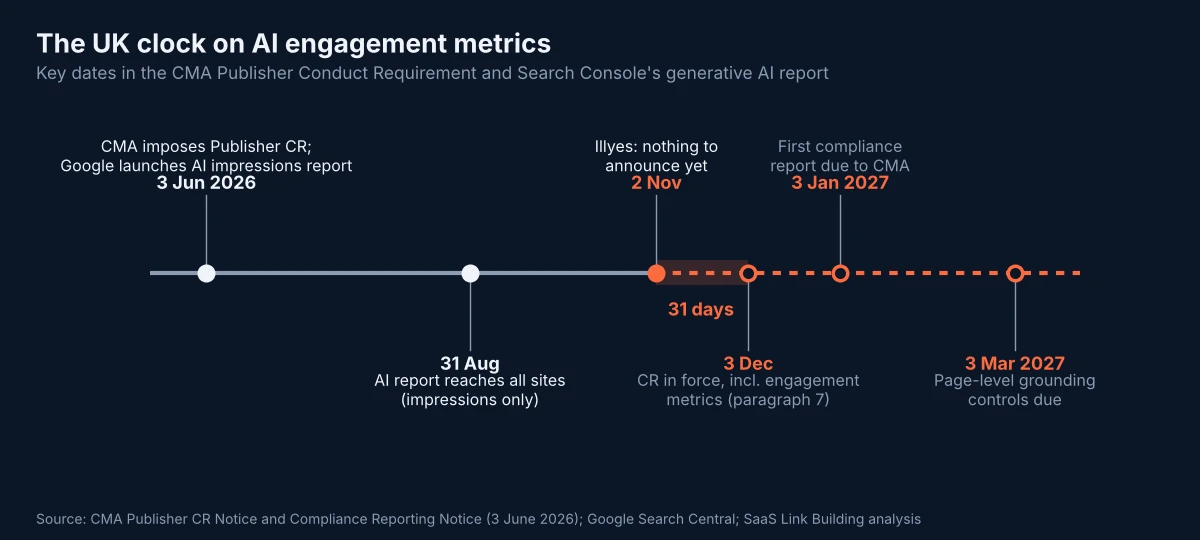
- The deadline: 3 December 2026 for most of the requirement, 3 March 2027 for page-level grounding controls, and 3 January 2027 for Google's first compliance report to the CMA, according to the Compliance Reporting Notice.
What the CMA expects, and what Search Console shows
The notice itself does not list specific metrics. The detail sits in the CMA's final decision. At consultation, the CMA's interpretative notes specified impressions, clicks and click-through rate for publisher content in generative AI features, separated from Google Search as a whole (paragraph 3.29). After hearing from Google and publishers, the CMA said it had "not made any changes to the level of information" it expects (paragraph 3.34). It also added a requirement for referral information showing whether a visit came from a generative AI feature or from other parts of search, so publishers can judge click quality in their own analytics (paragraph 3.39).
We set that against Google's own documentation for the report, checked on 2 November.
| Item | CMA final decision | Search Console generative AI report (Search) |
|---|---|---|
| Impressions in AI features | Expected (para 3.29) | Yes |
| Clicks from AI features | Expected (para 3.29) | Not documented |
| Click-through rate | Expected (para 3.29) | Not documented |
| Separate from overall Search data | Expected (para 3.29) | Yes, as a dedicated view |
| Split by AI Overviews vs AI Mode | Not required (paras 3.30 to 3.34) | No, combined |
| Referral signal identifying AI feature visits | Expected (para 3.39) | Not documented |
| Query data | Not specified | Not documented |
| Scope | Outputs shown to UK users (notice para 2) | All countries, filterable by country |
To check how unusual the impressions-only design is, we counted mentions of clicks in the main text of five Search Console help pages on 2 November. The two standard Performance report pages (setup and dimensions) mention clicks 10 times each and click-through rate up to four times. The generative AI report page for Search mentions clicks zero times. The Discover version mentions a click once, only to explain that the page URL shown is not where a user lands after clicking. The Search generative AI control page, which explains the opt-out, also has no mention.
Context: same day, two different promises
The CMA notice and Google's launch post for the generative AI performance reports are both dated 3 June 2026. Google's post listed impressions, pages, countries, devices and dates, and said Google would keep working with site owners on what data would help, "such as adding additional metrics over time." A note on the post says the reports reached all websites worldwide on 31 August. Neither the post nor the help page mentions the CMA.
Google argued against parts of the CMA's plan. According to the final decision, Google told the regulator that AI Overviews and AI Mode increasingly work as one experience, so splitting impressions and clicks by feature would not reflect how people behave, and that per-feature figures would be volatile. The CMA accepted the argument about a per-feature split but kept clicks and click-through rate in its expectations. Google also said publishers could already judge referral quality by combining Search Console with on-site analytics. The CMA disagreed and asked for referral information instead (paragraphs 3.37 to 3.39).
That referral gap is live. Our check of 28 AI Mode citations found none carrying a tracking tag, so publishers cannot yet separate those visits from other Google traffic by tag alone. For what is known about AI feature clicks so far, see our report on the AI Overview opt-out test.
What we do not know
Google has not said how it will comply. The notice says Google may take a different approach from the CMA's interpretative notes if it can show the CMA that its approach complies. Possible routes include adding clicks to the Search Console report, publishing data elsewhere, or limiting new metrics to UK traffic. This is speculation: none of these has been announced. The CMA's scope covers outputs shown to UK users, and its final decision notes Google may choose to comply more broadly. Google's first compliance report, due 3 January 2027, must list every metric offered to publishers and how they are delivered. The CMA expects to require Google to publish a non-confidential summary of that report.
What this means for SEO teams
- Export the impressions baseline now. The report has the standard 1,000-row table limit. Export page and country data for the last few months so any new metric can be compared with a clean before period.
- Watch the UK filter first. If engagement data arrives only for UK users, sites with UK audiences will see it before anyone else. Set the country filter to the United Kingdom in the report and in the main Performance report.
- Do not build plans on the 3 December date. The in-force date is a legal deadline, not a launch date. Google can comply through channels other than Search Console.
- Keep using landing-page proxies. Until clicks are reported, compare generative AI impressions by page with organic clicks to the same pages in the main Performance report, and note pages where AI impressions rise while clicks stay flat.
- Check your opt-out settings. The report can disappear if a site is excluded from generative AI features. See our explainer on Google's AI Overviews and AI Mode control.
Methodology
On 2 November 2026 we downloaded the CMA's Publisher CR Notice, final decision and Compliance Reporting Notice from GOV.UK and extracted the text. We fetched the Search Central launch post and five Search Console help pages (the generative AI performance reports for Search and Discover, the Search generative AI control page, and the Performance report setup and dimensions pages) and counted whole-word matches for "click" and for "CTR" or "click-through" in each page's main text, excluding navigation and feedback widgets. Dates were calculated from the notice date of 3 June 2026 using the CMA's stated six-month and nine-month periods and the published reporting schedule.
Conclusion
On paper, the CMA has already settled what publishers should get: engagement metrics covering impressions, clicks and click-through rate, plus a way to identify AI feature referrals. Google's public message, five months after it launched an impressions-only report on the same day as the CMA notice, is that it wants to give more data but has nothing to announce.
The next firm checkpoints are 3 December, when the requirement takes effect, and 3 January 2027, when Google must tell the CMA exactly which metrics it provides. Until then, the Illyes and Mueller exchange is the clearest signal available, and it points in two directions.
Questions and answers
Does Search Console show clicks from AI Overviews and AI Mode?
Not in a separate view. Google's help page for the Search generative AI performance report describes impressions only, broken down by page, country, date and device. Impressions from these features are also counted in the main Performance report.
What does the CMA require Google to provide?
Paragraph 7 of the CMA's Publisher Conduct Requirement, dated 3 June 2026, requires clear and detailed metrics on user engagement with publisher content in search generative AI features. The CMA's final decision says its interpretative notes specified impressions, clicks and click-through rate, plus referral information identifying visits from those features.
When does the CMA requirement take effect?
Six months after the 3 June 2026 notice, which is 3 December 2026. Page-level grounding controls follow nine months after the notice, on 3 March 2027, and Google's first compliance report is due by 3 January 2027.
Has Google confirmed click data is coming to Search Console?
No. On 2 November Gary Illyes said the team wants to give more data but has nothing to announce. John Mueller said reading that as ruling out click data was an odd interpretation. Google has not said how it will meet the CMA requirement.
Does the CMA rule apply outside the UK?
The requirement covers generative AI outputs shown to people located in the UK. The CMA's final decision notes Google may choose to comply on a broader basis, but Google has not said whether it will.
More releases
-
Studies
Is Google Still Putting Itself First in EU Search? Our 69-SERP Test After the €460M Fine
Two months after Google documented a redesign of its European results under the DMA, our 69-page test found its flight units sent no clicks to Google Flights, but Google's own hotel search still sat inside European hotel units, listed first in six of nine, and every product unit labelled Comparison Sites showed only Google.
-
Explainers
Search Console's Links Report Is a Sample: 12 SaaS Sites Hold 150,823 Spam-Scored Linkers
Google's John Mueller says site owners should ignore random spammy backlinks rather than check whether Search Console lists them. Google documents the Links report as a sample with 1,000-row tables, and all 12 SaaS sites we checked hold more than 1,000 spam-scored linking domains, with a median of about 12 new ones a day.
-
Industry news
Gemini Dropped Its utm_source Tag After 3 Weeks; None of 28 AI Mode Citations Carry One
Google's Gemini stopped adding utm_source=gemini to cited links around 29 September, about three weeks after it appeared, according to server logs shared by consultant Natzir Turrado. Google has not documented either change. Our pull of 10 AI Mode answers found no UTM tags on 28 citation links, and 24 routed through a Google redirect.
Tell us the site and the goals.
Rankings in Google and visibility in AI answers, from one monthly plan. One call is enough to say which one fits. Email works just as well.