AI Overview Opt-Out Test Cut Organic Clicks; 73% of Cited Sites Had No Page-One Link
A one-site test of Google's Search generative AI control saw organic clicks fall after the site was excluded from AI Overviews and AI Mode. Our check of 36 US searches found that 72.8% of cited sites had no organic link on the same page, while about a third of top-three organic results belonged to cited sites.
 Vibhu Dhariwal
Cofounder & CTO, Digital Gratified
- Published
- Section
- Industry news
- Reading time
- 8 minutes
Ras Al Khaimah, United Arab Emirates, .
A small public test of Google's Search generative AI control suggests that switching it off can cost a site more than its AI Overview traffic. In a case study posted on LinkedIn and reported by Search Engine Roundtable on 30 October, SEO consultant Cyrus Shepard described how he excluded one site from AI Overviews and AI Mode through Search Console. AI impressions fell to zero as expected, but regular organic clicks fell too, and the pages that had the most AI visibility lost average position while they were excluded.
Google's own help page for the control says the setting "isn't used as a ranking or inclusion signal affecting other parts of Search." To test the mechanism Shepard proposed, we pulled 36 US Google results pages on 31 October and counted how often a site cited in the AI Overview also held an organic link on the same page. The answer: on 32 of the 36 pages at least one site appeared in both places, but for 72.8% of cited sites the AI Overview citation was their only appearance on page one.
What the opt-out test found
According to Search Engine Roundtable's account of Shepard's post and his follow-up answers, the setup and results were as follows. The test covered one unnamed site, and the article does not give the test dates.
- Method: the site was set to Exclude in Search Console's Search generative AI setting, then returned to Include. AI Overviews kept appearing on the relevant queries throughout; the site was cited in them before and after the test, but not during it.
- AI share of impressions: about 8% of the site's impressions came from AI features before the switch, and AI impressions dropped to zero once it was excluded.
- Estimated AI click-through rate: about 0.9%, which Shepard estimated by subtracting the known AI impressions from overall impressions and comparing clicks before and after.
- Organic side effects: total impressions fell, and regular organic clicks fell as well. The individual URLs with the most AI visibility lost position while excluded and recovered once AI visibility was switched back on.
- Confounders: sitewide average position rose during the period, which Shepard attributed to a couple of new posts and brand searches.
Shepard's explanation is what he called a SERP halo effect: a site that shows up in more places on a results page is more likely to be clicked anywhere on it. Search Engine Roundtable noted that the design does not isolate clicks on pages with and without AI Overviews, and called for more tests.
Our check: how often cited sites also rank on the same page
A halo effect needs the same site to appear in both the AI Overview and the organic results. We measured how often that happens on 36 informational searches.
- All 36 searches showed an AI Overview, listing 250 source domains in total (median 7).
- 68 of those 250 cited domains (27.2%) also held at least one organic link on page one. The other 182 (72.8%) appeared on page one only as an AI Overview source.
- YouTube was cited in 34 of the 36 overviews and Reddit in 13. Leaving YouTube out, 44 of 216 cited domains (20.4%) also ranked organically on the page.
- 32 of the 36 pages had at least one site in both places, and the domain in organic position 1 was also cited in 12 of 36 overviews.
The overlap is concentrated near the top of the organic results. Of the 108 organic results in positions 1 to 3, 35 (32.4%) belonged to a site the overview also cited.
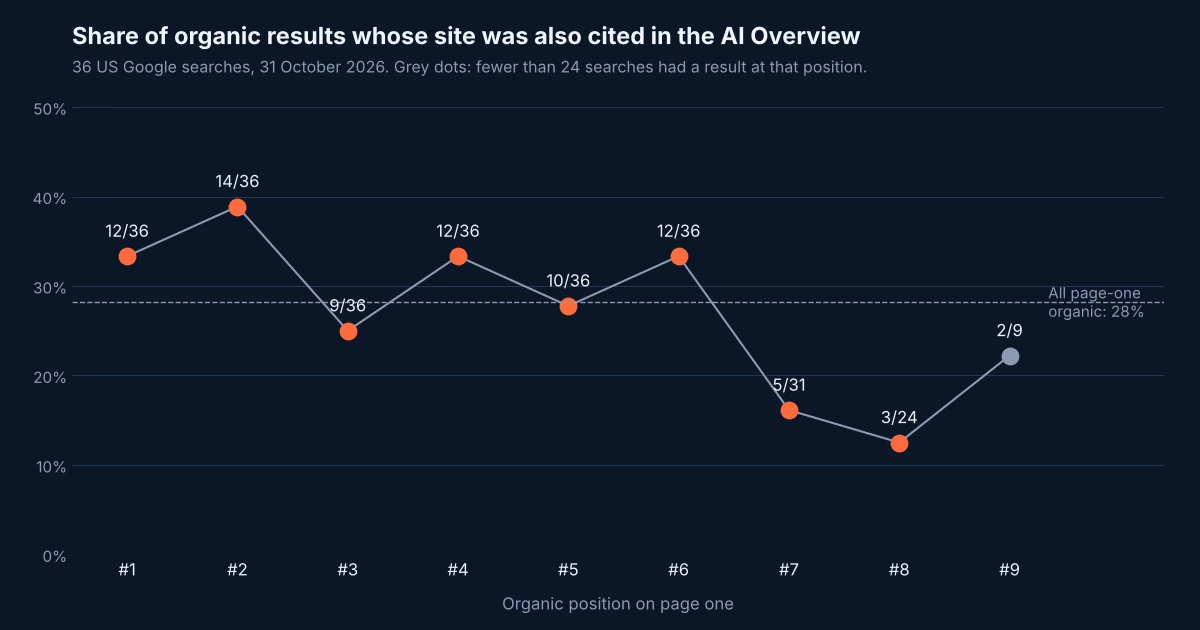
| Organic positions | Results | Site also cited in AI Overview | Share |
|---|---|---|---|
| 1 to 3 | 108 | 35 | 32.4% |
| 4 to 6 | 108 | 34 | 31.5% |
| 7 to 9 | 64 | 10 | 15.6% |
| All page one | 280 | 79 | 28.2% |
Two different groups of sites would feel an opt-out differently. For the roughly one in four cited sites that also rank on page one, excluding the site removes a second listing on a page where it already competes, which is exactly the situation in which Shepard saw organic clicks and positions slip. For the majority, the overview citation is the only place a searcher sees them on that page, so the opt-out removes their page-one presence for that query altogether.
How the 0.9% figure compares
Shepard's estimate sits close to independent behavioural data. Pew Research Center tracked the browsing of 900 US adults in March 2025 and found that users clicked a link inside the AI summary on 1% of visits to pages that had one. The same study found users clicked a traditional result on 8% of visits to pages with an AI summary, against 15% on pages without one.
The two are measured differently (Pew's is a share of panel visits, Shepard's an estimate per AI impression for one site), but both suggest links inside AI summaries earn few direct clicks. Shepard's test adds the possibility that their value shows up indirectly, in the organic listing next to them.
What Google has said
Google's help page says that with Exclude selected, a site's content is not shown in AI Overviews, AI Mode or generative AI features in Discover, and that the site will get no traffic or impressions from those features. It says the control is not a ranking or inclusion signal for the rest of Search, that exclusion generally takes effect within one to two days, and that the control reached all sites worldwide on 31 August 2026. We covered the control's addition to Google's main blocking guide in our 22 October report.
That statement and Shepard's result are not necessarily in conflict. Google's wording rules out the setting acting as a signal; it does not rule out user behaviour changing when a site disappears from a prominent part of the page. Google has not commented on the test, and a single site over an undisclosed period cannot separate the opt-out from other changes, such as the new posts and brand searches Shepard mentioned.
What this means for SEO teams
- Check your overlap before testing. Export the queries where your site appears in Search Console's generative AI report and check whether you also rank in the top three organically on those same queries. Our data suggests about a third of top-three results share a domain with the overview; those are the queries where a halo effect, if real, would bite.
- Test on a slice, not the whole domain. Google's help page says a URL-prefix property can follow or override the domain setting. Excluding one section first gives you a comparison group on the same site and the same dates.
- Log the dates and run long enough. Google says exclusion takes one to two days and sometimes longer and Search Console data arrives with a delay. Annotate the switch and compare equal windows before, during and after.
- Watch organic CTR on overlapping queries, not just AI impressions. AI impressions drop to zero by design; the open question is the organic listing.
- Keep the purpose clear. The control does not stop AI training. For that, the help page points to the Google-Extended token, which Google describes on its common crawlers page.
Our earlier work found AI Overviews on 77% of 150 Google searches, and most overviews in a 1,000-search SaaS sample carried no inline link, so the number of queries on which this trade-off applies is large.
Methodology
On 31 October 2026 we collected Google results for 36 English-language informational queries, spanning personal finance, health, home, cooking, travel, technology and SaaS topics, for the United States on desktop, using a SERP data API with AI Overview loading enabled. For each search we recorded the source domains listed in the AI Overview's reference panel and the domain of every organic result on page one. Pages carried between 6 and 9 organic results because AI Overviews, video carousels and People Also Ask boxes took other slots, giving 280 organic results in total. Where Google served an organic link through a redirect, we took the domain from the displayed breadcrumb or site name.
Domains were reduced to their registrable domain (for example, support.apple.com counted as apple.com) and counted once per search. YouTube counted as one domain whether a result was a video or a channel. In at least two searches the overview's reference panel listed only two or three domains while individual passages cited more, so the overlap figures are, if anything, conservative. This is a single-day snapshot of 36 searches from one location and device; results vary by query, location and time.
Conclusion
One site's opt-out test is not proof that leaving AI Overviews hurts organic performance, and Google says the control is not a ranking signal. Our count shows why the question is worth testing properly: on 32 of 36 searches at least one site appeared in both the AI Overview and the organic results, and about a third of top-three organic results belonged to a cited site.
For most cited sources, though, the AI Overview was their only appearance on page one. Teams weighing the Exclude setting should find out which group their queries fall into, test on one section first, and judge the result on organic clicks.
Questions and answers
What is Google's Search generative AI control?
It is a Search Console setting that lets a site be included in or excluded from AI Overviews, AI Mode and generative AI features in Google Discover. Google says it rolled out to all websites worldwide on 31 August 2026.
What happened in the opt-out test?
According to Search Engine Roundtable's report of Cyrus Shepard's one-site case study, AI impressions dropped to zero after exclusion, total impressions and regular organic clicks also fell, and the URLs with the most AI visibility lost position until the site was included again. He estimated AI impressions had a click-through rate of about 0.9%.
Does Google say opting out affects rankings?
No. Google's help page says the control isn't used as a ranking or inclusion signal affecting other parts of Search. Google has not commented on the test.
How often do AI Overview sources also rank organically on the same page?
In our 36-search check on 31 October 2026, 68 of 250 cited domains (27.2%) also held a page-one organic link, and 35 of 108 results in organic positions 1 to 3 (32.4%) belonged to a cited domain.
Does excluding a site stop Google training AI on its content?
No. Google's help page says the control doesn't affect AI training and points to the Google-Extended token for limiting training of the models behind these features.
More releases
-
Studies
YouTube Was Cited in All 30 AI Overviews We Pulled, Supplying 34% of 271 Citations
YouTube was cited in every one of 30 US Google AI Overviews we pulled on 31 October, supplying 92 of 271 unique citations (34%). Nearly half of those links pointed to a timestamp inside a video, and half the queries had no YouTube result in the organic top 10.
-
Explainers
Checkout Showed Up in 25% of AI Agent Sessions: How to Spot Google-Agent in Your Logs
Sessions involving AI agents recorded a checkout 25.21% of the time against 14.65% for humans, Microsoft Clarity data from 230,511 sites shows. Here is what agents do on websites, where the study needs care, and how to verify Google-Agent with its user agent, IP file and signed requests.
-
Studies
Is Google Sidelining Self-Ranked Listicles? 21% of Top 10s, 3% of AI Overview Citations
Vendor "best software" lists that rank their own product first held 14 of 68 organic top-10 results in our 31 October check of eight US Google searches, including three number one spots. The AI Overviews on the same pages cited only 2 such pages among 59 sources, and none of the 14.
Tell us the site and the goals.
Rankings in Google and visibility in AI answers, from one monthly plan. One call is enough to say which one fits. Email works just as well.