Is Google Sidelining Self-Ranked Listicles? 21% of Top 10s, 3% of AI Overview Citations
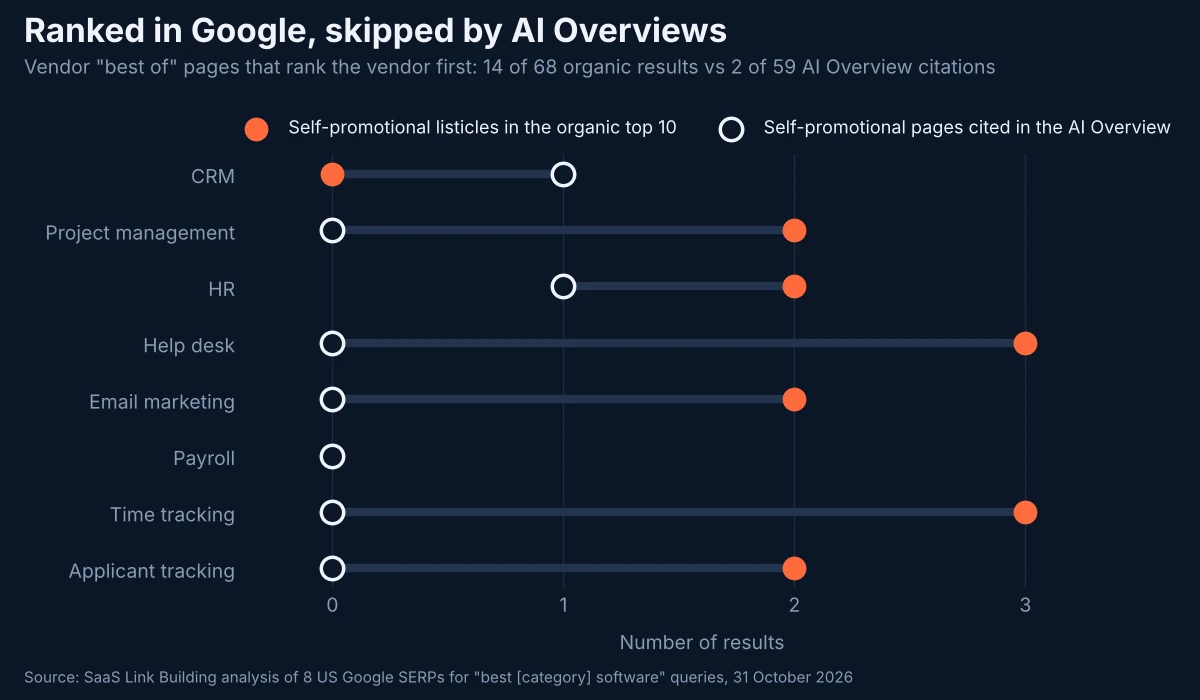
Vendor "best software" lists that rank their own product first held 14 of 68 organic top-10 results in our 31 October check of eight US Google searches, including three number one spots. The AI Overviews on the same pages cited only 2 such pages among 59 sources, and none of the 14.
 Vibhu Dhariwal
Cofounder & CTO, Digital Gratified
- Published
- Section
- Studies
- Reading time
- 14 minutes
Ras Al Khaimah, United Arab Emirates, .
Software companies that publish "best [category] software" lists and put their own product at number one have become one of the most argued-about tactics in search. In early February, SEOs began reporting that these self-promotional listicles had lost Google rankings in January. In June, a study by SEO consultant Lily Ray argued that Google's AI Overviews cite these pages but usually recommend someone else. And in an interview reported on 29 October, Google's John Mueller warned that easy tricks aimed at AI search eventually get caught. Google has never said it targets self-ranked lists. So is it quietly sidelining them?
We pulled eight live US Google results pages for "best [category] software" queries on 31 October 2026, opened every vendor list that ranked, and checked who put themselves first. The result splits the theory in two: self-promotional listicles still hold a fifth of organic top-10 positions, including three number one spots, but they made up only 2 of the 59 sources Google's AI Overviews cited on the same pages.
Key findings
- 14 of 68 standard organic results (20.6%) across the eight queries were vendor-owned "best of" lists that ranked the vendor first or listed it first. They appeared on six of the eight results pages.
- Three of those 14 held the number one organic position (HR, help desk and time tracking), and six of the 14 sat in the top three.
- All eight queries showed an AI Overview. Those overviews cited 59 sources, and only 2 (3.4%) were vendor pages promoting the vendor as "best".
- None of the 14 self-promotional listicles in the organic top 10 was cited by the AI Overview on the same page, and only 2 of the 14 brands behind them were named among the overview's picks.
- Vendors did get cited, just not through their listicles: four vendor product or home pages (Gusto, QuickBooks, Patriot Software and Clockify) were cited, and all four products were recommended.
The theory: Google is punishing vendors who rank themselves first
The tactic is simple. A software company publishes a list of the 12 best project management tools, ranks its own product first, and lists real competitors below it. The page targets a high-intent query, and if it ranks, the vendor controls the first impression. The format became common in SaaS marketing, and as AI Overviews and chat assistants began summarising "best" queries, the pages took on a second job: feeding AI answers.
The suspicion that Google had turned against the format surfaced in early February. Search Engine Roundtable reported on 4 February that Lily Ray and other consultants were seeing self-serving "best" lists, mostly in SaaS, lose rankings after unconfirmed volatility in January. Ray later dated the decline to around 20 January 2026 and said many affected sites lost visibility across the whole domain, not just on the listicle pages.
Her follow-up study, published on 17 June, went further. Ray tracked 100 B2B "best [category] software" queries on three dates (15 April, 15 May and 8 June). 80 of the 100 triggered an AI Overview. She reported that when a self-promoter's own listicle was cited, the brand was left out of the overview's actual recommendations 69% of the time (224 of 323 cited listicles), and that declines in organic visibility accelerated during the May 2026 core update. The study used a commercial AI tracking tool's historical snapshots, not Google data.
The theory, then, has two parts. One: Google's organic ranking systems have demoted self-promotional listicles. Two: Google's AI features treat them as weak evidence, citing them for facts while declining to repeat their verdicts. Our test was designed to check both.
Evidence for: what Google has said on record
Google has not named self-promotional listicles in any documentation or statement we could find. But three of its own pages describe systems that would logically catch them.
The reviews system covers ranked lists, not just single reviews. Google's reviews system documentation says the system evaluates first-party content written to give a recommendation or opinion, and that reviews can be single items, head-to-head comparisons or "ranked-lists of recommendations". It says the system mainly judges review content page by page, but that sites with a substantial amount of review content may see content anywhere on the site evaluated. That last line may explain Ray's observation that drops were often domain-wide. The same page says the system is improved continually, which suggests (our inference, not Google's statement) that changes to it can land without an announced update.
Google asks reviewers to prove their "best" claims. Its guide on how to write high quality reviews tells publishers that when they call something the best overall or best for a purpose, they should explain why, with first-hand supporting evidence. It also asks them to discuss benefits and drawbacks based on original research and to explain what sets a product apart from competitors. A vendor ranking itself first has an obvious conflict on every one of those points.
Google's AI guidance warns against manufactured mentions. Google's guide to its generative AI features in Search, last updated on 10 July 2026, lists seeking inauthentic mentions among the tactics site owners can ignore. It says AI features can show what is being said about products across blogs, videos and forums, but that its core ranking systems focus on high-quality content while other systems block spam, and that "our generative AI features depend on both". A vendor's own list is the least independent mention a brand can have.
Mueller's latest comments point the same way. In an interview with SEO consultant David Iwanow, reported by Search Engine Roundtable on 29 October, Mueller said tactics spread once someone writes about them, and that the systems eventually decide a tactic is "easy to recognize but it's hurting actual businesses". According to the same report, he did not call listicles bad in themselves, but described building a strategy on thousands of them as risky. He did not mention self-promotional lists specifically.
Evidence for: our own data on AI Overviews
Our pull supports the second half of the theory strongly, and it fits a pattern we have seen before in our study of AI Overview links on 1,000 SaaS searches. Across eight queries, the AI Overview drew on 59 sources. YouTube videos made up 24 of them, review directories and platforms 9, editorial and publisher pages 9, and forum threads 4. Vendor-owned content accounted for 11, but most of it was not self-promotion.
| Source type cited in the AI Overview | Citations | Share |
|---|---|---|
| YouTube videos | 24 | 40.7% |
| Review directories and platforms (G2, SHRM vendor directory, Shortlister) | 9 | 15.3% |
| Publishers and other organisations (Forbes, PCMag, U.S. News, Zapier, others) | 9 | 15.3% |
| Vendor lists or reviews that rank other companies' products | 5 | 8.5% |
| Forum threads (Reddit) | 4 | 6.8% |
| Vendor product or home pages | 4 | 6.8% |
| Vendor "best" pages promoting the vendor itself | 2 | 3.4% |
| Google Shopping product listings | 2 | 3.4% |
| Total | 59 | 100% |
Source: SaaS Link Building analysis of AI Overview citations on eight US Google results pages, collected 31 October 2026. Shares do not sum exactly to 100% because of rounding.
Two patterns stand out. First, Google was willing to cite vendor content when the vendor was not grading itself against rivals: an IT asset management firm's help desk roundup, an accounting software maker's applicant tracking list and a pay stub tool's payroll comparison were all cited, and none of them put the publisher's own product at the top of the category. Second, when Google cited a vendor's own page, it was usually a product or home page used for facts such as pricing and plan limits. All four vendors cited that way (Gusto, QuickBooks, Patriot Software and Clockify) were also named in the overview's picks.
The 14 self-promotional listicles that ranked organically fared very differently. Not one was cited by the AI Overview on its own results page, and only two of the brands behind them made the overview's list of picks: Rippling, which leads the HR overview, and Sender, which appears in the email overview's free-tier comparison table.
Evidence against: the organic crackdown is hard to see
The first half of the theory, that Google's organic rankings have turned against these pages, does not hold up well in our snapshot.
Self-promotional listicles were not rare survivors. They made up 14 of 68 organic results and appeared on six of eight results pages. Three of them held position one, and six were in the top three. A demotion strong enough to be visible from the outside would be expected to push the format down the page, not leave it holding top spots for HR, help desk and time tracking queries.
| Query | Vendor page that lists itself first | Organic position | Cited in AI Overview? | Brand in AI Overview picks? |
|---|---|---|---|---|
| best project management software | ProProfs Project | 4 | No | No |
| best project management software | ProofHub | 7 | No | No |
| best hr software | HR Acuity | 1 | No | No |
| best hr software | Rippling | 4 | No | Yes |
| best help desk software | Kayako | 1 | No | No |
| best help desk software | Motadata | 2 | No | No |
| best help desk software | Hiver | 6 | No | No |
| best email marketing software | Mailtrap | 2 | No | No |
| best email marketing software | Sender | 3 | No | Yes |
| best time tracking software | Apploye | 1 | No | No |
| best time tracking software | My Hours | 5 | No | No |
| best time tracking software | Teamwork.com | 8 | No | No |
| best applicant tracking system | AppSierra | 5 | No | No |
| best applicant tracking system | 100Hires | 8 | No | No |
Organic position counts standard organic results only, excluding AI Overviews, forum boxes, video carousels and ads. Source: SaaS Link Building SERP pull, 31 October 2026.
There are also problems with the timeline. Google's Search Status Dashboard lists no ranking update in January 2026. The December 2025 core update ran from 11 to 29 December, and the next logged event was the February 2026 Discover update, which began on 5 February. The January drops may reflect the reviews system's unannounced, ongoing changes, the tail of the December core update, or something unrelated. Google has not said which, and without its confirmation any date is an inference from third-party tracking data.
Several other things weaken the case:
- Payroll and CRM had no self-promoters in the organic top 10 at all, but the explanation is not obviously a penalty. The payroll results were dominated by small third-party comparison sites, which suggests the format has migrated to third-party domains rather than disappeared.
- Google still cited two self-promotional pages. For "best crm software" the overview cited Salesforce's own "best CRM" guide and listed Salesforce first among its picks. For "best hr software" it cited a list from Case IQ, an HR investigations vendor that puts itself first; Case IQ was not among the picks. Big, well-known brands may get treated differently from small ones, a pattern Ray also described and one we tested in organic results in our investigation into whether Google favors big brands.
- Correlation is not mechanism. AI Overviews leaned heavily on YouTube and review platforms across all queries. Self-promotional pages may simply lose out to those sources for reasons that have nothing to do with self-promotion, such as freshness, format, or how the overview's retrieval picks passages.
Does the June study hold up?
Partly, and our sample is too small to test its headline number directly. Ray's 69% figure measures how often a cited self-promoter was left out of the recommendations. We found only two cited self-promotional pages, and one of the two brands (Salesforce) was recommended, so we cannot say anything useful about that ratio from eight queries.
What our data does support is the direction of her finding, and arguably a stronger version of it. Nearly five months after her last snapshot, self-promotional listicles that rank on page one are not merely being cited and then overruled. On our eight pages they were not cited at all. The decoupling she described between ranking, citation and recommendation was visible in every query where a self-promoter ranked.
The difference may come from timing, query set or method. Ray tracked 100 queries on three dates between April and June using a commercial tool's stored AI Overview text; we took one live snapshot of eight queries. Neither approach can see inside Google's systems.
Verdict: likely in AI Overviews, unproven in organic rankings
AI Overviews: likely. In our sample, vendor pages that rank themselves first were cited at about one sixth of the rate they appear in the organic top 10 (3.4% of citations against 20.6% of organic results), and none of the 14 page-one self-promoters was cited. Combined with Google's own guidance that its AI features depend on the same quality and spam systems as core search, and that pursuing inauthentic mentions is a tactic site owners can ignore, the most reasonable reading is that self-ranked lists carry little weight as evidence in AI Overviews. Google has not confirmed this, and this is our interpretation of the data, not a Google statement.
Organic rankings: unproven. The reviews system documentation gives Google a clear mechanism, including site-wide evaluation, and Google describes it as improved continually. But self-promotional listicles still held a fifth of organic top-10 results and three number one spots in our snapshot. If a crackdown happened in January, it did not remove the format from page one. It is possible that demoted sites have been replaced by other self-promoters, or that the effect is concentrated in categories we did not test; our data cannot rule that out.
What this means for SEO teams
- Separate ranking goals from AI visibility goals. A self-ranked listicle at position one may still earn clicks from the classic results, but on our evidence it is unlikely to be the page an AI Overview cites. Track both separately in reporting.
- Invest in the pages Google did cite. Product and pricing pages with clear plan limits and prices were cited for factual detail, and every vendor cited that way was recommended. Keep those pages current and specific.
- Earn independent coverage. 37 of 59 citations came from YouTube, review platforms and forums. Reviews on those platforms and coverage by independent publishers are where AI Overview recommendations appear to come from.
- If you keep a comparison page, meet Google's review standard. Disclose the conflict, explain your methodology, show first-hand testing of rivals, and state where competitors are better. Google's review guidance asks for exactly that evidence, and its helpful content guidance on effort and originality points the same way.
- Audit at site level. Because the reviews system can evaluate a whole site with lots of review content, a large library of thin "best" pages may affect more than those URLs. Check whether non-listicle pages lost visibility at the same time.
Methodology
On 31 October 2026, between about 09:18 and 09:20 UTC, we pulled live Google results from a commercial SERP data API for eight queries: best crm software, best project management software, best hr software, best help desk software, best email marketing software, best payroll software, best time tracking software and best applicant tracking system. Settings were United States, English, desktop, first 10 organic results, with AI Overview content loaded. We avoided SEO and marketing tool categories.
We counted standard organic results only (68 in total, because forum boxes, video carousels and other features displaced some organic slots). Many organic links arrived wrapped in Google's /goto redirect format, so we identified domains from the displayed breadcrumbs. We classed a result as a self-promotional listicle when the publishing company sells a product in that category and its list ranks or lists that product first. We confirmed this by fetching 13 of the 14 pages and reading their headings and list order; for HR Acuity we relied on Google's snippet, which showed it listing itself at number one.
For AI Overviews we counted every unique cited URL per query (59 in total) and classed each by source type. A brand counted as recommended if the overview named it in its list of picks or comparison table. All eight queries returned an AI Overview. This is a single snapshot of a small sample; AI Overviews vary between sessions and locations, and the results should be read as indicative, not as a measure of Google's systems overall.
Conclusion
The evidence supports a narrower version of the theory than the one circulating in SEO circles. Self-promotional "best" lists are still ranking on page one of Google, sometimes at the very top, so claims of a sweeping organic crackdown are unproven. But in AI Overviews those same pages were almost invisible as sources, while independent videos, review platforms, publishers and vendors' own factual product pages did the work. For SaaS teams, ranking yourself first may still win a blue link; it does not appear to win the AI answer.
What do you think?
If you publish a "best [category]" list that ranks your own product first, has its AI Overview citation rate changed since January, and did organic traffic to non-listicle pages on the same site move at the same time? Share your data with us.
Questions and answers
What is a self-promotional listicle?
A "best [category]" list published by a company that sells a product in that category and ranks or lists its own product first. In our 31 October 2026 check, 14 of 68 organic top-10 results for eight software queries fit that description.
Has Google confirmed it demotes self-promotional listicles?
No. Google has not named the format in its documentation. Its reviews system documentation says the system evaluates ranked lists of recommendations and can assess a whole site with substantial review content, and its AI features guide says seeking inauthentic mentions isn't as helpful as it might seem.
Do AI Overviews cite self-promotional listicles?
Rarely, in our sample. The AI Overviews on eight US results pages cited 59 sources, and only 2 were vendor pages promoting the vendor itself. None of the 14 self-promotional listicles ranking in the organic top 10 was cited by the overview on the same page.
Was there a Google ranking update in January 2026?
Google's Search Status Dashboard lists none. The December 2025 core update ran from 11 to 29 December, and the next logged event was the February 2026 Discover update, which began on 5 February.
Which vendor pages did AI Overviews cite?
Mostly product and home pages used for facts such as pricing. In our sample, Gusto, QuickBooks, Patriot Software and Clockify pages were cited, and all four products were named among the overview's picks.
More releases
-
Industry news
Google's num=100 May Be Back, but 74.5% of Top-100 Organic URLs Still Hide Behind /goto
Google may be restoring the num=100 results parameter, an SEO consultant reported on 30 October, though it could not be reproduced. Our pull of 20 Google result pages found 1,323 of 1,776 organic URLs (74.5%) returned as google.com/goto links, at every position from first to hundredth.
-
Industry news
Reddit to Test Logged-In Only Access After Losing 2.8M US Logged-Out Daily Users
Reddit lost 2.8 million US logged-out daily users in the third quarter as search referrals fell, and says referrals dropped by more than 1 million a week in October. It will test a logged-in-only site outside the US this quarter. Our 20-search check finds Reddit still ranks on most results pages.
-
Studies
Google AI Mode Linked All 180 Product Cards in Our 50-Query Test to Its Own Pages
Google's AI Mode linked every product card to its own pages in our test of 50 US searches on 30 October 2026. All 180 linked cards opened google.com product pages rather than retailers, Google pages made up 40% of source links, and 70% of all links stayed on Google.
Tell us the site and the goals.
Rankings in Google and visibility in AI answers, from one monthly plan. One call is enough to say which one fits. Email works just as well.