YouTube Was Cited in All 30 AI Overviews We Pulled, Supplying 34% of 271 Citations
YouTube was cited in every one of 30 US Google AI Overviews we pulled on 31 October, supplying 92 of 271 unique citations (34%). Nearly half of those links pointed to a timestamp inside a video, and half the queries had no YouTube result in the organic top 10.
 Vibhu Dhariwal
Cofounder & CTO, Digital Gratified
- Published
- Section
- Studies
- Reading time
- 7 minutes
Ras Al Khaimah, United Arab Emirates, .
YouTube was cited in every one of the 30 Google AI Overviews we pulled on 31 October 2026, and it supplied 92 of the 271 unique citations, or 34%. No other site came close: Reddit was second with 12 citations, and Google's own developer documentation was third with 5. The test covered tech and SEO questions, health and personal finance questions, and commercial and how-to searches in the US, using a commercial SERP API that returns the full list of sources shown in each AI Overview.
The result sits awkwardly next to how Google describes the feature. Its AI features guide for site owners says AI Overviews and AI Mode can show "a wider and more diverse set of helpful links" than a classic web search. Our sample did draw on 146 different domains, but one video platform took a third of all citation slots.
Key findings
- All 30 queries returned an AI Overview on the first fetch, and all 30 cited at least one YouTube video.
- YouTube was the most cited domain, alone or tied, in 29 of the 30 AI Overviews.
- 43 of the 92 YouTube citations linked to a specific moment in the video (a timestamp parameter in the URL), and 18 were YouTube Shorts.
- Only 15 of the 30 queries had a YouTube page among the top 10 organic listings, so AI Overviews cited YouTube far more often than the classic results ranked it.
- Health and finance queries leaned least on YouTube and most on government, university and NHS pages, which supplied 13 of their 95 citations.
How the three query groups compared
We split the 30 queries into three groups of 10. Commercial and how-to searches, such as how to change a tire or the best password manager, relied on YouTube the most. Two of them, "how to start a podcast" and "how to change a tire", each cited eight separate videos.
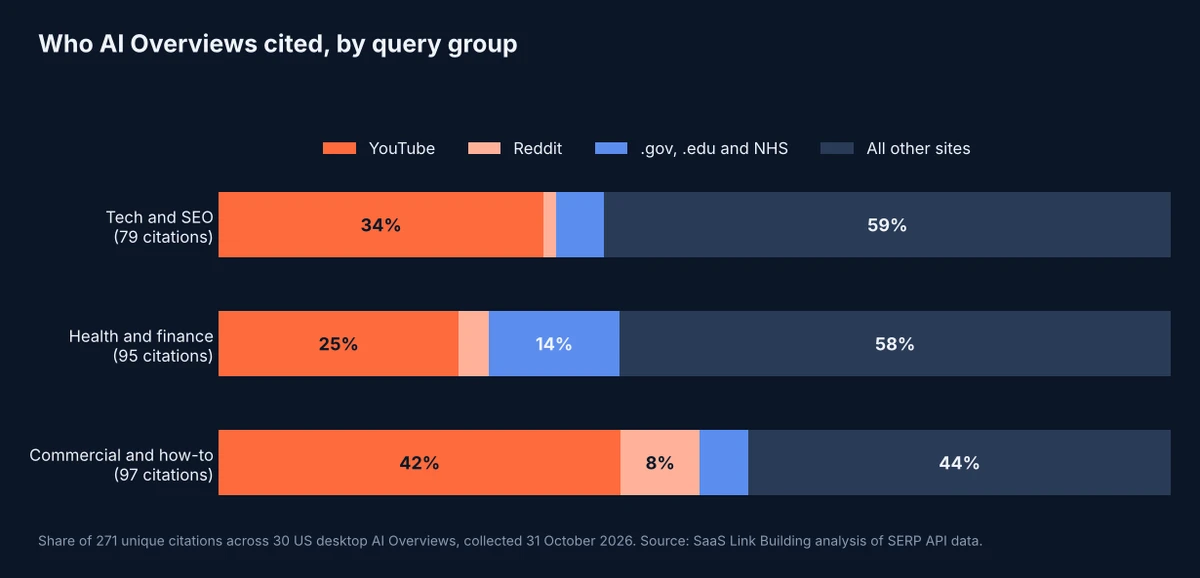
| Query group (10 queries each) | Unique citations | YouTube citations | YouTube links with a timestamp | YouTube Shorts cited | Queries with YouTube in organic top 10 |
|---|---|---|---|---|---|
| Tech and SEO | 79 | 27 | 9 | 7 | 2 |
| Health and finance | 95 | 24 | 10 | 5 | 7 |
| Commercial and how-to | 97 | 41 | 24 | 6 | 6 |
| All 30 queries | 271 | 92 | 43 | 18 | 15 |
Source: SaaS Link Building analysis of first-fetch SERP API data, 31 October 2026. A video cited more than once in the same AI Overview, for example at two timestamps, is counted once.
The tech and SEO group is the clearest example of the gap between AI Overviews and the organic results. Only two of its 10 queries had a YouTube result in the organic top 10, yet every one of its AI Overviews cited YouTube, 27 times in total. For "how to improve core web vitals", the AI Overview cited three YouTube videos alongside Google's own documentation and web.dev, while none of those videos appeared as organic listings on the page.
Health and finance answers spread their citations more widely. The five health queries cited 49 sources, 11 of them YouTube videos, with hospital systems, the NHS, the CDC and medical schools making up much of the rest. The five finance queries cited 46 sources, 13 of them YouTube, with banks, brokerages and federal consumer sites such as the Consumer Financial Protection Bureau and Investor.gov among the rest.
Timestamps: AI Overviews cite moments, not just videos
Almost half of the YouTube citations pointed to a moment inside a video rather than the video as a whole. In the commercial and how-to group, 24 of 41 YouTube citations carried a timestamp. That pattern matches how Google already treats video segments in classic Search: its video structured data documentation says Google tries to detect segments automatically and will prioritise key moments set by the publisher, either in structured data or in a YouTube description.
This is our inference, not something Google has confirmed: clearly labelled chapters make it easier for a system that quotes specific claims to link to the exact segment that supports them. Google has not said how AI Overviews choose video sources, and its AI features guide says there are no additional requirements or special optimisations for appearing in them.
How stable were the citations?
We fetched every query three times over roughly 10 minutes. In 25 of the 30 cases, the set of cited sources was identical across all three fetches. Of the five that changed, "what is a vpn" jumped from three citations on the first fetch to 10 on the next two, and "best running shoes for beginners" returned no AI Overview at all on the second fetch. Short-window stability does not tell us how citations move over days or weeks, and results may be cached by Google or by the data provider, so treat this as a consistency check on the snapshot rather than a stability study.
Context
This adds to a run of AI Overview tests in our newsroom. In a separate 36-search sample on 31 October, we found that 72.8% of cited sites had no organic link on the same page, and YouTube was cited in 34 of those 36 overviews. Earlier the same day, a test of self-ranked listicles found them in 21% of top 10s but behind only 3% of AI Overview citations. In an organic-only test, YouTube and Reddit beat big brands for page-one positions. Today's data suggests the YouTube advantage is larger still inside the AI answer box than in the classic links.
What this means for SEO teams
- Check which videos your AI Overviews cite. For your priority queries, list every cited source and note how many are videos. If a competitor's tutorial is cited and you have no video on the topic, that is a content gap the organic report will not show you.
- Add chapters to how-to and explainer videos. Timestamped citations point to specific segments. Write chapter titles that answer the questions people search for, either in the YouTube description or with Clip or SeekToAction markup for videos on your own site, as Google's video documentation describes.
- Do not ignore Shorts. 18 of the 92 YouTube citations in our sample were Shorts, across all three query groups.
- Expect less video in health and finance. In those topics, institutional sources still took a large share. Credentials, citations to research and clear authorship are likely to matter more than adding a video.
- Measure the AI Overview separately from rankings. Half of the queries where YouTube was cited had no YouTube organic result, so organic rank tracking alone will understate who is visible on the page. Our 150-search query type study shows how often AI Overviews appear by query type.
Methodology
We chose 30 English queries in three groups of 10: tech and SEO (for example "what is a canonical tag", "what is a vpn"), health and personal finance (for example "what causes high blood pressure", "what is a roth ira") and commercial and how-to (for example "best crm for startups", "how to write a cover letter"). Each query was sent to a commercial SERP API for Google, location United States, language English, desktop, top 10 results, with asynchronous AI Overview loading switched on. Each query was fetched three times on 31 October 2026 between 21:18 and 21:29 UTC.
All headline figures use the first fetch. For each AI Overview we took the list of source URLs Google displayed for it and removed duplicates. YouTube URLs were grouped by video ID, so the same video cited at two timestamps counts once; a citation counts as timestamped if any of its URLs carried a "t=" parameter. Domains were counted with "www." removed and m.youtube.com merged into youtube.com. Government, university and NHS sources are domains ending in .gov, .edu or nhs.uk. For the organic comparison, we read the domain of each of the top 10 organic listings from the result's display URL, or from its site name where the URL was a Google redirect. The sample is small and US-only, and AI Overviews vary by location, device, time and personalisation, so the percentages describe this snapshot rather than all of Google.
Conclusion
In our 30-query snapshot, YouTube was the single most dependable route into Google's AI Overviews: it was cited every time, it supplied a third of all sources, and nearly half of those citations pointed to a specific moment in a video. Health and finance answers leaned on YouTube less, with institutional sites still holding a large share.
For teams that report AI visibility only through organic rankings, the gap is the story. Half of the queries that cited YouTube had no YouTube result in the classic top 10, which means the source winning the AI answer may not appear in a rank tracker at all.
Questions and answers
How often did Google AI Overviews cite YouTube in this test?
In all 30 of the 30 AI Overviews we collected on 31 October 2026. YouTube supplied 92 of the 271 unique citations (34%) and was the most cited domain, alone or tied, in 29 of the 30.
Which other sites were cited most often?
Reddit was second with 12 citations and Google's developer documentation third with 5. In total the 30 AI Overviews cited 146 different domains.
Do AI Overviews link to specific moments in videos?
Often. 43 of the 92 YouTube citations carried a timestamp parameter pointing to a moment in the video, and 18 of the 92 were YouTube Shorts.
Did health and finance queries cite YouTube less?
Yes. YouTube supplied 24 of 95 citations (25%) for health and finance queries, against 41 of 97 (42%) for commercial and how-to queries. Domains ending in .gov or .edu and the NHS supplied 13 of the 95 health and finance citations.
Has Google said how AI Overviews choose video sources?
No. Google's AI features guide says there are no additional requirements or special optimisations needed to appear in AI Overviews or AI Mode beyond standard SEO best practices.
More releases
-
Industry news
AI Overview Opt-Out Test Cut Organic Clicks; 73% of Cited Sites Had No Page-One Link
A one-site test of Google's Search generative AI control saw organic clicks fall after the site was excluded from AI Overviews and AI Mode. Our check of 36 US searches found that 72.8% of cited sites had no organic link on the same page, while about a third of top-three organic results belonged to cited sites.
-
Explainers
Checkout Showed Up in 25% of AI Agent Sessions: How to Spot Google-Agent in Your Logs
Sessions involving AI agents recorded a checkout 25.21% of the time against 14.65% for humans, Microsoft Clarity data from 230,511 sites shows. Here is what agents do on websites, where the study needs care, and how to verify Google-Agent with its user agent, IP file and signed requests.
-
Studies
Is Google Sidelining Self-Ranked Listicles? 21% of Top 10s, 3% of AI Overview Citations
Vendor "best software" lists that rank their own product first held 14 of 68 organic top-10 results in our 31 October check of eight US Google searches, including three number one spots. The AI Overviews on the same pages cited only 2 such pages among 59 sources, and none of the 14.
Tell us the site and the goals.
Rankings in Google and visibility in AI answers, from one monthly plan. One call is enough to say which one fits. Email works just as well.