Does Schema Markup Help You Rank? 186 Top-10 Pages Show No Edge, Only Richer Snippets
Schema markup sat on 90.3% of the 186 top-10 Google pages we fetched across 36 searches, yet pages with and without it ranked almost identically (average position 4.48 against 4.50). Its measurable payoff was display: 15 of 17 recipe pages with Recipe markup showed stars or cook times.
 Vibhu Dhariwal
Cofounder & CTO, Digital Gratified
- Published
- Section
- Studies
- Reading time
- 14 minutes
Ras Al Khaimah, United Arab Emirates, .
Schema markup is one of the most widely repeated "ranking tips" in SEO, and in 2026 the claim has grown a second life: structured data, the argument goes, is what helps pages win in AI Overviews and AI Mode. Google's documentation says something narrower. To test which reading the live results support, we pulled 36 US Google results pages on 5 November 2026, fetched the 186 top-10 pages we could read, and parsed every block of JSON-LD and microdata on them. The short answer: markup is close to universal on page one, it is no more common in the top three than in positions 7 to 10, and its one measurable payoff in our sample was richer snippets, not higher rankings.
Key findings
- 90.3% of fetched top-10 pages carried structured data (168 of 186), almost all of it JSON-LD (162 pages).
- No position gradient. Pages with markup averaged position 4.48; pages without averaged 4.50. The number of schema types on a page showed no correlation with rank (Spearman rho 0.00).
- Within the same results page, it was a coin toss. In the 15 SERPs that mixed marked-up and unmarked pages, marked-up pages ranked higher on average in 8 and lower in 7.
- The payoff is display. 15 of 17 recipe pages with Recipe markup showed ratings or cook times in the snippet; 0 of 12 recipe-SERP pages without it did.
- Google says its markup penalty does not touch rankings. Its own policy page states a structured data manual action "doesn't affect how the page ranks in Google web search."
The theory, and who holds it
The belief comes in two strengths. The strong version says schema is a direct ranking signal: add Article, FAQPage or Product markup and Google will rank the page higher. The softer version, now the more common one, says markup helps Google "understand" a page and its entities, and that this understanding feeds rankings and, increasingly, selection for AI answers. Many SEO guides published this year make the second case, some presenting schema as a requirement for AI visibility.
The idea is not unreasonable on its face. Google itself says structured data gives it explicit clues about meaning, Google's systems are known to use engagement signals, and rich results change how a listing looks. If markup changes what Google knows and how users react, a ranking effect seems plausible. The question is whether the evidence shows one.
What Google has put on the record
Google's introduction to structured data frames markup as a way to help Google understand a page and to make it eligible for rich results. It says Google uses structured data to understand page content and to gather information about the people, books or companies it describes. It does not say markup raises rankings.
The clearest statement is in Google's structured data general guidelines. Describing what happens when a site breaks the markup rules, the page says a structured data manual action removes eligibility for rich results and "doesn't affect how the page ranks in Google web search." The same page warns that Google does not guarantee rich results even for correctly marked-up pages.
For AI features, Google's AI features and your website page says no special optimisation is required for AI Overviews and AI Mode, and that there is "no special schema.org structured data that you need to add." Its list of best practices covers the same fundamentals as regular Search, including making sure existing structured data matches the visible text and keeping Merchant Center and Business Profile information current.
Google's guide to Search ranking systems is also telling by omission. We searched the full text of the page: it never mentions structured data or schema.org. The only markup it refers to is the canonical markup used by its original content systems to identify the primary version of duplicated content. Its SEO Starter Guide likewise presents valid structured data as something that makes pages eligible for special features such as review stars and carousels.
Evidence for the theory
The strongest pro-schema evidence is about clicks, not rankings. Google's own structured data introduction lists case studies it chose to publish: Rotten Tomatoes measured a 25% higher click-through rate on 100,000 pages enhanced with structured data, the Food Network converted 80% of its pages to enable search features and saw a 35% increase in visits, and Nestlé measured an 82% higher click-through rate for pages shown as rich results. These are Google-published figures from those companies, not independent tests, but they establish that markup can change user behaviour on the results page.
That matters because clicks may feed rankings. As we reported when we examined whether Google uses clicks to rank pages, the 2024 liability opinion in US v. Google describes Navboost, a ranking system that memorises which documents users clicked for a query. Speculation, clearly labelled: if a rich snippet lifts a page's click-through rate, and click data informs ranking, then markup could help rankings indirectly over time. No Google source we found confirms that chain, and our one-day snapshot cannot test it.
The Content Warehouse documentation that leaked in 2024 also shows that Google stores what it extracts. In the leaked CompositeDoc model, the per-document record includes a richsnippet field described as a rich snippet extracted from the content of a document. That suggests Google's document record has a slot for rich snippet data taken from a page. It does not show how, or whether, that field is weighed in ranking, and reading a ranking role into it would be guesswork.
Evidence against it: our 36-SERP pull
We chose four verticals where markup is most often promoted: recipes (Recipe has a long-standing rich result), shopping reviews (Product, Review and rating markup), health information (MedicalWebPage) and software (SoftwareApplication and Product). Each vertical had nine queries. We then fetched every top-10 organic page and parsed its structured data. Full details are in the Methodology section.
Markup is table stakes, so it cannot separate winners
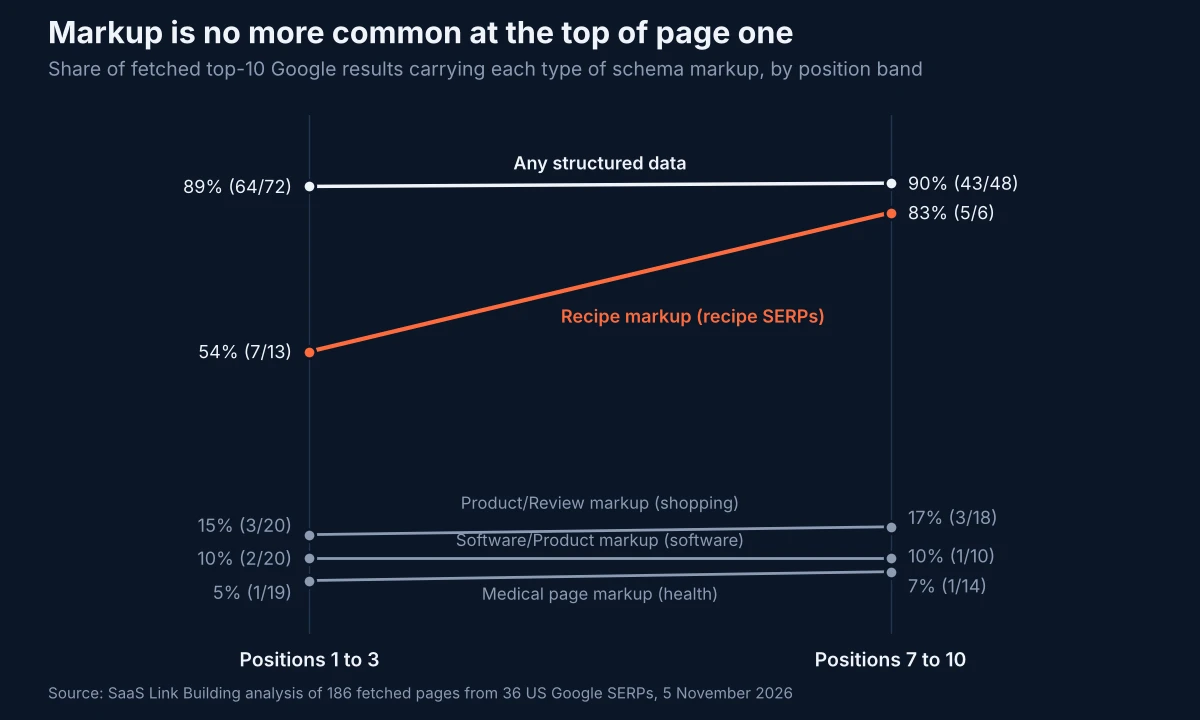
Nine in ten pages on page one already carry structured data. When a feature is that common, it cannot explain why one page ranks above another. The breakdown by position band was flat: 88.9% of pages in positions 1 to 3 had markup, 92.4% in positions 4 to 6 and 89.6% in positions 7 to 10. The median page carried nine distinct schema types in the top band and eight or nine in the others.
| Position band | Fetched pages | With any structured data | Share | Median schema types per page |
|---|---|---|---|---|
| 1 to 3 | 72 | 64 | 88.9% | 9 |
| 4 to 6 | 66 | 61 | 92.4% | 8 |
| 7 to 10 | 48 | 43 | 89.6% | 9 |
| All | 186 | 168 | 90.3% | 9 |
Source: SaaS Link Building SERP pull and page crawl, 5 November 2026.
Page-level comparisons show no edge
Average position was 4.48 for the 168 pages with markup and 4.50 for the 18 without, a gap of 0.02 places. A Mann-Whitney test found no meaningful difference (p = 0.96). Counting how many schema types each page declared, from zero to more than 20, produced a Spearman correlation with position of effectively zero (rho 0.0002, p = 0.998). Per-type averages clustered tightly around the overall mean: pages with Organization markup averaged position 4.36, BreadcrumbList 4.49, Article 4.61, FAQPage 4.50 and Review 4.12, all within half a place of each other on samples of 16 to 127 pages.
The fairest test compares pages inside the same results page, which controls for query difficulty. Fifteen SERPs contained both marked-up and unmarked pages. In 8 of them the marked-up pages ranked higher on average; in 7 they ranked lower.
The unmarked pages that rank at the top
Eight of the 72 top-3 pages we fetched had no detectable structured data at all. They included the National Heart, Lung, and Blood Institute page at position 1 for "how to lower cholesterol naturally", two Google Analytics help and developer pages at positions 2 and 3 for "how to set up google analytics 4", Amazon pages at position 1 for "best standing desk" and position 3 for "best electric toothbrush", a pasta brand's recipe page at position 1 for "easy lasagna recipe", a Facebook video at position 1 for "guacamole recipe" and a regional health system's page at position 3 for "how to get rid of hiccups". These are high-authority or closely intent-matched pages; our inference is that those qualities mattered more than markup here.
Even type-specific markup does not track rank
If any vertical should show a markup effect, it is recipes. Yet the 12 recipe-SERP pages without Recipe markup averaged position 3.50, while the 17 with it averaged 4.29. Recipe markup appeared on 7 of 13 top-3 pages and 5 of 6 pages in positions 7 to 10. In shopping SERPs, Product, Review or rating markup appeared on 15% of top-3 pages and 17% of positions 7 to 10; in health, medical page markup was on 5% and 7%; in software, 10% in both bands. None of these differences runs in the direction the theory predicts, and the samples are small, so they should be read as "no visible effect" rather than as a negative one.
Where markup does pay: the snippet
The display effect was sharp. Of the 17 recipe pages carrying Recipe markup, 15 showed ratings, review counts or cook times in their result. None of the 12 recipe-SERP pages without Recipe markup showed any of that. That is exactly what Google's documentation describes: markup makes a page eligible for a rich result, and the rich result is what changes how the listing looks.
| Group | Pages | Showing rich snippet details | What appeared |
|---|---|---|---|
| Recipe SERPs, with Recipe markup | 17 | 15 | Star ratings, review counts, cook time |
| Recipe SERPs, without Recipe markup | 12 | 0 | None |
| Shopping SERPs, with Product, Review or rating markup | 11 | 4 | Ratings, prices, return windows |
| Shopping SERPs, rich details on pages with no such markup in raw HTML | 7 | 7 | Store ratings, prices, delivery and return terms |
| Pages with FAQPage markup (all verticals) | 32 | 4 | Ratings, prices or cook times; no FAQ dropdowns |
Source: SaaS Link Building SERP pull and page crawl, 5 November 2026. Rich snippet details are those returned with each organic result.
Shopping results told a different story. Eleven shopping results showed ratings, prices or return terms, but only 4 of those pages had Product, Review or rating markup in their HTML. The other 7, including Amazon, eBay and retailer category pages, displayed store ratings and price ranges without it. Speculation: those details most likely come from merchant data such as Merchant Center feeds rather than on-page markup, which fits Google's advice to keep Merchant Center information current, but some sites also inject markup with JavaScript, which our raw-HTML parse would miss. Among 32 pages with FAQPage markup, the only rich details we saw were ratings, prices or cook times, never question dropdowns, in line with the shrinking set of rich results we tracked in our study of retired structured data on top sites.
Verdict: unproven as a ranking factor, confirmed as a display factor
On the direct claim, that schema markup itself lifts rankings, the evidence lines up against it. Google's documentation describes markup as an understanding and eligibility tool, its policy page says a markup penalty leaves rankings untouched, its ranking systems guide never mentions schema, and our pull found no position gradient in overall markup, type-specific markup or the number of types declared. We rate the direct ranking claim unproven, leaning strongly towards no effect. We stop short of "debunked" because a one-day correlation snapshot of 186 pages cannot rule out a small effect, and none of the Google pages we reviewed states outright that markup is never used as a ranking signal.
On the softer claim, that markup changes how results look and how users respond, the evidence is solid. In recipe SERPs, rich results appeared only on pages with Recipe markup, and the case studies Google publishes report click-through gains of 25% to 82% for marked-up pages and rich results. Whether those extra clicks loop back into rankings through systems like Navboost is plausible but unconfirmed.
The AI version of the claim has the weakest support. Google says plainly that no special schema is needed for AI Overviews or AI Mode, and we found no Google source saying markup improves selection for AI answers.
What this means for SEO teams
- Use markup where a rich result exists for your content type. In our sample, Recipe markup was the difference between a plain blue link and a result with stars and cook times. Product, Review and video markup are worth the same check against Google's current feature list.
- Do not sell schema as a ranking project. If a page is not ranking, markup is unlikely to be the fix. The unmarked pages at position 1 in our sample were authoritative or closely matched to intent, with no markup at all.
- Measure the right outcome. Track click-through rate and rich result impressions in Search Console's search appearance filter, not average position, when you add or change markup.
- Keep merchant data current. For shopping, much of the rich detail we saw appeared without on-page markup, so feed quality may matter as much as page markup.
- Audit what you ship. The median top-10 page declared nine schema types. Markup for retired features adds weight without adding eligibility, and invalid or misleading markup can cost rich result eligibility through a manual action.
Methodology
On 5 November 2026, between 09:17:06 and 09:17:36 UTC, we requested Google web results for 36 queries through a SERP API (US location, English interface, desktop device). The queries were split into four verticals of nine: recipes (for example "banana bread recipe"), shopping reviews ("best robot vacuum"), health information ("signs of dehydration") and software ("best project management software"). We kept organic results in positions 1 to 10, which gave 278 results: all but one SERP returned fewer than 10 organic results (between 6 and 10), so the positions 7 to 10 band is made up mostly of positions 7 and 8.
We fetched each result URL with a standard desktop browser user agent, following redirects, including Google /goto redirect links of the kind we described in our report on /goto links and rank tracking. We excluded 92 results we could not read reliably: 39 returned HTTP 403, 33 were YouTube videos or redirected to YouTube, 8 were Reddit threads that served a block page, 4 returned HTTP 400, 3 timed out or errored, 2 returned pages under 10 KB that did not contain the article, and one each returned 502, 520 or a PDF. That left 186 pages.
For each page we parsed every application/ld+json block, collecting all @type values including those nested inside @graph arrays, and recorded microdata itemtype values. A page counted as "with structured data" if it had at least one type from either source. Type counts include every nested and helper type, such as ListItem and ImageObject. We parsed raw HTML only, so markup injected by JavaScript after load is not counted. Rich snippet details are the ratings, prices, cook times and similar annotations returned with each organic result. Correlations use Spearman's rank correlation; the with and without comparison uses a two-sided Mann-Whitney U test.
One SERP looked anomalous: "sourdough starter recipe" returned the schema.org Recipe definition at position 2 and Google's own Recipe structured data documentation at position 4. Excluding that SERP, 164 of 181 pages carried markup and average positions were 4.50 with markup and 4.41 without, so the conclusions do not depend on it. This is a single-day, single-location snapshot of 36 queries; it shows correlation, not cause, and cannot detect small or slow effects.
Conclusion
Schema markup has become so standard on page one that it no longer distinguishes the pages that win. In our 36-SERP pull, pages with and without it ranked almost identically, and Google's own documentation describes markup as a way to earn rich results rather than rankings. The measurable return was in the snippet: Recipe markup reliably produced stars and cook times, which Google's published case studies tie to higher click-through rates. Teams should keep using markup where it earns a visible feature, and stop expecting it to move positions on its own.
What do you think?
Have you added or removed structured data on a set of pages and tracked average position separately from click-through rate in Search Console? Tell us what moved, and over what timeframe, so we can compare notes with this snapshot.
Questions and answers
Is schema markup a Google ranking factor?
Google's documentation describes structured data as a way to help it understand a page and to make it eligible for rich results. Its structured data guidelines say a structured data manual action removes rich result eligibility but does not affect how the page ranks in web search. In our 36-SERP pull, pages with markup averaged position 4.48 and pages without it 4.50.
Do I need schema markup to appear in AI Overviews or AI Mode?
No, according to Google. Its AI features page says no special optimisation is required and that there is no special schema.org structured data site owners need to add, while recommending that existing structured data matches the visible text on the page.
What does schema markup actually change in Google results?
It can make a page eligible for rich results. In our sample, 15 of 17 recipe pages with Recipe markup showed ratings, review counts or cook times, while none of the 12 recipe-result pages without it did. Google publishes case studies reporting click-through gains such as 25% for Rotten Tomatoes and 82% for Nestle rich results.
How common is structured data on page one of Google?
Very common. 168 of the 186 top-10 pages we fetched on 5 November 2026 (90.3%) carried JSON-LD or microdata, and the share was similar in positions 1 to 3 (88.9%) and 7 to 10 (89.6%).
More releases
-
Explainers
Gemini and AI Mode Fetch as Google and Google-Lens; 397 of 534 Fetcher Ranges Lack rDNS
Gemini and Google's AI Mode fetch pages with user agents Google has not documented, a 3 November test found. Our check of five Google crawler pages and 798 published IP prefixes shows the tokens are unlisted and that 397 of 534 ranges in one Google fetcher file have no reverse DNS record.
-
Updates
Google Lifts EEA Site Reputation Penalties; Publisher Coupons Took 21% of Irish Results
Google is emailing site owners that site reputation abuse manual actions no longer affect search results shown in the European Economic Area, a change in force since 30 August. In our check of 11 coupon searches, publisher-hosted coupon pages took 21% of Irish organic results against 13% in the UK.
-
Industry news
Search Console Click Spike: 82% of One Site's Clicked Queries Ranked Beyond Page 2
A click spike in Google Search Console around 1 November hit one of five properties we checked: clicks jumped fivefold to 379 with flat impressions, 93% from desktop, and 156 of 190 clicked queries ranked beyond position 20, a pattern that points to automated traffic rather than people.
Tell us the site and the goals.
Rankings in Google and visibility in AI answers, from one monthly plan. One call is enough to say which one fits. Email works just as well.