YouTube Out-Cites Dictionaries in Google's 'Define' AI Overviews, 66 to 60 in 31 Searches
Google now shows AI Overviews on definition searches fully expanded, according to an 11 November report. In our pull of 31 US 'define' searches, every result page carried an AI Overview, and YouTube drew 66 of 271 citations against 60 for dictionary sites, even though dictionaries held 32% of the organic top 10.
 Vibhu Dhariwal
Cofounder & CTO, Digital Gratified
- Published
- Section
- Studies
- Reading time
- 6 minutes
Ras Al Khaimah, United Arab Emirates, .
Google is now showing AI Overviews for definition searches fully expanded, with no "Show more" click needed, Search Engine Roundtable reported on 11 November after an SEO consultant spotted the change. Google has not announced it. To see what that means for the sites that have long owned these searches, we pulled live US results for 31 "define [word]" queries on 12 November and compared who ranks with who gets cited.
The answer is not the dictionaries. Every one of the 31 result pages carried an AI Overview, and across 271 citations YouTube was the single most cited source with 66, ahead of all dictionary and thesaurus sites combined at 60.
Key findings
- AI Overviews on every query. All 31 searches returned an AI Overview. The median overview ran to 216 words of text (range 118 to 295), and 25 of the 31 ended by asking the searcher a follow-up question, such as whether they wanted example sentences.
- YouTube in 29 of 31 overviews. Only the overviews for "define canonical" and "define inflation" cited no YouTube video. One overview, for "define ephemeral", cited YouTube five times.
- Merriam-Webster ranks and gets cited. It held the top organic spot on 14 of the 31 searches, and the AI Overview cited it on all 14.
- The Oxford English Dictionary ranks but is never cited. It held the top organic spot on 4 searches (expandable, latency, serendipity and ubiquitous) and appeared in no AI Overview at all.
- Wikipedia appeared in 16 overviews, and 23 of the 31 overviews cited at least one dictionary.
Ranking share versus citation share
The gap is clearest when the organic top 10 and the AI Overview sources are set side by side. Dictionary and thesaurus sites filled 72 of the 222 organic results we recorded. Video and social platforms filled 12.
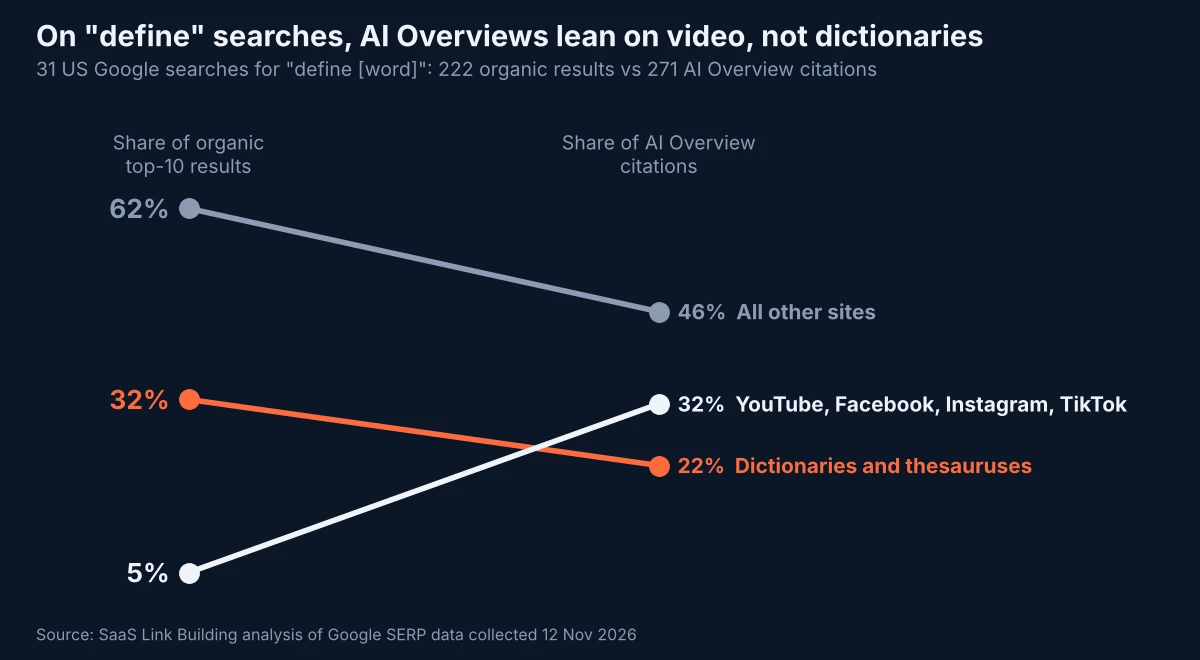
Within the dictionary group, Merriam-Webster took 22 citations and Cambridge Dictionary 18, followed by Vocabulary.com (8), Dictionary.com (6) and Collins (3). Facebook posts were cited 12 times, more than Dictionary.com and Collins together.
Everyday words versus specialist terms
Dictionaries kept most of their organic ground on everyday vocabulary, yet even there their share of citations fell from 59% to 41%. On finance and law terms they took just 9% of citations.
| Word group (searches) | Dictionary share of organic top 10 | Dictionary share of AI Overview citations | Median overview length |
|---|---|---|---|
| Everyday vocabulary, e.g. ephemeral, nuance (11) | 46 of 78 (59%) | 35 of 86 (41%) | 177 words |
| Slang, e.g. rizz, delulu (3) | 4 of 22 (18%) | 6 of 26 (23%) | 186 words |
| Tech, e.g. latency, backlink (7) | 11 of 52 (21%) | 10 of 58 (17%) | 260 words |
| Finance and law, e.g. escrow, tariff (7) | 9 of 50 (18%) | 6 of 70 (9%) | 243 words |
| Science, e.g. osmosis (3) | 2 of 20 (10%) | 3 of 31 (10%) | 218 words |
Specialist terms also drew longer overviews. For "define inflation" the top organic result was the Federal Reserve; for "define fiduciary" it was the Consumer Financial Protection Bureau, and both were cited in the overview.
Context
Definition queries are close to the purest test of whether an AI answer replaces a click: the full answer is a sentence or two, while an expanded overview of around 200 words can add synonyms, examples and usage notes on top. Google has not said whether expanded overviews change click-through on these searches.
The YouTube result echoes our earlier finding that YouTube was cited in all 30 AI Overviews we pulled for a broader query set, and our 150-search study of AI Overview triggers by query type, where local searches rarely triggered one. Definitions sit at the other end of that range. The Oxford English Dictionary pattern is harder to read. Its full entries sit behind a subscription, and it is possible (this is speculation) that pages with limited public text are less useful to the system that picks citations.
Google's guidance for site owners is in its documentation on AI features and your website, which says a page must be indexed and eligible to show with a snippet to appear as a supporting link, with no additional technical requirements.
What this means for SEO teams
- Glossary pages face the most exposure. If your SaaS site runs a glossary of terms like "latency" or "metadata", check Search Console for queries that start with "define" or end with "meaning" and compare click-through rates before and after 11 November.
- A video can earn the citation the page does not. With YouTube in 29 of 31 overviews, a short explainer video for your core terms is a second route into the overview for the same query.
- Give a citable definition in the first lines. Merriam-Webster was cited every time it ranked first. Put a plain one-sentence definition at the top of glossary entries.
- Do not assume ranking first is enough. The Oxford English Dictionary ranked first four times and was cited zero times.
Methodology
On 12 November 2026 we pulled Google results for 31 queries of the form "define [word]" through a SERP API, set to English and a United States location, desktop. The words covered everyday vocabulary (11), slang (3), tech (7), finance and law (7) and science (3). For each query we recorded whether an AI Overview appeared, its text length in words, its cited sources (271 in total) and the first 10 organic results (222 in total, since some pages showed fewer). Three overviews loaded asynchronously on the first pull, so we requested those queries again and used the complete result. Sources were grouped by the site name Google displays. Dictionary sites include Merriam-Webster, Cambridge, Oxford English Dictionary, Oxford Learner's, Dictionary.com, Vocabulary.com, Collins, Wiktionary, WordWeb, American Heritage, YourDictionary and Thesaurus.com. Video and social means YouTube, Facebook, Instagram and TikTok. Where Google wrapped an organic link in a redirect, as we described in our report on /goto links, we used the displayed source name. The data reflects one location and one moment; AI Overviews vary between pulls, so treat the shares as indicative.
Conclusion
On definition searches, ranking and being cited have come apart. Dictionaries still hold about a third of page one, but in the overview that now sits above them, YouTube alone was cited more often than every dictionary combined. For sites that publish definitions, the expanded overview is now the main competitor on the page, and the citation list inside it rewards a different mix of formats than the blue links below.
Questions and answers
Do 'define' searches on Google show AI Overviews?
In our 12 November pull of 31 US 'define [word]' searches, all 31 showed an AI Overview, with a median length of 216 words.
Which sources do AI Overviews cite for definitions?
YouTube was the most cited source with 66 of 271 citations, appearing in 29 of the 31 overviews. Dictionary and thesaurus sites together received 60, led by Merriam-Webster with 22 and Cambridge Dictionary with 18.
Has Google confirmed that definition AI Overviews are expanded by default?
No. The change was reported by Search Engine Roundtable on 11 November after an SEO consultant spotted it. Google has not announced it.
Does ranking first get a dictionary cited in the AI Overview?
Not always. Merriam-Webster ranked first on 14 searches and was cited in all 14 overviews, while the Oxford English Dictionary ranked first on 4 and was cited in none.
More releases
-
Updates
Gemini 4 Hydrogen Reaches All Searchers; Multi-Part AI Mode Queries Cited 24 Sources vs 14
Google made Gemini 4 Hydrogen the model behind Search for all users on 12 November, promising better handling of multi-part questions and a wider query fan-out. In 24 AI Mode searches we ran on launch day, detailed queries cited 24 non-Google sources against 14 for short ones, though the median answer cited just two.
-
Updates
Google Documents Its Search Referer Values; 28% of Top-Site Redirects Dropped gclid
Google published a help page on 12 November explaining how to identify Google Search visits in analytics and server logs from the HTTP Referer header. Our crawl of 502 top-site homepages found that 108 of 389 redirect chains dropped a gclid parameter, one of the causes Google lists for mismatched data.
-
Updates
Google Adds Things to Do to EEA Aggregator Units; 45 of 50 Attraction Links Left Google
Google extended its EEA aggregator and supplier units to things-to-do searches on 9 November. In our ten-city check, EEA results showed attraction cards linking to official sites on five pages, while US results showed Google's own Top sights module on all ten, with every entry linking back to Google.
Tell us the site and the goals.
Rankings in Google and visibility in AI answers, from one monthly plan. One call is enough to say which one fits. Email works just as well.