Google Corrected All 30 Typos We Tested; AI Overviews Kept the Same Sources in 20 of 24
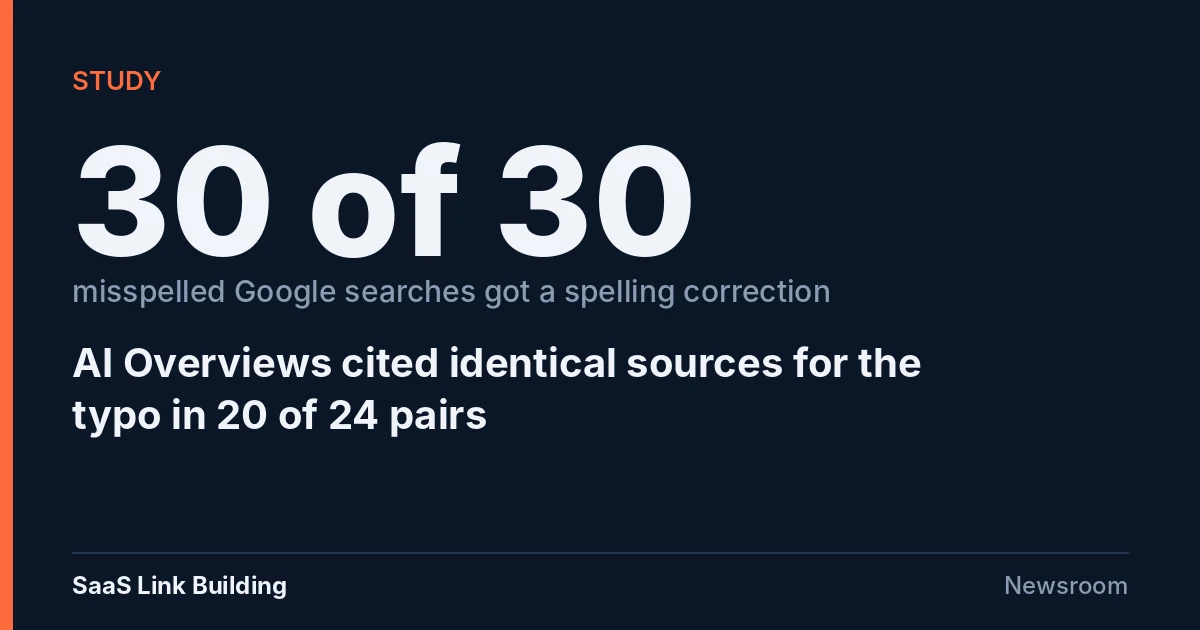
Google returned a spelling correction for all 30 misspelled searches in our 3 November test and showed corrected results for 29. Where both versions cited sources, AI Overviews cited identical domains in 20 of 24 pairs, while organic results shifted about as much as rerunning the correct query.
 Vibhu Dhariwal
Cofounder & CTO, Digital Gratified
- Published
- Section
- Studies
- Reading time
- 8 minutes
Ras Al Khaimah, United Arab Emirates, .
Google corrected the spelling of all 30 misspelled searches we ran on 3 November 2026, and on 29 of them it automatically showed results for the corrected query. Where both versions of a search produced an AI Overview with sources, the overview cited exactly the same set of websites in 20 of 24 pairs. The organic results moved more, but when we ran the correctly spelled searches a second time as a control, they moved almost as much on their own.
The test follows a 12 October Search Engine Roundtable report, based on a post on X by Khushal Bherwani, that AI Overviews now answer typo and no-result searches. Nobody had measured how often, or whether a misspelled query gets a different answer. We pulled 100 live Google results pages to find out.
Key findings
- Every misspelling was caught. Google returned a spelling correction for 30 of 30 misspelled queries. On 29 it replaced the query outright ("showing results for"); on "definately meaning" it kept the exact spelling and only suggested the fix, and its AI Overview opened by pointing out the misspelling.
- AI Overviews mostly survived the typo. Correct spellings produced an AI Overview on 28 of 30 searches. On those 28, the misspelled version showed a loaded AI Overview on 24. Three more returned a deferred AI Overview that did not load for our collector, and one showed none.
- The cited sources barely changed. In 20 of 24 pairs where both versions cited sources, the AI Overview cited an identical set of domains. Repeating the correct query gave an identical set in 18 of 25 cases, so the typo caused no more citation churn than a second search did.
- Organic results shifted, but so did the control. The misspelled search kept the same top organic domain in 14 of 30 pairs. Running the correct query again kept it in 16 of 30.
- Four corrections went sideways. On 4 of the 29 auto-corrected searches, the organic links our collector received had nothing to do with the corrected query, even though Google said it was showing corrected results.
- Gibberish got AI answers too. Of 10 nonsense strings, 5 returned AI Overview text. Three called the input gibberish, fictional or a likely typo; one explained a keyboard pattern; one described the words as pointing to real-world entities.
How Google handled the 30 typos
We built 30 pairs of searches from common English misspellings across health, finance, local, software, definition and how-to queries, then compared each misspelled search with its correct twin.
| What we counted | Correct spelling | Misspelled |
|---|---|---|
| Google offered a spelling correction | 0 of 30 | 30 of 30 |
| Results shown for the corrected query | n/a | 29 of 30 |
| AI Overview loaded | 28 of 30 | 24 of 30 |
| AI Overview slot present but did not load | 0 of 30 | 4 of 30 |
| Pairs where both overviews cited sources | 24 | |
| Of those, identical set of cited domains | 20 of 24 | |
| Same top organic domain in both versions | 14 of 30 | |
| Median top-5 organic domains shared | 3 of 5 | |
The AI Overview result is the clearest. When the misspelled search produced an overview, it was in effect the same overview: for "how to lowr cholestrol", "neumonia symptoms", "morgage calculator" and 17 other pairs, the cited domains matched the correct spelling exactly. The four pairs that differed ("definately meaning", the small business insurance pair, "febuary weather in florida" and the car maintenance checklist) still shared some sources.
The control: a second search moves results too
A single snapshot can make any two results pages look different. To check how much of the gap came from the typo itself, we fetched the 30 correctly spelled queries again between 05:38 and 05:43 UTC, with caching switched off, and compared them with the first run.
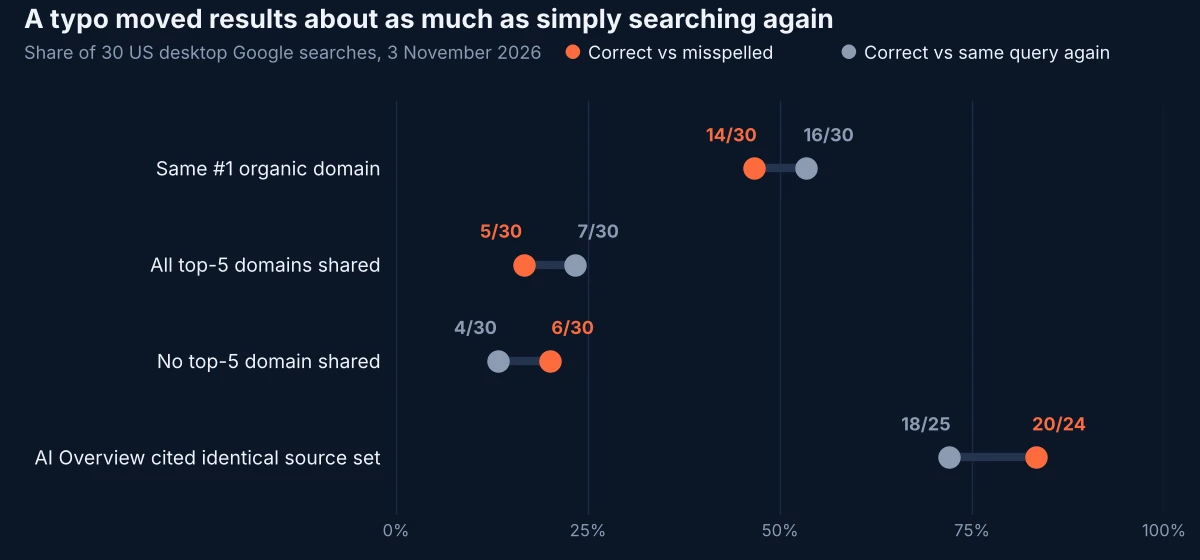
The two lines sit close together on every measure. Repeating an identical query kept the same top organic domain in 16 of 30 cases, against 14 of 30 for the typo. Some of that churn is localisation: "tomorrow weather" returned different local forecasts between runs, and the car maintenance query swapped national sites for local dealers. Our earlier repeat-fetch test found similar instability in collected Google results.
On this sample, a common misspelling did not produce a meaningfully different organic page once normal volatility is accounted for. Google sends both versions to roughly the same place.
Where the correction went wrong
Four searches were the exception. On "calender 2027", "diarrea remedies", "ibuprofin dosage for adults" and "restaraunt reservation app", Google reported that it was showing results for the corrected spelling, yet the organic links our collector received were unrelated to the corrected query: federal agency pages for the calendar search, legal "remedies" pages for the diarrhea search, streaming and film database pages for the ibuprofen search and restaurant trade associations for the app search.
Two of those four still carried an AI Overview, and both cited the same domains as their correctly spelled twins. In other words, the AI answer understood the corrected query while the blue links below it did not. We could not confirm whether real users saw the same organic links, so treat this as an observation from automated collection rather than proof of a Google bug. It echoes an earlier fault in which Google ignored query words on a share of tracked searches.
What Google did with gibberish
We also ran 10 strings with no meaning at all, such as "gwerpo snirk" and "xqwz jrtv bnmk".
| Outcome | Gibberish searches |
|---|---|
| Google suggested a spelling correction | 6 of 10 |
| AI Overview text loaded | 5 of 10 |
| Overview said the input looked like gibberish, fiction or a typo | 3 of 5 |
| Overview explained a keyboard pattern ("lkjhg fdsa") | 1 of 5 |
| Overview described the words as real-world entities | 1 of 5 |
Some of the corrections were creative: "flibbertigrum" became "flibbertigibbet", "snirk" became "smirk" and "quoxite" became "quixote". The one overview that treated nonsense as meaningful, for "qzvx plorn tremb", built its answer around a website whose domain matched the first word.
Context: what Google says about spelling
Google's How Search Works ranking page says its query language models took more than five years to develop and improve results in over 30% of searches, starting with steps "as seemingly simple as recognizing and correcting spelling mistakes". Its AI features guide for site owners says there are no special optimizations needed to appear in AI Overviews or AI Mode. Our data fits both: the misspelled form is not a separate target. Our 150-search AI Overviews study found overviews on 77% of searches across query types; on this sample they appeared on most typo searches as well.
What this means for SEO teams
- Do not build pages for misspellings. Every common typo we tested was corrected, and the AI Overview cited the same sources for both spellings in most cases. A page optimised for "morgage calculator" competes for the same results as "mortgage calculator".
- Check your brand's misspellings by hand. Google corrects dictionary words easily; it may not know a new product or company name. Search the three or four most common misspellings of your brand and note whether Google corrects them, suggests a competitor or shows nothing useful.
- Measure rankings more than once. Repeating the same query moved the top organic domain in 14 of 30 cases. Before reporting a ranking change, collect several snapshots and compare like with like.
- Do not assume AI citations follow organic rankings. On two broken corrections, the AI Overview stayed on topic while the organic links did not.
Methodology
We built 30 query pairs, each a correct English search and a common misspelling of it, plus 10 nonsense strings. All queries were collected with a SERP API from google.com with country US, language English and desktop device, between 05:21 and 05:36 UTC on 3 November 2026. Where the results page returned a deferred AI Overview, we made a follow-up request for its content; if that returned nothing, we recorded the overview as not loaded. The control re-fetched the 30 correct queries between 05:38 and 05:43 UTC with result caching disabled.
We recorded Google's spelling correction fields, whether an AI Overview loaded, the domains it cited, and the domains of the organic results returned (6 to 10 per page). Comparisons are at domain level: "identical set" means the same cited domains regardless of order. "Unrelated" organic results were judged from the returned domains. This is a snapshot from one location and device; results for real users can differ with location, history and time.
Conclusion
Google's spelling correction caught every common typo we threw at it, and the AI Overview usually gave the misspelled search the same answer, with the same sources, as the correct one. The organic results differed, but no more than they did when we simply searched the correct term twice.
For SEO teams that settles an old habit: misspelling pages are not worth building. The lessons sit at the edges, in a few corrections that sent the blue links off topic and AI answers that sometimes find meaning in gibberish.
Questions and answers
Does Google correct misspelled searches automatically?
In our test of 30 common English misspellings on US desktop Google on 3 November 2026, Google returned a spelling correction for all 30 and showed results for the corrected query on 29. On the remaining search, "definately meaning", it kept the exact spelling and suggested the fix.
Do AI Overviews appear on misspelled searches?
Yes, in most cases we tested. Of 28 query pairs where the correct spelling showed an AI Overview, the misspelled version showed a loaded AI Overview on 24. Three more returned an overview slot that did not load for our collector.
Do AI Overviews cite different sources for a typo?
Rarely, in our sample. Where both the correct and misspelled searches produced an AI Overview with sources, the cited domains were identical in 20 of 24 pairs. Running the same correct query twice gave identical domains in 18 of 25 cases.
Should I create pages that target misspelled keywords?
Our data suggests it is not worthwhile for common words. Google corrected every misspelling we tested and sent both versions to largely the same sources. Google's How Search Works page says its language systems recognise and correct spelling mistakes as part of understanding a query.
Does Google show AI Overviews for gibberish?
Sometimes. Of 10 nonsense strings we searched, 5 returned AI Overview text. Three said the input looked like gibberish, fiction or a typo, one explained a keyboard pattern, and one described the words as real-world entities.
More releases
-
Industry news
French Publishers Take AI Overviews to Brussels; Press Got 3 of 218 Citations in Our Test
Five French publisher groups have asked the European Commission to examine Google's AI Overviews and AI Mode, adding evidence to its December 2025 probe. Our 31-search check of google.fr found an AI Overview on every query, with press sites supplying 3 of 218 citations and YouTube 53.
-
Explainers
23 of 489 Top Sites Still Use NoArchive or NoCache, Tags Bing Drops for AI on 1 March
Bing will stop reading NoArchive and NoCache as AI controls on 1 March 2027, replacing them with separate AI Training and AI Grounding preferences. Our 2 November check of the Tranco top 1,000 found 23 of 489 sites still use the old tags, 11 aimed at Bingbot alone, including the BBC and The Guardian.
-
Studies
Google Put Top Stories Inside AI Overviews on 8 of 60 Trending Searches, None Political
Google placed its Top Stories news carousel inside the AI Overview on 8 of 60 trending US searches we pulled on 2 November, mostly sports, and on none of 18 political and government searches. Every embedded carousel listed 10 stories, against an average of 5.5 in standalone Top Stories boxes.
Tell us the site and the goals.
Rankings in Google and visibility in AI answers, from one monthly plan. One call is enough to say which one fits. Email works just as well.