Does Google Ignore Your Meta Description? It Rewrote 74% in Our 30-Query Test
Google replaced the publisher's meta description with its own snippet for 96 of 129 pages (74.4%) across 30 live US searches on 29 October 2026. It kept the description for nearly half of pages on short head terms but rewrote more than 85% on longer, more specific queries.
 Vibhu Dhariwal
Cofounder & CTO, Digital Gratified
- Published
- Section
- Studies
- Reading time
- 13 minutes
Ras Al Khaimah, United Arab Emirates, .
SEO teams spend hours polishing meta descriptions that many of them suspect Google never shows. To test that suspicion, the SaaS Link Building newsroom pulled 30 live Google searches on 29 October 2026, fetched every ranking page we could reach, and compared the snippet Google displayed with the page's own <meta name="description"> tag. Of the 129 pages that had a meta description, Google displayed it for 33 (25.6%) and wrote its own snippet from page text for the other 96 (74.4%).
The headline number is only half the story. How often Google kept the publisher's description depended heavily on the kind of search: it used the tag for close to half of the pages on short head terms, but for roughly one page in eight on longer queries. This investigation sets out the theory, the evidence on both sides, what Google itself has said over 19 years, and a verdict.
The theory: Google ignores the meta description
The claim circulates in two forms. The weak form is that Google often swaps a meta description for text it picks from the page. Few practitioners dispute that. The strong form is that writing meta descriptions has become close to pointless because Google overrides them most of the time, so the effort is better spent on page copy.
The strong form gets its support from two places. First, practitioners see their carefully written descriptions replaced in the results every day, often by a sentence from the middle of an article. Second, earlier industry measurements put the rewrite rate above 60%. A widely cited 2020 industry study of 20,000 keywords found Google rewrote meta descriptions 62.78% of the time, with 59.65% for short "fat-head" keywords and 65.62% for long-tail ones. That study is now six years old, and Google's results pages have changed a great deal since, which is why we ran a fresh check rather than relying on it.
Key findings
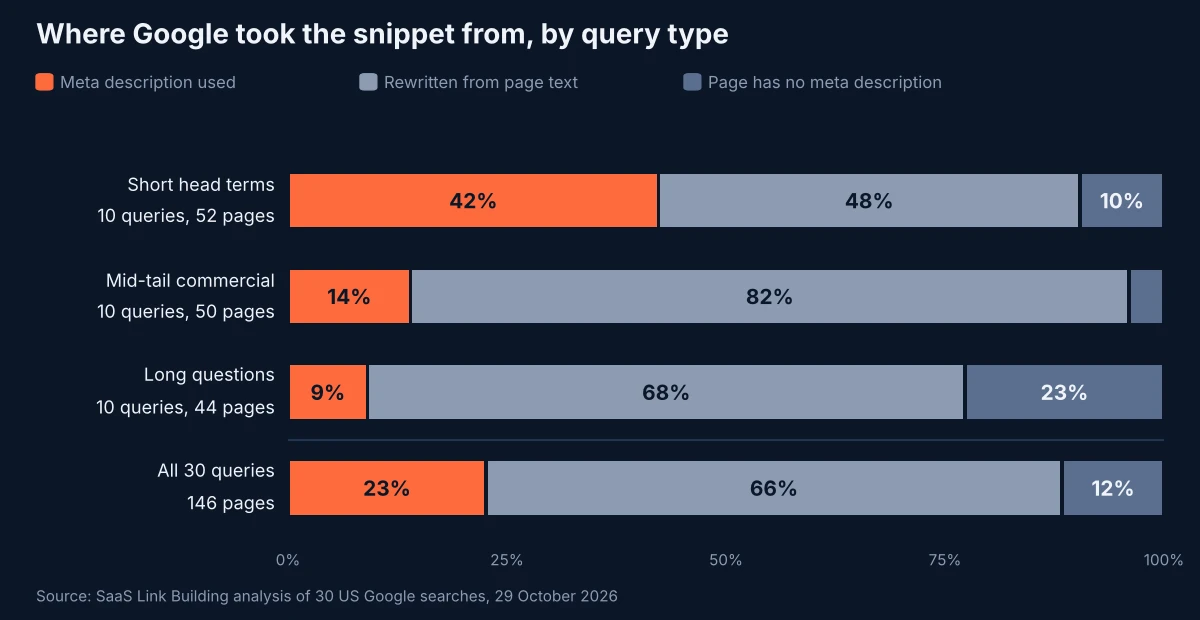
- Across 30 US searches, Google showed the page's meta description verbatim for 33 of 129 pages that had one (25.6%) and replaced it for 96 (74.4%).
- On short head terms such as "crm" or "web hosting", Google kept the description for 22 of 47 pages (46.8%).
- On mid-tail commercial searches such as "best crm for small business", it kept 7 of 48 (14.6%).
- On long question searches such as "why does my dog eat grass", it kept 4 of 34 (11.8%).
- 17 of 146 analysed pages (11.6%) had no meta description at all and still ranked on page one, including Wikipedia at position 2 for "crm".
- Descriptions that contained every meaningful word of the query were used 35.5% of the time (22 of 62); descriptions missing at least one query word were used 16.4% of the time (11 of 67).
- For the two searches we could also check on Bing, Bing showed the meta description for 8 of 13 checkable pages, while Google used none of the 11 checkable pages with a description on the same two queries.
Evidence for the theory
Google's own documentation now says it prefers page text
The strongest evidence comes from Google itself. Its current snippet documentation says Google "primarily uses the content on the page" to build a snippet, and may also use the meta description when it describes the page better than other parts of the content. The same page says snippets are designed to match the specific search, so one page can show different snippets for different queries.
Google's SEO Starter Guide goes further. It tells site owners the snippet is sourced from the page content, and that occasionally it may come from the meta description tag.
That language is a reversal. In September 2007 the Google Webmaster Central blog published a post on meta description makeovers in which Google said it frequently preferred to display a page's meta description when one was available, because it gave users a clear idea of the page. The post now carries a notice pointing readers to the current documentation.
| Google source | Date | How it describes meta description use |
|---|---|---|
| Webmaster Central blog | 28 September 2007 | Google "frequently" prefers to show the meta description when available |
| Snippet documentation | Current | Google "primarily" uses page content; may use the meta description when it describes the page better |
| SEO Starter Guide | Current | Snippet is sourced from page content; "occasionally" from the meta description |
Nothing here is hidden. Google says in plain words that the meta description is a secondary input. The debate among SEOs is less about whether Google rewrites and more about how often, and whether the remaining share justifies the work.
Our data: three in four descriptions replaced
Our check found a higher rewrite rate than the 2020 industry figure: 74.4% against 62.78%. The two numbers come from different samples, query sets and methods, so they are not a like-for-like trend line, but nothing in our data suggests Google has become more willing to use publisher descriptions since then.
The pattern by query type was sharper than the 2020 study reported. That study found a gap of about six points between head and long-tail keywords. In our sample the gap was 35 points: Google replaced 53.2% of descriptions on short head terms but 85.4% on mid-tail commercial queries and 88.2% on long questions.
Several examples show why. For "mortgage rates", Freddie Mac ranked first with a meta description saying the average 30-year rate had declined this week. Google ignored it and printed the page's live figures instead: a 30-year fixed rate of 7.32% and a 15-year rate of 6.68% as of 22 October 2026. Bankrate, at position 3, got the same treatment: a generic description about comparing lenders was replaced with the week's actual rate movement. For "why does my dog eat grass", Purina's description promised reassurance and an explanation; Google showed a sentence from the body about dogs liking the taste of grass. For "best crm for small business", a roundup's description about testing dozens of Salesforce alternatives was replaced with its verdict on one specific product.
In each case, Google picked the passage that answered the query, not the passage that summarised the page.
Ten long-question searches, four descriptions used
On six of the ten long questions, Google used no meta description at all among the pages we could check. "Why does my dog eat grass" (0 of 6), "how often should you replace your toothbrush" (0 of 6) and "why is my sourdough starter not rising" (0 of 4) were the clearest cases. Two of the dog pages had no meta description, and two toothbrush pages had none either; they ranked on page one regardless.
Evidence against the theory
On head terms, Google still uses the tag about half the time
The strong form of the theory does not survive the head-term data. For short, broad searches Google kept the publisher's description for 46.8% of the pages that had one. For "vpn" it kept 4 of 6, for "running shoes" 3 of 5 and for "noise cancelling headphones" 3 of 5. We did not classify page types, but the kept descriptions included both shop pages and editorial roundups whose descriptions already stated the page's main point in one sentence. Kitchen Kapers' coffee maker collection page and Rtings' noise cancelling headphones roundup both appeared exactly as written in their tags.
For sites whose traffic depends on a small set of broad commercial terms, the meta description is still the snippet a large share of searchers see.
Descriptions that match the query survive more often
Google's documentation says the snippet is chosen to fit the search. Our data supports that. When a description contained every meaningful word of the query, Google used it 35.5% of the time. When it was missing at least one query word, Google used it 16.4% of the time. The meta description is not ignored at random: it competes with the page body, and it wins more often when it answers the same question the searcher typed.
This is a correlation from a small sample, and head terms are both shorter (so easier to match fully) and more likely to keep their descriptions, so the two effects overlap. It is still the pattern a practitioner would expect if Google scores candidate snippets against the query.
Bing behaves differently
The theory is often framed as "search engines ignore meta descriptions". Our small Bing check does not support that broader version. For "why does my dog eat grass" and "best robot vacuum for pet hair", Bing displayed the meta description for 8 of the 13 pages we could fetch, including the American Kennel Club and Good Housekeeping. On the same two queries, Google used none of the 11 checkable descriptions. Two queries are not enough to estimate a Bing rate, but they are enough to show the behaviour is Google's choice, not an industry norm.
| Query | Google: description used | Bing: description used |
|---|---|---|
| why does my dog eat grass | 0 of 6 | 6 of 9 |
| best robot vacuum for pet hair | 0 of 5 | 2 of 4 |
| Total | 0 of 11 | 8 of 13 |
Pages we could fetch with a meta description present. Source: SaaS Link Building analysis of live Google and Bing results, 29 October 2026.
Position did not decide it
One version of the theory holds that Google only respects descriptions on top-ranking pages. Our data does not show a clean pattern. Descriptions were kept for 36.7% of pages in positions 1 to 3, 11.4% in positions 4 to 6 and 27.8% in positions 7 to 10. The dip in the middle reflects which queries happened to have which pages there, not a ranking rule, and we would not read anything into it from a sample this size.
What we could not test
Some parts of the debate are beyond a SERP study. Google's 2007 post said meta descriptions do not affect ranking; we did not test ranking effects. We also could not see the click-through effect of a rewritten snippet against an original one, which is the question that matters most commercially. Any claim that Google rewrites descriptions to improve click-through is speculation: Google's documentation talks about relevance to the search, not click rates.
Finally, Google's snippets differ by device, location and search, and change over time. Our numbers describe one day of US results from a single data source.
Verdict: likely, for most searches
The weak form of the theory is confirmed, by Google's own documentation as much as by our data. The strong form, that meta descriptions are pointless, is not supported. Our overall verdict on "Google ignores your meta description" is likely: for mid-tail and long-tail searches, Google replaced more than 85% of descriptions in our sample, so for most of the queries most pages rank for, the description is not what searchers see. For short head terms, Google kept the description close to half the time, which is too often to call it ignored.
What this means for SEO teams
- Prioritise descriptions where Google still uses them. Pages that rank for short, broad terms are where a handwritten description was most often shown in our data. Google's own documentation recommends focusing on critical URLs if you cannot write a description for every page.
- Write the body for the snippet. On long-tail and question searches, the snippet came from page text more than 85% of the time. A clear, self-contained answer sentence near the relevant heading is what Google is likely to lift. This overlaps with how AI Overviews pick citation text; our 30-query test of AI Overview citation snippets found 26% of checkable citation cards showed AI-written summaries rather than page text.
- Put the query words in the description. Descriptions containing every query term were used about twice as often as those that did not. For a page's main target query, include the terms naturally.
- Do not panic about missing descriptions. 11.6% of the page-one results we analysed had none, including Wikipedia. A missing tag is a lost opportunity on broad pages, not a ranking problem.
- Use snippet controls deliberately. If a page's body produces a misleading snippet, Google's documentation lists
data-nosnippetfor excluding passages andmax-snippetfor limiting length. Our study of robots meta snippet controls on top sites found none of 799 top-site pages used nosnippet. - Check Bing separately. If Bing or Bing-powered search sends meaningful traffic, the description matters more there, based on our small check.
Methodology
On 29 October 2026 we collected the organic results for 30 English-language queries through a SERP API using Google's US results: 10 short head terms, 10 mid-tail commercial queries and 10 long question queries. The 30 queries returned 268 organic results. We excluded 60 results on user-generated or platform pages where a page-level meta description is not set by an independent publisher (YouTube, Reddit, Facebook, Instagram, Quora, Stack Exchange and Amazon) plus one PDF, and two further results with malformed or tracking-only URLs, leaving 205 pages.
We fetched each page once with a standard browser user agent and no other measures. 160 pages returned HTTP 200; 45 could not be fetched (38 blocked automated requests, the rest returned errors or timed out), and we did not attempt to get around the blocks. We then removed 7 responses that were block or error pages and 7 pages where the displayed snippet appeared neither in the meta description nor in the current page text (indicating the page had changed since Google crawled it). That left 146 pages, of which 129 had a meta description.
A snippet was counted as "meta description used" when, after normalising case, punctuation and trailing ellipses, its first 50 characters appeared in the meta description or its text matched the start of the description with a similarity ratio of at least 0.8. In practice the scores split cleanly: every page scored either 1.0 or 0.55 and below. All other snippets on pages with a description were checked against the page body (at least 30% of the snippet's six-word sequences present) and counted as "rewritten from page text". For the Bing comparison we requested Bing results for four of the same queries that day; one returned no results and one returned unrelated dictionary pages, leaving two queries and 17 results, of which 13 could be fetched with a meta description present.
Query-term coverage counted the share of a query's words, excluding common stop words, that appeared in the description. The sample is small and covers a single day; percentages for subgroups rest on 34 to 67 pages and should be read as directional.
Conclusion
Google does replace most meta descriptions, and it says so in its own documentation, which has moved from "frequently" preferring them in 2007 to saying the snippet may "occasionally" come from them today. But the replacement rate depends on the search. On broad head terms, our data shows Google kept the publisher's description close to half the time; on longer, more specific searches it almost always wrote its own. For SEO teams the practical answer is to write descriptions carefully for broad, high-traffic pages and to write body copy that can stand on its own as a snippet everywhere else. Earlier investigations from the newsroom, including whether Google rewards fresh dates, found the same theme: Google's behaviour shifts with the query far more than blanket rules suggest.
What do you think?
Have you compared your own Search Console click-through rates on pages where Google shows your meta description against pages where it rewrites it, and if so, which performed better?
Questions and answers
How often does Google rewrite meta descriptions?
In our check of 30 US Google searches on 29 October 2026, Google showed its own snippet instead of the page's meta description for 96 of 129 pages that had one (74.4%). A 2020 industry study of 20,000 keywords put the rate at 62.78%.
When is Google most likely to use my meta description?
On short, broad searches. Google kept the description for 46.8% of pages on head terms such as "crm" or "web hosting", against 14.6% on mid-tail commercial queries and 11.8% on long questions. Descriptions containing every query word were used 35.5% of the time, against 16.4% for those missing one.
What does Google say about meta descriptions and snippets?
Google's snippet documentation says it primarily uses page content to build snippets and may also use the meta description when it describes the page better. Its SEO Starter Guide says the snippet may occasionally come from the meta description tag. In 2007 Google said it frequently preferred to show meta descriptions.
Do pages need a meta description to rank on page one?
No. In our sample, 17 of 146 analysed page-one results (11.6%) had no meta description, including Wikipedia at position 2 for "crm". Google's 2007 guidance said meta descriptions do not affect ranking.
More releases
-
Studies
45% of Top-Site WordPress Installs Patched Within 12 Hours of the 7.1.4 Security Release
WordPress shipped security release 7.1.4, with backports to every branch back to 4.7, on 28 October. Our crawl of the 20,000 most popular domains about 12 hours later found 44.7% of the 729 WordPress homepages exposing a version already patched, while one in five were two or more releases behind.
-
Industry news
Google Search Revenue Rose 0.1% From Q2 as AI Mode Ads Expand to 10 New Countries
Alphabet's Q3 2026 results show Google Search & other revenue up 12% year on year to $63.35 billion but just 0.1% above Q2, as Google named lower AI Mode monetization as a drag and expanded AI Mode ads to 10 new countries. Google Network grew 1.4% after eight straight quarterly declines.
-
Industry news
Google Opens Connected Apps Platform as Search Lists 5 Apps Against Gemini's 85
Google opened a preview of its Connected Apps Platform on 28 October, letting developers bring MCP-based apps into AI Mode in Search and the Gemini app. Google's help pages list 85 Connected Apps in Gemini but only 5 in Search, all US English, and the new developer policy bans tool descriptions written to win selection.
Tell us the site and the goals.
Rankings in Google and visibility in AI answers, from one monthly plan. One call is enough to say which one fits. Email works just as well.