Bing's AI-Off Extension Just Adds noAI=1 to Searches; It Has 137 Chrome Users
Bing documented two ways to hide its AI answers on 11 November: a preview browser extension and a -ai query operator. Our read of the extension's code shows it appends a noAI=1 parameter, ships with AI off, and resets the default search engine and new tab to Bing. It has 137 Chrome users.
 Vibhu Dhariwal
Cofounder & CTO, Digital Gratified
- Published
- Section
- Explainers
- Reading time
- 7 minutes
Ras Al Khaimah, United Arab Emirates, .
Microsoft published a Bing Search Blog post on 11 November 2026 setting out two ways to search Bing without AI-generated answers: a preview browser extension called Microsoft Bing AI Search Choice, and a new -ai query operator. The Bing announcement explains what each option does for searchers, but not how it works. We downloaded the extension's public package and read its code: the toggle simply adds a noAI=1 parameter to Bing search URLs, AI answers are off by default after install, and installing it also makes Bing the browser's default search engine and new tab page.
What changed
Bing's post presents the two options as a matter of user choice, saying "Bing users should have a choice in how they search." Neither option is a setting inside Bing itself.
- The extension (preview). Available for Chrome and Microsoft Edge, it adds a toggle that decides whether Bing shows AI-generated answers across all of a user's Bing searches. Bing's post says the extension also sets Bing as the default search engine.
- The
-aioperator. Adding-aito the end of a query returns results without AI-generated answers for that one search. Bing's own example is "why is the sky blue -ai". No install is needed.
The post describes both methods only in terms of "AI-generated answers". It does not say whether Copilot Search, Copilot entry points or other AI modules are also hidden, and it says nothing about ads, advertisers or publishers.
The extension itself is not new. Microsoft's head of search, Jordi Ribas, announced it on X in June, as Windows Central reported on 11 June 2026. The November post is the first time Bing has documented it on its official blog alongside the operator.
Inside the extension: what the code actually does
We pulled version 1.0.0.3 of the package from Google's Chrome Web Store update service and read its manifest and scripts. It is a small extension, with a handful of files and a listing size of 9.39 KiB on the Chrome Web Store page.
| Component | What we found in the package | Why it matters |
|---|---|---|
| AI toggle (background.js) | Adds noAI=1 to any www.bing.com/search or bing.com/search URL when AI is off; removes it when AI is on | The "switch" is a URL parameter, not an account setting |
| Default state | DEFAULT_ENABLED = false | AI answers are off from the moment the extension is installed until the user turns them on |
| Open tabs | When the toggle changes, every open Bing results tab is reloaded with or without the parameter | The change applies at once, not only to new searches |
| Default search engine | chrome_settings_overrides sets Bing as default, with FORM=WLPREW&PC=W384 in the search URL | Searches from the address bar carry Microsoft's own form and partner codes |
| New tab page | Overrides the new tab and redirects it to bing.com/?PC=W384 | Installing the AI switch also replaces the new tab page |
| Permissions | storage and webNavigation, with host access limited to Bing search URLs | The extension cannot read other sites |
The popup labels the toggle "Enable AI Features" with the line "Allow AI summaries and other features in Bing results", which suggests the parameter covers more than the answer box. We could not confirm from the code which modules Bing removes when it sees noAI=1: that decision happens on Bing's servers, not in the extension.
Adoption is tiny so far
The Chrome Web Store listing showed 137 users and a single rating when we checked it, with the last update dated 6 June 2026. PPC Land counted six users for the same Chrome version in early June. The listing says the developer, Microsoft Corporation, "will not collect or use your data". The Edge Add-ons listing did not show a user count.
We tested the -ai operator on 9 queries
Because -ai changes the query string itself, we checked whether it also changes the organic results. We pulled the US desktop top 10 for nine queries through a SERP API, once plainly and once with -ai appended, and counted the URLs the two lists shared.
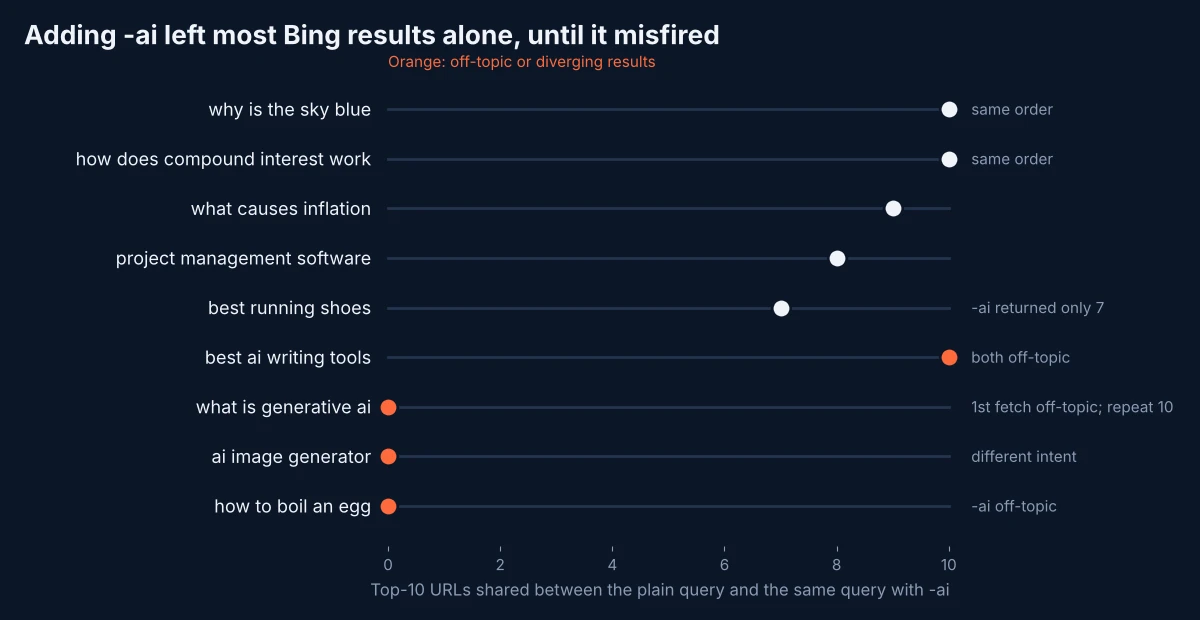
On ordinary informational and commercial queries the operator did what Bing describes. "Why is the sky blue" and "how does compound interest work" returned the same 10 URLs in the same order. "What causes inflation" kept 9 of 10, and "project management software" kept 8 of 10, with a Wikipedia page and a comparison site moving in. "Best running shoes" with -ai returned only 7 results, all of them in the plain top 10.
It misfired elsewhere. The -ai version of "how to boil an egg" returned 10 unrelated video and prayer pages. The first -ai fetch of "what is generative ai" returned seven pages from an unrelated adult site, although a repeat fetch matched the plain results exactly. For "ai image generator" the plain query returned news articles about AI imagery while the -ai version returned generator tools, so the two shared no URLs. For "best ai writing tools", both versions returned dictionary and retailer pages for the word "best", so that pair says nothing about the operator. Scraped Bing results can be noisy, so treat these as signs of instability rather than a measured error rate.
What this means for SEO teams
- Check your Bing visibility both ways. If you report on Bing, look at your key queries with AI answers on and off. Our Bing AI overviews ad test found AI summaries on 12 of 36 searches, so the difference can be visible on a large share of results.
- Prefer the parameter for monitoring. The
-aioperator alters the query and, in our test, sometimes the organic results. The extension's approach leaves the query untouched and addsnoAI=1to the URL. We have not verified that Bing honours the parameter when it is added by hand, so test before building it into a rank-tracking setup. - Do not expect a traffic shift. With 137 Chrome users, the extension is unlikely to move Bing referral numbers. The operator has no install barrier but requires typing it on every search.
- Keep Bing's other AI controls separate. These options change what a searcher sees. They do not change how Bing uses your content. Publisher controls such as robots meta tags are a different system, covered in our analysis of the NoArchive and NoCache tags Bing is retiring for AI use.
- Watch Bing Webmaster Tools. Bing has been adding AI reporting, including the Topics Portfolio beta. If a meaningful number of searchers turn AI off, any gap between AI citation data and classic click data is where it would show.
How it compares with Google
Google's nearest option is the "Web" filter it added in May 2024, which shows only text links, as 9to5Google reported at launch. It is a results tab chosen one search at a time, so it sits closer to Bing's -ai operator than to the extension.
Earlier tests of what happens when AI summaries disappear, including our look at an AI Overview opt-out test, suggest the effect on organic clicks is not straightforward.
Methodology
On 13 November 2026 we downloaded the public package of the Microsoft Bing AI Search Choice extension (ID mcaabonmnmphidjfohjkdobemneigopa, version 1.0.0.3) from Google's Chrome Web Store update service and read manifest.json, background.js, popup.js, popup.html and newtab.html. We did not install or run the extension. User count, rating, size and update date come from the Chrome Web Store listing on the same day.
For the operator test we requested Bing US desktop results for nine queries through a SERP API between 01:18 and 01:35 UTC on 13 November 2026, once without and once with -ai appended, and compared the organic result URLs, ignoring tracking parameters. Two queries were fetched a second time to check consistency. The SERP data did not reliably capture Bing's AI answer modules, so we measured organic results only.
Conclusion
Bing's AI-off choice is lighter than its announcement suggests. The extension is a URL switch that adds noAI=1, ships with AI turned off, and doubles as a way to make Bing the default search engine and new tab page. The -ai operator works on simple queries but changed organic results on several of ours.
For SEO teams, the practical change is a new view to check: Bing results without AI answers. The audience using it is still small, but it gives a clean baseline for comparing classic Bing rankings with the default layout.
Questions and answers
How do you turn off AI answers in Bing?
Bing's Search Blog post of 11 November 2026 lists two ways: install the Microsoft Bing AI Search Choice extension (preview) for Chrome or Edge and switch its toggle off, or add -ai to the end of a single query, for example "why is the sky blue -ai".
How does the Microsoft Bing AI Search Choice extension work?
Version 1.0.0.3 of the extension adds a noAI=1 parameter to bing.com/search URLs when AI is switched off and removes it when AI is switched on. Its code sets AI to off by default after install.
Does the Bing AI extension change my default search engine?
Yes. Bing's post says it sets Bing as the default search engine, and the extension's manifest also overrides the browser's new tab page to open bing.com.
How many people use the Bing AI Search Choice extension?
The Chrome Web Store listing showed 137 users and one rating on 13 November 2026, with the last update dated 6 June 2026. The Edge Add-ons listing did not show a user count.
Does the -ai operator change Bing's organic results?
In our test of nine queries on 13 November 2026, simple queries such as "why is the sky blue" kept the same top 10, but the -ai version of three queries returned off-topic or different results on the first fetch.
More releases
-
Updates
Gemini 4 Hydrogen Reaches All Searchers; Multi-Part AI Mode Queries Cited 24 Sources vs 14
Google made Gemini 4 Hydrogen the model behind Search for all users on 12 November, promising better handling of multi-part questions and a wider query fan-out. In 24 AI Mode searches we ran on launch day, detailed queries cited 24 non-Google sources against 14 for short ones, though the median answer cited just two.
-
Studies
YouTube Out-Cites Dictionaries in Google's 'Define' AI Overviews, 66 to 60 in 31 Searches
Google now shows AI Overviews on definition searches fully expanded, according to an 11 November report. In our pull of 31 US 'define' searches, every result page carried an AI Overview, and YouTube drew 66 of 271 citations against 60 for dictionary sites, even though dictionaries held 32% of the organic top 10.
-
Updates
Google Documents Its Search Referer Values; 28% of Top-Site Redirects Dropped gclid
Google published a help page on 12 November explaining how to identify Google Search visits in analytics and server logs from the HTTP Referer header. Our crawl of 502 top-site homepages found that 108 of 389 redirect chains dropped a gclid parameter, one of the causes Google lists for mismatched data.
Tell us the site and the goals.
Rankings in Google and visibility in AI answers, from one monthly plan. One call is enough to say which one fits. Email works just as well.