Search Console AI Report Bug Hit Core Update Launch; 3 of 8 2026 Updates Overlapped
Google has logged an error that cut impressions in Search Console's Generative AI performance report for 9 to 11 November, the window in which the November 2026 core update began. Our timeline of Google's own records shows three of this year's eight ranking updates launched on a day with a logged data error.
 Vibhu Dhariwal
Cofounder & CTO, Digital Gratified
- Published
- Section
- Updates
- Reading time
- 7 minutes
Ras Al Khaimah, United Arab Emirates, .
Google has added a new entry to its Search Console data anomalies page: a logging error lowered impressions in the Generative AI performance report in Search for data from 9 to 11 November 2026. The window covers 10 November, the day Google released the November 2026 core update, so site owners reading the report this week for early core update effects are looking at incomplete numbers. Search Engine Roundtable reported the entry on 12 November.
We compared every 2026 entry on Google's anomalies page with the ranking updates on Google's Search Status Dashboard. Three of the eight updates Google has listed this year began on a day that Search Console later flagged as a data error.
What changed
Google's entry says the error caused a decrease in impressions on the Generative AI performance report in Search for 9 to 11 November, and adds: "This issue affects data logging only." In Google's wording on these entries, that means the reported numbers are wrong, not the way pages were shown in search.
The entry names only the Generative AI report in Search. It does not mention the main Performance report or the Generative AI view for Discover. Google has not said whether the missing impressions will be restored. When the same report lost data for 13 to 17 August, Google added a note on 21 August saying the missing data had been restored; the November entry carries no such note yet.
The Generative AI performance reports launched on 3 June 2026 to a subset of sites and, according to Google, reached all websites worldwide by 31 August. They show how often a site's URLs appeared in generative AI features such as AI Overviews and AI Mode, broken down by page, country, device and date.
Four logging errors in five months
The Generative AI reports are now named in four entries on Google's anomalies page, two of them for the Search report itself.
| Data dates (as listed) | Report named by Google | Metrics hit | Restoration note |
|---|---|---|---|
| 24 June | Discover, and Generative AI in Discover | Clicks and impressions (Discover); impressions (Gen AI) | None |
| 13 August | Discover, and Generative AI in Discover | Clicks and impressions (Discover); impressions (Gen AI) | None |
| 13 to 17 August (5 days) | Generative AI in Search | Impressions | Restored, per update dated 21 August |
| 9 to 11 November (3 days) | Generative AI in Search | Impressions | None so far |
Counting both Search entries, 8 of the 162 days from the report's 3 June launch to 11 November (about 4.9%) carry a logged impressions error. The August error fell before the global rollout, when only some sites had the report; the November error is the first since every site gained access.
Across all reports, the anomalies page now lists 11 entries dated 2026, up from ten when we reviewed the log in October. Four of them are Discover logging errors.
Bug days keep landing on update days
We set each anomaly date against the start and end dates of the ranking updates listed on Google's Search Status Dashboard. Three updates began on a day with a logged error:
- The May 2026 core update began on 21 May, a day Discover lost clicks and impressions to a logging error.
- The June 2026 spam update began on 24 June, a day Discover and Generative AI in Discover were hit.
- The November 2026 core update began on 10 November, inside the 9 to 11 November Generative AI in Search error.
A fourth case is a near miss: the 13 to 17 August Generative AI in Search error ended the day before the August 2026 spam update began on 18 August. The February Discover update, the March spam and core updates and the September spam update had no logged error in their windows, once the year-long impressions error discussed below is set aside.
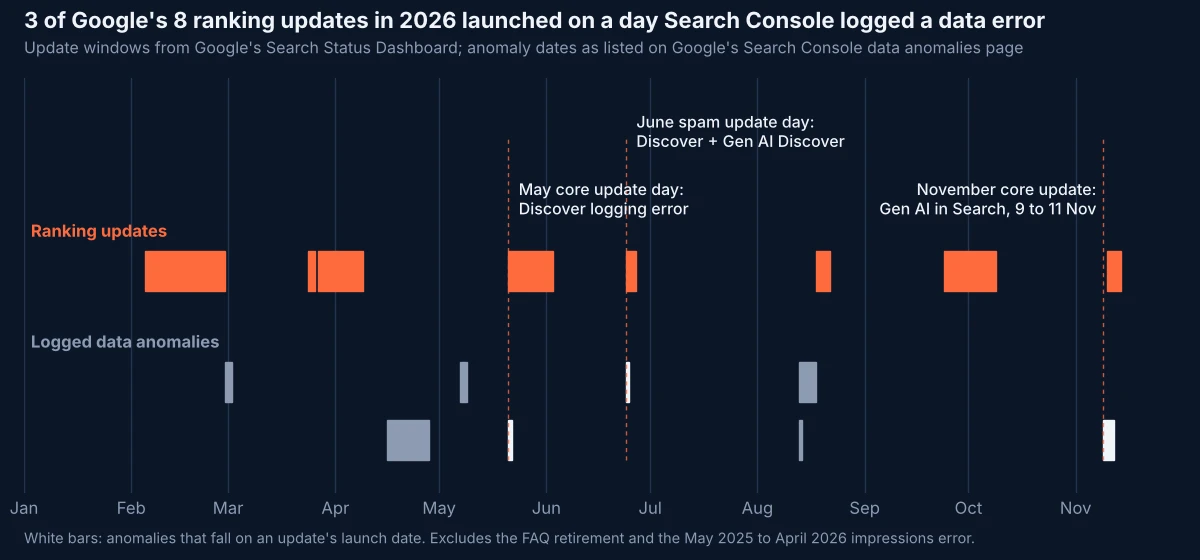
Google has not linked any of these errors to its ranking updates, and three coincidences in eight updates is not evidence of a cause. The logged errors we counted cover 26 days of 2026 so far, so some overlap would be expected by chance. The practical point is narrower: the days when SEO teams most want clean data are the days this year when it has most often been flawed.
This tally leaves out two entries on purpose. The FAQ rich result retirement from 7 May is a feature change, not an error. And a separate logging error, which Google says misreported impressions from 13 May 2025 until 27 April 2026, overlaps every update before May; including it would make all early-year updates look affected.
Why it matters this week
Core updates usually prompt a rush to compare before and after data, and the Generative AI report is Google's dedicated view of how often a site appears in AI Overviews and AI Mode. Google says the rollout may take up to two weeks (see our coverage of the November core update). Any comparison that uses 9 to 11 November as the "after" period, or as the last days of the "before" period, will understate AI feature impressions.
Impression counts in the AI report already move for reasons unrelated to ranking, including how Google displays sources, as we explained when looking at the AI Overview citation card test. A logging gap adds another source of noise.
What SEO teams should do
- Annotate 9 to 11 November in any dashboard that draws on the Generative AI report, and add the same note to reports for clients or stakeholders.
- Start core update comparisons on 12 November for AI feature impressions, or compare 14 days before 9 November with 14 days after 11 November.
- Use clicks from the main Performance report as the steadier signal for this window: Google's entry names only the Generative AI report and only impressions.
- Recheck the anomalies page next week. In August Google restored the missing data four days after the error window closed. If it does the same now, exports pulled this week will differ from later ones.
- Keep update and anomaly calendars side by side. Our 2026 update calendar covers the ranking side; Google's anomalies page is the other half.
Methodology
On 13 November 2026 we read Google's Search Console data anomalies help page and recorded every entry dated 2026, using the data dates exactly as Google lists them. On the same day we downloaded the incidents feed of Google's Search Status Dashboard (status.search.google.com/incidents.json) and listed every 2026 ranking update with its start and end date; the November 2026 core update has no end date yet, so we treated it as running through 13 November. We counted an update as overlapping when its start date fell inside an anomaly's listed dates. We excluded the FAQ rich result retirement (a feature change) and the impressions error spanning 13 May 2025 to 27 April 2026 (which covers every update before May). The 162-day count runs from 3 June to 11 November 2026 inclusive. Anomaly dates are data dates in Search Console; update start times on the dashboard are in UTC.
Conclusion
Google has confirmed that Search Console's Generative AI report undercounted impressions from 9 to 11 November, the window in which the November 2026 core update began. It is the report's second Search logging error since launch, and the first since all sites gained access.
The error does not change how sites performed in search, according to Google, but it does affect the data most teams will use to judge the update. Until Google says whether the data will be restored, treat those three days as missing and build comparisons around them.
Questions and answers
What did Google confirm about the Search Console Generative AI report?
Google's data anomalies page says a logging error caused a decrease in impressions on the Generative AI performance report in Search for data from 9 to 11 November 2026, and that it affects data logging only.
Does the bug affect actual rankings or traffic?
Google says the issue affects data logging only, meaning the reported impressions are understated rather than search performance changing. Its entry names only the Generative AI report in Search.
Will Google restore the missing data?
Google has not said. For an earlier error in the same report, covering 13 to 17 August 2026, Google added a note on 21 August saying the missing data had been restored.
When did the November 2026 core update start?
Google's Search Status Dashboard lists the November 2026 core update as released on 10 November 2026, with a rollout that may take up to two weeks.
More releases
-
Explainers
Bing's AI-Off Extension Just Adds noAI=1 to Searches; It Has 137 Chrome Users
Bing documented two ways to hide its AI answers on 11 November: a preview browser extension and a -ai query operator. Our read of the extension's code shows it appends a noAI=1 parameter, ships with AI off, and resets the default search engine and new tab to Bing. It has 137 Chrome users.
-
Updates
Gemini 4 Hydrogen Reaches All Searchers; Multi-Part AI Mode Queries Cited 24 Sources vs 14
Google made Gemini 4 Hydrogen the model behind Search for all users on 12 November, promising better handling of multi-part questions and a wider query fan-out. In 24 AI Mode searches we ran on launch day, detailed queries cited 24 non-Google sources against 14 for short ones, though the median answer cited just two.
-
Studies
YouTube Out-Cites Dictionaries in Google's 'Define' AI Overviews, 66 to 60 in 31 Searches
Google now shows AI Overviews on definition searches fully expanded, according to an 11 November report. In our pull of 31 US 'define' searches, every result page carried an AI Overview, and YouTube drew 66 of 271 citations against 60 for dictionary sites, even though dictionaries held 32% of the organic top 10.
Tell us the site and the goals.
Rankings in Google and visibility in AI answers, from one monthly plan. One call is enough to say which one fits. Email works just as well.