Does Google Ignore Canonical Tags? 140 of 149 Top Results Matched Their Own
Google calls the canonical tag a hint, and many SEOs say it ignores it. We checked 32 live US Google searches on 27 November: 140 of 149 ranking pages that declared a canonical were shown at exactly that URL. Most of the overrides we found involved syndicated copies on other domains.
 Vibhu Dhariwal
Cofounder & CTO, Digital Gratified
- Published
- Section
- Studies
- Reading time
- 13 minutes
Ras Al Khaimah, United Arab Emirates, .
Few complaints come up in technical SEO threads as often as this one: Google ignores the canonical tag. Site owners declare one URL as the preferred version of a page, then find a different URL ranking, or a Search Console report saying Google picked another page instead. To test how often that happens in live results, we pulled Google's US top 10 for 32 searches on 27 November 2026, fetched every result we could reach, and compared each page's declared canonical with the URL Google actually showed. We also checked Google's own canonical choice for 23 of our newsroom's posts through Search Console.
The short answer: the blanket claim does not hold up. Of the 149 ranking pages that declared a canonical we could read, 140 pointed at exactly the URL Google displayed. Google does set canonicals aside, and it says so in its documentation, but the exceptions we found were narrow and mostly predictable.
Key findings
- 140 of 149 ranking pages with a readable canonical (94.0%) declared the same URL Google showed in its results.
- 7 of 149 (4.7%) ranked even though their canonical pointed to a different URL. Four of those seven were syndicated or republished articles whose canonical pointed to another domain.
- 2 more pages sent mixed signals: the URL in Google's results redirected elsewhere, while the redirect target's canonical pointed back to it. In both cases Google showed the canonical-declared URL, not the redirect target.
- 19 of 168 checkable results (11.3%) carried no canonical in their server HTML at all.
- 23 of 23 newsroom posts we inspected in Search Console had a Google-selected canonical identical to the declared one.
The theory, and why so many SEOs believe it
The belief that Google disregards canonical tags rests on something real. Google's Search Console has a dedicated status in its Page indexing report called "Duplicate, Google chose different canonical than user". Google's Page indexing report help page explains that the status means a page is marked as canonical for a set of pages, but Google thinks another URL makes a better canonical and has indexed that one instead. That status, not a hunch, is what many site owners point to.
Ecommerce stores are a frequent source of these complaints. In August 2023, a merchant who had moved a store to Shopify reported on the Shopify Community forum that Google was overriding declared canonicals with unrelated products, brands or categories, affecting about 30% of products. Other merchants in the same thread described the same pattern, and the thread was never resolved. Stories like that have helped turn "Google ignores canonicals" into received wisdom.
The theory usually comes in two versions. The strong version says rel="canonical" is little more than a suggestion that Google routinely overrules. The weaker version says Google follows canonicals most of the time but overrides them whenever other signals disagree, and that site owners often cannot tell why. Our test was designed to measure which version better fits what Google shows in its results.
Evidence for: Google says the tag is only a hint
Google has never claimed the canonical tag is binding. Its explainer on what canonicalization is says Google may choose a different page as canonical than the site owner does, for various reasons, and states plainly that "indicating a canonical preference is a hint, not a rule." The same page says the factors that play a role include HTTPS versus HTTP, redirects, sitemap inclusion and rel="canonical" annotations, and that Google picks the page it judges "objectively the most complete and useful" for searchers.
The number of inputs is larger than most people assume. In a December 2024 episode of Google's Search Off the Record podcast, Allan Scott, who works on duplication in Google Search, estimated that Google uses roughly 40 signals for canonicalization. With that many inputs, a single tag in the page head can be outweighed.
Google's own canonicalization troubleshooting guide lists the situations in which its chosen canonical tends to differ from the declared one: language variants without localisation annotations, incorrect canonical elements generated by a CMS or plugin, misconfigured servers, hacked sites that inject cross-domain canonicals, syndicated content and, in rare cases, copycat sites. It also warns that after a fix, Google may hold pages in a duplicate cluster for up to two weeks, which helps explain why some site owners conclude their tags are being ignored when the change simply has not been processed yet.
Our own data supplied real examples. Seven ranking pages declared a canonical that pointed somewhere other than the URL Google showed, and two more sat on a redirect that contradicted their canonical. The table lists all nine.
| Search | Organic position | URL Google showed | Declared canonical pointed to | Type |
|---|---|---|---|---|
| best electric cars | 4 | AMP article on a local TV station's site (wavy.com) | The same article on a different domain | Cross-domain (syndication) |
| how to grow tomatoes | 8 | Article on shopping.yahoo.com | Same article on chowhound.com | Cross-domain (syndication) |
| best vpn | 5 | Article on thehour.com | Same article on entrepreneur.com | Cross-domain (syndication) |
| how to write a cover letter | 1 | Article on cvknowhow.com | Same article on topcv.co.uk | Cross-domain |
| area rugs | 2 | Home Depot product page | Home Depot's homepage | Same site, different path |
| kids bunk beds | 1 | Filtered furniture collection page | The unfiltered parent collection | Same site, different path |
| how to lower cholesterol | 2 | www version of a health article | Non-www version of the same article | Host variant |
| email marketing software | 9 | Blog subdomain URL that 301-redirects to a subfolder | Back to the blog subdomain URL | Redirect and canonical disagree |
| help desk software | 8 | www URL that 301-redirects to non-www | Back to the www URL | Redirect and canonical disagree |
Three of the seven true mismatches deserve attention because they cut against the idea that Google simply obeys the tag. Home Depot's product page served a canonical pointing to its homepage in the HTML our fetcher received, yet Google ranked the product page itself. A furniture retailer's filtered collection page declared its unfiltered parent as canonical, and Google still ranked the filtered version first for "kids bunk beds". A health publisher's www article pointed to the non-www address, and Google showed the www URL.
Evidence against: the tag held in 94% of cases
The same data shows how rare those overrides are. Across 32 searches, we could fetch and read 168 of the 264 organic results. Of those, 149 declared a canonical, and 140 declared the exact URL Google was showing (after removing a Google tracking parameter, explained below). That held across positions: the large majority of results in positions 1 to 3, 4 to 6 and 7 and below all carried self-referencing canonicals that matched.
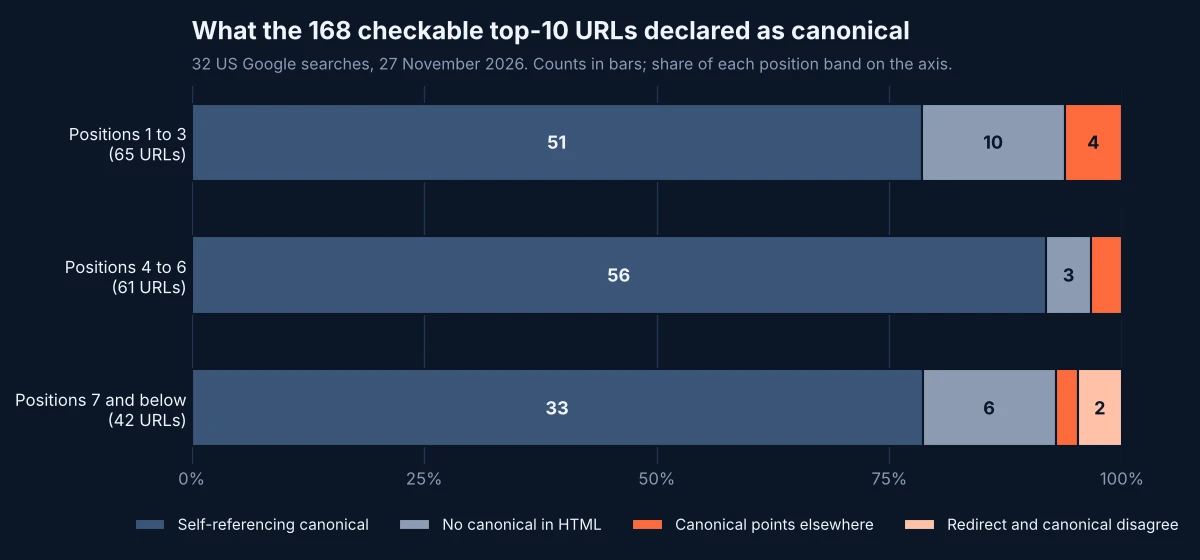
Our own site gave the same answer from Google's side of the fence. We ran URL Inspection through the Search Console API on 23 newsroom posts published between October and late November. In all 23, the Google-selected canonical was identical to the user-declared canonical, and all were indexed. That is a small site with clean, self-referencing canonicals, so agreement is the expected result; it says little about large catalogue sites.
Google's documentation also explains most of the overrides we saw. Four of the seven mismatches were articles whose canonical pointed to the same article on another domain. Google's troubleshooting guide says the canonical link element is not recommended for avoiding duplication with syndication partners, because the pages are often very different, and that partners blocking indexing is the most effective fix. In other words, Google does not promise to honour cross-domain canonicals on syndicated copies, and in our sample it did not.
The Home Depot case matches the guide's description of incorrect canonical elements: a product page declaring the homepage as its canonical is almost certainly a misconfiguration, and ranking the product page is arguably the outcome both Google and the retailer would want. The two redirect conflicts are less tidy. Google's guide to specifying canonical URLs lists redirects first, ahead of rel="canonical" annotations, with sitemap inclusion as a weak signal. Yet in both of our cases Google displayed the URL the canonical named rather than the redirect target. One possible explanation, and it is only a guess, is that the redirects are recent and Google has not yet processed them. Either way, these are cases where Google agreed with the tag, not overrode it.
Finally, 20 of the 264 URLs in our results carried a srsltid parameter added by Google's Merchant Center auto-tagging, a feature merchants can switch off. Google's Merchant Center help page on auto-tagging says the parameter is added to URLs when someone clicks a product on Google Search leading to an online store. Of the 15 such URLs we could read, 13 had a canonical matching the clean URL. Seeing the parameter in results is not, by itself, evidence that Google ignored a canonical.
What our data cannot tell us
Our test has limits worth stating plainly. We could not read 96 of the 264 results: 31 were YouTube URLs that returned rate-limit pages to our fetcher, 53 returned errors, blocks or timeouts, seven served bot-check pages, three redirected to a different host or path, one was a soft 404 and one was an XML feed. Large retailers and publishers with aggressive bot protection are under-represented as a result.
We read canonicals from server-delivered HTML only. Sites that insert their canonical with JavaScript, including some large platforms, would show up as having none. We also cannot see Google's selected canonical for sites we do not own; a URL appearing in results is a strong indication, but not proof, of how Google clustered it. Some SERPs in the sample also looked unusual, with little-known pages outranking household names. Our earlier report on altered results served to rank trackers documented Google serving altered results to some automated queries, which may play a part. The canonical comparison holds for whatever Google returned, but the mix of sites may differ from what a signed-in user sees.
The following is speculation, labelled as such: the Shopify complaints and the persistent Search Console status suggest overrides are far more common on large catalogue sites with many near-duplicate pages than on the top-10 results we sampled, because Google only shows one URL from each duplicate cluster in results. A top-10 sample will naturally under-count overrides that keep a URL out of the results entirely. A crawl of a big store's own Search Console data would be the better test of that version of the theory.
Verdict: debunked as a blanket claim
Verdict: debunked for the strong version of the theory. Google did not ignore canonical tags in our sample; 94% of ranking pages that declared one were shown at exactly the declared URL, and 23 of 23 of our own pages had their canonical accepted.
The weaker version, that Google overrides canonicals when other signals disagree, is confirmed, by Google itself. Its documentation calls the tag a hint and lists situations in which it may be overruled, and our sample found examples matching two of them, syndicated copies on other domains and what look like incorrect canonical elements, plus a host-variant case. Where we found overrides of the tag, most followed Google's stated rules rather than looking arbitrary. That is a different problem from being ignored: it means the tag loses when it conflicts with stronger evidence, and the fix is usually to remove the conflict.
What this means for SEO teams
- Check Google's choice, not your tag. Use URL Inspection to compare the Google-selected and user-declared canonical for your key templates. A canonical only matters if Google agrees with it.
- Make every signal point the same way. If a URL 301-redirects to B, B's canonical must not point back to the original. Our two redirect conflicts show Google will pick a side, and it may not be the one you intended.
- Do not rely on cross-domain canonicals for syndication. Four of our seven overrides were articles whose canonical pointed to another domain. Google's guidance is that syndication partners should block indexing of your content instead.
- Audit CMS-generated canonicals. A product page pointing to the homepage, or a filtered page pointing to its parent while offering different products, invites Google to override the tag. Spot-check templates after theme or plugin updates.
- Pick one host and one protocol. Redirect the alternative versions instead of relying on the tag alone; our www and non-www mismatch is the kind of case redirects settle.
- Give fixes time. Google says re-evaluation can take up to two weeks before pages split out of a duplicate cluster.
The pattern is similar to what we found when we tested whether Google rewrites titles: Google treats site-supplied signals as strong suggestions and departs from them when its other evidence points elsewhere. Our earlier test of how often Google rewrites title tags found that override far more common than the canonical overrides measured here. The redirect case on a blog subdomain is also relevant to our report on subdomains versus subfolders, since moving content between the two is where a redirect and a canonical can end up pointing in opposite directions.
Methodology
On 27 November 2026 (around 09:18 UTC) we requested Google's US English desktop organic results, top 10, for 40 queries spanning ecommerce, software, finance, travel, health, recipes and how-to topics, through a SERP data API. Results for 32 queries were returned within our collection window and form the sample; they contained 264 organic URLs (paid listings excluded). Organic position means the result's order among organic listings only.
Later the same day, we fetched each URL with a standard desktop Chrome user agent, following redirects, and extracted every rel="canonical" link element from the server-delivered HTML plus any canonical in the HTTP Link header. We removed Google's srsltid parameter before fetching and comparing. URLs were compared after lowercasing the host, decoding the path, removing a trailing slash and sorting query parameters. We treated a result as a mismatch when the declared canonical differed in domain, host, scheme, path or query string from the URL Google showed. We excluded URLs that returned HTTP errors, timed out, served bot-check or suspended-account pages, redirected to a different host or path (except two whose redirect target declared the original URL as canonical, which we kept and report separately as redirect conflicts), were soft 404s, or were not HTML; YouTube URLs were excluded because our fetcher was rate-limited. That left 168 analysable URLs, 149 of them with a canonical. Separately, we ran URL Inspection through the Search Console API on 23 saaslinkbuilding.com posts published between 13 October and 25 November 2026 (UTC) and compared the Google-selected and declared canonicals.
Conclusion
Google does not ignore canonical tags; in our sample it agreed with them on 140 of 149 ranking pages and on all 23 of our own. What it does, by its own account, is treat the tag as one strong signal among dozens, and it overrides it when the page is syndicated, the tag looks clearly wrong, or a different version of the URL is the stronger candidate. For most sites, a canonical override is a symptom of conflicting signals, not of Google disregarding the tag.
The theory persists because the cases where Google disagrees are visible in Search Console and painful on large catalogue sites, while the cases where it quietly agrees go unnoticed. Teams that keep redirects, canonicals, sitemaps and internal links pointing at the same URL should expect Google to follow their lead.
What do you think?
If you manage a large catalogue or syndicated content, how many URLs sit in "Duplicate, Google chose different canonical than user" in your Page indexing report, and what did the Google-selected canonical have in common when you inspected them? Share your numbers with the newsroom.
Questions and answers
Does Google have to follow a rel=canonical tag?
No. Google's canonicalization documentation says indicating a canonical preference is a hint, not a rule, and that Google may choose a different page as canonical for various reasons.
How often did Google show a different URL than the declared canonical in this test?
In 7 of 149 ranking pages (4.7%) that declared a readable canonical, the URL Google showed differed from it. In 140 (94.0%) they matched. Two further pages had a redirect that contradicted their canonical, and Google showed the canonical-declared URL in both.
Why did Google rank syndicated copies despite a cross-domain canonical?
Google's canonicalization troubleshooting guide says the canonical link element is not recommended for avoiding duplication with syndication partners, because the pages are often very different, and that partners blocking indexing of the content is the most effective solution.
How strong is rel=canonical compared with other signals?
Google's guide to specifying canonical URLs lists redirects and rel=canonical link annotations as strong signals and sitemap inclusion as a weak signal, and says using several methods together increases the chance the preferred URL appears in results.
How long does Google take to re-evaluate canonical fixes?
Google's troubleshooting guide says that even after fixing content issues, Google might hold pages in a duplicate cluster for up to two weeks.
More releases
-
Studies
Google Edited 106 Search Docs Pages in 2026; Its Changelog Links Just 54 of Them
Google has edited 106 Search Central and crawling documentation pages in 2026 by their own printed dates, but only 54 are linked from a 2026 changelog entry. Our crawl of Google's developer sitemap also found 28 pages whose sitemap lastmod runs ahead of the date the page shows.
-
Industry news
Google's Ranking Hub Spells Out 3 of 10 CMA Fair Ranking Duties Before They Bind
Google's new Search ranking hub, published on 24 November, fully spells out three of the ten obligations in the UK CMA's fair ranking conduct requirement, which takes effect on 17 December. It names no notice periods in days, and the December core update preannouncement clears 15 business days on 15 December.
-
Explainers
Mueller Backs Shared Inventory Pages; 16 of 17 Top Marketplaces Run a Page per City
Google's John Mueller says a shared inventory section with location details per place works well, and that duplicating inventory across every location is hard for Search to manage. In our pull of 170 page-one results across 18 local searches, 147 used city-specific URLs and 16 of 17 recurring national sites ranked a separate page per city.
Tell us the site and the goals.
Rankings in Google and visibility in AI answers, from one monthly plan. One call is enough to say which one fits. Email works just as well.