Is Google Rewriting More Titles Than It Admits? 72.5% of 182 We Checked Were Altered
Google last said in 2021 that it uses the HTML title element around 87% of the time. Our 25 November check of 182 US results found 72.5% of title links differed from the title tag, but most were trims, and the title's own text survived in 86.3%. Verdict: unproven.
 Vibhu Dhariwal
Cofounder & CTO, Digital Gratified
- Published
- Section
- Studies
- Reading time
- 15 minutes
Ras Al Khaimah, United Arab Emirates, .
Google says the HTML title element is still what it shows for most search results. In September 2021 it put a number on that: title elements are "now used around 87% of the time", up from around 80% a month earlier. Five years on, Google has not published a new figure, it has tested AI-written headlines in Discover and Search, and many SEOs believe their titles are being rewritten far more often than Google admits. On 25 November 2026 we pulled Google's US desktop results for 36 queries and compared 182 title links with the title tags on the pages behind them to see which side the evidence supports.
Key findings
- Google showed the page's title tag exactly as written (or only cut short with an ellipsis) for 50 of 182 results (27.5%). The other 132 (72.5%) differed from the title tag in some way.
- Most of those changes were trims, not rewrites: in 98 results (53.8%) Google kept one segment of the title word for word and dropped the rest, usually the site name after a pipe or hyphen, or a subtitle after a colon.
- Google changed the actual wording in 25 results (13.7%), and added or swapped the site name in 9 (4.9%).
- 21 of the 25 wording rewrites matched the page's own H1 heading, one of the sources Google's documentation lists.
- Counting every result where the title tag's own text survived (verbatim, trimmed or rebranded), Google used the title element in 157 of 182 results (86.3%), within a point of the 87% it cited in 2021.
- Of 60 pages that ranked for two or more of our queries, none showed a different title link for a different query, across 141 appearances.
The theory: Google rewrites far more titles than it says
The suspicion is old, but three things have sharpened it this year. First, Google's only published usage figure dates from 2021, before AI Overviews, AI Mode and five years of core updates. Second, Google has tested AI-written headlines, first in Discover and then in Search. Third, independent measurements produce rewrite rates far above 13%. An SEO agency study published on 24 September 2026, which compared 35,842 top-10 results for 10,000 US keywords with their title tags, reported that 64.5% of displayed titles differed from the tag once ellipsis cuts were set aside.
The argument: if two thirds of titles are changed, Google's "87%" no longer describes reality, and site owners control less of their snippet than Google implies. We covered a similar gap for meta descriptions last month, when Google rewrote 74% of meta descriptions in our 30-query test.
What Google has said on the record
Google's position has been consistent in wording, if not in numbers. Its August 2021 announcement of a new title system said content from HTML title tags is "by far the most likely used, more than 80% of the time". The same post said titles would generally no longer change based on the query, and that the new system makes more use of the main visible headline, H1 and other header tags, and prominent styled text.
Google's title link documentation, last updated on 10 December 2025, lists the sources it may draw on: the title element, the main visual title, headings such as H1, og:title, other large and prominent text, other text on the page, anchor text on the page, the text of links pointing to the page, and WebSite structured data. It names the problems that trigger a change: half-empty titles, obsolete dates, inaccurate titles, micro-boilerplate, no clear main title, a language or script mismatch, and a site name that duplicates the one already shown in the result. That last case matters for any measurement, because Google shows the name of the site with each result, as described in its site names documentation. The title link page also tells site owners who see a modified title to consider whether Google's version is "a better fit for the query".
| Date | What Google said or did | Source |
|---|---|---|
| 2012 | Google starts using text beyond the title element where it judges the title does not describe the page well | Google Search Central blog, September 2021 |
| 24 Aug 2021 | New title system; title tags used "more than 80% of the time"; titles generally no longer vary by query | Google Search Central blog |
| 17 Sep 2021 | After feedback, title elements used "around 87% of the time" | Google Search Central blog |
| 10 Dec 2025 | Title link documentation last updated, including the duplicated site name case | Google Search Central documentation |
| Dec 2025 | AI-written headlines tested in Discover as a "small UI experiment" | Tech Times |
| 23 Jan 2026 | Google says Discover's AI headlines are a feature, not an experiment | 9to5Google, citing The Verge |
| 23 Mar 2026 | Google confirms a "small" and "narrow" test of AI-generated headlines in Search | TweakTown, citing The Verge |
| 24 Nov 2026 | December core update preannounced, including improvements to personalized results | Google Search Status Dashboard |
The AI headline thread is the part that fuels the suspicion most. In January, Google told The Verge that AI headlines in Discover had moved from experiment to feature and that the feature "performs well for user satisfaction", according to 9to5Google's report. Google also said there that the Discover headline reflects information across a range of sites and is not a rewrite of an individual article's headline. Nieman Lab's summary of the same report noted that its writer still saw misleading headlines in the feed.
In March, the experiment reached Search. Google spokespeople described it as small and narrow and said it had not been approved for a full launch, and spokesperson Mallory De Leon said "it would not be using a generative model" if Google launched something based on it, TweakTown reported. The same report said the generated headlines drew on user context, search history and location, so the same page could show different headlines to different people. Tech Times added that the test was not limited to news articles. We have found no Google statement since March saying the Search test ended, expanded or launched.
Google's 24 November preannouncement of the December core update, logged on the Search Status Dashboard, says the update includes work on personalized results for people who have personalization turned on. It says nothing about titles; we note it because personalization is the mechanism reported for the AI headline test, which our logged-out data cannot see. We covered that announcement in our December core update report.
Evidence for the theory
On a strict reading, our data backs the critics. Fewer than three in ten results showed the title tag as the site owner wrote it. The other 72.5% were altered in some way, a rate in the same range as the September agency study. Their breakdown (27.2% unchanged, 8.3% cut with an ellipsis, 44.5% showing only part of the tag, 20% showing words not in the tag) sits close to ours, even though their sample was about 200 times larger.
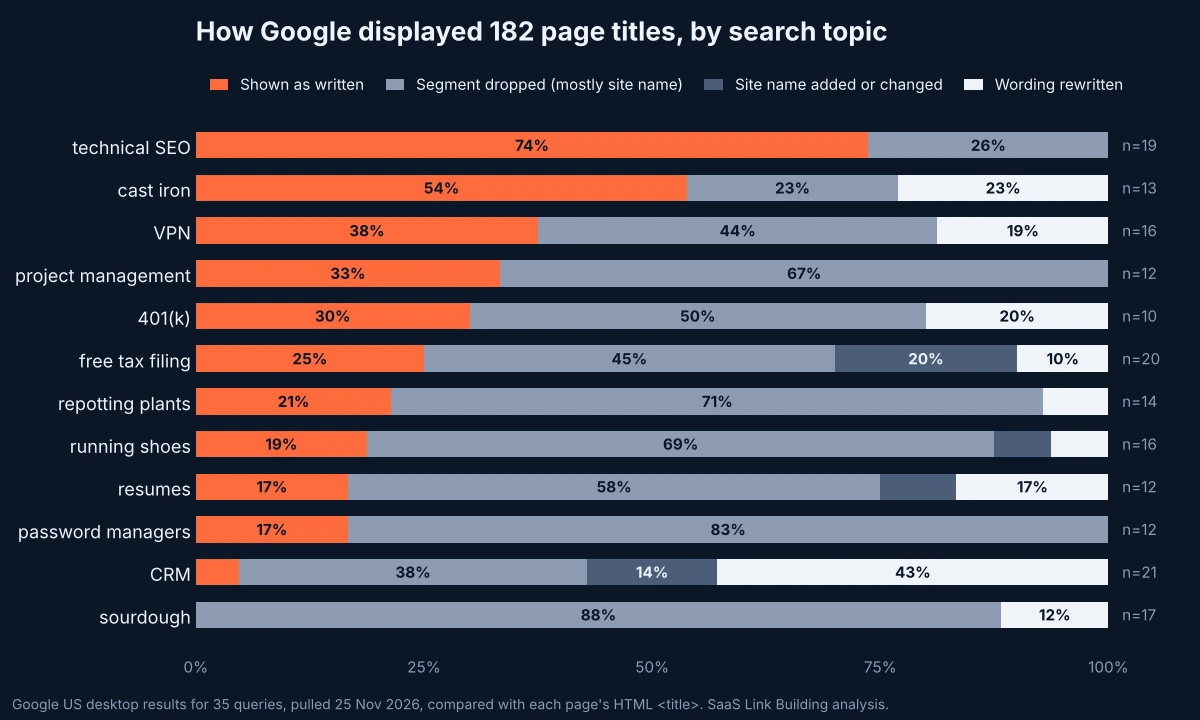
The topic split shows how uneven the treatment is. For technical SEO queries, Google showed 14 of 19 titles as written. For sourdough starter queries it showed none of 17 as written, because almost every recipe site in that SERP appends its brand to the title and Google stripped it. CRM queries drew the most real rewrites: 9 of 21 results carried wording that was not in the title tag. Three pages accounted for all nine (HubSpot's and Zoho's small business CRM pages and a U.S. Chamber of Commerce guide), and each time the displayed text matched the page's H1.
Structure predicted treatment more than topic did. Of the 155 titles that used a separator (a pipe, hyphen, colon or similar between segments), only 29 (18.7%) were shown as written. Of the 27 titles with no separator, 21 (77.8%) were. Length also mattered: the title tags Google showed verbatim had a median of 48.5 characters, against 57 characters for all the title tags it altered and 64 for those whose wording it rewrote.
Google does not spare its own pages. Its technical SEO documentation page carries the title "Technical SEO Techniques and Strategies | Google Search Central | Documentation | Google for Developers". In both SERPs where it ranked, Google displayed only "Technical SEO Techniques and Strategies".
| Page | Title tag | Title link Google showed | What changed |
|---|---|---|---|
| HubSpot CRM page | Free CRM Software for Small Businesses | HubSpot | Free CRM Software for Startups & Small Businesses | Wording replaced with the H1 |
| Zoho CRM page | Best CRM for Small Businesses | Zoho CRM | The Best CRM Software for Small Businesses | Wording replaced with the H1 |
| U.S. Chamber of Commerce guide | CRM for Small Business: Top Free or Low-Cost Options | CO- by US Chamber of Commerce | 10 Free or Low-Cost CRM Tools for Small Businesses | Wording replaced with the H1 |
| Fidelity explainer | What is a 401(k)? | Fidelity | What's a 401(k)? | Wording replaced with the H1 |
| PCWorld VPN guide | Best VPN services 2026: 7 top picks for every VPN need | PCWorld | Best VPN services: 7 top picks for every VPN need | Year and brand dropped, matching the H1 |
| TurboTax free edition page | Free Tax Filing - $0 Fed. $0 State. $0 to File. | TurboTax 2025-2026 | Free Tax Filing - $0 Fed. $0 State. $0 to File. - TurboTax - Intuit | Site name segment changed |
| Google technical SEO doc | Technical SEO Techniques and Strategies | Google Search Central | Documentation | Google for Developers | Technical SEO Techniques and Strategies | Three trailing segments dropped |
| The Clever Carrot recipe | Beginner Sourdough Starter Recipe - The Clever Carrot | Beginner Sourdough Starter Recipe | Site name dropped |
In three of the 25 wording rewrites we could not match Google's text to the page's H1 or og:title in the raw HTML. One running shoe site's title tag carried only its brand and a slogan; Google showed "Best Running Shoes for Beginners - Runva", text we did not find in the page's H1. The other two were the same Facebook video in two SERPs, shown under a title different from both its title tag and its og:title. They may come from other text Google's documentation allows, such as anchor text from links to the page, or they may be generated; our data cannot tell, and either explanation is speculation.
Evidence against the theory
The case weakens once you ask what Google actually claimed. Its 2021 figure measured how often titles came from the title element, not how often they were displayed untouched, and its documentation says it may drop a duplicated site name. If every result where the title tag's own words survived counts as "used", Google used the title element in 157 of our 182 results, or 86.3%. Counted by unique page instead of by appearance, the figure is 108 of 123 pages, or 87.8%. The agency study's comparable figure (unchanged, ellipsis or partial) works out at 80.0%. All three sit close to Google's 87%. In our view, a gap of that size is more likely to reflect differences in sample mix and five years of changes than concealment, though we cannot prove that.
Most changes also follow Google's published rules. Many of the 98 trims dropped site names, which Google already shows with each result; others cut a subtitle after a colon or a run of extra phrases. The 25 wording rewrites came overwhelmingly (21 times) from the page's H1, a source Google's documentation names. Several fit the problems Google lists. A tax site's title tag, "Free Tax Filing - IRS Free File Program | -IRS Free File Free Tax by Online Taxes at OLT.com", became its H1, "Free federal. Free state. If you qualify." A Pinterest pin's title tag ran to 122 characters of keyword variations; Google showed its H1, "7 Tips for Resume Writing".
The strongest point against the AI version of the theory is consistency. The March test, as reported, tailored headlines to user context. If that were happening broadly, the same page should sometimes carry different titles for different searches. In our full pull of 36 queries, 60 pages ranked for two or more queries, appearing 141 times in total, and every one of them carried the same title link each time (the figure is 44 pages, also with no differences, if we count only results we could analyse). That matches Google's 2021 statement that titles would generally no longer change with the query. It does not rule out personalized titles for signed-in users, whom our pull could not represent.
The rewrites we saw were also short and plain. The median rewritten title link ran to 42 characters, against 64 for the title tags they replaced. This newsroom has seen Google take more liberties elsewhere: in October we found AI Overviews rewrote 26% of citation snippets as AI summaries. Organic title links, in our sample, were far more conservative.
Verdict: unproven
The claim that Google rewrites more titles than it admits is unproven. Our test and a far larger independent study agree that most title links no longer match the title tag as written: 72.5% in our sample and 64.5% in theirs, setting ellipsis cuts aside. That is a real loss of control that Google's "87%" figure does not convey. But measured the way Google measures it, use of the title element in our sample (86.3%) is within a point of what Google said in 2021, and most wording rewrites trace back to the page's own H1. We found no sign of query-specific or AI-generated titles in logged-out US results. The real problem is a communication gap: Google's only usage figure is five years old, and it has never said how often titles are trimmed versus rewritten, or how far its AI headline test in Search has spread.
What this means for SEO teams
- Write the title you want as the first segment. More than half of our sample lost at least one segment, usually the last. Anything that must appear in the title link (the product name, the year, the offer) belongs in the main segment, before the first pipe, hyphen or colon.
- Align the H1 with the title tag. When Google rewrote wording, it used the H1 21 times out of 25. If the two say different things, assume Google may pick the H1, and make sure you would be happy with that.
- Reconsider appending the brand to every title. Google shows the site name with each result, and it dropped a segment from 98 of the 155 titles in our sample that used a separator. Use WebSite structured data so the site name is right, and spend the characters on the page's topic.
- Keep titles short. Title tags shown verbatim had a median of 48.5 characters; those Google altered, 57.
- Audit, do not guess. Pull the displayed titles for your top pages from a SERP API or rank tracker and compare them with your title tags each month, sorting changes into trims, brand swaps and wording rewrites. Wording rewrites are the ones that need action. Our earlier analysis of how often title tags contain the exact query is a useful companion check.
- Check signed-in results by hand for news and commercial pages. The AI headline test was reported to use personal context, which logged-out tools cannot see.
Methodology
On 25 November 2026 we pulled Google's organic results for 36 English queries through a SERP API, set to the United States, desktop, with no signed-in profile. The queries formed 12 topic clusters of three related phrasings each (for example "best password manager", "password manager comparison" and "top password managers"). The pull returned 270 organic results pointing to 189 unique URLs.
We fetched each URL's HTML once with a desktop Chrome user agent and extracted the title element, the og:title meta tag and the first H1. We excluded 88 results: 55 where the fetch failed or was refused (mostly 403 and 429 responses) and 33 where the raw HTML carried a placeholder title rather than the page's real one (such as a bare "Reddit" or "- YouTube", or a block page). Because Google renders JavaScript and we compared raw HTML, a few pages could carry a different title after rendering. That left 182 results from 35 queries and 123 unique URLs.
After normalizing case, spacing, HTML entities, quote marks and dash characters, we sorted each result into one of four groups: shown as written (identical, or identical up to an ellipsis); segment dropped (the displayed title equals one segment of the title tag split at a pipe, hyphen, colon or similar separator); site name added or changed (the main text survives with a different brand segment); and wording rewritten (everything else). We then checked rewritten titles against the page's H1 and og:title. Percentages are of the 182 analysed results unless stated otherwise. The sample is small, US-only and taken at a single point in time, and topic results rest on 10 to 21 results each.
Conclusion
Google is not quietly discarding most title tags. It trims them heavily, swaps in H1 headings when titles look stuffed or mismatched, and still draws on the title element in more than eight of ten results. The bigger unknown is the AI headline test Google confirmed in March, which our logged-out data cannot see and which Google has not updated publicly since.
For site owners, the practical answer is the same either way: put the words that matter first, make the H1 agree with the title, and measure displayed titles instead of trusting a five-year-old figure.
What do you think?
Have you seen Google show a title for your pages that appears nowhere in your HTML, or one that changes depending on the search? Share the example and the query with us, and tell us whether you were signed in at the time.
Questions and answers
How often does Google use a page's title tag as the title link?
Google said in September 2021 that title elements are used around 87% of the time. In our 25 November 2026 check of 182 US desktop results, the title tag's own text survived in 86.3% of title links, but only 27.5% showed the title tag exactly as written (or cut short with an ellipsis).
Where does Google get the text when it changes a title?
Google's title link documentation lists the title element, the main visual title, headings such as H1, og:title, other prominent text, anchor text on the page, text in links pointing to the page and WebSite structured data. In our test, 21 of the 25 titles with rewritten wording matched the page's H1.
Why does Google drop the site name from my title?
Google's documentation says that for domain-level site names it may omit the site name from the title link if it repeats the site name already shown in the search result. In our sample, Google kept one segment of the title and dropped the rest (often the site name) in 98 of 182 results.
Is Google using AI to rewrite titles in Search results?
In March 2026 Google confirmed a small, narrow test of AI-generated headlines in Search that had not been approved for full launch, and a spokesperson said a launched version would not use a generative model, as TweakTown reported. We found no Google update on the test since. In our logged-out sample, none of 60 pages that ranked for several queries showed a different title for a different query.
More releases
-
Studies
AI Overviews Gave Full Recipes for 33 of 40 Thanksgiving Searches; YouTube Led Citations
Google answered 33 of 40 US Thanksgiving recipe searches on 25 November with an AI Overview laid out as a complete recipe, with measured ingredients and step-by-step instructions. YouTube was the most cited source, with 53 of 294 citations, and 55% of citations came from domains outside the visible results.
-
Industry news
WebMCP Rewrites Its Tool Objects; 3 of 21 Top Sites Using It Still Call the Old API
The WebMCP draft specification dated 24 November now returns AI agent tools as objects with a hidden ID and renames their window field to source, a change Chrome's docs already reflect. Our crawl of the top 3,000 domains found WebMCP signals on 21 sites, and 3 still call only the older navigator entry point.
-
Studies
A Test Says Googlebot Renders Only 249 Files; 13 of 365 Top Homepages Load More
An SEO consultant's tests suggest Google's renderer loads at most 249 files per page and drops the rest, a limit Google has not documented. Our crawl of 365 top homepages found 13 that request more than 249 files, and six once images, fonts and media are excluded.
Tell us the site and the goals.
Rankings in Google and visibility in AI answers, from one monthly plan. One call is enough to say which one fits. Email works just as well.