WebMCP Rewrites Its Tool Objects; 3 of 21 Top Sites Using It Still Call the Old API
The WebMCP draft specification dated 24 November now returns AI agent tools as objects with a hidden ID and renames their window field to source, a change Chrome's docs already reflect. Our crawl of the top 3,000 domains found WebMCP signals on 21 sites, and 3 still call only the older navigator entry point.
 Vibhu Dhariwal
Cofounder & CTO, Digital Gratified
- Published
- Section
- Industry news
- Reading time
- 8 minutes
Ras Al Khaimah, United Arab Emirates, .
The draft specification for WebMCP, the proposed browser API that lets a web page hand structured tools to AI agents, now describes each registered tool as a Tool object with a hidden internal ID instead of a plain dictionary. The WebMCP Draft Community Group Report dated 24 November 2026 renames the field that points to the registering page from window to source, and Chrome's own imperative API guide, last updated on 20 November, already shows the new shape. Our crawl of the 3,000 most popular domains on 25 November found WebMCP code or origin trial tokens on 21 sites, and 3 of them still call only the older navigator.modelContext entry point, which the current draft does not define.
What changed
- Tools become objects with an identity. The change was proposed in pull request #348, "Introduce the Tool interface", opened on 15 October by Google's Dominic Farolino. It replaces the
RegisteredTooldictionary thatgetTools()used to return and keys every tool by an internal ID rather than by its name. - Calls bind to the exact tool, not the name. The spec says each call to
getTools()creates new objects, andexecuteTool()runs "exactly the tool that getTools() returned". Its own example shows that if a page unregisters a tool and quickly registers a new one under the same name, a call made with the old object is rejected with a NotFoundError instead of silently running the replacement. windowis nowsource. TheToolinterface exposes name, title, description, inputSchema, outputSchema, source, origin and annotations. There is nowindowattribute.- Serialization breaks. The pull request notes that
JSON.stringify(tool)now returns{}, the spread operator copies nothing andstructuredClone(tool)throws. Missing schemas and annotations come back as null rather than undefined. - Arguments move from strings to objects. Chrome's guide says JSON-stringified input arguments are deprecated from Chrome 155 and passes a plain object to
executeTool().
PPC Land reported on 24 November that André Cipriani Bandarra, who leads developer relations for Chrome's AI features, had warned testers on LinkedIn to expect significant changes in the next few weeks. Chrome has not published a migration date in its documentation.
Who this breaks, and who it does not
Most of the change lands on the agent side: browser extensions, testing tools and agents that list tools with getTools() and then match, copy or log them. Code that does tool.window === window, stores tools with JSON.stringify, or treats a missing schema as undefined needs rewriting. A page that only registers tools with document.modelContext.registerTool() keeps the same call.
The clearest example of documentation now out of step is Shopify's. Its WebMCP tools page says Shopify provides tools on every Liquid storefront and tells agent builders to match tools by name, window and origin and to pass arguments as JSON strings. Its checkout WebMCP guide includes sample code that compares candidate.window === window. Under the 24 November draft that property no longer exists, so the comparison would fail and the sample would report that the tool is not registered.
| Item | WebMCP draft, 24 Nov | Chrome imperative guide, 20 Nov | Shopify developer docs |
|---|---|---|---|
| Entry point | document.modelContext only | document.modelContext | document.modelContext |
| Field naming the registering page | source | source | window |
| Tool arguments | Object | Object; JSON strings deprecated from Chrome 155 | JSON string; objects fail in Chrome 153 |
provideContext() | Not defined | Not mentioned | Not mentioned |
Source: our comparison of the WebMCP draft, Chrome's imperative API guide and Shopify's two WebMCP pages, all fetched on 25 November 2026.
What our crawl of the top 3,000 domains found
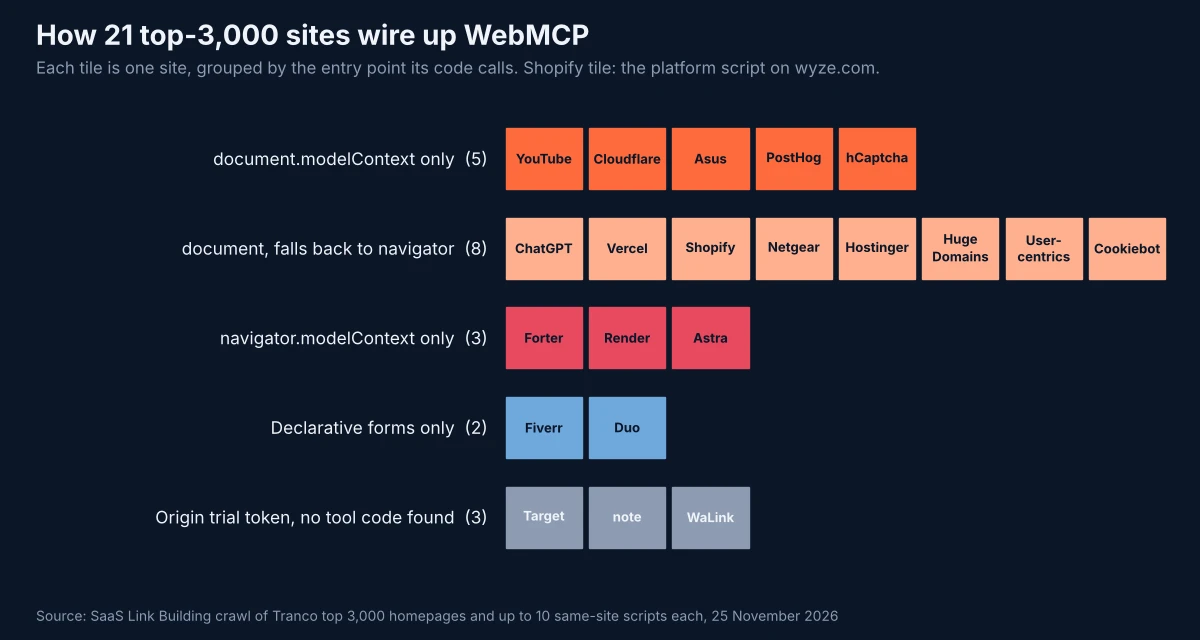
We fetched the homepages of the top 3,000 domains on the Tranco list and up to 10 same-site scripts on each, then read every origin trial token and searched the code for WebMCP calls. 1,808 domains returned an HTML homepage, covering 1,650 distinct sites after redirects. Of those, 21 showed a WebMCP signal, about 1.3%.
Three findings stand out:
- Three sites call only the old entry point. Forter, Render and the Astra WordPress theme site look for
navigator.modelContext, and two of them register throughprovideContext(), a method the current draft does not define. Render's script returns early ifnavigator.modelContextis missing. In a browser that follows the current draft, none of their tools would register. A tracker for the open source WebMCP-org packages reports that Chrome 152 removed the navigator version. - Eight sites hedge. Vercel, Hostinger, Netgear, HugeDomains, Usercentrics, Cookiebot, ChatGPT and Shopify's storefront script on Wyze's store check
document.modelContextfirst and fall back tonavigator.modelContext. Vercel and Hostinger also fall back toprovideContext(). - Third-party scripts register tools too. hCaptcha's widget script registers an
hcaptcha_verifytool when a site's configuration enables it, and the analytics SDK code we found on Laravel's and Digg's pages wrapsregisterTool()when acapture_webmcpoption is switched on. A site can expose or record agent tools without its own developers writing any.
Six sites carried a WebMCP origin trial token: Target, note, Netgear, PostHog, WaLink and Duo. WebMCP was the most common origin trial among the 26 sites in our sample that carried any token, ahead of Long Animation Frame Timing with five. All six WebMCP tokens expire on 30 March 2027. Fiverr's homepage search form uses the declarative attributes toolname and tooldescription instead of JavaScript, and Duo's script listens for activations of declarative form tools.
Where WebMCP stands
Chrome's Chrome Status entry lists the WebMCP origin trial from Chrome 149, first set to run to Chrome 156 and extended to Chrome 162. The specification is incubated in the Web Machine Learning Community Group, with editors from Google and Microsoft, and is not on the W3C standards track. Chrome's WebMCP overview says the API is gated by a tools permissions policy that blocks registration in cross-origin iframes by default, and that clients have to visit a site to learn whether it has tools.
The API is a moving target. Chrome's guide dates outputSchema support to Chrome 159 and a debugging annotation to Chrome 156, and the entry point has already moved once, from navigator to document. We have tracked how few sites publish other agent signals in our study of agent files on 699 top sites, and how agent traffic shows up in server logs in our guide to spotting Google-Agent sessions.
What this means for SEO teams
- Find out whether your site already exposes tools. Search your templates and bundles for
modelContext,registerToolandtoolname. If you run a Shopify Liquid store, Shopify says tools are already on your storefront. - Retire
navigator.modelContextandprovideContext(). If either is your only path, move todocument.modelContext.registerTool()and keep any fallback behind a feature check. - Audit third-party scripts. CAPTCHA, consent and analytics vendors are adding WebMCP code. Check which options are switched on and whether the tools they register describe your site accurately.
- Do not build reporting on tool objects. If your agent testing or monitoring serializes tools with
JSON.stringify, copy the named fields out explicitly, and match tools bysourceandorigin. - Treat WebMCP as an experiment. It runs under an origin trial with expiring tokens, so keep normal HTML forms and links working for agents that read the page, as they do today, and for visitors.
For the crawler side of agent access, see our report on how Google says to allow Google-Agent.
Methodology
On 25 November 2026 we took the top 3,000 domains from the Tranco list published that day and requested each homepage at https://www. and then https:// with a desktop Chrome user agent. 1,808 domains returned an HTML page with status 200, which resolved to 1,650 distinct hosts. For each page we decoded every origin trial token in an origin-trial meta tag or response header, and fetched up to 10 scripts from the same registrable domain. We searched the HTML and those scripts for navigator.modelContext, document.modelContext, registerTool(, provideContext( and forms with a toolname attribute, then read each match by hand. We removed two false positives that used "modelContext" for other protocols and counted sites that redirect to the same host once. We did not run JavaScript, so tools loaded by third-party or late-loading scripts are undercounted, and a site's presence in the chart means its code contains the call, not that an agent has used it.
Conclusion
WebMCP's tool objects are changing shape so that a call made on one tool cannot land on a different tool that took the same name. For the few top sites that have adopted the API, the larger risk is older code that still waits for navigator.modelContext, and documentation, including Shopify's, that still describes fields the draft has renamed.
With 21 of 1,650 top sites showing any WebMCP signal, adoption is early. The sites that are using it should expect at least one more round of changes before Chrome's origin trial ends at Chrome 162.
Questions and answers
What is WebMCP?
WebMCP is a proposed browser API that lets a web page register structured tools, such as search or add to cart, that an AI agent in the browser can call instead of clicking through the page. Its specification is incubated in the W3C Web Machine Learning Community Group and is not on the W3C standards track.
What changed in the WebMCP specification?
The draft dated 24 November 2026 has getTools() return Tool objects that carry a hidden internal ID instead of a plain dictionary. The field that points to the registering page is now called source rather than window, and executeTool() runs exactly the tool object that getTools() returned.
Does my site need to change its WebMCP code?
If your site registers tools with document.modelContext.registerTool(), the registration call is unchanged. If it relies only on navigator.modelContext or provideContext(), the current draft defines neither, so the tools would not register in a browser that follows it.
How many top sites use WebMCP?
Our crawl of the Tranco top 3,000 domains on 25 November 2026 found WebMCP code or a WebMCP origin trial token on 21 of 1,650 distinct sites that returned a homepage, about 1.3%.
How long does Chrome's WebMCP origin trial run?
Chrome Status lists the trial from Chrome 149, first to Chrome 156 and extended to Chrome 162. The six WebMCP origin trial tokens we found all expire on 30 March 2027.
More releases
-
Studies
AI Overviews Gave Full Recipes for 33 of 40 Thanksgiving Searches; YouTube Led Citations
Google answered 33 of 40 US Thanksgiving recipe searches on 25 November with an AI Overview laid out as a complete recipe, with measured ingredients and step-by-step instructions. YouTube was the most cited source, with 53 of 294 citations, and 55% of citations came from domains outside the visible results.
-
Studies
Is Google Rewriting More Titles Than It Admits? 72.5% of 182 We Checked Were Altered
Google last said in 2021 that it uses the HTML title element around 87% of the time. Our 25 November check of 182 US results found 72.5% of title links differed from the title tag, but most were trims, and the title's own text survived in 86.3%. Verdict: unproven.
-
Studies
A Test Says Googlebot Renders Only 249 Files; 13 of 365 Top Homepages Load More
An SEO consultant's tests suggest Google's renderer loads at most 249 files per page and drops the rest, a limit Google has not documented. Our crawl of 365 top homepages found 13 that request more than 249 files, and six once images, fonts and media are excluded.
Tell us the site and the goals.
Rankings in Google and visibility in AI answers, from one monthly plan. One call is enough to say which one fits. Email works just as well.