A Test Says Googlebot Renders Only 249 Files; 13 of 365 Top Homepages Load More
An SEO consultant's tests suggest Google's renderer loads at most 249 files per page and drops the rest, a limit Google has not documented. Our crawl of 365 top homepages found 13 that request more than 249 files, and six once images, fonts and media are excluded.
 Vibhu Dhariwal
Cofounder & CTO, Digital Gratified
- Published
- Section
- Studies
- Reading time
- 8 minutes
Ras Al Khaimah, United Arab Emirates, .
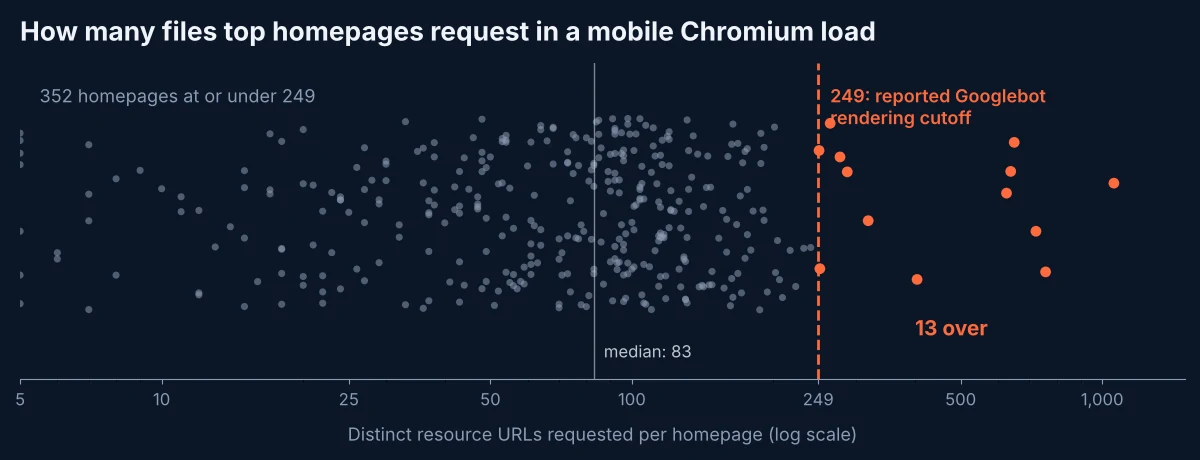
An SEO consultant reported on 23 November that Google's rendering stops after 249 page resources, a cap that appears nowhere in Google's documentation. Franz Enzenhofer, who runs the consulting site Full Stack Optimization, says files past that point are dropped, and that when a late JavaScript file is among them, Search Console's live test can show a broken page while still reporting the URL as available to Google. We found no public comment from Google on the claim, and no Google page that sets a limit on the number of files. To see how many sites the reported cap could touch, we loaded 365 top homepages in a mobile Chromium browser on 25 November and counted every distinct file each one requested. Thirteen requested more than 249.
Key findings
- 13 of 365 homepages (3.6%) requested more than 249 distinct files. The median homepage requested 83 and nine in ten requested 172 or fewer.
- The heaviest were news and portal homepages. Fox News requested 1,059 files, Yahoo 758, Weather.com 650, Indiatimes 639 and Business Insider 626, most of them images and embedded frames.
- 10 of the 13 still had scripts queued after file 249. In Shop.app's case, 132 of its 379 script requests came after that point.
- Counting only what Google says its renderer fetches, 6 sites crossed the line. Google says rendering skips media and fonts, and with images, fonts and media removed, six homepages still exceeded 249 requests.
- Nine more sat between 201 and 249, including Home Depot (217), CNET (223) and NPR (240), close enough that a few extra ad calls could push them over.
What the 249-file test claims
Enzenhofer built a test page and ran it through Search Console's URL Inspection live test and Google's Rich Results Test, then compared Google's screenshots and resource lists with his own server logs. He swept 13 page sizes from 0 to 999 images and ran 18 further runs in random order. In all 12 runs above the limit, he reports, Google loaded exactly 249 files, and in all 6 runs below it Google loaded everything. The HTML document itself did not count.
His other observations:
- Stylesheets, scripts, images, fonts and API calls all counted toward the cap.
- Files were processed in the order they were discovered, so the last ones found were the ones dropped.
- Lazy loading delayed image requests but did not exempt them: Google still requested 243 of 300 lazy images.
- 300 image tags pointing at a single URL counted as one file, so the cap is on distinct URLs.
- Adding a
modulepreloadhint for each JavaScript file made Google find the code first. The test app then rendered, and the files dropped at the cap were images instead.
The tests ran through Google's testing tools. The write-up does not show that Googlebot's rendering for indexing behaves the same way, and we found no independent replication yet. Treat the number as a well-documented observation, not a confirmed Google limit.
Where it sits against what Google has documented
Google's published limits are about bytes, not file counts. In its March post Inside Googlebot, Google says Googlebot fetches up to 2MB of any individual URL (64MB for PDFs) and that the Web Rendering Service fetches every resource referenced in the HTML, "excluding media, fonts, and a few exotic files". Each resource has its own byte counter. The post says nothing about a cap on how many resources one page can pull in.
The two accounts do not fully line up. Google describes a renderer that skips media and fonts, while the test logged image and font requests counting toward the 249. One possible explanation is that Search Console's live test, which fetches resources in real time, behaves differently from rendering for the index, but that is speculation: Google has not said. Its JavaScript SEO basics guide also notes that rendering may reuse cached JavaScript and CSS and ignore caching headers, another sign that the live test and indexing rendering need not see a page the same way.
That is why our key findings give two numbers. Thirteen homepages exceed 249 if every file counts, as in the test. Six exceed it if images, fonts and media are left out, as Google's description of its renderer would suggest.
The 13 homepages over 249
| Homepage | Distinct files | Without images, fonts, media | Scripts after file 249 | Load event within 30s |
|---|---|---|---|---|
| foxnews.com | 1,059 | 436 | 37 | Yes |
| yahoo.com | 758 | 362 | 23 | No |
| name.com | 723 | 717 | 2 | No |
| weather.com | 650 | 328 | 19 | No |
| indiatimes.com | 639 | 239 | 9 | No |
| businessinsider.com | 626 | 248 | 27 | Yes |
| shop.app | 404 | 401 | 132 | No |
| zoom.us | 318 | 199 | 29 | Yes |
| bild.de | 287 | 130 | 13 | No |
| walmart.com | 277 | 258 | 4 | No |
| tradingview.com | 264 | 190 | 0 | No |
| auth0.com | 251 | 136 | 0 | Yes |
| An adult video site | 250 | 165 | 0 | No |
Source: SaaS Link Building crawl of Tranco top-800 domains, 25 November 2026. "Scripts after file 249" counts script requests discovered after the 249th distinct file. Counts include requests made inside ad and embed frames.
Two patterns stand out. First, on the news and portal homepages, images and embedded frames made up most of what came after file 249. We did not classify requests by owner, but these pages carry heavy advertising and embeds. Nine of the 13 had still not fired the browser's load event after 30 seconds. Googlebot may not run every one of those ad calls, so these counts are an upper bound. Second, on app-like pages the late requests were mostly scripts: on Shop.app, scripts made up 379 of 404 requests, the profile where a dropped file is most likely to break rendering.
The wider picture is reassuring. Even with ad requests included, 352 of the 365 homepages stayed at or below 249. The risk is concentrated in a small group of very heavy or very script-dependent sites. Whether a page needs JavaScript at all is a separate question, which we covered in our test of how many top homepages rely on JavaScript to show content.
What this means for SEO teams
- Count your distinct files, not your bytes. Open Chrome DevTools on a key template, reload with the cache disabled, and read the request count, or run a headless browser over your templates. Category pages, infinite-scroll listings and news homepages are where counts climb.
- Read the Page resources panel in URL Inspection. A green "URL is available to Google" does not mean the page rendered as intended. Check the screenshot and the list of resources that could not be loaded, and look for JavaScript files in it.
- Make critical code discoverable early. Put the scripts and styles that build main content in the head, or declare them with modulepreload for ES modules, so they are not queued behind dozens of images.
- Cut duplicate and throwaway URLs. Sprite small icons, combine tiny scripts, batch API calls into one request, and avoid cache-busting query strings that turn one file into many.
- Keep primary content in the server HTML. Whatever the true limit, text and links in the initial HTML do not depend on the renderer fetching anything.
Methodology
On 25 November 2026 we took the top 800 domains from the Tranco list (list ID JZW4Y) and loaded each homepage over HTTPS in headless Chromium through Playwright, using its Pixel 7 phone profile. For each page we recorded every request made after the main document, including requests from frames, kept the first occurrence of each distinct URL in the order it was requested, and ignored data: and blob: URLs. We waited for the load event (up to 30 seconds), then for network idle (up to 10 seconds), then 2 more seconds. We did not scroll or click.
We kept pages that returned a 2xx status, plus pages that responded but did not fire the load event within 30 seconds (124 of the final 365, counted on what they had requested by then), and dropped pages with fewer than 5 requests and duplicates that redirected to the same host. That left 365 homepages; the rest were infrastructure domains with no homepage, blocked our browser, or returned errors. "Without images, fonts, media" removes requests Chromium classified as image, font or media. Our browser is not Googlebot: it ran third-party ad and tracking code that Google's renderer may skip, and it identified itself as mobile Chrome rather than Googlebot, so our counts are an upper bound on what Google would request.
Conclusion
If the reported cap holds for indexing, it is a real but narrow risk. Only 13 of 365 top homepages requested more than 249 files in our test, and only six did once images, fonts and media were set aside. Those sites tend to be ad-heavy news portals and script-heavy web apps, and for them the order in which files are discovered matters as much as how many there are.
Google has documented byte limits for Googlebot but no file-count limit, and its own description of what its renderer fetches does not match everything the test observed. Until Google clarifies, the safe approach is to keep key content in the HTML and make the code that builds the page easy to find early. Our report on the crawlers and fetchers Google documented on 23 November covers the other clients that may show up in your logs.
Questions and answers
Has Google confirmed a 249-file rendering limit?
No. Google's documentation and its March 2026 Inside Googlebot post describe byte limits (2MB per URL for Googlebot, 64MB for PDFs) but no limit on the number of files a page can load. The 249 figure comes from an SEO consultant's tests using Search Console's URL Inspection live test and the Rich Results Test.
What counts toward the reported 249-file limit?
According to the test write-up, stylesheets, scripts, images, fonts and API calls all counted, the HTML document did not, and repeated requests for the same URL counted once. Google's own post says its renderer skips media, fonts and a few exotic files, so it is not yet clear whether images count during rendering for the index.
How many sites request more than 249 files?
In our 25 November 2026 crawl, 13 of 365 top homepages (3.6%) requested more than 249 distinct files in a mobile Chromium load. Six did once images, fonts and media were excluded. The median homepage requested 83.
How can I check whether a page is affected?
Run the URL through the live test in Search Console's URL Inspection tool, then check the screenshot and the list of page resources that could not be loaded, looking for JavaScript files. You can also count distinct requests in Chrome DevTools with the cache disabled.
More releases
-
Studies
AI Overviews Gave Full Recipes for 33 of 40 Thanksgiving Searches; YouTube Led Citations
Google answered 33 of 40 US Thanksgiving recipe searches on 25 November with an AI Overview laid out as a complete recipe, with measured ingredients and step-by-step instructions. YouTube was the most cited source, with 53 of 294 citations, and 55% of citations came from domains outside the visible results.
-
Industry news
WebMCP Rewrites Its Tool Objects; 3 of 21 Top Sites Using It Still Call the Old API
The WebMCP draft specification dated 24 November now returns AI agent tools as objects with a hidden ID and renames their window field to source, a change Chrome's docs already reflect. Our crawl of the top 3,000 domains found WebMCP signals on 21 sites, and 3 still call only the older navigator entry point.
-
Studies
Is Google Rewriting More Titles Than It Admits? 72.5% of 182 We Checked Were Altered
Google last said in 2021 that it uses the HTML title element around 87% of the time. Our 25 November check of 182 US results found 72.5% of title links differed from the title tag, but most were trims, and the title's own text survived in 86.3%. Verdict: unproven.
Tell us the site and the goals.
Rankings in Google and visibility in AI answers, from one monthly plan. One call is enough to say which one fits. Email works just as well.