Google Documents 12 More Crawlers; 31 Top Sites Aim Robots.txt at Bots That Ignore It
Google documented 12 existing crawlers and fetchers on 23 November, including GoogleDocs, pageburst and Chrome-Lighthouse, and moved APIs-Google with a corrected user agent string. All sit outside robots.txt control. Our crawl of 527 top-site robots.txt files found 31 that write rules for such agents anyway.
 Vibhu Dhariwal
Cofounder & CTO, Digital Gratified
- Published
- Section
- Explainers
- Reading time
- 7 minutes
Ras Al Khaimah, United Arab Emirates, .
Google added 12 user agents to its crawler documentation on 23 November 2026 and moved a thirteenth, APIs-Google, to a different list with a corrected user agent string. According to the crawling infrastructure changelog, none of the agents are new: Google says it is documenting "existing high-volume clients that are more likely to show up in server logs". All 13 sit in categories Google describes as ignoring robots.txt, which matters for anyone who reads logs or writes robots.txt rules. We crawled the robots.txt files of the top 1,000 sites to see who already tries to control these agents, and found 31 sites with robots.txt groups aimed at Google agents that Google says skip those rules.
What changed
The update touches two reference pages and the APIs-Google page:
- Six agents joined the special-case crawlers list: Google-analytics-postbacks, Google-Calendar-Importer, GoogleDocs, Google-Edu, pageburst and PlayStore-Google.
- Six agents joined the user-triggered fetchers list: AppEngine-Google, Google-Apps-Script, Google-Cloud-Tasks, GoogleImageProxy, Google Web Preview and Chrome-Lighthouse (listed under PageSpeed Insights).
- APIs-Google moved from special-case crawlers to user-triggered fetchers. Google says its webhook push requests come from the user-triggered fetcher IP ranges and ignore robots.txt. The documented string gained a missing semicolon after "APIs-Google", and the changelog tells developers who hardcoded the old value to update it.
By our count of the live pages, the special-case list now has 10 active entries and the user-triggered list has 16. Subtracting the changelog's additions and the APIs-Google move, that is up from 5 and 9 respectively. Google still says neither list is exhaustive.
The 13 agents and what they do
Each row below comes from Google's own descriptions on the two reference pages. The last column is our count of top-1,000 sites whose robots.txt names the agent in a user-agent line.
| User agent | Google's list | What it does | Top sites naming it |
|---|---|---|---|
| Google-analytics-postbacks | Special-case | Sends Google Analytics attribution postbacks to ad network endpoints | 0 |
| Google-Calendar-Importer | Special-case | Refreshes .ics calendar feeds that Calendar users subscribe to | 0 |
| GoogleDocs | Special-case | Powers Sheets functions such as IMPORTHTML that pull data from web URLs | 0 |
| Google-Edu | Special-case | Verifies domains submitted for Google Workspace for Education | 0 |
| pageburst | Special-case | Renders pages for Google Ads quality, landing-page safety and page understanding | 0 |
| PlayStore-Google | Special-case | Fetches and validates developer URLs in Play Store listings | 0 |
| AppEngine-Google | User-triggered | Requests made by App Engine apps through the URL Fetch service | 1 |
| Google-Apps-Script | User-triggered | UrlFetchApp requests from user-written Apps Script code | 4 |
| Google-Cloud-Tasks | User-triggered | Asynchronous and scheduled webhooks from Cloud Tasks queues | 0 |
| GoogleImageProxy | User-triggered | Fetches images embedded in emails and documents, for example in Gmail | 2 |
| Google Web Preview | User-triggered | Builds link preview thumbnails, for example in Google Classroom | 2 |
| Chrome-Lighthouse | User-triggered | Fetches pages when someone runs a PageSpeed Insights audit | 4 |
| APIs-Google (moved) | User-triggered | Delivers webhook push notifications from Google Cloud and Workspace APIs | 3 |
None of the 527 readable robots.txt files we collected names any of the six new special-case crawlers. Seven sites name at least one of the six new user-triggered fetchers or APIs-Google; two of those, pinterest.com and pinimg.com, serve identical files.
Our robots.txt check: rules that cannot work
Google's reference pages say special-case crawlers "may ignore robots.txt rules" and that user-triggered fetchers generally ignore them because a person asked for the fetch. Each of the six new special-case entries states that the agent ignores robots.txt, and Google's own APIs-Google page says the same. A robots.txt group addressed to one of them is therefore a statement of intent, not a control.
Across the wider set of Google agents that sit on these two robots-ignoring lists (plus their retired tokens), 31 of the 527 sites name at least one in a user-agent line, and all 31 attach a disallow rule to it. The 31 sites use 29 distinct files. The largest cluster is 13 Amazon and Prime Video domains whose files address Google-NotebookLM, a token the user-triggered page now lists only as a former agent for Gemini Notebook, supported until August 2026.
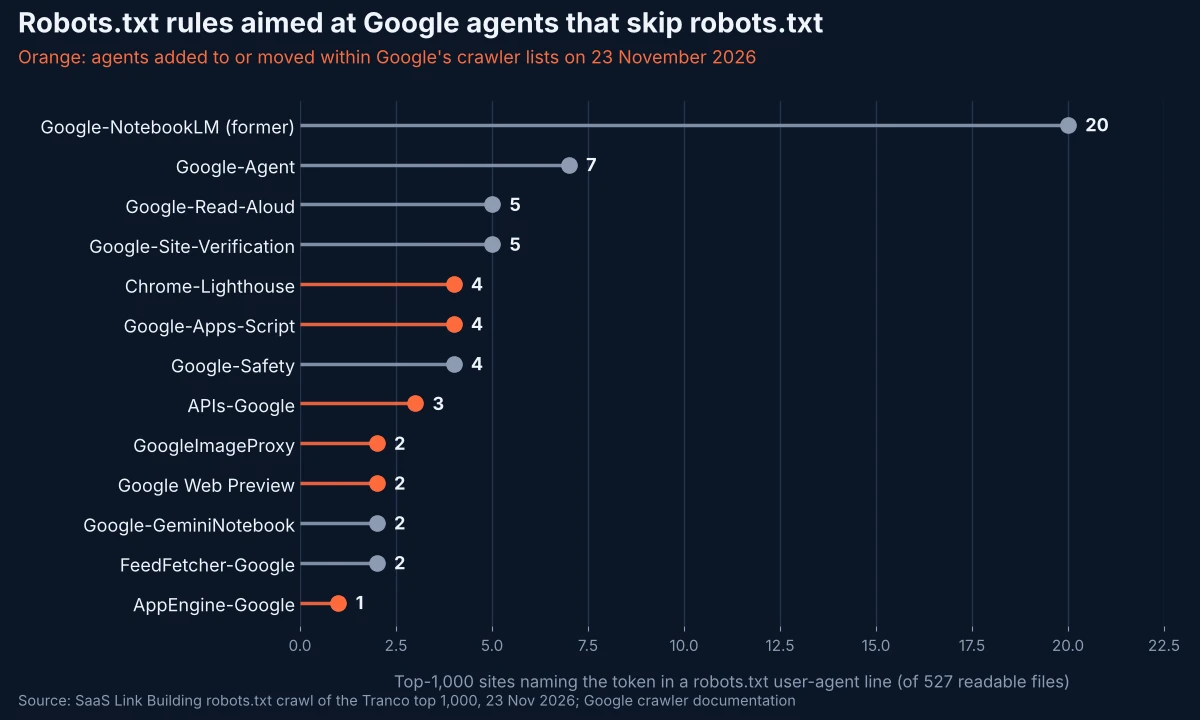
The pattern repeats what we saw when Google published its guidance on allowing Google-Agent: sites write robots.txt groups for agents that never read them, while Google's documentation points to other controls. Our earlier explainer on robots.txt directives that do nothing covers the same trap from another angle.
How to identify the new agents in your logs
Most of these agents send short, distinctive strings, so a plain text search finds them. A worked example for an Nginx or Apache access log:
grep -E "Google-analytics-postbacks|Google-Calendar-Importer|GoogleDocs|Google-Edu|pageburst|PlayStore-Google|AppEngine-Google|Google-Apps-Script|Google-Cloud-Tasks|GoogleImageProxy|Google Web Preview|Chrome-Lighthouse|APIs-Google" access.log | awk -F'"' '{print $6}' | sort | uniq -c | sort -rnThat prints each matching user agent string with its request count. Two details from the documentation affect matching:
- pageburst and Chrome-Lighthouse look like Chrome. Both send full browser strings with a Chrome version, so a bot filter keyed on "bot" or "crawler" misses them. Match the token itself.
- App Engine and Apps Script carry an ID. AppEngine-Google strings include "appid:" and Google-Apps-Script strings include "id:" with the script ID. Log the full string; Google's abuse form asks for it.
How to verify a request really came from Google
The strings can be spoofed, as each page warns. Google's verification guide applies to all of them, but the expected hostnames differ by list:
- Special-case crawlers resolve to hosts matching rate-limited-proxy-***-***-***-***.google.com.
- User-triggered fetchers resolve to either ***.gae.googleusercontent.com or google-proxy-***.google.com, depending on whether the fetcher is Google-owned or user-owned.
Worked example: if a request claiming to be pageburst comes from an address whose reverse DNS ends in gae.googleusercontent.com, treat it as a mismatch, because pageburst sits on the special-case list. Run a forward lookup on the returned hostname to confirm it maps back to the same address.
For IP allowlists, Google publishes the ranges as JSON. In our pull on 23 November, all four files carried a creation time of 20 November:
| IP range file | Prefixes | IPv4 | IPv6 |
|---|---|---|---|
| special-crawlers.json | 272 | 136 | 136 |
| user-triggered-fetchers.json | 1,088 | 544 | 544 |
| user-triggered-fetchers-google.json | 504 | 252 | 252 |
| user-triggered-agents.json | 20 | 12 | 8 |
Our October analysis of Google's crawler IP prefixes explains how these files fit together, and our look at Gemini and AI Mode fetchers found many user-triggered ranges without reverse DNS.
What to do
- Fix hardcoded APIs-Google checks. If a webhook endpoint matches the full documented string, update it to the corrected form with the semicolon, or match the token "APIs-Google" alone.
- Stop unwanted fetches at the source, not in robots.txt. For APIs-Google, Google says to ask whoever configured the notifications to disable them, or to report unexpected push requests through its Google Cloud abuse form. For App Engine and Apps Script traffic, the same form wants the app or script ID, source IP and timestamp.
- Use server controls for real blocking. Rate limits or firewall rules on verified IP ranges work where robots.txt does not. Expect side effects: blocking Chrome-Lighthouse can break PageSpeed Insights tests, and blocking GoogleImageProxy can break images in emails your customers open in Gmail.
- Review dead robots.txt groups. Groups aimed at retired or robots-ignoring agents add noise. Keep them only if your team wants a record of intent, and label them so nobody assumes they work.
- Do not expect ranking effects. None of the 13 agents is Googlebot. The documentation ties each one to a product or task such as Ads, Sheets, Calendar or Classroom rather than to Googlebot's crawl for Search.
Methodology
On 23 November 2026 we took the top 1,000 domains from the Tranco research list and requested https://domain/robots.txt, falling back to the www host. We kept responses with HTTP 200 and a non-HTML content type: 527 files. We parsed user-agent groups, lowercased the tokens and matched them against the agent names on Google's special-case and user-triggered pages, treating the special-case entries marked as ignoring robots.txt and every user-triggered fetcher as robots-ignoring, plus the former Google-NotebookLM and google-speakr tokens. A site counts once per token. We read Google's documentation pages and IP range files directly on the same day. Before-and-after list sizes are derived from the live pages and the changelog, not from archived copies.
Conclusion
Google's 23 November update is housekeeping, but useful housekeeping: 13 agents that already hit servers now have documented names, purposes and IP ranges. The practical change is small for most sites and real for teams that run webhooks or filter bots, since Google places every one of these agents outside robots.txt control. Our crawl shows a minority of large sites already writing rules for such agents, which suggests the documentation is arriving after the confusion it is meant to clear up.
Questions and answers
Which user agents did Google add to its crawler documentation on 23 November 2026?
Six special-case crawlers (Google-analytics-postbacks, Google-Calendar-Importer, GoogleDocs, Google-Edu, pageburst and PlayStore-Google) and six user-triggered fetchers (AppEngine-Google, Google-Apps-Script, Google-Cloud-Tasks, GoogleImageProxy, Google Web Preview and Chrome-Lighthouse). APIs-Google moved from the special-case list to the user-triggered list.
Are these new Google crawlers?
No. Google's crawling changelog says they are existing high-volume clients that are more likely to appear in server logs, documented because site owners asked about them.
Can I block these agents with robots.txt?
No. Google's documentation says each of the six new special-case crawlers ignores robots.txt, that user-triggered fetchers generally ignore it, and that APIs-Google ignores it. Use server-side controls, or for APIs-Google ask whoever configured the push notifications to disable them.
What changed in the APIs-Google user agent string?
Google corrected a typo by adding the missing semicolon after APIs-Google in the documented string, and advises developers who hardcoded the old value to update it.
How do I verify that a request from one of these agents is genuine?
Use a reverse DNS lookup followed by a forward lookup, or match the IP against Google's published range files. Special-case crawlers resolve to rate-limited-proxy hosts on google.com; user-triggered fetchers resolve to gae.googleusercontent.com or google-proxy hosts on google.com.
More releases
-
Updates
Google Adds Wallet to AI Mode; 12 of 14 Money AI Overviews Asked for Personal Details
Google is rolling out Google Wallet as a Personal Intelligence source in AI Mode, with Drive and Gemini app context to follow. In 14 logged-out US money searches we ran, every one returned an AI Overview, 12 asked the searcher for personal details, and publishers supplied 23 of 145 citations.
-
Updates
Google Adds Back Button Hijacking FAQ; 5 of 176 News Pages Needed Two Back Presses
Google added a five-question FAQ to its back button hijacking spam policy on 23 November, saying ad platform code is allowed and the rule covers Discover and visits from social media. In our test of 176 news pages from Google News results, 5 sent readers back to the same article before letting them leave.
-
Studies
Does Buying Google Ads Lift Organic Rankings? Advertisers Held 63% of Top-3 Spots
Google says ad spend has no effect on organic results. Our pull of 323 organic results for 40 US commercial searches found Google Ads advertisers held 63% of top-three spots against 51% of positions 7 to 10, but the biggest spender ranked first on only 7 of 38 pages. Verdict: unproven.
Tell us the site and the goals.
Rankings in Google and visibility in AI answers, from one monthly plan. One call is enough to say which one fits. Email works just as well.