Google Adds Back Button Hijacking FAQ; 5 of 176 News Pages Needed Two Back Presses
Google added a five-question FAQ to its back button hijacking spam policy on 23 November, saying ad platform code is allowed and the rule covers Discover and visits from social media. In our test of 176 news pages from Google News results, 5 sent readers back to the same article before letting them leave.
 Vibhu Dhariwal
Cofounder & CTO, Digital Gratified
- Published
- Section
- Updates
- Reading time
- 8 minutes
Ras Al Khaimah, United Arab Emirates, .
Google added a five-question FAQ on back button hijacking to its spam policies on 23 November 2026, according to the Search Central documentation changelog, which says the answers address "common questions we've received about the back button hijacking policy." The most practical answer for publishers: Google says it is not stopping sites from loading code hosted by advertising platforms, and only acts on pages that show the behaviour.
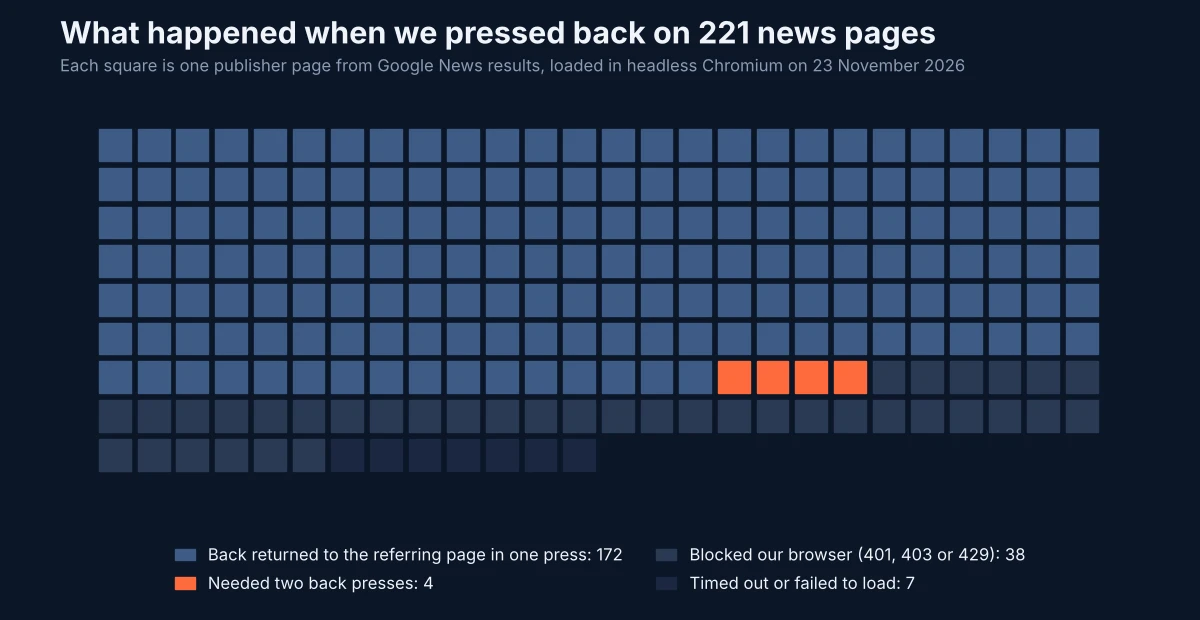
To see how common the behaviour is on pages Google itself surfaces, we loaded one article from each of 221 publishers that appeared in Google News results, pressed back once, and recorded where the browser landed. Of the 176 pages that loaded, 172 returned straight to the page we came from. Four needed a second press, and a fifth page joined them on a repeat run.
What changed
The back button hijacking section in Google's malicious practices policy now carries an FAQ under the main definition. Google answers five questions:
- Advertising code: Some hijacking was caused by third-party ad platforms, Google says, but sites can keep importing code those platforms host. Action is taken only on pages that exhibit the behaviour.
- User reports: Users can flag sites through Google's spam report form.
- Discover: The policy applies to Google Discover, because Google treats Discover as part of Search.
- Non-Search visits: If a visitor arrives from another channel, such as social media, and is hijacked inside a browser, the policy still applies.
- Apps: "Open in app" behaviour, where a site launches an external app that then blocks the return trip, is outside the policy.
We checked the 18 translated versions of the spam policies page Google links from its language menu. None of them carries the new FAQ yet, while all 18 already include the separate site reputation FAQ.
How the policy got here
| Date | Event | Source |
|---|---|---|
| 13 April 2026 | Google announces back button hijacking as an explicit violation of its malicious practices policy | Search Central blog |
| 15 June 2026 | Enforcement begins, two months after the announcement, with manual actions or automated demotions possible | Search Central blog |
| 23 November 2026 | Five-question FAQ added under the policy | Documentation changelog |
In the April announcement, Google said it had seen a rise in the practice and that inserting deceptive or manipulative pages into a visitor's browser history had always been against Search Essentials. The same post already warned that some cases come from "included libraries or advertising platform" code. Today's FAQ goes one step further and spells out that loading ad platform code is not itself the problem.
The FAQ arrives while the November 2026 core update is still rolling out: Google's Search Status Dashboard lists it as starting on 10 November with no end time posted. It also follows Google's change to how its site reputation policy applies in the EEA, another section of the same spam policies page.
Our test: one back press on 221 news pages
We built a list of 221 publisher article pages from Google News results for five broad US queries (celebrity news, recipes, NFL, Black Friday deals and weather forecast), one page per domain. Each page was opened from a neutral starting page in headless Chromium. After the page loaded we pressed the down arrow key three times and scrolled, then pressed back and checked whether the browser had returned to the starting page.
Key findings:
- 176 pages loaded (174 with HTTP 200 and 2 with HTTP 202). 38 refused our automated browser with a 401, 403 or 429 response, and 7 timed out or failed mid-test.
- 172 of the 176 pages (97.7%) returned to the starting page in one back press.
- 4 pages needed two presses. In each case the extra history step pointed at the same article URL, so a reader pressing back would have seen the article again rather than the page they came from.
- Two of the four flagged pages made
history.pushStatecalls from the top-level page during the first run. On the other two the extra entry appeared with no such call, which suggests (this is our inference, not something we could confirm) that an embedded frame such as an ad or video player created it. - 150 of the 176 pages registered a
popstatelistener. That is normal for modern sites and is not evidence of hijacking on its own.
Repeat runs
Because ad-driven behaviour can change from one page load to the next, we ran the four flagged pages twice more, alongside three control pages built on the same newspaper content management system as three of the flagged sites.
| Page | Platform | Run 1 | Run 2 | Run 3 |
|---|---|---|---|---|
| Local news site A | Shared newspaper CMS | 2 presses | 2 presses | 2 presses |
| Local news site B | Shared newspaper CMS | 2 presses | 2 presses | 2 presses |
| Local TV news site C | Shared newspaper CMS | 2 presses | 2 presses | 2 presses |
| Local news site D | Other CMS | 2 presses | 2 presses | 2 presses |
| Control site E | Shared newspaper CMS | 1 press | 2 presses | 2 presses |
| Control site F | Shared newspaper CMS | 1 press | 1 press | 1 press |
| Control site G | Shared newspaper CMS | 1 press | 1 press | 1 press |
All four flagged pages repeated the behaviour on every run, and one control page (E), which had returned cleanly in the first run, needed two presses in both repeat runs. The other two controls on the same platform never did. That pattern points away from the CMS itself and towards something loaded on the page, which is the scenario Google's first FAQ answer describes. We have not named the sites: our test cannot tell whether a page would meet Google's threshold for action, and none of them sent us to an unrelated page or an ad, which is the more aggressive form of hijacking the April post describes.
Why the key press matters
Chrome already defends against some of this behaviour. Under Chromium's history manipulation intervention, history entries a page creates before the visitor interacts with it are marked as skippable, and the browser's back button passes over them. Once the page receives a user activation (a tap, click or key press), its entries are no longer skippable.
That is why our test pressed a key before pressing back. A reader who never taps, clicks or types on the page may never notice a problem, while a reader who taps anything, even to close a cookie banner, can. Site owners who test by loading a page and pressing back straight away can miss the issue entirely.
What this means for SEO teams
- Test with an interaction first. Open a page from another site, tap or press a key on it, then press back. Repeat on mobile and on ad-heavy pages, several times, since our results changed between loads.
- Check history length in the console. Note
history.lengthright after the page loads and again after a minute of reading. A jump without your navigating means something added an entry. - Audit third-party tags rather than removing them wholesale. Google's FAQ says ad platform code is allowed. The fix is to find the specific tag, widget or player creating entries and disable that behaviour or ask the vendor to.
- Do not assume referral traffic is exempt. Google now says the policy applies even when the visitor arrived from social media, so a script that only triggers for social or newsletter visits is still in scope.
- Watch Discover. Discover-heavy publishers should treat this as a Discover risk as well as a Search one. If a manual action does arrive, Google's April post points site owners to a reconsideration request in Search Console after the fix.
Earlier policy and documentation edits are covered in our review of Google Search documentation changes in 2026.
Methodology
On 23 November 2026 we collected article URLs from Google News results (US English) for five queries and kept the first URL per publisher domain, giving 221 pages, which we tested between 17:19 and 17:31 UTC. Each page was loaded in headless Chromium (desktop viewport, 1280 by 900) after first loading a neutral starting page, so the article had a real history entry to return from. After 6 seconds we pressed the down arrow key three times, scrolled 1,500 pixels and waited 5 seconds. We then triggered a back navigation and recorded the URL, repeating up to five times until the starting page returned. A script injected before page load counted pushState and replaceState calls on the top-level page, whether the page had user activation at each call, and popstate listeners. History entries were read from the browser's navigation history. The four pages that needed two presses and three control pages on the same CMS were retested twice more shortly afterwards. Pages that returned 401, 403 or 429, or that timed out, were excluded from the 176 tested. Headless browsers can be served different code than real visitors, so results reflect what our test browser saw.
Conclusion
Google's new FAQ makes the back button hijacking policy easier to act on: ad code is allowed, the behaviour is not, and the rule covers Discover and visitors from other channels. In our test, the problem was rare on pages surfaced in Google News results, but where it appeared it was persistent across reloads and looked more like a side effect of embedded code than a deliberate scheme. The practical lesson is to test the way a real reader behaves: interact with the page first, then press back, more than once.
Questions and answers
What did Google add to its spam policies on 23 November 2026?
Google added a five-question FAQ under the back button hijacking section of the malicious practices policy. It covers third-party ad code, user spam reports, Google Discover, visitors arriving from other channels such as social media, and "open in app" behaviour.
Will Google penalise a site just for using an advertising platform's code?
No. Google's FAQ says site owners can keep importing code hosted by advertising platforms and that it only takes action on pages that exhibit back button hijacking behaviour.
Does the back button hijacking policy apply to Google Discover?
Yes. Google says Discover is part of Google Search, so its spam policies, including this one, apply there.
When did Google start enforcing the back button hijacking policy?
Google announced the policy on 13 April 2026 and said enforcement would begin on 15 June 2026, with possible manual spam actions or automated demotions.
How common was back button hijacking in the SaaS Link Building test?
Of 176 news pages from Google News results that loaded in our headless Chromium test on 23 November 2026, 172 returned to the previous page in one back press. Four needed two presses on every run, and a fifth did so in two repeat runs.
More releases
-
Updates
Google Adds Wallet to AI Mode; 12 of 14 Money AI Overviews Asked for Personal Details
Google is rolling out Google Wallet as a Personal Intelligence source in AI Mode, with Drive and Gemini app context to follow. In 14 logged-out US money searches we ran, every one returned an AI Overview, 12 asked the searcher for personal details, and publishers supplied 23 of 145 citations.
-
Explainers
Google Documents 12 More Crawlers; 31 Top Sites Aim Robots.txt at Bots That Ignore It
Google documented 12 existing crawlers and fetchers on 23 November, including GoogleDocs, pageburst and Chrome-Lighthouse, and moved APIs-Google with a corrected user agent string. All sit outside robots.txt control. Our crawl of 527 top-site robots.txt files found 31 that write rules for such agents anyway.
-
Studies
Does Buying Google Ads Lift Organic Rankings? Advertisers Held 63% of Top-3 Spots
Google says ad spend has no effect on organic results. Our pull of 323 organic results for 40 US commercial searches found Google Ads advertisers held 63% of top-three spots against 51% of positions 7 to 10, but the biggest spender ranked first on only 7 of 38 pages. Verdict: unproven.
Tell us the site and the goals.
Rankings in Google and visibility in AI answers, from one monthly plan. One call is enough to say which one fits. Email works just as well.