Google Adds Wallet to AI Mode; 12 of 14 Money AI Overviews Asked for Personal Details
Google is rolling out Google Wallet as a Personal Intelligence source in AI Mode, with Drive and Gemini app context to follow. In 14 logged-out US money searches we ran, every one returned an AI Overview, 12 asked the searcher for personal details, and publishers supplied 23 of 145 citations.
 Vibhu Dhariwal
Cofounder & CTO, Digital Gratified
- Published
- Section
- Updates
- Reading time
- 7 minutes
Ras Al Khaimah, United Arab Emirates, .
Google on 23 November said it is starting to roll out Google Wallet as a Personal Intelligence source in AI Mode, with Google Drive and a shared context link to the Gemini app to follow in the coming weeks. In the same post, Robby Stein, VP of Product for Google Search, said AI Overviews and AI Mode will show more responses tailored to a user's recent search context.
Wallet is the first financial account Google has added to Personal Intelligence in AI Mode. To see what that could replace, we ran 14 logged-out US searches built around the jobs Google named: spending, card rewards, savings goals and tax preparation. All 14 returned an AI Overview, and 12 of the 14 ended by asking the searcher to share personal details such as income, debts or spending. That is the information a connected Wallet account can now supply without being asked.
What changed
- Google Wallet, rolling out now. Users can opt in to connect Wallet so AI Mode can track spending, map savings milestones and suggest ways to use cash back, travel perks and points on cards linked through Wallet. Google says AI Mode "can't move, manage, or invest your money"; it reads account information only.
- Google Drive, coming weeks. Documents, spreadsheets and PDFs in Drive will feed answers. Google's example is a personalised plan for tax season.
- Gemini app context, coming weeks. Context will be shared between the Gemini app and AI Mode, and users will be able to connect the Gemini app to Personal Intelligence in AI Mode. Search history can already be connected to Personal Intelligence in the Gemini app.
- A Personalization icon, soon. An icon under tailored responses will show which context AI Mode used.
- More personal AI Overviews. Google says both AI Overviews and AI Mode will show more responses tailored to recent searches, so someone planning a trip can pick up a new thread without starting again.
The post does not say which countries, languages, account types or Google AI plans get the Wallet connection, and Google published no usage figures.
Ten months from Gmail to Wallet
Personal Intelligence began in the Gemini app and reached Search eight days later. Each step since has widened either the audience or the data:
| Date | Product | What Google announced | Personal data sources named |
|---|---|---|---|
| 14 Jan 2026 | Gemini app | US beta for eligible Google AI Pro and AI Ultra subscribers | Gmail, Google Photos, YouTube, Search |
| 22 Jan 2026 | AI Mode in Search | US, English, AI Pro and AI Ultra subscribers, as a Labs experiment | Gmail, Google Photos |
| 17 Mar 2026 | AI Mode, Gemini app, Gemini in Chrome | Wider US rollout; Gemini app and Chrome versions start reaching free-tier users | Gmail, Google Photos "and more" |
| 23 Nov 2026 | AI Mode in Search | Wallet rolling out; Drive and Gemini app context in the coming weeks | Gmail, Calendar, Photos, Wallet; Drive and Gemini app next |
Source: Google's announcements of Personal Intelligence in the Gemini app (14 January), Personal Intelligence in AI Mode (22 January), the US expansion (17 March) and the 23 November post linked above.
Throughout, Google has said the connected experiences are for personal Google accounts, not Workspace business, enterprise or education users.
The help pages still list three apps
We downloaded three Google Search Help pages late on 23 November (UTC): Personal Intelligence in AI Mode, connecting Google content apps to Search and the main AI Mode help page. None of the three mentions Wallet or connecting the Gemini app. All three name Gmail, Google Calendar and Google Photos as the apps that can be connected, and the content apps page adds that other Workspace apps are "coming soon".
Drive appears twice, but not as a Personal Intelligence source. The AI Mode page mentions it as a place to upload files from, and the content apps page names it in a statement that Search services do not train generative AI models directly on Drive, Gmail or Calendar content. The pages say personalisation is limited to users aged 18 or older with history and personalised recommendations turned on. This is the same lag we found on 21 November, when Google's Connected Apps help page listed none of eight new partners.
What AI Overviews cite for these questions today
Personalised answers matter to publishers because of what they could stand in for. In our 14 searches, the AI Overviews cited 145 distinct sources. Only 23 of them (15.9%) were publishers and media outlets. Banks, card issuers, credit unions and other finance firms supplied 43, government sites 11, and video and social platforms 55, most of them YouTube.
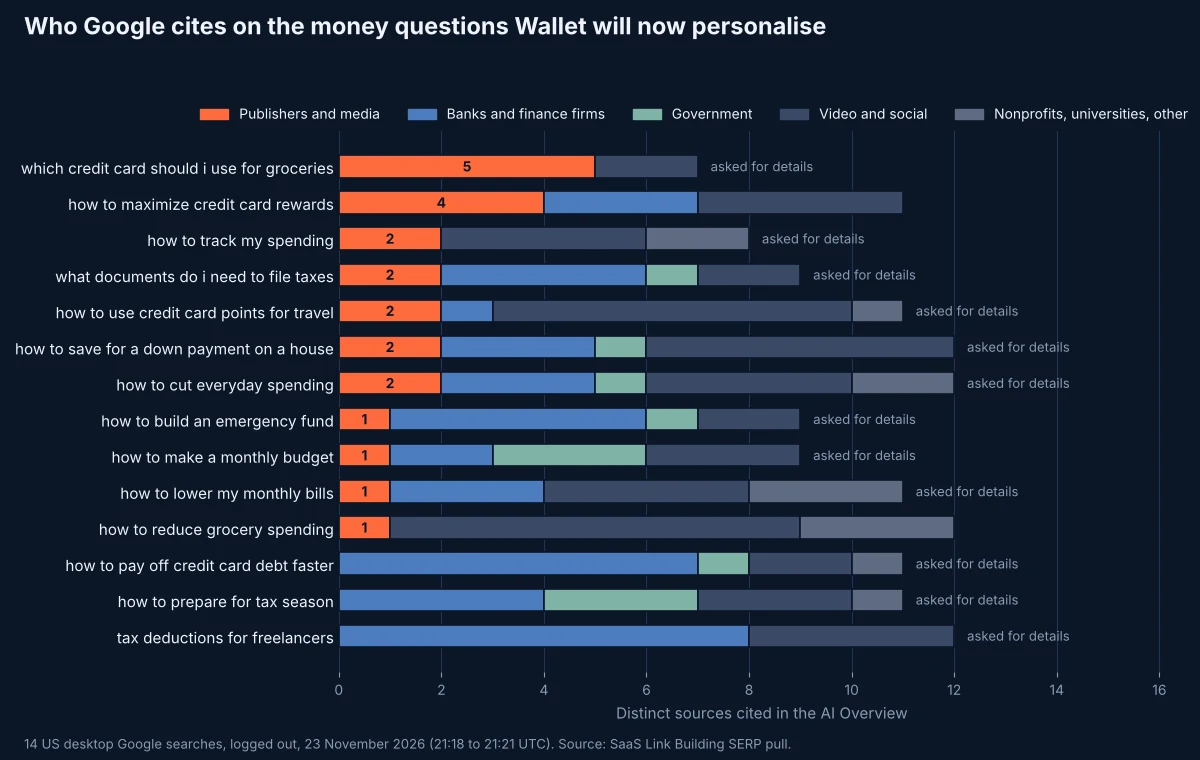
The closing lines were the clearest signal. On 12 of the 14 searches, the AI Overview finished with an offer to tailor its answer if the searcher shared more: "total debt, approximate APRs" on credit card payoff, "monthly take-home income and main monthly bills" on budgeting, and W-2 versus self-employed status on tax documents. Only the card rewards and grocery spending overviews ended without one.
Logged out, those questions go unanswered or the searcher types the details in. With Wallet connected, Google says AI Mode can read that account information itself. Google has not said how that changes which pages are cited or how many links a personalised answer shows, so the effect on publisher clicks is not yet measurable.
What this means for SEO teams
- Expect more variance in money SERPs. If AI Overviews lean on recent searches and connected accounts, two users with the same query may see different answers. Logged-out rank tracking, already strained by altered results served to trackers, will describe less of what signed-in users see, so treat AI Overview citation reports as a baseline rather than a full picture.
- Write for the generic layer. Personal data replaces the "it depends on your situation" part of an answer, not the rules, rates and definitions behind it. Pages that state fees, thresholds, eligibility and deadlines plainly remain what a model needs to cite.
- Watch the Personalization icon. When it ships, it should show whether an answer drew on Wallet, Drive or search history. Check it on your priority queries while signed in, and record which responses still cite your pages.
- Brief finance and tax clients now. Banks, issuers and tax firms already supplied 43 of the 145 citations in our pull. Their own help content competes with publishers for the generic layer, and Google is already adding Experian and H&R Block to Search as Connected Apps.
- Plan for ads. We reported in October that Google was testing ads in AI Mode for Personal Intelligence users. Wallet adds spending data to the context those users carry.
Methodology
On 23 November 2026, between 21:18 and 21:21 UTC, we pulled Google desktop results for 14 English-language queries from a US location through a SERP API, logged out and unpersonalised, with the AI Overview loaded. Queries were written to match the uses Google named for Wallet and Drive: tracking and cutting spending, card rewards, savings goals, debt payoff and tax preparation. For each AI Overview we counted distinct cited sources (the same source name and URL counted once per search) and grouped them by the source name the result reported: publishers and media; banks, card issuers and credit unions; investment, tax and credit firms; government sites; video and social platforms; and nonprofits, universities and other sites. We counted an overview as asking for personal details when its final passage invited the searcher to share their own financial information. Separately, at about 21:19 UTC, we downloaded the three Google Search Help pages linked above and searched their text for Wallet, Drive, Calendar, Gmail, Photos and the Gemini app. The SERP pull is one snapshot from one location and will vary by user, device and time.
Conclusion
Wallet turns AI Mode's Personal Intelligence from a calendar and inbox assistant into one that can read a user's spending. In the money searches we pulled, Google's logged-out AI Overviews already cited publishers for fewer than one in six sources and asked for personal details in 12 of 14 answers. Those are the gaps connected accounts are built to fill.
Google's own help pages have not caught up, its post gives no availability details, and the Personalization icon that would show what data shaped an answer has not shipped. Until it does, SEO teams have no direct way to see when a personalised answer has replaced a cited one.
Questions and answers
What did Google add to AI Mode on 23 November 2026?
Google said it is starting to roll out Google Wallet as an opt-in Personal Intelligence source in AI Mode, with Google Drive and context sharing with the Gemini app following in the coming weeks. Gmail, Calendar and Photos were already connectable.
Can AI Mode make payments or move money through Google Wallet?
No. Google's announcement says that if a user connects Wallet, AI Mode can only read information from their accounts and cannot move, manage or invest their money.
Will AI Overviews become more personalised too?
Yes, according to Google. Its 23 November post says users will start seeing more personally relevant responses in both AI Overviews and AI Mode, tailored to their recent search context.
Who can use Personal Intelligence in AI Mode?
Google's help pages say AI Mode personalisation is available to users aged 18 or older who have history and personalised recommendations turned on. Google has said the connected experiences are for personal Google accounts, not Workspace business, enterprise or education accounts. The 23 November post does not list countries or plans for the Wallet connection.
How can users see what personal data shaped an AI Mode answer?
Google says a Personalization icon will soon appear below tailored responses to show the context AI Mode used. Users can also turn app connections on or off, or adjust personalisation in Search settings.
More releases
-
Updates
Google Adds Back Button Hijacking FAQ; 5 of 176 News Pages Needed Two Back Presses
Google added a five-question FAQ to its back button hijacking spam policy on 23 November, saying ad platform code is allowed and the rule covers Discover and visits from social media. In our test of 176 news pages from Google News results, 5 sent readers back to the same article before letting them leave.
-
Explainers
Google Documents 12 More Crawlers; 31 Top Sites Aim Robots.txt at Bots That Ignore It
Google documented 12 existing crawlers and fetchers on 23 November, including GoogleDocs, pageburst and Chrome-Lighthouse, and moved APIs-Google with a corrected user agent string. All sit outside robots.txt control. Our crawl of 527 top-site robots.txt files found 31 that write rules for such agents anyway.
-
Studies
Does Buying Google Ads Lift Organic Rankings? Advertisers Held 63% of Top-3 Spots
Google says ad spend has no effect on organic results. Our pull of 323 organic results for 40 US commercial searches found Google Ads advertisers held 63% of top-three spots against 51% of positions 7 to 10, but the biggest spender ranked first on only 7 of 38 pages. Verdict: unproven.
Tell us the site and the goals.
Rankings in Google and visibility in AI answers, from one monthly plan. One call is enough to say which one fits. Email works just as well.