Does Buying Google Ads Lift Organic Rankings? Advertisers Held 63% of Top-3 Spots
Google says ad spend has no effect on organic results. Our pull of 323 organic results for 40 US commercial searches found Google Ads advertisers held 63% of top-three spots against 51% of positions 7 to 10, but the biggest spender ranked first on only 7 of 38 pages. Verdict: unproven.
 Vibhu Dhariwal
Cofounder & CTO, Digital Gratified
- Published
- Section
- Studies
- Reading time
- 13 minutes
Ras Al Khaimah, United Arab Emirates, .
Google has said for years that paying for search ads does nothing for a site's organic rankings. Its Google Ads help centre states that "Google's search results are independent of Google's advertising programs." Plenty of marketers still suspect otherwise, and the suspicion got fresh fuel when internal emails at the US antitrust trial showed Google's search and ads leaders arguing over query growth. To test the theory against live results, we pulled 40 US commercial Google searches on 23 November 2026 and checked every organic result against a database of US Google paid search results. Domains that buy Google Ads did rank higher on average, but the pattern is small, uneven and explained at least as well by who those domains are as by what they spend.
This investigation sets out the theory, the evidence for and against it, and our verdict.
Key findings
- Of 323 non-Google organic results across 40 searches, 186 (57.6%) came from domains with at least one keyword in our database of US Google paid results.
- Those advertisers took 74 of 117 (63.2%) top-three spots, against 47 of 93 (50.5%) of spots in positions 7 to 10. They held first place on 25 of 39 searches where a non-Google site ranked first.
- Within the same search, advertisers ranked an average of 0.78 positions higher than non-advertisers. A shuffle test within each search put the chance of a gap that large arising at random at under 1%.
- The pattern held in 7 of 8 verticals, but the advertiser share of top-three spots, tested on its own, fell short of conventional significance (p = 0.071), and the home services vertical ran the other way.
- On the 38 pages where at least one domain had estimated paid traffic, the biggest paid spender ranked first on only 7. Fourteen first-place results went to domains with no paid keywords in our database, including Duolingo for "learn spanish online" and Runner's World for "running shoes".
- Paid and organic size moved together (rank correlation 0.63), which is the strongest reason to doubt that ads cause the gap.
The theory: ad money buys organic goodwill
The belief takes two forms. The blunt version says Google quietly rewards its paying customers in the free results, either deliberately or because ad spend is somehow visible to ranking systems. The softer version says ads help organic rankings indirectly: a brand that advertises heavily gets more people searching for it by name, clicking its results and linking to it, and those signals feed the organic algorithm.
Some site owners also suspect the reverse: in the 2021 case discussed below, a site owner asked Google whether launching ads had hurt his organic rankings.
The question matters because the answer changes budgets. If ads lift organic rankings, cutting paid search has a hidden organic cost. If they do not, the two channels should be judged on their own returns.
The evidence for
Trial emails showed the ads side pressing on search
The strongest documentary evidence for the theory is about influence rather than rankings. During the US Justice Department's antitrust trial in 2023, emails showed that Google declared a "Code Yellow" in early 2019 over fears it would miss its search revenue target for the quarter. According to Bloomberg's report on the exhibits, republished by Tech Xplore, engineers from search and Chrome were moved onto the problem for seven weeks, and the then head of search, Ben Gomes, wrote that his team was "getting too close to the money." Prabhakar Raghavan, then head of ads, had pressed for a meeting over what he called continuing softness in queries.
Those emails show revenue pressure on the search team. They do not show that any ranking change favoured advertisers, and the same report notes that Gomes testified he was frustrated when he wrote them and that the two executives settled on a new query metric. Google's spokesperson told Bloomberg that its ads systems do not affect organic results.
A plausible indirect route through clicks and brand demand
Speculation, clearly labelled: the indirect version of the theory has a mechanism Google itself has partly confirmed. Trial testimony and documents described Google using click data in ranking, which we examined in our investigation into whether Google uses clicks to rank pages. If advertising raises the number of people who search for a brand by name and click its organic listing, those clicks could in principle strengthen the brand's organic standing. Nothing we found shows Google measuring or rewarding ad spend directly, and the same effect would come from television, sponsorship or any other brand marketing.
In our data, advertisers ranked a little higher
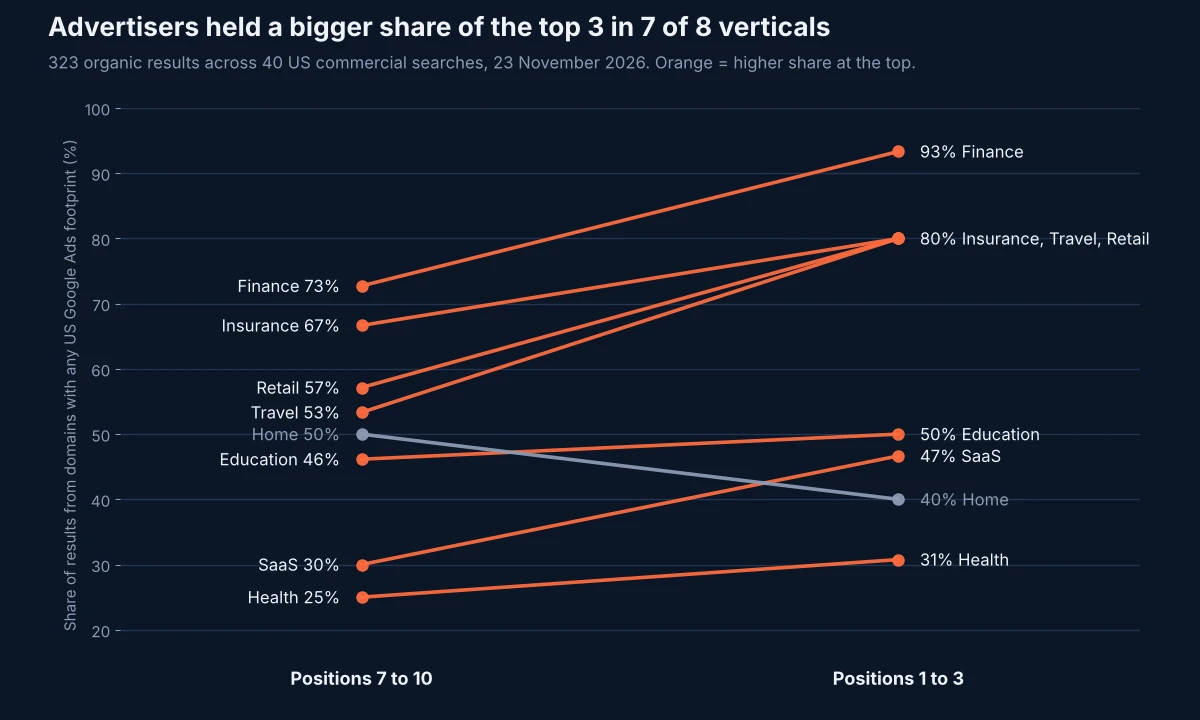
Our pull found a consistent tilt toward advertisers at the top of the page. Across all 40 searches, the share of results from domains with a paid footprint fell from 63.2% in positions 1 to 3 to 57.5% in positions 4 to 6 and 50.5% in positions 7 to 10.
The tilt survived a stricter definition of "advertiser". When we counted only domains with at least 10 paid keywords, their share fell from 42.7% of top-three spots to 28.0% of positions 7 to 10. With a threshold of 100 paid keywords, only 31 results qualified, but they still averaged position 4.10 against 4.81 for everyone else.
| Advertiser definition | Results counted as advertisers | Share of top 3 | Share of positions 7 to 10 | Average position: advertisers vs others |
|---|---|---|---|---|
| 1 or more paid keywords | 186 of 323 | 63.2% | 50.5% | 4.47 vs 5.10 |
| 10 or more paid keywords | 116 of 323 | 42.7% | 28.0% | 4.32 vs 4.98 |
| 100 or more paid keywords | 31 of 323 | 12.8% | 6.5% | 4.10 vs 4.81 |
We also checked whether the gap was simply bigger sites outranking smaller ones. We split the 323 results into thirds by each domain's estimated US organic traffic. Advertisers ranked higher than non-advertisers in all three bands, most clearly among the smallest sites, where 24 advertiser results averaged position 4.04 against 5.18 for 84 non-advertiser results.
| Organic size band (estimated monthly US organic visits) | Advertiser results (average position) | Non-advertiser results (average position) |
|---|---|---|
| Smallest third (up to about 99,000) | 24 (4.04) | 84 (5.18) |
| Middle third (about 99,000 to 1.8 million) | 70 (4.56) | 38 (4.74) |
| Largest third (above about 1.8 million) | 92 (4.52) | 15 (5.60) |
Finally, we compared advertisers and non-advertisers inside each search, so that differences between topics could not drive the result. On 25 of the 39 searches where both groups appeared, advertisers had the better average position, with a mean gap of 0.78 places. When we shuffled the advertiser labels at random within each search 5,000 times, a gap that large or larger appeared in under 1% of shuffles.
The evidence against
Google has denied it in writing, repeatedly
Google's denials are specific. Its Google Ads help page for new advertisers says running online ads has no impact on where a site appears in organic results, and that paying for a click does not change the organic results that searcher sees (Google Ads Help). Google's How Search Works page on its approach goes further, saying Search gives "no special treatment such as ranking boosts" for reasons that include advertising or unrelated business partnerships. In a May 2021 Search Central office-hours video, John Mueller told a site owner that removing ads would not help organic rankings because, in a transcript published by Search Engine Roundtable, "the systems are completely separate."
These are statements of policy, not proof. But they are on the record, repeated across Google's ads and search properties, and the trial reporting we reviewed for this piece does not contradict them.
Google's own research shows ads and organic often do not overlap
A March 2012 Google research post summarising 390 "search ads pause" studies found that, on average, 66% of ad clicks happened with no organic result from the same advertiser on the first page. When an advertiser did rank first organically, half of its ad clicks were still incremental; at organic positions 5 and below, 96% were. Google has a commercial interest in showing that ads add traffic. Even so, its data shows that most ad clicks came on searches where the advertiser had no first-page organic listing, which is hard to square with ads buying organic visibility.
The advertisers are usually the companies the searcher is looking for
The biggest problem with reading our data as proof is the identity of the advertisers. For "car insurance quotes", "personal loans", "car rental" and "cruise deals", the organic results were dominated by insurers, lenders, rental firms and cruise lines: the businesses that sell the thing being searched for. Those businesses advertise because they sell it, and they rank because their pages are the most direct answer. Our data cannot separate the two. In finance, 14 of 15 top-three results came from advertisers, but so did 8 of 11 results in positions 7 to 10.
Paid and organic size were also closely linked. Across the 323 results, a domain's estimated paid traffic and its estimated organic traffic had a rank correlation of 0.63. Paid traffic tracked position a little more than organic traffic did (correlations of -0.135 and -0.066 respectively, where negative means a better position), but both relationships were weak.
The biggest spenders did not win
If ad money bought organic positions, the heaviest spender on each page should rank near the top. It did not. Counting the 38 pages where at least one domain had estimated paid traffic, the domain with the most ranked first on only 7 and ranked seventh or lower on 11. Of the 39 first-place results from non-Google sites, 14 went to domains with no paid keywords in our database, including Duolingo for "learn spanish online", Runner's World for "running shoes", Policygenius for "life insurance quotes" and Teamwork for "project management software".
The vertical pattern was also inconsistent. Home services ran backwards, with advertisers holding 40% of top-three spots against 50% lower down, and education and health showed gaps of only four to six percentage points. Tested on its own, the advertiser share of top-three spots across all searches fell short of conventional statistical significance (p = 0.071 in our shuffle test).
That fits our earlier test of whether Google favours big brands, where YouTube and Reddit together held 18.2% of 324 listings.
The verdict: unproven
Direct influence of ad spend on organic rankings: unproven, and unlikely. Google denies it in its ads documentation, its search policy pages and on camera. Its own research found that most ad clicks came on searches where the advertiser had no first-page organic listing. In our data, the largest spender on a page rarely ranked first, and a third of first-place results went to sites with no paid keywords in our database.
A correlation between advertising and better organic positions: confirmed in our sample. Advertisers held more of the top three than of the bottom of page one, inside the same searches and within each band of organic size. That gap is real enough not to be dismissed as noise.
The most consistent reading is that the companies with the most commercial relevance to a query both buy ads for it and earn organic positions for it. An indirect effect through brand demand and clicks is possible, but it is unmeasured, and it would apply to any marketing that makes people search for a brand by name. The 2019 trial emails show the ads business pressing the search team on growth, which is a governance concern, but they contain no evidence that rankings were adjusted for advertisers.
What this means for SEO teams
- Do not keep a campaign running to protect rankings. Nothing in Google's statements, its research or our data suggests that pausing ads will cost organic positions directly. Judge paid search on its own return.
- Test the indirect effect on your own site before believing it. If you pause or cut a campaign, track impressions and clicks for queries containing your brand name in Search Console for the following weeks. A fall in branded demand, not a ranking penalty, is the mechanism worth watching.
- Use paid data to find organic gaps. Google's 2012 research found most ad clicks came with no organic result from the same advertiser on page one. Pull the queries where you pay but do not rank, and treat them as an organic content backlog.
- Expect competitors that sell the product to hold the top spots. In commercial searches, merchants and providers dominated both groups. A small publisher competing on "car insurance quotes" faces relevance, not a pay-to-play filter.
- Keep the click signal in mind. Trial evidence indicates that the pages people click on matter. Clear titles and pages that answer the query help organic results whether or not you advertise. Our analysis of site-level quality signals covers how those effects may build across a domain.
Methodology
On 23 November 2026 we collected Google's US English organic results (location: United States, desktop) for 40 commercial searches through a SERP API, recording the position and URL of each organic result. The searches were split into eight verticals of five: SaaS, finance, insurance, travel, retail, education, home services and health. Examples include "crm software", "high yield savings account", "pet insurance", "cruise deals", "standing desk", "online mba", "home warranty" and "hearing aids". The API returned between 6 and 10 organic results per search, 337 in total. We excluded 14 results from Google's own properties (google.com and youtube.com), leaving 323 results from 266 unique domains. Positions are Google's original organic slots; removing a Google or YouTube result did not renumber the results below it. Ads, AI Overviews and other SERP features were not counted as organic results.
Each result's hostname was reduced to its registrable domain (for example, mwg.aaa.com became aaa.com). For each domain we then retrieved estimated US Google organic and paid traffic, and the count of paid keywords, from a third-party database of US Google search results, on the same day. A domain was counted as an advertiser if the database showed at least one US Google paid keyword for it; we repeated the analysis with thresholds of 10 and 100 paid keywords. The database estimates ad presence from observed results, so it can miss advertisers, especially those that bid on few or local keywords, and it does not show whether a domain advertised on the specific search we pulled.
Significance was tested with a permutation test: we shuffled advertiser labels within each search 5,000 times and counted how often the shuffled data produced a gap at least as large as the observed one. Rank correlations are Spearman coefficients. A single snapshot of 40 searches is a small sample, and the results show direction rather than precise effect sizes.
Conclusion
Advertisers did rank a little higher in Google's organic results in our 40-search sample, and the gap held within searches and across organic size bands. That is enough to explain why so many marketers believe the theory. It is not enough to prove it. The businesses that buy ads for a query are usually the businesses that sell what the query asks for, the biggest spenders rarely took first place, and Google's written policy, its own research and a Google Search Advocate on camera all point the other way. Until someone produces evidence that ranking systems can see ad spend, the safer assumption is that relevance drives both.
Google's search revenue rose 12% year on year in the third quarter but was nearly flat on the second quarter as ads spread into AI Mode, as our report on Google's Q3 2026 search revenue noted, so the question of where ads end and organic results begin will not go away.
What do you think?
Have you paused or sharply cut a Google Ads campaign and tracked your organic rankings and branded search clicks in Search Console afterwards? Share what changed, how long it took and which vertical you work in.
Questions and answers
Does running Google Ads improve organic rankings?
Google says no. Its Google Ads help centre states that running online ads has no impact on where a site appears in organic search results, and its How Search Works pages say Search does not give ranking boosts for advertising. Our 40-search test found advertisers ranked slightly higher on average, but the pattern is explained at least as well by the fact that advertisers usually sell what the searcher wants.
Will pausing Google Ads hurt my SEO?
There is no evidence that pausing ads lowers organic rankings directly. In a May 2021 office-hours video, Google's John Mueller said ads and organic rankings are separate systems. Any indirect effect would come through lower brand demand, so track queries containing your brand name in Search Console after a pause.
What was Google's 2019 Code Yellow?
According to a Bloomberg report on US antitrust trial exhibits, Google declared a Code Yellow in early 2019 over fears it would miss a quarterly search revenue target, and moved search and Chrome engineers onto the problem for seven weeks. The emails show revenue pressure on the search team, not ranking changes for advertisers.
Do advertisers usually also rank organically?
Often not. A March 2012 Google research post covering 390 search ads pause studies found that 66% of ad clicks occurred with no organic result from the same advertiser on the first page.
More releases
-
Industry news
Google Search Profiles Reportedly Reach Spain; 12 of 16 Google Pages Still Say US Only
Google Search profiles appear to be opening in Spain, Australia and other markets without an announcement, according to weekend reports. Our check of Google's own pages on 23 November found all 43 help centre translations list only Canada, India and the US, and 12 of 16 creators.google editions still say profiles are US only.
-
Updates
Google's AI Mode Temporary Threads Last 24 Hours; Repeat Answers Shared 11 of 28 Sources
Google's new AI Mode temporary threads skip history and personalization, and its help page, not the launch post, says they disappear after 24 hours and still leave site and analytics tracking in place. Our signed-out repeat test found only 11 of 28 cited domains survived a second pass.
-
Studies
Google Site Kit Adds Newsletter Sign-Ups; 119 of 231 Top Sites Updated Within 6 Days
Google's Site Kit 1.192.0, released on 16 November, lets WordPress sites set up Reader Revenue Manager newsletter sign-ups. Our crawl of the top 50,000 domains six days later found 251 Site Kit sites: 51.5% of those showing a version had updated, against 39.4% of all installs, and just 6 load Reader Revenue Manager.
Tell us the site and the goals.
Rankings in Google and visibility in AI answers, from one monthly plan. One call is enough to say which one fits. Email works just as well.