Google Site Kit Adds Newsletter Sign-Ups; 119 of 231 Top Sites Updated Within 6 Days
Google's Site Kit 1.192.0, released on 16 November, lets WordPress sites set up Reader Revenue Manager newsletter sign-ups. Our crawl of the top 50,000 domains six days later found 251 Site Kit sites: 51.5% of those showing a version had updated, against 39.4% of all installs, and just 6 load Reader Revenue Manager.
 Vibhu Dhariwal
Cofounder & CTO, Digital Gratified
- Published
- Section
- Studies
- Reading time
- 8 minutes
Ras Al Khaimah, United Arab Emirates, .
Google released version 1.192.0 of Site Kit by Google, its official WordPress plugin for Search Console, Analytics and AdSense data, on 16 November. The release lets site owners switch on Reader Revenue Manager newsletter sign-ups from the plugin's Feature Discovery Hub. To see how quickly the biggest sites took the update, we crawled the homepages of the top 50,000 domains on the Tranco list on 22 November, six days after the release. We found 251 sites running Site Kit. Of the 231 that print a version number, 119 (51.5%) were already on 1.192.0. That is well ahead of the 39.4% share for all active installs on WordPress.org.
Key findings
- 251 of the 3,681 WordPress homepages we could identify among the top 50,000 domains (6.8%) carry Site Kit's generator tag or its snippet comments.
- 119 of 231 version-tagged Site Kit sites (51.5%) ran 1.192.0 six days after release. Another 40 (17.3%) ran 1.191.0, the release from two weeks earlier.
- The fastest group was the top 10,000 domains: 26 of 37 version-tagged sites (70%) were already on 1.192.0.
- 46 sites were at least five releases (about ten weeks) behind. 12 ran a version at least a year old, and the oldest was 1.45.0.
- Only 6 of the 251 Site Kit sites loaded Google's Reader Revenue Manager script, the system behind the new newsletter sign-up feature.
What changed in Site Kit 1.192.0
The plugin's changelog lists 36 items for 1.192.0. Most of the new work is in Reader Revenue Manager. Site owners can now set up the newsletter sign-up feature from the Feature Discovery Hub, and express setup gains a survey preview and a screen for reusing an existing call to action. If the owner turns on "Require consent before signing up" during setup, the form now enforces reader consent. Survey triggers were also added.
The release adds a "Recent activity" view to the dashboard and the Traffic card, plus error and "gathering data" states for a feature the changelog calls Fresh Data. It also adds shared interface pieces for AI-generated content: an AI icon, an AI disclosure line and AI text styling. The changelog does not say which feature will use them.
The newsletter form itself is a Reader Revenue Manager call to action. Google's Publisher Center help page describes it this way: readers can sign up with "Continue with Google" or by typing an email address. Publishers can ask for first and last names and add an optional or required consent checkbox. The unified sign-up interface cannot be switched off. Reader Revenue Manager is a Publisher Center product. Google's getting started page says engagement features such as newsletter sign-ups are available even in some countries where payments are not, and that a publication must first be added in Publisher Center.
How fast sites updated
Site Kit ships on a steady two-week cycle. The plugin's release tags in the WordPress.org repository show 23 releases in 2026, from 1.170.0 on 12 January to 1.192.0 on 16 November, almost all published on a Monday. WordPress.org's daily download counts show how much of the install base updates automatically: 1,965,580 downloads on 17 November, the day after 1.192.0 went out, compared with 48,212 the day before. WordPress.org lists the plugin at more than 5 million active installations.
The chart compares our crawl with the version breakdown on the plugin's WordPress.org advanced page, which we read on the same day.
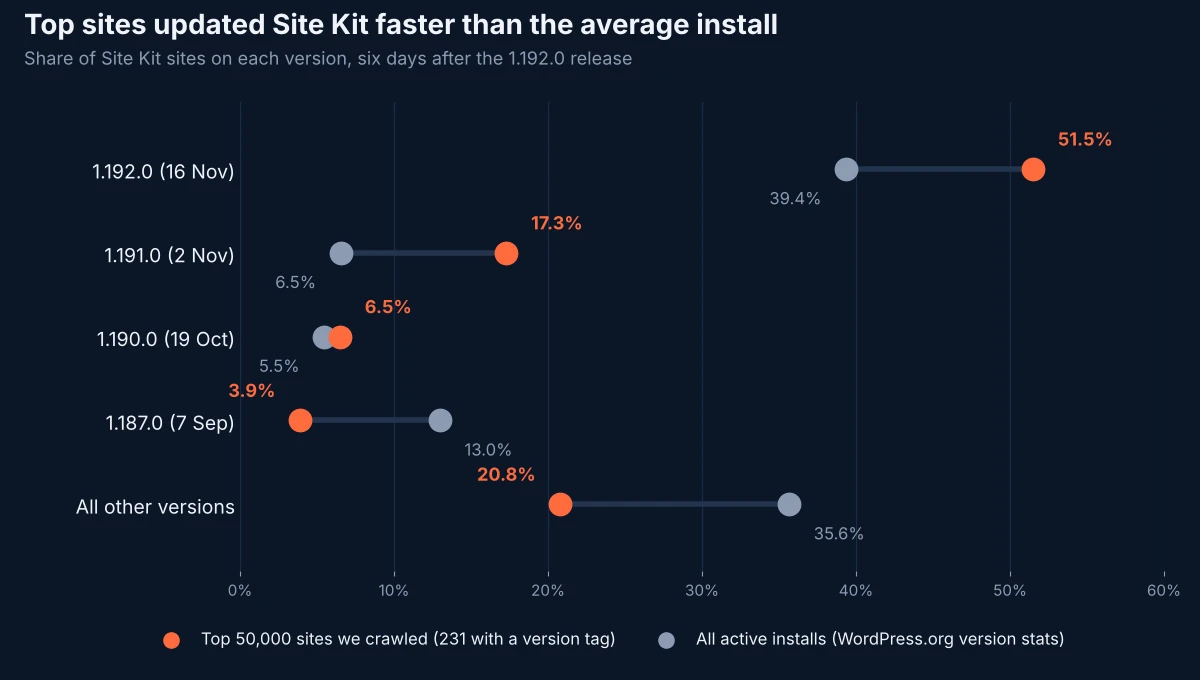
The biggest gap is version 1.187.0, released on 7 September. It holds 13.0% of all active installs on WordPress.org but only 3.9% of the top sites we found. We found no stated reason why so many installs stopped at that release. Version 1.188.0 lists the same WordPress and PHP minimums (WordPress 5.2, PHP 7.4) as 1.187.0, so the plugin's stated requirements did not change between the two.
Update speed by site rank
| Tranco rank band | WordPress homepages | Site Kit sites | Version-tagged | On 1.192.0 |
|---|---|---|---|---|
| 1 to 10,000 | 593 | 38 | 37 | 26 (70%) |
| 10,001 to 25,000 | 1,144 | 67 | 59 | 25 (42%) |
| 25,001 to 50,000 | 1,944 | 146 | 135 | 68 (50%) |
| Total | 3,681 | 251 | 231 | 119 (51.5%) |
Source: our crawl of Tranco top 50,000 homepages, 22 November. "Version-tagged" means the page printed Site Kit's generator meta tag with a version number.
The middle band updated more slowly than the sites on either side of it. With 59 tagged sites in that band, a handful of slow updaters shifts the share by several points, so we would not read much into the difference between the lower two bands. The top band is clearer: 26 of 37 sites updated within six days.
What Site Kit is doing on these sites
Site Kit leaves HTML comments around the tags it places, which shows which Google products each site has connected. On the 251 Site Kit homepages, we found the following English-language comments:
- Google tag (gtag.js) or Google Analytics snippet: 191 sites
- Google Tag Manager container: 37 sites
- Consent mode dataLayer: 34 sites
- AdSense meta tags: 26 sites, with the AdSense snippet itself on 9
- Google Ads snippet: 9 sites
46 sites carried the generator tag but no English snippet comment. Some may use Site Kit only for Search Console data, which needs no tag on the page. Others print the comments in another language. One Brazilian site, for example, labels its Analytics snippet in Portuguese.
For SEO teams, the Analytics count is the most useful number. On roughly three in four Site Kit sites we found, the plugin itself places the Google tag. That matters as Google changes how its tags work. We covered Google's move to treat Google tags as Tag Manager containers earlier this month.
The newsletter feature starts from a small base
Across all 26,433 unique homepages that returned a page, 102 loaded a Reader Revenue Manager script (swg-basic.js, or any script under news.google.com/swg/). Of those, 59 were WordPress sites and only 6 also ran Site Kit. Putting the newsletter setup inside Site Kit gives Google a way to reach publishers who have never opened Publisher Center. Among the biggest WordPress sites, almost none use the feature yet. Our earlier study of preferred source buttons on Google News sites found a similarly slow uptake for another reader-facing Google feature.
What this means for SEO teams
- Check which version you run. View your homepage source and look for the "Site Kit by Google" generator tag. If it is more than two releases behind, find out whether auto-updates are off and whether that was deliberate.
- Know which tags Site Kit owns. If Site Kit places your Google tag and a tag manager also fires one, you can double-count page views. The HTML comments show which plugin placed each tag.
- Treat the newsletter form as a Publisher Center product. The sign-up form, consent text and data fields are set in Reader Revenue Manager. Review the consent wording before you switch it on, especially if you must comply with GDPR or similar rules.
- Plan updates for the two-week cycle. With a release roughly every second Monday, sites that update by hand fall a month behind after two missed cycles. Our WordPress 7.1.5 patch-rate study found a similar split between fast and slow updaters for core security releases.
Methodology
On 22 November 2026, between 21:19 and 21:39 UTC, we requested the homepage of each of the top 50,000 domains on the daily Tranco list, trying https://domain/ and then https://www.domain/. We used a desktop Chrome user agent, followed up to six redirects and read up to 1.5 MB of HTML per page. 28,162 domains returned HTTP 200. We merged domains that redirected to the same final host and kept the best-ranked one, which left 26,433 unique homepages.
We counted a page as WordPress if its HTML referenced /wp-content/ or /wp-includes/, or carried a WordPress generator tag (3,681 homepages). We counted it as Site Kit if it carried a "Site Kit by Google" generator meta tag or an HTML comment containing "added by Site Kit" (251). Versions come from the generator tag, which 231 sites printed. Snippet types come from English-language Site Kit comments only, so the module counts are a floor. The Reader Revenue Manager count looks for swg-basic.js or any script under news.google.com/swg/, whatever placed it.
We took release dates from the plugin's SVN tag history, and version shares, download counts and install counts from WordPress.org's public plugin statistics, all read on 22 November. Homepages that blocked our requests or hid their generator tags are not counted, so the true number of Site Kit sites in the top 50,000 is likely higher than 251.
Conclusion
Site Kit 1.192.0 makes Google's Reader Revenue Manager newsletter sign-ups a setup option inside the plugin that more than 5 million WordPress sites use to connect Search Console and Analytics. The largest sites updated quickly: just over half of the top-50,000 sites we could version were on the new release within six days, against 39.4% of all installs. Use of the newsletter feature is another matter. Only 6 of 251 Site Kit sites loaded Reader Revenue Manager at all. The next releases will show whether a setup button inside the plugin changes that.
Questions and answers
When was Site Kit 1.192.0 released?
Site Kit 1.192.0 was tagged on WordPress.org on 16 November 2026, two weeks after 1.191.0 on 2 November. The plugin's release history shows 23 releases in 2026.
What does Site Kit 1.192.0 add?
According to the plugin changelog, it lets site owners set up the Reader Revenue Manager newsletter sign-up feature from the Feature Discovery Hub, enforces reader consent when that option is turned on, adds survey triggers and a Recent activity view, and adds shared components for AI-generated content.
How many top sites use Site Kit?
Our 22 November crawl of the Tranco top 50,000 domains found Site Kit on 251 of 3,681 identifiable WordPress homepages (6.8%). Sites that blocked our requests or hide the generator tag are not counted.
How quickly did sites update to Site Kit 1.192.0?
Six days after release, 119 of 231 version-tagged Site Kit sites in our crawl (51.5%) ran 1.192.0. WordPress.org's version statistics put the share across all active installs at 39.36%.
What is the Reader Revenue Manager newsletter sign-up?
It is a call to action set up in Google's Publisher Center. Readers can sign up with Continue with Google or an email address, and publishers can request names and add an optional or required consent checkbox.
More releases
-
Studies
Does Buying Google Ads Lift Organic Rankings? Advertisers Held 63% of Top-3 Spots
Google says ad spend has no effect on organic results. Our pull of 323 organic results for 40 US commercial searches found Google Ads advertisers held 63% of top-three spots against 51% of positions 7 to 10, but the biggest spender ranked first on only 7 of 38 pages. Verdict: unproven.
-
Industry news
Google Search Profiles Reportedly Reach Spain; 12 of 16 Google Pages Still Say US Only
Google Search profiles appear to be opening in Spain, Australia and other markets without an announcement, according to weekend reports. Our check of Google's own pages on 23 November found all 43 help centre translations list only Canada, India and the US, and 12 of 16 creators.google editions still say profiles are US only.
-
Updates
Google's AI Mode Temporary Threads Last 24 Hours; Repeat Answers Shared 11 of 28 Sources
Google's new AI Mode temporary threads skip history and personalization, and its help page, not the launch post, says they disappear after 24 hours and still leave site and analytics tracking in place. Our signed-out repeat test found only 11 of 28 cited domains survived a second pass.
Tell us the site and the goals.
Rankings in Google and visibility in AI answers, from one monthly plan. One call is enough to say which one fits. Email works just as well.