WordPress 7.1.5 Fixes 18 Flaws; 64% of 400 Top-Site Installs Patched Within 60 Hours
WordPress released security update 7.1.5 on 18 November, fixing 18 vulnerabilities, four of them exploitable without logging in. Our crawl of the top 20,000 domains about 60 hours later found 63.8% of 400 WordPress homepages on a patched release, while 24% had also missed the October fixes.
 Vibhu Dhariwal
Cofounder & CTO, Digital Gratified
- Published
- Section
- Studies
- Reading time
- 8 minutes
Ras Al Khaimah, United Arab Emirates, .
WordPress shipped version 7.1.5 at 17:08 UTC on 18 November 2026, its second security release in three weeks, with fixes for 18 vulnerabilities and two hardening changes, and backports to every branch back to 4.7. About 60 hours later, our crawl of the 20,000 most popular domains found that 255 of the 400 WordPress homepages exposing a released version number (63.8%) were already on one of the 18 November releases. Another 96 (24.0%) were two or more releases behind, which means they had also missed the 28 October security fixes.
The release matters to search teams for the same reason the last one did: Google treats hacked content as spam, and outdated core software is one of the routes attackers use to plant it. Four of the issues fixed in 7.1.5 can be triggered without logging in, including a privilege escalation that WordPress says could lead to remote code execution.
Key findings
- Of 11,480 top domains whose homepage loaded, 1,345 carried WordPress markup and 400 exposed a version we could match to the WordPress.org release archive.
- 63.8% ran an 18 November release: 7.1.5 itself (217 sites) or a backport such as 6.9.12, 7.0.9 or 6.8.13 (38 sites).
- 12.2% were exactly one release behind, almost all of them (39 of 49) on 7.1.4.
- 24.0% were two or more releases behind, and 36 homepages reported a version first released in 2024 or earlier.
- The most popular sites again did not patch fastest: the top 5,000 sat at 58.6%, against 68.7% for sites ranked 5,001 to 10,000.
What 7.1.5 fixes
The announcement lists 20 security items and recommends updating immediately. We grouped them by the type of issue WordPress gives for each.
| Issue type | Items | Can be triggered without logging in |
|---|---|---|
| Cross-site scripting (reflected or stored) | 8 | 1 (shortcode attributes in comments) |
| Information disclosure | 4 | 1 (private taxonomy terms via REST API search) |
| Privilege escalation | 2 | 1 (Template Part block attributes, possible remote code execution) |
| SQL injection | 2 | 0 |
| Authorization bypass | 1 | 0 |
| Denial of service | 1 | 1 (batched XML-RPC pingbacks) |
| Hardening changes | 2 | Not applicable |
| Total | 20 | 4 |
The announcement calls 7.1.5 a short-cycle release and says WordPress 7.2 is planned for 8 December 2026. It also says the fixes were backported to all branches still eligible for security fixes, currently through 4.7, while only the latest version is actively supported. The WordPress release archive lists 25 maintenance releases dated 18 November, from 7.1.5 down to 4.7.40, plus 7.2 RC2.
Five security releases since August
The pace is the part site owners may not have noticed. Every point release on the 7.1 branch so far has carried a "Security updates" section in its WordPress.org version notes.
| Release | Date | Days since previous 7.1 release |
|---|---|---|
| 7.1 | 19 August 2026 | n/a |
| 7.1.1 | 17 September 2026 | 29 |
| 7.1.2 | 22 September 2026 | 5 |
| 7.1.3 | 6 October 2026 | 14 |
| 7.1.4 | 28 October 2026 | 22 |
| 7.1.5 | 18 November 2026 | 21 |
Five security releases in the 91 days since 7.1 shipped means a site that pauses updates for a month can fall several fixes behind. In our crawl, 96 homepages were at least two releases behind on their own branch, and 7 were more than 20 behind.
Where the patched sites are
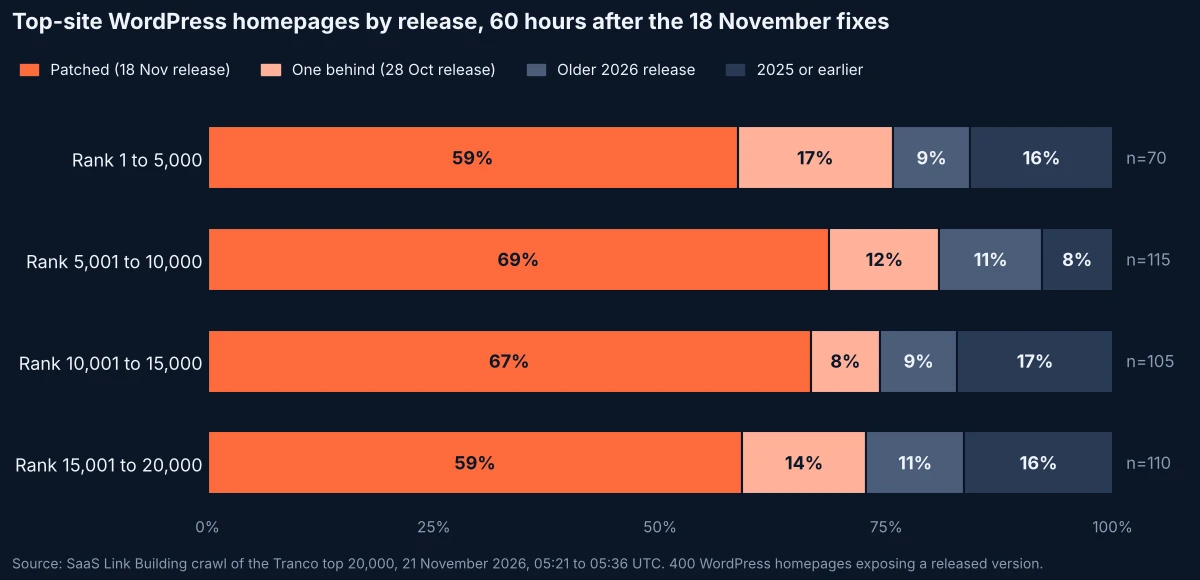
Patch rates ranged from 58.6% to 68.7% across the four bands, and the two outer bands (the most popular 5,000 and those ranked 15,001 to 20,000) were the slowest. The bands hold between 70 and 115 sites each, so the differences are indicative. We saw the same pattern in our 7.1.4 patch rate study, where the top 5,000 also trailed the next band down.
How a site exposes its version also lined up with how current it was. Of the 284 homepages that publish a WordPress generator tag, 68.3% were patched. Of the 116 that hide the tag but still load core files with a version parameter, 52.6% were. Our crawl cannot say why. One possible explanation is that sites which strip the tag are more often running customised setups with their own update processes.
How this compares with 7.1.4
In October we crawled the Tranco top 20,000 about 12 hours after 7.1.4 and found 44.7% of 729 WordPress homepages patched. The two figures are not a like-for-like trend: this crawl came about 48 hours later in the release cycle, and we tightened version detection to ignore bundled library versions, which left a smaller sample. What does line up is the tail. In October, 20.6% of homepages were two or more releases behind; this time it was 24.0%, and every site in that group had missed both the October and the November security fixes.
Our sample also tracks the wider WordPress base. 68.8% of the homepages we identified were on the 7.1 branch, close to the 66.7% that WordPress.org's version statistics showed for all reporting sites on the same morning.
Why this is a search problem
Google's spam policies list hacked content, including injected pages, code and links, as a violation. When Google finds that a site was compromised, the Security issues report in Search Console says so, and affected pages can carry a warning in search results or trigger a browser interstitial. Google's guide to how sites get hacked by spammers puts outdated software near the top of the list and names WordPress security releases among the feeds to follow.
Cross-site scripting, the largest group of issues in this release, is one way injected scripts and links reach visitors and crawlers. Third-party code is a separate route, as the Optimizely script compromise showed earlier this week.
What SEO teams should do
- Check every WordPress property you manage. The patched versions are 7.1.5, 7.0.9, 6.9.12, 6.8.13 and the matching 18 November release on older branches. A site on 7.1.4 is not patched.
- Confirm automatic minor updates are on. WordPress's update documentation says minor core updates, which include security releases, install automatically by default. Look for
AUTOMATIC_UPDATER_DISABLEDorWP_AUTO_UPDATE_COREset to false in wp-config.php, and for hosts that hold back core updates. - Review XML-RPC. One of the unauthenticated issues is a denial of service through batched pingbacks. If nothing on the site needs XML-RPC, it is worth asking whether it should be reachable.
- Purge caches after updating so that the live HTML matches the installed version and your audits do not report false positives.
- Watch Search Console. Check Security issues and Manual actions, and scan the Pages report for unfamiliar URLs. Platforms that host user pages should also follow Google's user-generated spam guidance.
Methodology
We took the first 20,000 domains of the Tranco top sites list downloaded on 21 November 2026 and requested each homepage over HTTPS (falling back to the www host) between 05:21 and 05:36 UTC, about 60 hours after the 17:08 UTC release announcement, following redirects, with a desktop Chrome user agent and a 15-second timeout. 11,480 homepages returned a status below 400; the rest failed, timed out or blocked us, so the sample covers sites we could reach.
We counted a site as WordPress when its homepage referenced /wp-content/ or /wp-includes/ (1,345 sites). We read the version from the WordPress generator meta tag (284 sites in the final sample) or, where that was absent, from the version parameter on core stylesheets or the core emoji script under /wp-includes/ (116 sites). Version parameters on bundled libraries such as jQuery were ignored. We kept versions that match a release in the WordPress.org archive, then set aside one pre-release site, leaving 400. A site counted as patched if its version is one of the releases dated 18 November 2026 in that archive; "releases behind" counts later releases on the same branch. Rank bands use the Tranco rank, and the branch comparison uses the WordPress.org statistics API read at 05:31 UTC. Sites that strip all version information are not represented, and page caches can keep showing an older version after an update.
Conclusion
Two and a half days after WordPress 7.1.5 and its backports, close to two thirds of the top-site WordPress installs we could identify were on a patched release, and 49 of the remaining 145 were one step behind, mostly on 7.1.4. Automatic minor updates should close much of that part of the gap.
The quarter of the sample that is two or more releases behind is the group to worry about. With five security releases on the 7.1 branch since August, a stalled update process now leaves a site exposed to several rounds of published fixes, and any spam injected through those holes becomes a search visibility problem as well as a security one.
Questions and answers
Which WordPress versions contain the 18 November security fixes?
WordPress 7.1.5 and the backported releases dated the same day, including 7.0.9, 6.9.12 and 6.8.13, down to 4.7.40 on the oldest branch still receiving security fixes, according to the WordPress release archive.
How many top sites had updated to a patched release?
In our crawl between 05:21 and 05:36 UTC on 21 November 2026, about 60 hours after the release announcement, 255 of 400 WordPress homepages in the Tranco top 20,000 that exposed a released version (63.8%) reported an 18 November release.
Which WordPress 7.1.5 issues can be exploited without logging in?
The release announcement lists four unauthenticated issues: disclosure of private taxonomy terms via the REST API search endpoint, stored XSS via shortcode attributes in comments, a denial of service via batched XML-RPC pingbacks, and a privilege escalation via Template Part block attributes that could lead to remote code execution.
Does WordPress install security releases automatically?
By default, yes. WordPress's automatic background updates documentation says minor core updates, which include maintenance and security releases, are applied automatically unless a site disables them.
More releases
-
Updates
Google Adds an AI Mode Sidebar to Its Homepage; Search Button Held in 30 of 30 Checks
Google began rolling out a collapsible sidebar of recent AI searches on its desktop homepage on 19 November 2026, Robby Stein said. Two days later, all 30 signed-out sessions we loaded across 20 locales still showed the classic Google Search button, with no sidebar or AI Mode button.
-
Studies
Google Calls '7 Tips' Posts Commodity Content; They Held 39% of Page One in Our Test
Google is telling brands to stop publishing generic "Top 10" tips posts, but its results still reward them. Across 30 US tips searches on 21 November, numbered lists held 90 of 233 page-one organic results and a third of AI Overview citations, and a page titled exactly like Google's own commodity example ranked first.
-
Industry news
Google Adds Target, Experian and H&R Block to Search Apps; Help Page Lists 0 of 8
Google is adding Target, Albertsons, Safeway, Shaw's, Experian and H&R Block as Connected Apps in Search and the Gemini app, with Angi and Thumbtack to follow. Its Search help page lists none of the eight yet, and in our 16-search test a partner's own site ranked in the organic top 10 on 10.
Tell us the site and the goals.
Rankings in Google and visibility in AI answers, from one monthly plan. One call is enough to say which one fits. Email works just as well.