Google Adds an AI Mode Sidebar to Its Homepage; Search Button Held in 30 of 30 Checks
Google began rolling out a collapsible sidebar of recent AI searches on its desktop homepage on 19 November 2026, Robby Stein said. Two days later, all 30 signed-out sessions we loaded across 20 locales still showed the classic Google Search button, with no sidebar or AI Mode button.
 Vibhu Dhariwal
Cofounder & CTO, Digital Gratified
- Published
- Section
- Updates
- Reading time
- 7 minutes
Ras Al Khaimah, United Arab Emirates, .
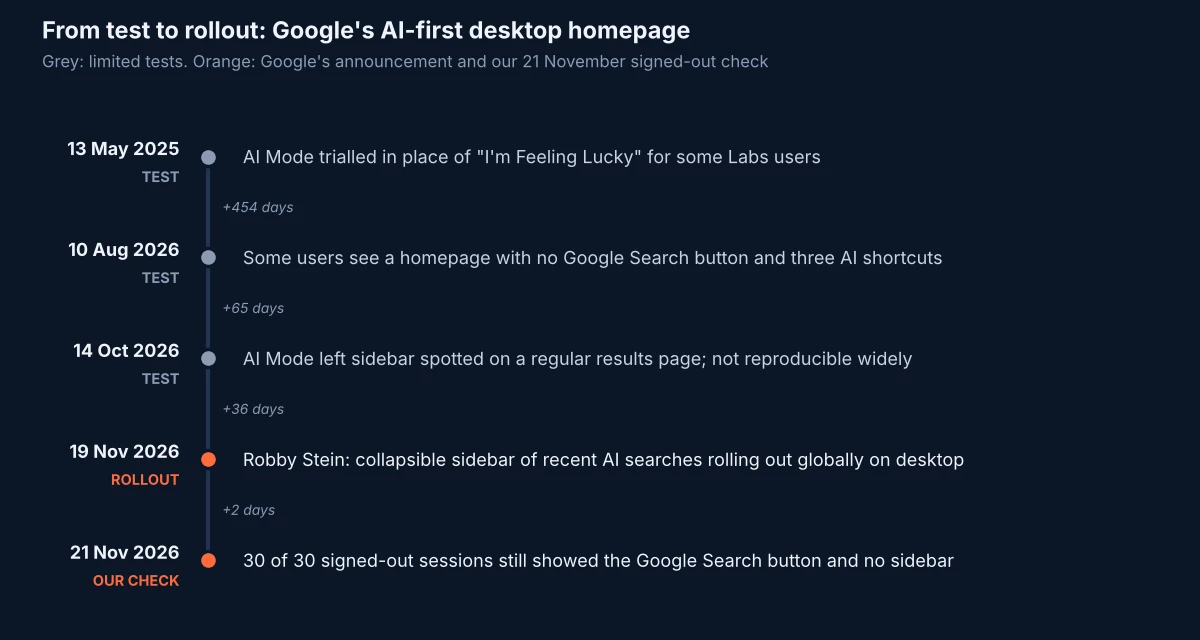
Google has started rolling out a collapsible sidebar on its desktop homepage that lists a user's recent AI searches, so they can reopen and continue an AI Mode conversation from google.com. Robby Stein, Google's vice president of product for Search, announced the change on X on 19 November 2026, describing it as a way to "easily find & jump back into your recent AI searches" and saying it is rolling out globally.
Two days later, the rollout had not reached the signed-out homepage we could load. In 30 browser sessions across 20 language and country settings on 21 November, every page still showed the classic Google Search and I'm Feeling Lucky buttons, and none showed the sidebar, an AI Mode button or the AI shortcuts that replaced the Search button in an August test.
What changed
- A sidebar of AI threads. Stein's post says the collapsible panel is new on the desktop homepage and lets people return to recent AI searches. He wrote that in testing the sidebar made a big difference, without sharing figures.
- Desktop, global rollout. The announcement names the desktop homepage and says the rollout is global. It does not mention the Google app or the mobile homepage.
- No word on the Search button. Stein's post does not mention the Google Search button. ShiftDelete.Net reported that the redesign also swaps the button for Gemini shortcuts, but found the classic layout still in place when it checked from Türkiye on 21 November.
- A long road from test to launch. Search Engine Roundtable reported on 14 October that an AI Mode left sidebar had appeared on a regular results page for at least one user, and treated it as a limited test. The homepage version is the first that Google has announced as a rollout.
How the homepage got here
The sidebar is the latest of several attempts to move AI features onto the most visited page Google owns. In May 2025, Google tested putting AI Mode where the I'm Feeling Lucky button sits, for some users in its Labs programme. TechCrunch reported that a spokesperson said the change might never launch fully.
In August 2026, some signed-out visitors saw a homepage with no Google Search button at all. The Next Web described three shortcuts in its place: Create images, Ask about files and Brainstorm. I'm Feeling Lucky stayed, and one of the shortcuts needed a signed-in account. Stein called that version "a small test on desktop" in a response quoted by Tom's Guide, and said the search box itself was not affected.
The sidebar is a different kind of change. The August test changed what a new visitor is offered before searching. The sidebar is built for people who have already used AI Mode and want to pick a thread back up, which fits the longer, multi-turn sessions Google keeps pointing to. Earlier this month we found Google testing the removal of the AI Mode tab on some mobile results pages, so the entry points to AI Mode are still moving in both directions.
Our check: the classic homepage is still what signed-out visitors get
We loaded www.google.com in 20 language and country combinations, signed out, first as raw HTML and then in a full browser. The table shows what the rendered page displayed under the search box and in the footer.
| Setting (hl, gl) | Search button label shown | I'm Feeling Lucky | AI Mode button, shortcuts or sidebar | "AI tools from Google" footer line |
|---|---|---|---|---|
| en, us (11 sessions) | Google Search | Yes | No | Yes, 11 of 11 |
| en, gb | Google Search | Yes | No | Yes |
| en, in / en, ca / en, au | Google Search | Yes | No | No |
| hi, in | Google Search | Yes | No | No |
| de, de | Google Suche | Yes | No | No |
| fr, fr | Recherche Google | Yes | No | No |
| es, es / es, mx | Buscar con Google | Yes | No | No |
| it, it | Cerca con Google | Yes | No | No |
| pt-BR, br | Pesquisa Google | Yes | No | No |
| nl, nl / pl, pl / tr, tr / ru, ru | Localised Google Search label | Yes | No | No |
| ja, jp / ko, kr / id, id / ar, ae | Localised Google Search label | Yes | No | No |
| All 30 sessions | 30 of 30 | 30 of 30 | 0 of 30 | 12 of 30 |
The only AI element we saw was a footer line in English for the US and UK settings, reading "Build, create, and do more with AI tools from Google." We did not see it in the 18 sessions set to other locales. In the raw HTML for all 20 settings, the Google Search and I'm Feeling Lucky buttons were present, and the page made no reference to AI Mode.
This does not mean the rollout has stalled. Google rolls out homepage changes gradually, and a sidebar of recent AI searches has little to show a visitor with no history. Our sessions also came from a data centre address, which Google may treat differently from home connections. What the check does show is that, two days after the announcement, a first-time desktop visitor could still land on a homepage with the same two buttons it has had for years.
What this means for SEO teams
The sidebar matters less for the homepage than for what it encourages: returning to an AI Mode thread and asking another question. Google's guidance on AI features and your website says traffic from AI Mode is included in Search Console's Performance report under the Web search type. Its Performance report help page adds that a follow-up question in AI Mode is treated as a new query, with impressions, positions and clicks counted against that new query.
If the sidebar does lead to more resumed threads, the effect in Search Console would be more distinct queries, many of them long and conversational, rather than repeat visits that show up as one search. That is our reading of Google's counting rules, not something Google has said about the sidebar. Our earlier report on a 155-site study of AI Mode-style queries found their share of impressions at the median site rose about sevenfold between June 2025 and September 2026, before this change.
- Mark the date. Add a note for 19 November 2026 in your reporting dashboards so later shifts in desktop query mix can be checked against the rollout.
- Watch query length on desktop. Filter the Performance report to desktop and track how many queries have eight or more words, week on week, compared with mobile.
- Separate new and returning AI Mode demand. Long follow-up queries that start with phrases like "what about" or "and for" are a sign of resumed threads. Tag them in your exports rather than treating them as new keyword opportunities.
- Do not expect a referral label. Clicks from a resumed thread are still Google Search clicks. Nothing in Google's documentation says the sidebar will be reported separately.
Methodology
On 21 November 2026, between 21:15 and 21:25 UTC, we requested https://www.google.com/ with hl and gl parameters for 20 language and country pairs, using a desktop Chrome user agent and no cookies, from a server whose address geolocates to Ohio, United States. We saved each HTML response and checked it for the Google Search button (name="btnK"), the I'm Feeling Lucky button (name="btnI") and any AI Mode reference. We then loaded the same 20 pages in headless Chromium at 1440 by 900 pixels, plus 10 more fresh US English sessions, for 30 rendered sessions in all. For each, we recorded which buttons and links were visible on screen and whether the page text included AI Mode, the August test's shortcut labels, a recent-searches sidebar, or the footer line about AI tools. We did not test signed-in accounts, home or mobile connections, or the mobile homepage. Country-code domains such as google.co.uk redirected to google.com and were not counted separately.
Conclusion
Google has now announced, rather than tested, an AI-first change to its desktop homepage: a sidebar that keeps AI Mode conversations one click away. The classic Search button is not part of Google's announcement, and in our signed-out check it was still on every page we loaded.
For SEO teams, the practical change is likely to show up in query data rather than on the homepage itself. If people resume AI Mode threads more often, Search Console will count each follow-up as a separate query, and desktop query reports are where that shift should appear first. Our coverage of Gemini 4 Hydrogen in Search found AI Mode answers to multi-part questions already cite more sources, so longer threads could also mean more chances to be cited.
Questions and answers
What did Google announce for its homepage?
On 19 November 2026, Robby Stein, Google's vice president of product for Search, said Google is rolling out a collapsible sidebar on the desktop homepage globally that lets people find and return to their recent AI searches.
Has Google removed the Google Search button?
Google's announcement does not mention the button. In our check on 21 November 2026, all 30 signed-out desktop sessions across 20 language and country settings still showed the Google Search and I'm Feeling Lucky buttons.
Does AI Mode traffic appear in Search Console?
Yes. Google says traffic from AI features, including AI Mode, is included in the Performance report under the Web search type, and that a follow-up question in AI Mode is counted as a new query.
Was the sidebar tested before the rollout?
An AI Mode left sidebar was reported on a regular results page on 14 October 2026 as a limited test. Separately, a homepage without the Search button and with three AI shortcuts was seen by some signed-out users in August 2026, which Stein called a small test.
More releases
-
Studies
Google Calls '7 Tips' Posts Commodity Content; They Held 39% of Page One in Our Test
Google is telling brands to stop publishing generic "Top 10" tips posts, but its results still reward them. Across 30 US tips searches on 21 November, numbered lists held 90 of 233 page-one organic results and a third of AI Overview citations, and a page titled exactly like Google's own commodity example ranked first.
-
Industry news
Google Adds Target, Experian and H&R Block to Search Apps; Help Page Lists 0 of 8
Google is adding Target, Albertsons, Safeway, Shaw's, Experian and H&R Block as Connected Apps in Search and the Gemini app, with Angi and Thumbtack to follow. Its Search help page lists none of the eight yet, and in our 16-search test a partner's own site ranked in the organic top 10 on 10.
-
Studies
Do Core Web Vitals Move Google Rankings? 5 of 20 No. 1 Results Took Over 4 Seconds
Google says Core Web Vitals feed its ranking systems, and a leaked schema ties them to ranking. Our test of 152 Google mobile results across 31 searches found the higher-ranked page loaded faster in just 57.2% of pairs, and 5 of 20 number one results took over 4 seconds.
Tell us the site and the goals.
Rankings in Google and visibility in AI answers, from one monthly plan. One call is enough to say which one fits. Email works just as well.