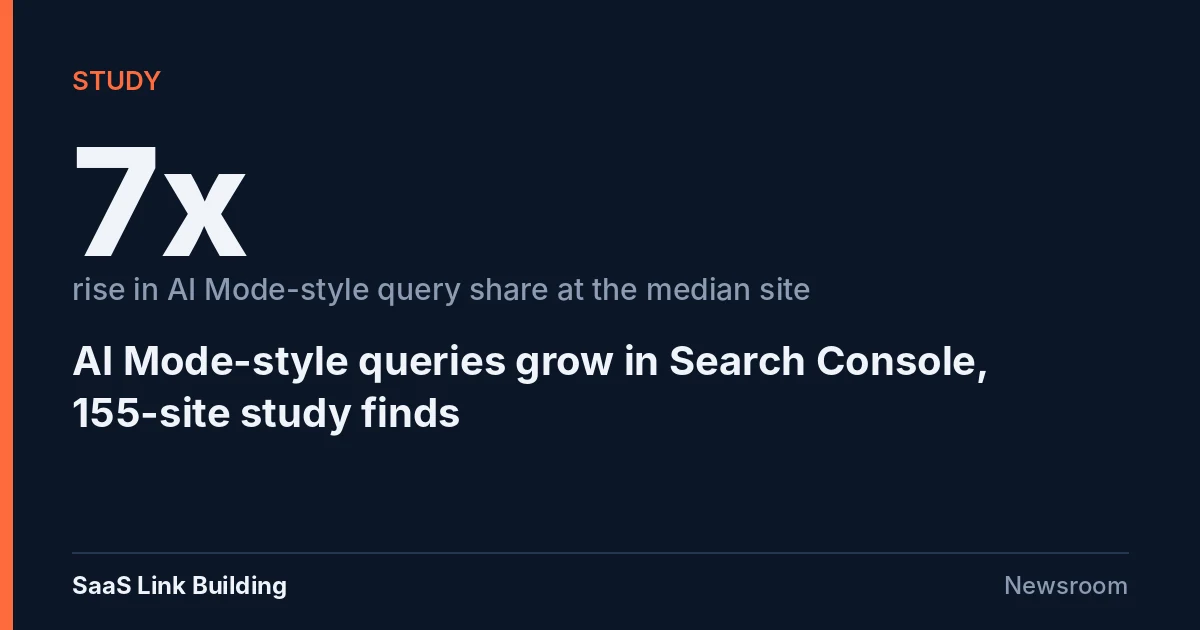
AI Mode-Style Queries Rose 7x in Search Console at the Median Site, 155-Site GSC Wizard Study Finds
Conversational follow-up queries typical of AI Mode grew from 0.032% to 0.22% of impressions at the median site between June 2025 and September 2026, according to a GSC Wizard study of 155 Search Console properties. These queries had a 2.9% click-through rate, against 35.6% for all queries.
 Vibhu Dhariwal
Cofounder & CTO, Digital Gratified
- Published
- Section
- Studies
- Reading time
- 4 minutes
Ras Al Khaimah, United Arab Emirates, .
Conversational, AI Mode-style queries have grown sevenfold as a share of Search Console impressions at the typical site over the past 16 months, according to a study of 155 Search Console properties published on 14 October 2026 by Search Console analytics tool GSC Wizard. The analysis, written by Jan-Willem Bobbink, found that these queries earned a click-through rate of just 2.9%, against 35.6% for all queries pooled.
Google does not label AI Mode traffic separately in the Performance report. The study instead classifies query shapes that look like follow-ups typed inside a conversation, such as a bare "yes" or a pivot like "what about salary", and tracks how often they appear.
Key findings
- The median site's AI-shaped share rose about 7x. It went from 0.032% of impressions to 0.22% between June 2025 and September 2026.
- Reply artefacts grew 21x. Bare replies such as "yes" rose from 5.6 to 116 per million impressions and appeared on 94 of the 155 sites.
- Pivot follow-ups grew 39x. They rose from 0.12 to 4.56 per million impressions, with most of the increase after May 2026.
- They are still a sliver of demand. Across the whole dataset, AI-shaped queries made up 0.13% of impressions.
- Clicks are scarce. AI-shaped queries had a 2.9% CTR overall, 1.5% for pivot follow-ups and 4.7% for reply artefacts.
- The spread is wide. In the week of 21 September 2026, 88 of 118 sites with data had at least some AI-shaped queries.
| Metric | Start of period (June 2025) | End of period (September 2026) | Change |
|---|---|---|---|
| Reply artefacts per million impressions | 5.6 | 116 | 21x |
| Pivot follow-ups per million impressions | 0.12 | 4.56 | 39x |
| Median site's AI-shaped share of impressions | 0.032% | 0.22% | about 7x |
| Pooled AI-shaped share of all impressions | 0.31% | 0.10% | down |
| Query group | Click-through rate |
|---|---|
| All queries, pooled | 35.6% |
| Reply artefacts | 4.7% |
| All AI-shaped queries | 2.9% |
| Pivot follow-ups | 1.5% |
Why the pooled share fell while the median rose
The two headline measures move in opposite directions. The median site's share rose about sevenfold, but the pooled share across every impression in the dataset fell from 0.31% to 0.10%. The study attributes the difference to a few large sites that dominate total volume. For most individual properties, the trend is upward.
Language patterns
The study also found that politeness in reply queries varies by language. Three in four German yes-replies included "bitte" or "gerne", and 67% of Dutch replies included "graag". English reached 40%, while Indonesian replies across 40 sites contained none. English accounted for 49.8% of AI-shaped impressions and Dutch for 6.0%, with about a third not assignable to a language. The queries spanned 27 languages.
How Google counts AI Mode in Search Console
The study's approach rests on how Google records AI Mode activity. Google's Performance report help page says that when a user asks a follow-up question in AI Mode, they are essentially performing a new query, and all impression, position and click data in the new response are credited to that new query. Clicks on external links in AI Mode count as clicks, standard impression rules apply, and position follows the same method as a regular results page.
That means the follow-up text a user types inside AI Mode can surface in the Queries table as if it were a standalone search.
Limitations
The author describes the work as inference rather than measurement, because Search Console does not flag which queries came from AI Mode. The properties come from one tool account and mix client and the author's own sites, so they are not a random sample of the web. Trend figures use only properties with data in at least 90% of weeks. The study also warns that recent weeks may be understated by about 16%, because Search Console keeps adding rows for several days after a date first appears.
What this means for SEO teams
- Look for conversational fragments in your own Queries report. Filter for very short replies ("yes", "no", "ok") and phrases starting with "what about" or "and". Their presence suggests your pages are being cited inside AI Mode conversations.
- Expect low CTR on these rows. At 2.9%, AI-shaped queries click far less often than standard searches. Exclude them when benchmarking CTR for a page, or blended averages will drift down.
- Read the context of the query, not just the words. A pivot follow-up shows the question a user asked after reading an AI answer. These can reveal comparison and objection topics worth covering on the page.
- Allow for reporting lag. Wait several days before judging the latest week, given the study's note on late-arriving rows.
- Track by language. If you run multilingual sites, segment by locale, since phrasing patterns differ sharply between languages.
Conclusion
The GSC Wizard study offers one of the first attempts to size AI Mode follow-up traffic using Search Console data alone. Its numbers suggest the share is still tiny, at 0.13% of impressions, but rising quickly at the typical site, and that these queries rarely produce clicks. Because Google counts each AI Mode follow-up as a new query, SEOs can already find traces of these conversations in their own reports, even without a dedicated AI Mode filter.
Questions and answers
Does Search Console show AI Mode queries separately?
According to the study, Google does not label which queries come from AI Mode. Google's Performance report help page says a follow-up question in AI Mode is essentially a new query, and its impressions, position and clicks are counted under that new query.
How much did AI Mode-style queries grow in the study?
At the median site, their share of impressions rose from 0.032% to 0.22% between June 2025 and September 2026, about 7x. Reply artefacts such as a bare yes grew 21x per million impressions, and pivot follow-ups grew 39x.
What click-through rate do these queries get?
The study found a 2.9% CTR for AI-shaped queries overall, 1.5% for pivot follow-ups and 4.7% for reply artefacts, compared with 35.6% for all queries pooled.
How many sites and what period did the study cover?
155 Search Console properties connected to one GSC Wizard account, from the first full week of June 2025 to the last full week of September 2026. It was published on 14 October 2026.
More releases
-
Updates
Google Merchant Center Adds Warranty Attribute for All Products as Quebec's 3 to 6 Year Warranty Law Starts
Google Merchant Center now supports a warranty attribute for general products, letting merchants show warranty length in Shopping ads and free listings. Google cites Quebec's Bill 29, whose legal warranty of good working order took effect on 5 October 2026 and covers appliances and electronics for 3 to 6 years.
-
Industry news
AI Slop Sites Grew Over Fivefold Year on Year as Ad Requests Hit 834M in September, DoubleVerify Data Shows
Domains publishing low-quality AI-generated content rose more than fivefold in Q2 2026 versus Q2 2025 and their traffic quadrupled, according to DoubleVerify data reported by Axios on 17 October. Monthly ad requests to these pages climbed from 184 million in January to 834 million in September 2026.
-
Industry news
No Google Ranking Update Since 8 October Despite Volatility Chatter; Core Update Gap Reaches 152 Days
Google's Search Status Dashboard has logged no ranking update since the September 2026 spam update ended on 8 October, despite rising volatility reports from 15 October. Our analysis of the dashboard shows 152 days have passed since the May 2026 core update began, the second longest gap since August 2024.
Tell us the site and the goals.
Rankings in Google and visibility in AI answers, from one monthly plan. One call is enough to say which one fits. Email works just as well.