Google Calls '7 Tips' Posts Commodity Content; They Held 39% of Page One in Our Test
Google is telling brands to stop publishing generic "Top 10" tips posts, but its results still reward them. Across 30 US tips searches on 21 November, numbered lists held 90 of 233 page-one organic results and a third of AI Overview citations, and a page titled exactly like Google's own commodity example ranked first.
 Vibhu Dhariwal
Cofounder & CTO, Digital Gratified
- Published
- Section
- Studies
- Reading time
- 9 minutes
Ras Al Khaimah, United Arab Emirates, .
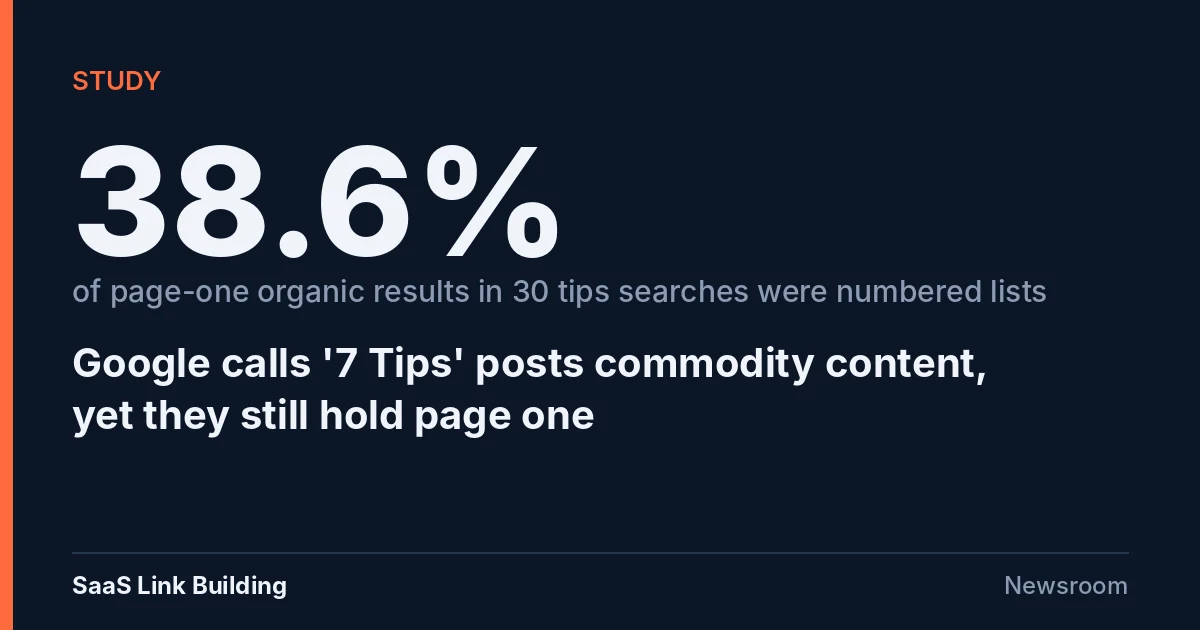
Google's advice to stop publishing generic "Top 10" tips posts has not yet shown up in its own search results. In 30 US Google searches for everyday "tips" and "things to consider" topics that we ran on 21 November 2026, 90 of the 233 page-one organic results (38.6%) carried a numbered tips, steps or "things" headline, and 27 of the 30 results pages had at least one.
The searches follow a Think with Google article by Brendon Kraham, Google's VP of Search and Commerce Global Ads Solutions, which tells brands to swap a generic list for first-hand material. Think with Google promoted the piece on X on 19 November with a cheat sheet that paired "Stop the 'Top 10' listicle" with leading on first-hand expertise, as Search Engine Journal reported. The same idea already sits in Google Search's own guide to optimizing for generative AI search, which uses "7 Tips for First-Time Homebuyers" as its example of commodity content.
Key findings
- Google's own example ranks first. For "tips for first time homebuyers", the number one organic result was a page titled 7 Tips for First-Time Homebuyers, published by California's Department of Financial Protection and Innovation. Four of the seven page-one results on that search had numbered titles.
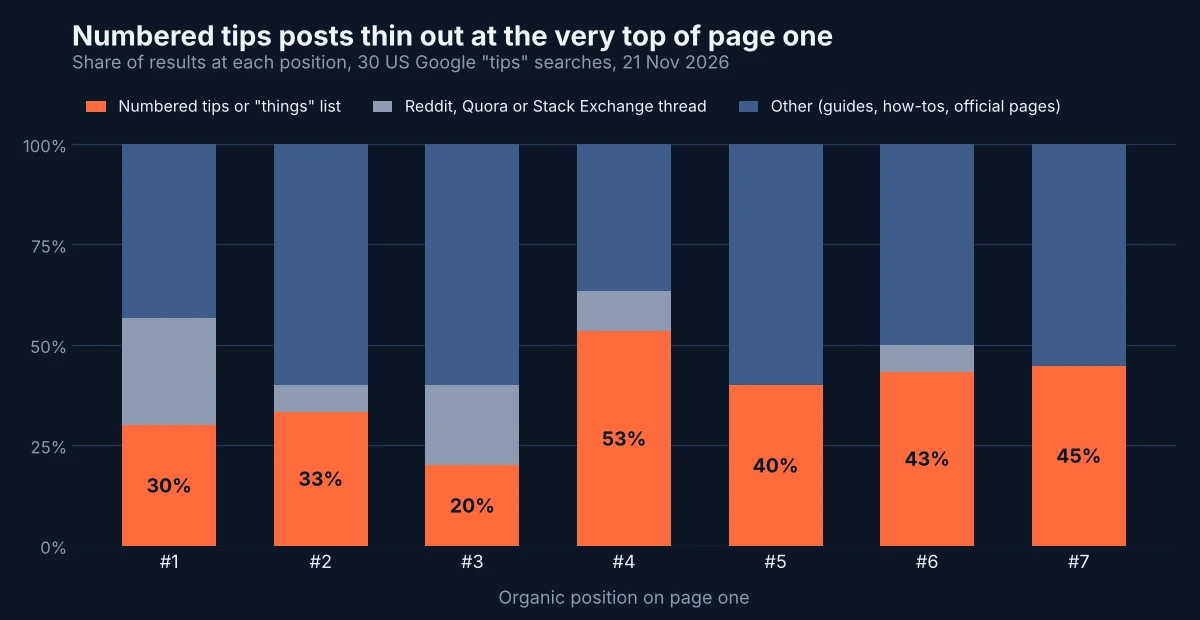
- Numbered lists are everywhere, but rarer at the very top. They took 27.8% of positions one to three (25 of 90) and 45.4% of positions four to seven (54 of 119). A numbered list held the top spot on 9 of 30 searches.
- Forums took the top spot almost as often. Reddit, Quora or Stack Exchange threads ranked first on 8 of 30 searches, although they made up only 21 of the 233 page-one results (9.0%).
- AI Overviews cite numbered lists at a similar rate. An AI Overview appeared on all 30 searches. On the 23 that returned their source list, 86 of 254 cited sources (33.9%) had numbered titles, against 37.0% of page-one organic results on the same 23 searches.
- Kraham's own example avoids lists. "Things to consider when buying running shoes", the topic of his running store example, returned no numbered titles on page one; a Reddit r/running guide ranked first.
What Google actually said
Kraham's article is aimed at chief marketing officers, not SEOs, and it is published on Google's ads and marketing site rather than Search Central. Its point is about distinctiveness. Using a running store as the example, it says that "Instead of publishing a generic 'Top 10 Things to Consider,'" the store could publish a deep-dive video on why one customer's shoes collapsed. It also tells brands to measure leads and sales rather than unproven proxy metrics.
Search Central's guidance makes the same distinction in more technical language. The generative AI guide, last updated on 10 July, says commodity content is "often based on common knowledge" and contrasts the homebuyer tips headline with a first-person account of waiving a home inspection. Neither page says numbered lists are penalised, and neither says the format itself is the problem. The test both apply is whether the content adds experience or insight that not just anyone could have written. Google's earlier rater questions on effort and originality point the same way.
Some SEOs read the cheat sheet line as a warning about listicles in general, including the self-ranking "best of" lists that brands publish about their own category. Kraham's article never uses the word listicle and does not mention those lists or any penalty. We looked at how that second type performs in a separate test of self-promotional listicles in October.
Search by search
Numbered headlines were most concentrated on home, work and money topics. Seven of nine page-one results for "tips for selling a house" were numbered lists, as were six of nine for "tips for working from home" and five of eight for both "tips for saving money on groceries" and "tips for first time renters". Outdoor and safety searches were the exception: "camping tips for beginners" and "tips for driving in snow" returned no numbered titles, ranking long-form beginner guides and, for snow driving, safety pages from a federal agency and a motoring club instead.
| Search (Google US) | Page-one organic results | Numbered tips or "things" titles | Numbered titles among AI Overview sources |
|---|---|---|---|
| tips for selling a house | 9 | 7 | 4 of 8 |
| tips for better sleep | 7 | 5 | Not returned inline |
| tips for working from home | 9 | 6 | 8 of 13 |
| tips for first time renters | 8 | 5 | Not returned inline |
| tips for learning a new language | 8 | 5 | 5 of 11 |
| tips for public speaking | 8 | 5 | 9 of 11 |
| tips for saving money on groceries | 8 | 5 | Not returned inline |
| tips for first time homebuyers | 7 | 4 | 4 of 11 |
| tips for painting a room | 7 | 4 | Not returned inline |
| things to consider before getting a credit card | 8 | 4 | 1 of 8 |
| tips for small business owners | 8 | 4 | 3 of 10 |
| tips for writing a resume | 8 | 4 | 3 of 12 |
| tips for paying off debt | 7 | 3 | 5 of 12 |
| tips for taking better photos with your phone | 7 | 3 | 5 of 11 |
| tips for planning a wedding | 8 | 3 | 5 of 11 |
| things to consider when choosing a college | 9 | 3 | 5 of 10 |
| tips for running in cold weather | 9 | 3 | 2 of 10 |
| things to consider when buying a laptop | 7 | 2 | Not returned inline |
| tips for a job interview | 7 | 2 | 3 of 14 |
| tips for reducing energy bills | 7 | 2 | 2 of 9 |
| tips for studying for exams | 7 | 2 | 5 of 10 |
| tips for running your first marathon | 8 | 2 | 0 of 12 |
| tips for starting a vegetable garden | 8 | 2 | Not returned inline |
| things to consider when buying a used car | 9 | 2 | 2 of 12 |
| tips for traveling with a baby | 6 | 1 | 4 of 14 |
| tips for hosting thanksgiving | 8 | 1 | 2 of 11 |
| tips for new dog owners | 9 | 1 | 4 of 13 |
| camping tips for beginners | 8 | 0 | 3 of 11 |
| things to consider when buying running shoes | 7 | 0 | Not returned inline |
| tips for driving in snow | 7 | 0 | 2 of 10 |
Inside the AI Overviews
AI Overviews did not filter numbered lists out. On "tips for public speaking", 9 of the 11 sources the overview cited had numbered titles, more than the five numbered results on page one. On "tips for working from home" the figure was 8 of 13. YouTube videos were the single largest source type, supplying 94 of the 254 citations (37.0%), a pattern we also found in an earlier count of YouTube citations in AI Overviews. Reddit supplied 18.
The few titles that signalled first-hand experience did not avoid numbers either. Only six of the 233 organic titles framed the advice as the writer's own, such as a technology publisher's "I've Worked From Home for 10 Years" piece or a Reddit post from someone who had reviewed more than 1,000 resumes. Three of those six still used a numbered format.
What this means for SEO teams
- Do not strip numbers from headlines on Google's say-so. Nothing Google has published penalises the format, and numbered titles held nearly two in five page-one slots in our sample. The number is not what Google's guidance targets.
- Audit tips posts for what only you could write. For each planned "X tips" post, list which points come from your own customers, data, tests or staff. If none do, the post matches Google's own definition of commodity content.
- Put the first-hand material where it is visible. The example in the generative AI guide is a specific story with a specific outcome. A tips post can keep its list while leading with a case, a measurement or a photo nobody else has.
- Cover video and forums. With YouTube supplying more than a third of AI Overview citations and forum threads ranking first on 8 of 30 searches, a text-only tips strategy misses two of the formats Google surfaced most prominently in these results.
- Read results after the core update ends. The Search Status Dashboard still lists the November 2026 core update as rolling out, so rankings in this snapshot may move. Our coverage of the November core update tracks its timeline.
Methodology
On 21 November 2026 we pulled Google US results (English, location United States, desktop) through a SERP API for 30 informational searches built around "tips for" or "things to consider" phrasing, including Google's own homebuyer example, Kraham's running shoe example and 28 common consumer, career, home and travel topics. Each search was fetched once.
We counted only standard page-one organic results, which numbered six to nine per search (233 in total) because video, forum and other features took the remaining space. A result was classed as a numbered list when its title contained a number, in digits or words from two upwards, within three words before "tips", "things", "ways", "steps", "factors", "secrets", "tricks", "habits", "mistakes", "strategies", "ideas", "dos", "points", "techniques", "lessons", "rules" or "experts". We checked all 90 matches and the remaining titles by hand. Forum threads are results Google labelled as Reddit, Quora or Stack Exchange. Titles signalling first-hand experience were those written in the first person singular about the writer's own practice.
All 30 results pages included an AI Overview. For 23 of them the overview's source list came back in the initial response; the other seven required a second request that we did not make, so they are excluded from the citation counts. Citations were classified by title using the same rule. The study measures headline format only, not page quality, and is a single snapshot taken during a core update.
Conclusion
Google is telling marketers to move away from generic tips posts, but its results still reward them: numbered lists filled 38.6% of page one across our 30 searches and a third of AI Overview citations, and the page titled exactly like Google's commodity example ranked first. The gap suggests the guidance describes where Google wants content to go, not a filter that is already removing lists.
The practical reading is narrower than "stop the listicle". Lists that repeat common knowledge compete with forums, video and official pages that also rank at the top. Lists built on experience only the publisher has are the version Google's own documents describe as worth making.
Questions and answers
Did Google tell site owners to stop publishing listicles?
Not as a ranking rule. A Think with Google article by Brendon Kraham, published on 14 October 2026, told brands to replace a generic "Top 10 Things to Consider" post with first-hand content. It does not use the word listicle or mention any penalty.
What does Google mean by commodity content?
Google's guide to optimizing for generative AI search describes commodity content as content often based on common knowledge that adds little unique insight, and uses "7 Tips for First-Time Homebuyers" as its example.
How common are numbered tips posts in Google results?
In our pull of 30 US Google tips searches on 21 November 2026, 90 of 233 page-one organic results (38.6%) had numbered tips, steps or "things" headlines, and 27 of the 30 searches had at least one.
Do AI Overviews cite numbered list articles?
Yes. On the 23 searches whose AI Overview returned its source list, 86 of 254 cited sources (33.9%) had numbered titles, close to the 37.0% share among page-one organic results on the same searches.
More releases
-
Updates
Google Adds an AI Mode Sidebar to Its Homepage; Search Button Held in 30 of 30 Checks
Google began rolling out a collapsible sidebar of recent AI searches on its desktop homepage on 19 November 2026, Robby Stein said. Two days later, all 30 signed-out sessions we loaded across 20 locales still showed the classic Google Search button, with no sidebar or AI Mode button.
-
Industry news
Google Adds Target, Experian and H&R Block to Search Apps; Help Page Lists 0 of 8
Google is adding Target, Albertsons, Safeway, Shaw's, Experian and H&R Block as Connected Apps in Search and the Gemini app, with Angi and Thumbtack to follow. Its Search help page lists none of the eight yet, and in our 16-search test a partner's own site ranked in the organic top 10 on 10.
-
Studies
Do Core Web Vitals Move Google Rankings? 5 of 20 No. 1 Results Took Over 4 Seconds
Google says Core Web Vitals feed its ranking systems, and a leaked schema ties them to ranking. Our test of 152 Google mobile results across 31 searches found the higher-ranked page loaded faster in just 57.2% of pairs, and 5 of 20 number one results took over 4 seconds.
Tell us the site and the goals.
Rankings in Google and visibility in AI answers, from one monthly plan. One call is enough to say which one fits. Email works just as well.