Do Core Web Vitals Move Google Rankings? 5 of 20 No. 1 Results Took Over 4 Seconds
Google says Core Web Vitals feed its ranking systems, and a leaked schema ties them to ranking. Our test of 152 Google mobile results across 31 searches found the higher-ranked page loaded faster in just 57.2% of pairs, and 5 of 20 number one results took over 4 seconds.
 Vibhu Dhariwal
Cofounder & CTO, Digital Gratified
- Published
- Section
- Studies
- Reading time
- 14 minutes
Ras Al Khaimah, United Arab Emirates, .
Google says Core Web Vitals are used by its ranking systems, and a leaked internal schema defines fields for loading and layout-shift data inside a record Google ties to ranking. Yet when we pulled 31 Google mobile searches on 21 November 2026 and measured 152 ranking pages, the page in the higher position loaded faster in only 57.2% of head-to-head comparisons, and 5 of the 20 number one results we could measure took more than 4 seconds to paint their main content. This investigation weighs what Google has said, what the leaked documentation shows and what our own measurements found.
The theory: speed is a ranking lever you can pull
Since Google first announced the page experience signal in May 2020, a large part of the industry has treated Core Web Vitals as a direct, measurable ranking lever. The argument runs like this: Google built named metrics (Largest Contentful Paint for loading, Cumulative Layout Shift for visual stability and a responsiveness metric, First Input Delay at launch and now Interaction to Next Paint), published pass thresholds, put a dedicated report in Search Console and told site owners to hit those thresholds. Why would a search engine do all that for a signal that barely matters?
Performance consultants, speed-tool vendors and many in-house developers hold some version of this view. Case studies that pair a speed project with a traffic gain are a familiar sight on social media. A stronger form of the theory goes further: Google downplays the signal in public so site owners do not chase scores at the expense of content, while its systems weigh it more heavily than admitted.
The opposing camp says Core Web Vitals are a light signal that rarely changes the order of results, and that relevance and quality swamp it. Both sides cite Google. So we went to the primary sources first.
Evidence for: what Google and its own documents say
Google's documentation names Core Web Vitals as a ranking input
Google's help page on page experience is direct on the narrow question. In its FAQ, it says Core Web Vitals are used by its ranking systems and recommends that site owners achieve good scores to succeed in Search. The same page goes further than many SEOs realise: it says the other page experience aspects (HTTPS, mobile display, ad density, interstitials) do not directly lift rankings, which makes Core Web Vitals the one part of page experience Google still describes as a ranking input. The Core Web Vitals documentation sets the thresholds Google asks for: LCP within 2.5 seconds, INP under 200 milliseconds and CLS under 0.1.
The history supports the same reading. Google's November 2020 announcement said the page experience signals would come to ranking in May 2021, and the April 2021 rollout post confirmed LCP, FID (since replaced by INP) and CLS would be included, with the update phased in from mid-June to the end of August 2021.
A Googler called it more than a tie-breaker
In August 2021, while that rollout was still under way, John Mueller told a Reddit thread that page experience is "a ranking factor, and it's more than a tie-breaker," while adding that it does not replace relevance, according to a Search Engine Roundtable report from 6 August 2021. That statement is often quoted by those who argue the signal carries real weight.
The leaked schema defines Core Web Vitals fields in a ranking record
The strongest primary evidence comes from the leaked Google Content Warehouse API documentation, which remains mirrored on HexDocs. One module, IndexingMobileVoltVoltPerDocData, describes a per-document record for a system called VOLT. Its description says the data is "used for ranking changes" and that the record holds only Core Web Vitals and the HTTPS (secure) signal. It holds a mobileCwv field, a desktopCwv field and HTTPS flags.
A second module, IndexingMobileVoltCoreWebVitals, defines what those fields contain: LCP, CLS, INP and the retired FID, described as field data "extracted from UKM aggregated 75-percentile data." UKM is Chrome's URL-keyed metrics pipeline. In plain terms, the schema defines a place for real-user Chrome measurements at the 75th percentile, the same basis the public Chrome UX Report uses, inside a structure tied to ranking.
Three cautions apply. The leaked documentation describes data structures, not how much weight any field receives. The record is described as living in a Muppet attachment, yet both CWV fields carry an engineer's note saying they are not populated in Muppet, so the schema shows a slot designed for ranking use without proving the values are filled in that store. And the same record lists the HTTPS signal, which Google's help page now says does not directly lift rankings, a reminder that schemas can lag public guidance. What the leak does show is that Google designed a per-document structure for CWV data tied to ranking changes, which is consistent with what Google says publicly. We covered how Google draws on Chrome data more broadly in our investigation into whether Google ranks pages on Chrome data.
Our data: a small tilt toward faster pages at the top
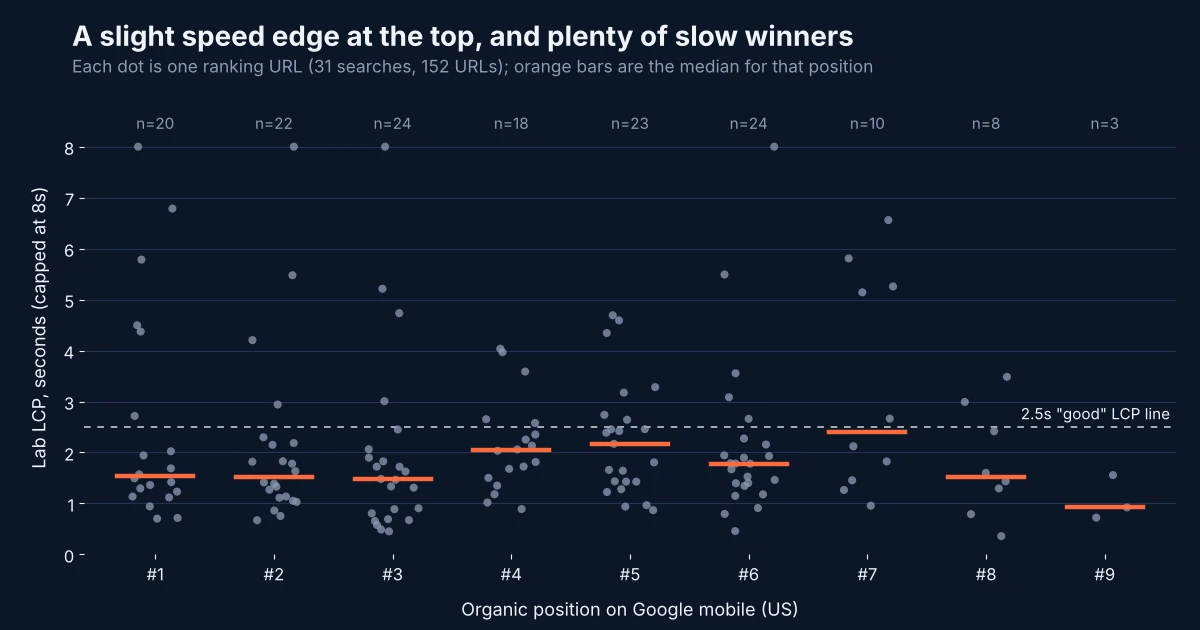
Our own measurements, described in full in the Methodology section, found a modest pattern in the theory's favour. Across all 152 pages, results in positions 1 to 3 had a median lab LCP of 1.49 seconds, against 1.81 seconds for positions 4 to 6. Of 327 within-search pairs where both pages were measured, the higher-ranked page had the faster LCP in 187 (57.2%). Of the 19 searches where we measured at least five results, 13 showed a positive rank correlation (slower pages lower down) and 6 showed the reverse.
Evidence against: the edge shrinks under scrutiny
Google itself caps the signal's importance
The same Google pages that confirm Core Web Vitals in ranking also limit their weight. The 2020 announcement said Google would favour pages with "the best information overall," even where parts of page experience fall short. The current help page says Search always tries to show the most relevant content even when page experience is weak, and warns that chasing a perfect score purely for SEO may not be a good use of time. The 2021 rollout post told site owners they "generally should not expect drastic changes." Google's April 2023 update on page experience folded the topic into its helpful content guidance and said the Page Experience report in Search Console would become a simpler page, without adding weight to the signal.
Mueller's later comments point the same way. In a LinkedIn reply in October 2024, he wrote that Core Web Vitals "are not giant factors in ranking" and that he doubted a site would see a big drop from them alone, according to Search Engine Roundtable's report on 29 October 2024.
Platforms explain most of the speed gap
When we split our sample, the top-of-page speed advantage turned out to be largely a platform effect. Reddit, YouTube, Pinterest and Amazon pages made up 33 of the 152 measured URLs, but 20 of the 66 measured top-three results. Their median lab LCP was 1.33 seconds, against 1.72 seconds for every other site. Remove them, and the pairwise result falls to 108 faster against 94 slower (53.5%), barely better than a coin toss. The median LCP of independent sites in positions 1 to 3 (1.70 seconds) was essentially the same as in positions 4 to 6 (1.78 seconds).
Speculation, clearly labelled: these platforms are probably fast because they invest heavily in front-end engineering, and they probably rank because of brand demand, freshness and the forum and video results Google now shows widely. Their speed and their rankings may share a cause (scale) rather than one producing the other. Our data cannot separate the two.
Slow pages win top spots every day
A heavy ranking weight on loading speed should make slow number one results rare. They were not. Eleven of the 66 top-three pages in our sample had a median lab LCP above 4 seconds, the line Google's Core Web Vitals thresholds class as poor, and so did 5 of the 20 number one results we could measure.
| Search (US, mobile) | Position | Median lab LCP |
|---|---|---|
| how to make cold brew coffee | 2 | 18.3s |
| best vpn | 1 | 13.5s |
| how to write a cover letter | 3 | 9.6s |
| how to descale a kettle | 1 | 6.8s |
| best project management software | 1 | 5.8s |
| best crm for small business | 2 | 5.5s |
| how to make sourdough starter | 3 | 5.2s |
| best hiking backpacks | 3 | 4.7s |
| best crm for small business | 1 | 4.5s |
| how to unclog a drain | 1 | 4.4s |
| best standing desk | 2 | 4.2s |
Top-three results with lab LCP above 4 seconds, median of two runs, 21 November 2026. Source: SaaS Link Building newsroom measurements.
Layout stability told a similar story. Only 9 of the 152 pages had a lab CLS above 0.25 (the poor band on the same threshold scale), and 2 of them sat in the top three. Positions 4 to 6 had the weakest CLS pass rate (80%) of any bucket, lower than positions 7 to 10 (86%), which is not the gradient a strong signal would produce.
The measurement problem cuts both ways
Google's systems work from field data gathered from real Chrome users at the 75th percentile, as the leaked UKM description indicates, and the public Chrome UX Report API serves a 28-day average of that kind of data. Our test, like most third-party tests, used lab loads from a single location. Lab and field results often diverge: a page can be slow on one cold load and fast for repeat visitors with a warm cache, or the reverse. Our two runs agreed on the LCP pass or fail classification for 128 of 147 pages measured twice, with a median difference of 0.35 seconds, so the lab numbers were consistent with each other, but they are still not what Google sees. We also could not measure INP, which needs real user interactions. Anyone who claims to have proven or disproven the signal with lab scores alone is overreaching, and that includes us.
What our numbers show, bucket by bucket
| Positions | URLs measured | Median lab LCP | LCP at or under 2.5s | CLS at or under 0.1 | Pass both | Median TTFB |
|---|---|---|---|---|---|---|
| 1 to 3 | 66 | 1.49s | 79% | 89% | 74% | 0.48s |
| 4 to 6 | 65 | 1.81s | 74% | 80% | 62% | 0.51s |
| 7 to 10 | 21 | 1.60s | 67% | 86% | 67% | 0.52s |
| All | 152 | n/a | n/a | n/a | 68% (103) | n/a |
Lab measurements of Google mobile (US) organic results for 31 searches, median of two runs, 21 November 2026. TTFB is time to first byte. Source: SaaS Link Building newsroom analysis.
The top three pass both thresholds more often (74%) than positions 4 to 6 (62%), but positions 7 to 10 (67%) do better than the middle bucket, and the medians do not fall steadily with rank. That is the shape of a weak association, not a strong ranking lever.
Verdict: unproven as a major factor, confirmed as a minor one
We split the claim in two, because the debate usually blurs them.
- "Core Web Vitals are a Google ranking signal": confirmed. Google's documentation says so, a named Googler said so on the record, and the leaked schema defines field CWV data inside a per-document record described as used for ranking changes.
- "Core Web Vitals are a major ranking lever that Google understates": unproven. Google's own statements cap the signal below relevance, Mueller has called it not a giant factor, and our data shows a 57.2% pairwise edge that falls to 53.5% once four large platforms are removed. Five of the 20 number one results we measured were in the poor LCP band.
If Google secretly weighted Core Web Vitals heavily, we would expect slow number one results to be rare and the speed gradient to hold for independent sites. Neither held in our sample. A larger study built on field data from the Chrome UX Report could detect a smaller effect than ours can, and we would welcome one, but nothing in the primary record supports the stronger claim.
What this means for SEO teams
- Fix poor scores before polishing good ones. Google's thresholds work as bands. Moving a template out of the poor LCP band (over 4 seconds) is more defensible than shaving 1.8 seconds to 1.2. Use the Core Web Vitals report in Search Console rather than single lab runs.
- Prioritise templates, not URLs. The leak's per-document design and Google's note that it also runs some site-wide assessments both suggest fixing shared templates (article, product, category) gives the widest coverage.
- Do not trade content for speed. Removing useful images, tables or interactive tools to win a score works against what Google says it prioritises: the most relevant content.
- Watch INP on interactive pages. Page-load lab tests without user interaction cannot capture it. Calculators, filters and configurators are where real users feel it, and where field data will show problems first. Our earlier report on soft navigation metrics in CrUX explains how single-page apps may soon be measured differently.
- Treat speed as a conversion project with a ranking bonus. Google ties page experience to user satisfaction, and our investigation of how Google uses clicks in ranking shows why: a frustrating page can lose users, and lost engagement may matter more than the score itself. That link is a hypothesis, not something Google has confirmed.
Methodology
On 21 November 2026 at about 09:19 UTC we pulled Google results for 31 searches through a SERP API, set to the United States, English and a mobile device. The searches were split between 16 commercial queries starting "best" (software, gadgets and household products) and 15 informational "how to" queries, chosen to avoid news, local and medical topics. We recorded every organic result and its position. Many links were served through Google redirect addresses, which we resolved by following the redirects; 13 could not be resolved and were excluded, leaving 209 URLs.
We loaded each URL in headless Chromium through Playwright with a 412 by 915 pixel mobile viewport, touch enabled and an Android Chrome user agent, without CPU or network throttling, from a single cloud location. After the load event we waited four seconds and read Largest Contentful Paint from the browser's PerformanceObserver, Cumulative Layout Shift as the largest session window of shifts without recent input, and time to first byte from Navigation Timing. We ran the full set twice (09:20 to 09:27 UTC and 09:27 to 09:34 UTC) and used the median of the two runs for each URL.
We excluded pages that returned an error status (mostly 403 and 429 bot blocks), timed out after 45 seconds or reported no LCP. That left 152 URLs across all 31 searches, 147 of them measured in both runs. Pairwise comparisons count every pair of measured results within the same search. Rank correlation uses Spearman's rho for the 19 searches with at least five measured results. "Platforms" means reddit.com, youtube.com, pinterest.com and amazon.com. Lab results are not Chrome field data, INP was not measured, and results from one location, one day and 31 searches should be read as an indication, not a census.
Conclusion
Google is telling the truth when it says Core Web Vitals feed its ranking systems, and the leaked VOLT schema is consistent with that. What the evidence does not support is the idea that speed scores are a hidden heavyweight. In our sample, faster pages held a slight edge at the top, most of it explained by large platforms, and a quarter of the number one results we measured were slow enough to fail Google's own LCP guidance.
For most sites, the practical reading is to get out of the poor band, keep templates stable and fast for real users, and spend the rest of the effort on the relevance and content quality that Google itself ranks above page experience.
What do you think?
Have you ever moved a template from poor to good Core Web Vitals in Search Console and seen rankings change in the following weeks, with nothing else changed? Share your before and after numbers with us, and we will include verified cases in a follow-up.
Questions and answers
Are Core Web Vitals a Google ranking factor?
Yes. Google's page experience documentation says Core Web Vitals are used by its ranking systems. The same page says Google still shows the most relevant content even when page experience is weak, so the signal does not override relevance.
What Core Web Vitals scores does Google consider good?
Google's Core Web Vitals documentation asks for Largest Contentful Paint within 2.5 seconds, Interaction to Next Paint under 200 milliseconds and Cumulative Layout Shift under 0.1. Google's threshold guidance classes LCP above 4 seconds and CLS above 0.25 as poor, measured at the 75th percentile.
What did the leaked Google API documents show about Core Web Vitals?
A leaked Content Warehouse module called IndexingMobileVoltVoltPerDocData describes a per-document record for a system called VOLT that it says is used for ranking changes, with fields for mobile and desktop Core Web Vitals plus HTTPS flags. A related module says the values are 75th percentile field data from Chrome's UKM pipeline. The documents do not show how much weight the data receives, and a note says the CWV fields are not populated in one internal store.
Did faster pages rank higher in the SaaS Link Building test?
Only slightly. Across 327 pairs of results in 31 Google mobile searches measured on 21 November 2026, the higher-ranked page had the faster lab LCP in 187 pairs (57.2%). Excluding Reddit, YouTube, Pinterest and Amazon, the figure fell to 53.5%, and 5 of the 20 number one results measured had a median lab LCP above 4 seconds.
More releases
-
Updates
Google Adds an AI Mode Sidebar to Its Homepage; Search Button Held in 30 of 30 Checks
Google began rolling out a collapsible sidebar of recent AI searches on its desktop homepage on 19 November 2026, Robby Stein said. Two days later, all 30 signed-out sessions we loaded across 20 locales still showed the classic Google Search button, with no sidebar or AI Mode button.
-
Studies
Google Calls '7 Tips' Posts Commodity Content; They Held 39% of Page One in Our Test
Google is telling brands to stop publishing generic "Top 10" tips posts, but its results still reward them. Across 30 US tips searches on 21 November, numbered lists held 90 of 233 page-one organic results and a third of AI Overview citations, and a page titled exactly like Google's own commodity example ranked first.
-
Industry news
Google Adds Target, Experian and H&R Block to Search Apps; Help Page Lists 0 of 8
Google is adding Target, Albertsons, Safeway, Shaw's, Experian and H&R Block as Connected Apps in Search and the Gemini app, with Angi and Thumbtack to follow. Its Search help page lists none of the eight yet, and in our 16-search test a partner's own site ranked in the organic top 10 on 10.
Tell us the site and the goals.
Rankings in Google and visibility in AI answers, from one monthly plan. One call is enough to say which one fits. Email works just as well.