Does Google Rank on Chrome Data? Court Files Say Likely, 444 Results Show No Broad Tilt
Google exhibits cited in the US v. Google remedies opinion describe a popularity signal that uses Chrome visit data, and leaked documentation stores site-level Chrome views. Our 444-result Google and Bing comparison found Google favours Chrome's busiest sites mostly through YouTube and Reddit, and gives small sites more room.
 Vibhu Dhariwal
Cofounder & CTO, Digital Gratified
- Published
- Section
- Studies
- Reading time
- 15 minutes
Ras Al Khaimah, United Arab Emirates, .
Does Google rank websites on how much Chrome traffic they get? Google has never said so, and in 2012 its then head of webspam, Matt Cutts, reportedly told an SEO that it does not. Yet a September 2025 federal court opinion records Google exhibits describing a popularity signal that "uses Chrome data", and the Content Warehouse documentation that leaked in 2024 carries a field described as "Site-level Chrome views". To test the claim, we went back to those primary sources and ran our own check on 4 November 2026: we pulled 444 first-page organic results from Google and Bing for 25 US queries and matched every ranking site against Chrome's own public popularity list.
Our short answer: it is likely that Chrome visit data feeds at least one Google signal. What our data does not show is a broad ranking advantage for sites that Chrome users visit most. Google's first page leans toward Chrome's busiest sites mostly because of YouTube and Reddit. Take those two out and Google draws more of its results from sites outside Chrome's top million than Bing does.
Key findings
- The September 2, 2025 remedies opinion in United States v. Google cites two exhibits suggesting that Google's popularity signal, called P*, is based on Chrome visit data and on the number of anchors (links) pointing at a page. The court said it could go no further because the plaintiffs offered no testimony on the point.
- Our scan of the leaked Content Warehouse documentation (version 0.4.0) found eight attributes named after Chrome browser data, spread across four modules, including
chromeInTotal, a site-level count of Chrome views. - Across 25 queries, 23.9% of Google's 222 first-page organic results came from origins in Chrome's top 1,000, against 9.0% of Bing's 222.
- YouTube (21 results) and Reddit (13) supplied 34 of Google's 53 top-1,000 results. Without them, Google's top-1,000 share falls to 10.1%, against 8.2% for Bing without them.
- Without YouTube and Reddit, 27.7% of Google's results came from sites outside Chrome's top million, against 20.0% for Bing. Google gave more first-page slots to small sites, and fewer to sites ranked 1,000 to 10,000, than Bing did.
The theory: Google ranks what Chrome users visit
Google owns Chrome, and the theory says Google would be foolish not to use what Chrome sees. If millions of people type a site's address directly, return to it often and stay on it, that is a strong popularity and trust signal, and it cannot be faked as cheaply as links. If true, brand demand and direct visits are ranking inputs, not just side effects of good rankings.
The idea is old. A 2012 WebmasterWorld thread asked whether Google used Chrome data, and SEO consultant Bill Hartzer wrote there on 23 August 2012 that Cutts had told him in person that Google's organic algorithm does not use any Chrome data. That account is secondhand: we found no recording or written statement from Cutts himself. When the Content Warehouse documents surfaced in May 2024, the Chrome fields were one of the points critics seized on. Wikipedia's summary of the leak, citing The Verge, records that Google employees had previously denied using Chrome data for ranking. Google confirmed the documents were genuine but warned against assumptions drawn from incomplete information, a statement reported by The Verge.
We have tested related claims before. Our investigation into whether Google uses clicks to rank pages counted Chrome fields as part of a wider click and dwell audit. This piece asks the narrower question it left open: is Chrome traffic itself a ranking input, and can we see its effect on the results page?
Evidence for: the court record
The clearest evidence comes from Judge Amit Mehta's remedies opinion (Document 1436 in case 1:20-cv-03010). The plaintiffs wanted Google to share several ranking signals with rivals, including its popularity signal. On pages 143 to 144, the court wrote that two exhibits suggest popularity is based on Chrome visit data and on the number of anchors, a measure of links between pages that is used to promote well-linked documents. One exhibit is cited as describing the popularity signal (P*) as using Chrome data.
The judge then drew a line. The Chrome visit data, he wrote, appears to be a form of user-interaction data, though gathered through Chrome visits rather than through the default search deals at the heart of the case. But because the plaintiffs offered no testimony, the court said it could say no more and declined to order the signal shared. The court did not find that Chrome data drives rankings, only that Google's exhibits describe a popularity signal built partly on it.
The same section explains what popularity signals are for. Citing the 2024 liability ruling and trial testimony from witnesses including James Allan, Google's expert in computer science, the opinion says quality and popularity signals help Google decide how often to crawl pages, so that the index stays fresh. It also lists quality and popularity among the top-level signals Google uses as inputs to a page's final score. Popularity is not only a crawl scheduler, then, but the record does not say how much weight it carries in ranking.
The anchors half matters too. It links this debate to the older one about PageRank, which we examined in our investigation into whether Google still ranks on links. If P* blends Chrome visits with link counts, a site's popularity score reflects both how often people visit it and how often other sites point to it.
Evidence for: the leaked documentation
The leaked material is reference documentation for Google's internal Content Warehouse API, published by accident as an auto-generated client library. We downloaded the source of version 0.4.0 of the google_api_content_warehouse package from the Hex registry and searched all 2,593 model files for the word Chrome. After removing Chromecast and ChromeOS settings for Google Assistant, eight attributes named after Chrome browser data remain:
| Attribute | Module | What the documentation says |
|---|---|---|
| chromeInTotal | QualityNsrNsrData | Described as site-level Chrome views; sits in a site-level quality record alongside the nsr score and site chunk fields |
| chromeTransCount, chromeTransProb, chromeWeight | QualitySitemapScoringSignals | Undescribed; the module holds scoring signals for sitelinks and, per its description, is meant only for debugging for now |
| uniqueChromeViews | VideoContentSearchVideoInfo | A count of unique Chrome visits; the module is debug data for video anchors and must never enter the search serving stack |
| chromeCounts, instantChromeViews, qualityPopfeedsChromeBackgroundAnnotation | IndexingDocjoinerDataVersion | Undescribed; this module tracks the version and timestamp of each piece of data attached to a document |
A ninth field points the same way without Chrome in its name. In the QualitySitemapTargetGroup module, topUrl is described as a list of top URLs with the highest two-level score, which the documentation equates with Chrome transition clicks. Our reading, which Google has not confirmed, is that sitelinks are at least partly chosen by how Chrome users move from a home page to inner pages.
The most interesting field is chromeInTotal. It lives in the same record as nsr, which the SEO community widely reads as a normalised site rank. That reading is speculation, as the documentation gives nsr no description, but a site-level view count beside a site-level quality score is hard to dismiss.
Evidence for: Chrome data Google admits it uses
There is one place where Google openly ties Chrome data to Search. Google's page experience documentation states that "Core Web Vitals are used by our ranking systems". The Search Console Core Web Vitals report that Google points site owners to is built on real-world usage data from the Chrome UX Report (CrUX), which Chrome's own documentation describes as a dataset of how real Chrome users experience popular sites. Google has not said in its documentation that its ranking systems read CrUX itself, and Core Web Vitals measure speed and stability, not popularity. Still, the pipeline exists: Chrome field data is collected at scale and surfaced in Search tools.
CrUX also publishes a popularity measure. According to the CrUX metrics documentation, its popularity rank is based on the total number of navigations to each origin, published in buckets (top 1,000, top 5,000, top 10,000 and so on). That is the closest public proxy for Chrome visit data there is, and it is the yardstick we used for our test.
Our test: does Google's first page favour Chrome's busiest sites?
If Chrome visits were a strong ranking input, sites that Chrome users visit most should be overrepresented on Google's first page compared with a search engine that does not own Chrome. Bing makes a reasonable control: it builds its own index and rankings, and Microsoft does not own Chrome. We ran the same 25 US English queries on both engines, covering health, money, shopping, technology, travel, general knowledge and B2B software, and matched each result's origin to the CrUX top-million list.
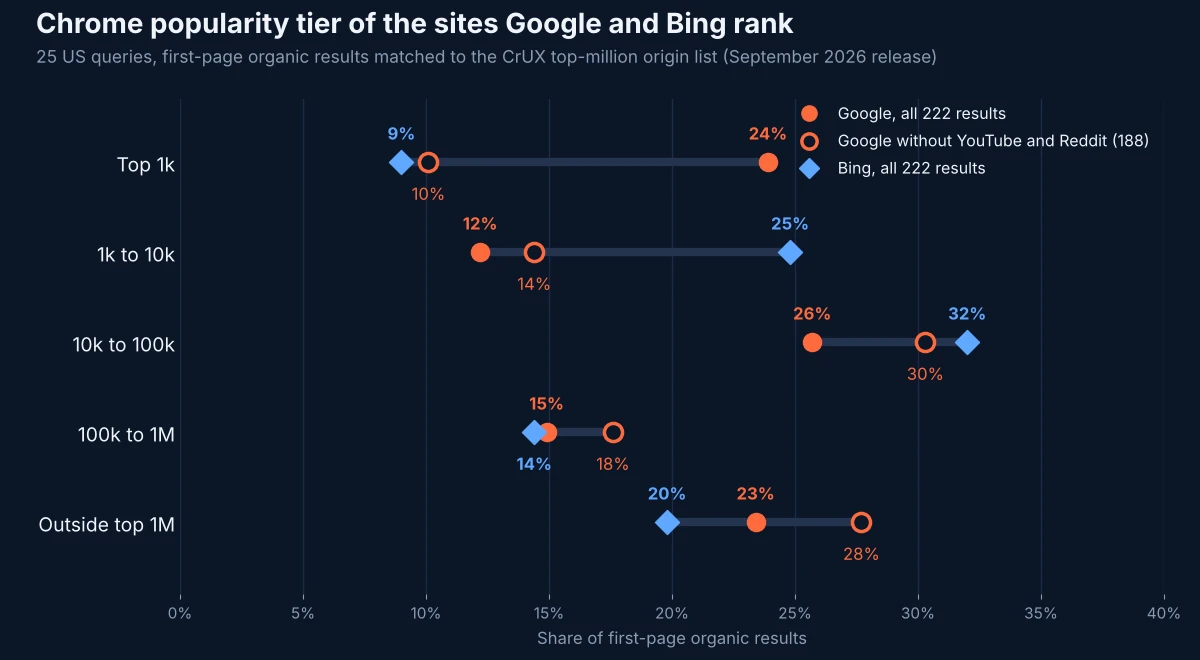
At first glance the theory looks strong. Nearly a quarter of Google's results (53 of 222) came from Chrome's 1,000 busiest origins, against 20 of 222 on Bing. But the top-1,000 group on Google is dominated by three names. YouTube appeared 21 times and Reddit 13 times. Facebook added six more. On Bing, YouTube appeared twice and Reddit not at all.
Strip out YouTube and Reddit and the gap all but closes: 10.1% of Google's remaining 188 results sit in the top 1,000, against 8.2% of Bing's 220. Further down, the pattern reverses. Bing took 25.0% of its results from origins ranked 1,000 to 10,000, against 14.4% for Google without YouTube and Reddit. And Google drew 27.7% of its non-YouTube, non-Reddit results from sites outside Chrome's top million entirely, such as a Minneapolis heart health site, university IT help pages and independent travel blogs. Bing's figure without them was 20.0%.
| Chrome popularity tier | Google, all (222) | Google without YouTube and Reddit (188) | Bing, all (222) |
|---|---|---|---|
| Top 1,000 | 53 (23.9%) | 19 (10.1%) | 20 (9.0%) |
| 1,000 to 10,000 | 27 (12.2%) | 27 (14.4%) | 55 (24.8%) |
| 10,000 to 100,000 | 57 (25.7%) | 57 (30.3%) | 71 (32.0%) |
| 100,000 to 1 million | 33 (14.9%) | 33 (17.6%) | 32 (14.4%) |
| Outside top 1 million | 52 (23.4%) | 52 (27.7%) | 44 (19.8%) |
Position inside Google's results told the same story. Origins in Chrome's top 1,000 made up 24.0% of Google's positions 1 to 3 and 19.4% of positions 7 to 10, a small difference on samples of 75 and 72 results. On a query-by-query basis, Google's first page had the higher share of top-10,000 origins on 14 queries and Bing on 11. Neither points to a consistent lift.
The YouTube and Reddit finding fits other evidence. Google owns YouTube, and in February 2024 it announced an expanded partnership with Reddit that includes access to Reddit's Data API. Our study this morning found Reddit ranking on 30 of 36 Google results pages we pulled for a different query set; in this test it appeared on 12 of 25. Facebook, Amazon and Wikipedia are also top-1,000 Chrome origins, yet appeared on Google only six, one and one times. Our data cannot tell whether Chrome visits or other factors lift YouTube and Reddit on Google.
Evidence against
The court did not find it. The remedies opinion is careful. It records what two exhibits say and then declines to treat that as proof, because nobody testified about how the signal is built or how much it matters. Anyone citing the opinion as confirmation that Google ranks on Chrome data is overstating it.
Several leaked Chrome fields are labelled as debug data. The sitelinks scoring module is described as debug-only for now, and the video module that holds uniqueChromeViews carries an instruction never to populate it into the serving stack. Three more fields are only version stamps in a tracking record. That leaves chromeInTotal as the one field that plausibly sits in a quality signal, and even there the documentation gives no weight or use.
Google's public Chrome data pipelines are opt-in. According to the CrUX methodology, a user's visits only count towards CrUX if they have enabled usage statistics reporting, sync their browsing history and have no sync passphrase. Chrome's help page on URL data says that when Google is the default search engine and the "Make searches and browsing better" setting is on, Chrome sends the address of the current page to Google, with improving address-bar suggestions as the only stated purpose. Neither page says what feeds the internal Chrome visit data behind P*.
Our test shows no broad tilt. If site-level Chrome views were a heavy ranking input, the mid-sized sites that millions of Chrome users visit should beat obscure ones on Google more often than on Bing. We saw the opposite: Google gave more first-page slots to sites outside Chrome's top million. That fits what we found when we asked whether Google favours big brands: the big winners were platforms, not brands in general.
Popularity also steers crawling. The remedies opinion says popularity signals help Google decide how often to recrawl pages so the index stays fresh. Speculation, clearly labelled: if a Chrome-fed popularity signal mattered more for crawling than for ranking on individual queries, that would square the court exhibits with our flat results.
Verdict: likely, but narrow
Likely: Chrome visit data is an input to at least one Google signal. Google's own exhibits, as cited by a federal judge, describe a popularity signal that uses Chrome data, and the leaked documentation stores site-level Chrome views in a site-level quality record. The 2012 denial attributed to Cutts is secondhand and predates both. We found no recent on-record statement from Google that addresses these fields directly.
Unproven: that Chrome traffic is a meaningful ranking factor that lifts popular sites over less visited ones. The court refused to draw that conclusion, the documentation gives no weights, and our 444-result comparison found no Chrome-popularity tilt in Google's results once YouTube and Reddit are set aside. Speculation, clearly labelled: the most plausible reading is that Chrome data helps Google estimate which sites and pages matter enough to crawl often and show as sitelinks, rather than acting as a direct boost on individual queries.
What this means for SEO teams
- Do not buy or fake traffic. Even if site-level Chrome views count, they are pooled across a whole site and, in the one place the court described them, mixed with link counts. Bot visits are unlikely to move them and will pollute your analytics.
- Treat brand demand as a crawl and discovery asset. The court record links popularity signals to crawl frequency, so it is reasonable to expect (though unconfirmed) that sites people visit directly get recrawled sooner. Watch the Crawl Stats report in Search Console after a campaign that lifts direct visits, rather than expecting ranking jumps.
- Design navigation for sitelinks. The leaked sitelinks records refer to Chrome transitions between pages. Make the inner pages people actually use (pricing, login, docs) one click from the home page with clear labels.
- Keep Core Web Vitals in the green. Google says these metrics, which Search Console reports from Chrome field data, are used by its ranking systems. Check the Core Web Vitals report in Search Console for origin-level failures, which affect every page on the site.
Methodology
On 4 November 2026 we ran 30 US English queries through a SERP API, once on Google (desktop, the basic HTML results view, US location) and once on Bing (US market), and saved the archived JSON for each search. Five Bing result sets were unrelated to the query (dictionary pages for "best" or "improve", webmail sign-in pages, or unrelated forum threads), so we dropped those five queries from both engines, leaving 25 queries. We kept every organic result on the first page: 222 on Google and 222 on Bing. We reduced each result URL to its origin (scheme and host) and looked it up in the global CrUX top-million origin list, September 2026 release, downloaded from the public crux-top-lists repository the same day. Origins not on the list were classed as outside the top million. CrUX publishes popularity in buckets, so we grouped the 1,000 to 5,000 and 5,000 to 10,000 buckets into one tier, and did the same for 10,000 to 100,000 and 100,000 to 1 million. For the leaked documentation, we downloaded the source of version 0.4.0 of the google_api_content_warehouse package from the Hex registry, searched the 2,593 model files case-insensitively for "chrome", and removed fields for Chromecast and ChromeOS devices. Court quotations come from the remedies opinion, Document 1436 in case 1:20-cv-03010, filed 2 September 2025. A 25-query sample is small; it can show whether a large effect exists, not measure a small one. CrUX popularity also correlates with links and brand searches, so no observational comparison can isolate Chrome data on its own.
Conclusion
The documents make the old denial hard to sustain in its broadest form. Google's own exhibits describe a popularity signal that uses Chrome data, and its internal documentation stores site-level Chrome views beside a site-level quality score. It is likely that Chrome data plays some role in how Google judges sites.
The results page does not show that role as a visible boost for popular sites. On our 25 queries, Google's first page was not meaningfully more concentrated on Chrome's busiest sites than Bing's once YouTube and Reddit were set aside, and it gave more room to small sites. For now, the evidence supports a narrow conclusion: Chrome data probably helps Google decide what matters across a site, but there is no sign that more Chrome visits buy higher rankings.
What do you think?
Have you seen non-brand rankings or crawl frequency change after a surge in direct or branded traffic, such as a TV campaign or a viral launch, with no new links or content? Tell us what you saw and how long it took; we would like to compare your data with ours.
Questions and answers
Does Google use Chrome data for ranking?
Probably in part, but it is not proven as a direct ranking boost. In the September 2025 remedies opinion in US v. Google, Judge Amit Mehta cited two exhibits suggesting Google's popularity signal (P*) is based on Chrome visit data and anchor counts, but declined to go further because no witness testified about it.
What is chromeInTotal in the Google leak?
chromeInTotal is an attribute in the QualityNsrNsrData module of the leaked Content Warehouse documentation (version 0.4.0). Its description reads site-level Chrome views. The documentation does not say how it is used or weighted.
Did Google ever deny using Chrome data in Search?
In a 2012 WebmasterWorld post, SEO consultant Bill Hartzer wrote that Matt Cutts told him in person that Google's organic algorithm does not use Chrome data. That account is secondhand. Wikipedia's summary of the 2024 leak, citing The Verge, says Google employees had previously denied using Chrome data for ranking.
Does Google favour sites with lots of Chrome traffic?
Not broadly, in our test. Across 25 US queries collected on 4 November 2026, 23.9% of Google's first-page results came from Chrome's top 1,000 origins against 9.0% on Bing, but YouTube and Reddit supplied 34 of Google's 53. Without them the shares were 10.1% and 8.2%, and Google drew more results from sites outside Chrome's top million.
Is Core Web Vitals data from Chrome used in ranking?
Google's page experience documentation says Core Web Vitals are used by its ranking systems, and the Search Console Core Web Vitals report is built on Chrome UX Report field data. Google has not said in its documentation that ranking systems read the CrUX dataset itself.
More releases
-
Studies
Reddit Ranks on 30 of 36 Google SERPs We Pulled but Gets 6% of AI Overview Citations
Reddit blamed AI Overviews for falling Google referrals on its Q3 call. Our check of 36 live US results pages found Reddit still ranked on 30, at a median position of 2, but supplied only 17 of 278 AI Overview citations, while estimated US traffic fell 35% this year.
-
Explainers
Mueller Says Robots.txt Can Hide Pop-ups From Google; 28 of 33 Widget Hosts Don't Block It
Google's John Mueller says blocking a pop-up's script in robots.txt should generally keep Google from rendering it. Our 4 November check found only 5 of 33 consent, pop-up, chat and age-verification script hosts block Googlebot themselves, so most sites need to disallow their own loader file instead.
-
Industry news
AI Mode Sent 35 of 49 Flight Links to Google Pages; Booking Sites Got Just 2
Google AI Mode sent 35 of 49 links in 24 US flight searches to its own pages, mostly Google Flights, our 3 November check found. Booking and fare-comparison sites got 2, despite holding 49% of organic results. Six answers did link elsewhere, mostly to airlines.
Tell us the site and the goals.
Rankings in Google and visibility in AI answers, from one monthly plan. One call is enough to say which one fits. Email works just as well.