Optimizely Hack Hit 178 Brands; 123 of 3,009 Top Sites Run a CSP That Would Block It
An attacker used an Optimizely signup flaw on 16 November to plant malicious JavaScript in customer snippets served on 178 organisations' sites. Report URI found a strict Content Security Policy stopped it. Our crawl of 3,009 top homepages found only 123 with a policy that blocks both routes the payload used.
 Vibhu Dhariwal
Cofounder & CTO, Digital Gratified
- Published
- Section
- Studies
- Reading time
- 8 minutes
Ras Al Khaimah, United Arab Emirates, .
An attacker used a flaw in Optimizely's Web Experimentation signup flow on 16 November to insert malicious JavaScript into customer projects, and that code was then served to visitors of well-known sites from Optimizely's own CDN. Security researcher Scott Helme of Report URI found the code in snippets belonging to 178 organisations, including Zoom, the BBC, CNN and Salesforce. Optimizely confirmed the incident on its status page. Report URI's analysis showed that one browser control, a restrictive Content Security Policy (CSP), separated the sites that blocked the payload from those that ran it. So we checked the homepages of the top 5,000 domains on the Tranco list to see how many already have such a policy. Of the 3,009 homepages that returned HTML, 123 (4.1%) did.
Key findings
- Most top sites have no enforced CSP at all. 1,771 of 3,009 homepages (58.9%) sent no enforced policy. Another 141 of those sent only a report-only policy, which logs violations but blocks nothing.
- Most script rules would not have stopped this attack. 649 homepages set script rules. Of those, 435 allowed 'unsafe-eval' and 436 included a wildcard or scheme-wide source such as https:, either of which would let a payload like this one run.
- Only 123 homepages block both routes the payload used, an unlisted outside host and eval. 70 of them also restrict where the page can send data.
- Optimizely users in our sample look much the same. 45 of the homepages load an Optimizely snippet in their HTML. One of them, ring.com, has a policy that blocks both routes. 16 have no CSP and 14 have a CSP without script rules.
- The snippets we found are clean now. None of the 32 distinct Optimizely snippet files we fetched on 18 November contained the attacker's domains or markers listed by Report URI.
What happened at Optimizely
Each Web Experimentation customer loads a JavaScript snippet that can carry custom Project JavaScript, which runs on every page. According to Report URI, the attacker wrote code into that field, so it was still served from cdn.optimizely.com, a host every affected site already trusted.
In an update posted at 14:49 UTC on 18 November, Optimizely said an unauthorised party had used the signup flaw to impersonate users on targeted customer accounts. The company said it closed the vulnerability within three hours of detection, removed the injected code from all affected projects and that the incident was limited to Web Experimentation. It also said: "Less than 5% of our customers were impacted." It did not say how many projects that was.
Report URI's account gives more detail:
- Scale: 188 of the 1,611 Optimizely snippets it fetched, belonging to 178 organisations, carried the code. Helme says the true number is likely higher.
- Payload: the script swapped cryptocurrency wallet addresses, watched site forms for card numbers, sent cookies not marked HttpOnly and page screenshots to the attacker, and loaded iOS exploit kits on older iPhones and iPads.
- Losses and clean-up: the attacker's wallets had received about $7,040 by 19:25 UTC on 16 November, and Report URI saw every infected Optimizely file cleaned by 23:11 UTC that day.
The SEO link in the chain
Report URI's timeline traces the same actor's injector back to 17 September, when it first appeared on Turkish sites through an SEO "backlink panel" script, and it lists the panel's domain among its indicators of compromise. From 13 November an earlier wave spread through Kissmetrics, StorifyMe and Minute Media scripts. Report URI does not say how the backlink panel script was compromised or how many sites ran it, and we could not verify that independently.
It is the second attack route this week with an SEO thread running through it, after the FBI's warning about SEO poisoning. Link widgets, testing tools and tag scripts all run with the same rights as a site's own code, which makes them attractive targets.
Why CSP decided who was protected
Report URI crawled affected organisations' own hosts and checked their CSPs against what the payload needed. Of the 159 organisations in its results, 68 had no CSP. 50 had one that allowed both the payload and the data theft. 17 let the payload run but blocked the data theft through connect-src, so wallet swapping still worked. 24 (15%) blocked execution, and what they shared was a restrictive script-src.
Two common settings let the code through. 'strict-dynamic' trusts any script that an already trusted script inserts, so the Optimizely snippet could load the attacker's file. 'unsafe-eval' let a fallback copy of the payload run through eval even where the outside file was blocked, which Report URI says is what happened at HSBC. Allowlisting Optimizely's domain could not help, because the bad code came from it.
Optimizely's own CSP guidance for customers is marked as updated on 17 November. When we read it on 18 November, its sample policy used a nonce with 'strict-dynamic' and did not include 'unsafe-eval', which Report URI had said Optimizely's documentation told customers to allow.
How the top 5,000 compare
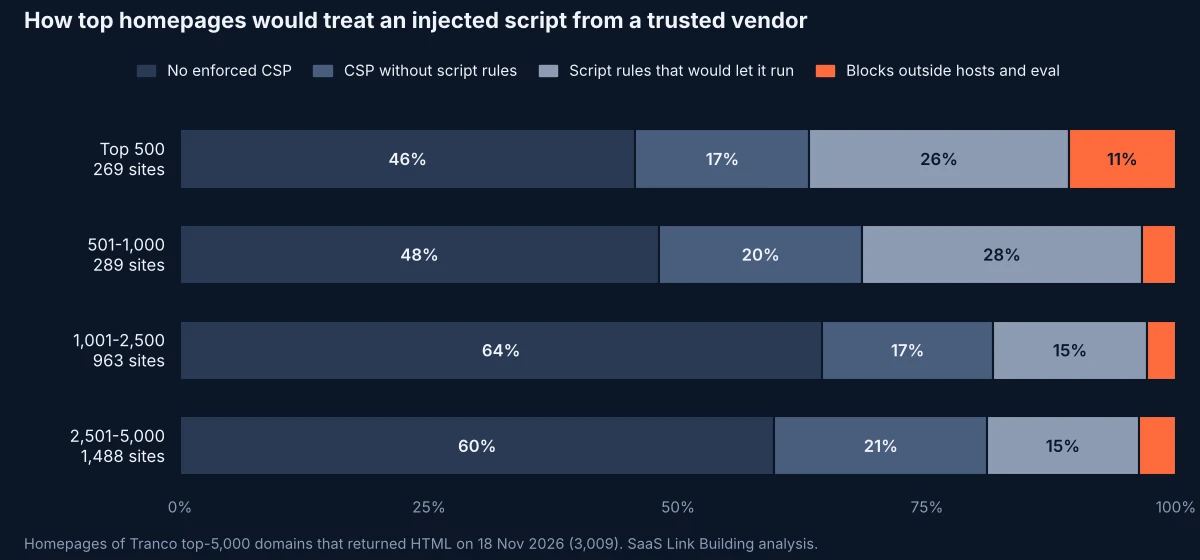
589 homepages (19.6%) sent a CSP with no script-src or default-src rule, typically one limited to framing or upgrading insecure requests. The table shows the full split.
| CSP on the homepage | All homepages (3,009) | Share | Optimizely users (45) |
|---|---|---|---|
| No enforced CSP | 1,771 | 58.9% | 16 |
| CSP without script rules | 589 | 19.6% | 14 |
| Script rules that allow outside hosts and eval | 371 | 12.3% | 9 |
| Blocks unlisted hosts but allows eval | 64 | 2.1% | 3 |
| Allows outside hosts but blocks eval | 91 | 3.0% | 2 |
| Blocks unlisted hosts and eval | 123 | 4.1% | 1 |
The biggest sites do better, though not by much. In the top 500, 29 of 269 homepages (10.8%) block both routes, against 3.5% for ranks 501 to 1,000 and 2.9% to 3.8% further down the list. Even in the top 500, 123 homepages (45.7%) send no enforced policy at all.
Two caveats apply. We looked only at homepages, and checkout or login pages may carry stricter policies. And no host allowlist helps if the payload comes from a host the site already allows.
What Google does when a site serves malware
For search teams the risk goes beyond stolen data. Google's Security issues report help says pages affected by a security issue can appear with a warning label in search results or an interstitial warning in the browser. It lists "malicious JavaScript loaded from another site" among the ways hacked sites redirect visitors, and says a security review after clean-up can take from a few days to a few weeks. Google calls the Search Console report the source of truth, since Safe Browsing warnings depend on context.
Google has not said whether any site affected by this incident received a warning. The injected code was live for less than a day on most affected snippets, according to Report URI's timeline.
What SEO teams should do
- Check the Security issues report now if your site loads Optimizely Web Experimentation or any of the scripts named in the earlier wave. If a warning appears, follow Google's hacked sites guide before requesting a review.
- Search your Optimizely project code. Report URI advises looking in Project JavaScript and experiment custom code for the attacker's domain, for atob( and for any script your team did not write, and checking the History log for changes.
- Inventory every third-party script SEO and marketing added. Testing tools, link widgets, chat and review badges all run with full page rights. Remove what nobody owns. Even core software lags: in our WordPress 7.1.4 patching check, only 45% of top-site installs updated within 12 hours.
- Work with developers on a real script policy. Start in report-only mode, list only the hosts you need, avoid 'unsafe-eval' and wildcard sources, and restrict connect-src. Mozilla's CSP guide explains each directive.
- Plan for downtime during clean-up. If you must take pages offline to remove injected code, serve a 503 rather than a 404 or 500, as Google's John Mueller advised during the PHP security patching in October.
Methodology
On 18 November 2026 between 17:21 and 17:25 UTC we requested the homepage of each of the top 5,000 domains on the Tranco list downloaded that day, first at https://domain/ and then at https://www.domain/, following redirects with a desktop Chrome user agent. 3,009 returned an HTML page with a status below 400; the rest were non-web domains, blocked us or timed out. We read the CSP and report-only CSP headers and any CSP meta tag. Where several policies applied, a route counted as blocked if any one of them blocked it. A policy "blocks unlisted hosts" if its script-src (or default-src when script-src is absent) has no wildcard, no scheme-wide source (https:, http:, data:, blob:) and no 'strict-dynamic'. It "blocks eval" if it lacks 'unsafe-eval'. We counted a site as an Optimizely user if its homepage HTML referenced an Optimizely snippet or CDN host; sites that load Optimizely only through a tag manager are missed, so 45 is a floor. We then downloaded the 32 distinct snippet files referenced and searched them for the attacker domains and markers in Report URI's indicator list. We did not test any policy against the live payload.
Conclusion
The Optimizely incident showed that a trusted vendor's script can turn hostile without any change to a site's own code, and that a strict script policy was the main thing that stopped it. Our crawl suggests that very few large sites have one: 123 of 3,009 top homepages would block both routes this payload used, and 1,771 send no enforced policy at all.
For SEO teams, third-party scripts belong in site health checks alongside crawlability and speed, with Search Console's Security issues report checked whenever a vendor reports a breach.
Questions and answers
What happened in the Optimizely security incident?
On 16 November 2026 an unauthorised party exploited a flaw in the Optimizely Web Experimentation account signup flow, impersonated users on targeted customer accounts and inserted malicious JavaScript into their projects. Optimizely says it closed the vulnerability within three hours of detection and that less than 5% of its customers were affected.
How many sites served the malicious code?
Report URI found the code in 188 of the 1,611 Optimizely snippets it fetched, belonging to 178 organisations including Zoom, the BBC, CNN and Salesforce. It says the true number is likely higher. Optimizely has not given a project count.
How many top sites have a CSP that would have blocked the payload?
In our 18 November crawl of 3,009 homepages from the Tranco top 5,000, 123 (4.1%) had script rules that block both unlisted outside hosts and eval. 1,771 (58.9%) sent no enforced Content Security Policy.
Can a hacked third-party script affect how a site appears in Google Search?
Google's Security issues report help says pages affected by a security issue can show a warning label in search results or a browser interstitial, and that a security review after clean-up can take from a few days to a few weeks. Google has not said whether any site in this incident received a warning.
More releases
-
Studies
Only 6.9% of ChatGPT Prompts Show Buying Intent; Our Test Found Brands in 15 of 15
Only 6.9% of prompts in a SparkToro panel of 12,321 US ChatGPT users showed purchase research. Our own 30-prompt test of OpenAI's GPT-6.1 Sol found the other side: all 15 buying questions got brand picks, usually three with one favourite, while 14 of 15 everyday tasks named no brand.
-
Studies
Does Google Let YouTube Break Its Two-Per-Site Rule? It Took 3+ Spots in 7 of 48 SERPs
Google says it generally shows no more than two listings from one site in its top results. In 48 US searches we ran on 18 November, one site broke that line on 10 pages, YouTube on seven. A full-page recheck confirmed three cases, all YouTube. Our verdict: likely, with caveats.
-
Explainers
Mueller Warns Against 200 'Back Soon' Pages; 10 of 16 Maintenance Plugins Send One
Google's John Mueller says a site that goes down should not serve a 200 "back soon" page, because the text can be indexed and the page de-duplicated. Our source-code review of 16 popular WordPress maintenance plugins found 10 send a 200 by default and five cannot send a 503 at all.
Tell us the site and the goals.
Rankings in Google and visibility in AI answers, from one monthly plan. One call is enough to say which one fits. Email works just as well.