Does Google Let YouTube Break Its Two-Per-Site Rule? It Took 3+ Spots in 7 of 48 SERPs
Google says it generally shows no more than two listings from one site in its top results. In 48 US searches we ran on 18 November, one site broke that line on 10 pages, YouTube on seven. A full-page recheck confirmed three cases, all YouTube. Our verdict: likely, with caveats.
 Vibhu Dhariwal
Cofounder & CTO, Digital Gratified
- Published
- Section
- Studies
- Reading time
- 13 minutes
Ras Al Khaimah, United Arab Emirates, .
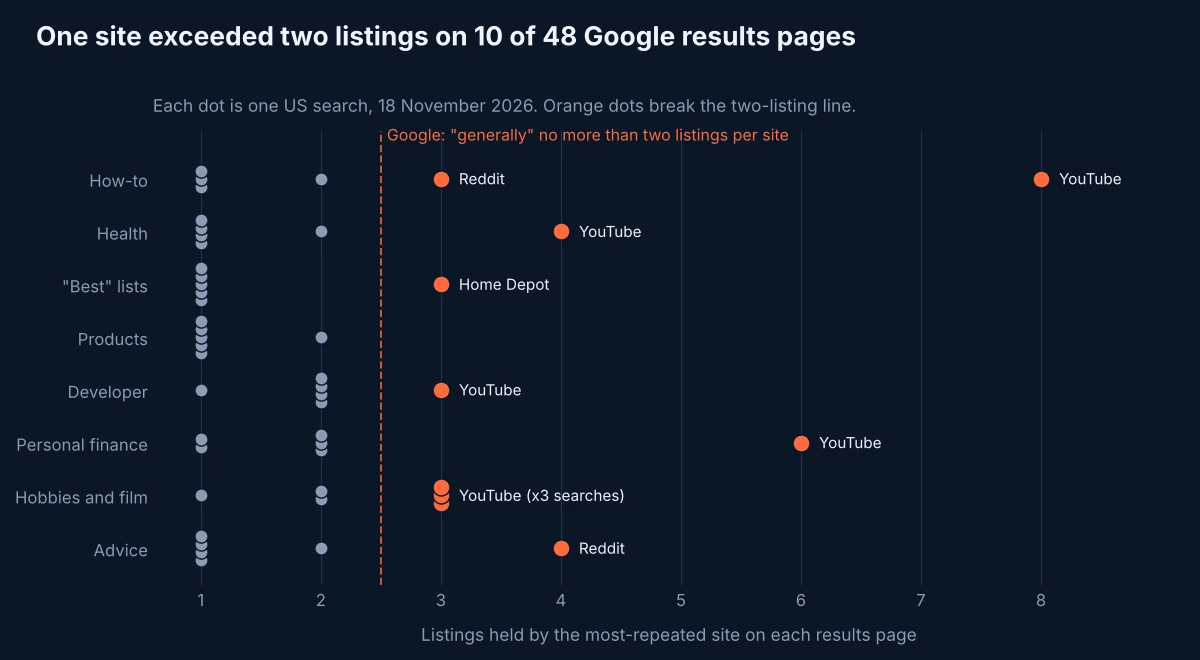
Google says its site diversity system means it "generally won't show more than two web page listings from the same site" in its top results. We tested that promise on 18 November 2026 by pulling 48 US Google results pages across eight kinds of search. On 10 of them (21%), a single site held three or more organic listings. YouTube was the site in seven of those cases, Reddit in three and Home Depot in one, and one search ("best movies of 2025") had both YouTube and Reddit at three listings each. A second pull of the full results pages for those 10 searches confirmed the crowding on three, all of them YouTube.
Our verdict on the theory that YouTube routinely gets past Google's own two-per-site line: likely, on a minority of searches. The cap held on most searches we ran, and Google's documentation leaves room for exceptions, but the exceptions were not spread evenly. Every confirmed case was YouTube, a Google-owned platform; the Reddit cases did not hold up on recheck.
The theory, and who holds it
The idea is simple. Google promised in 2019 to stop one site from taking over a page of results, yet people who watch results closely keep seeing YouTube videos or Reddit threads stacked three, four or more deep. If that is happening at scale, it matters for publishers: every extra slot a platform holds is a slot an independent site does not get.
The promise itself dates from June 2019. Google's Search Liaison account announced the change on Twitter, saying users would no longer see more than two listings from one site in the top results, unless Google judged more to be especially relevant, such as a search naming a specific retailer, 9to5Google reported on 6 June 2019. The same report says Google framed the change as a response to user feedback asking for more variety, and kept it separate from the June 2019 core update announced that week.
Not everyone wanted a tighter cap. In February 2021 The Financial Brand argued the opposite case for banks: that limiting listings per domain favours variety over relevance and frees first-page space for other brands, at the expense of large established ones. So the debate runs in two directions. Some say Google enforces the cap too loosely for big platforms. Others say it enforces it too strictly for brands with many relevant pages.
This newsroom has touched the platform question from other angles. We found YouTube cited in every one of 30 AI Overviews we pulled, and our repeat test of Reddit's presence in Google's top 10 found it on 19 of 36 results pages. Neither test asked how many listings each platform held on a single page, which is what the diversity promise is about.
What Google's documentation actually says
The live version of the rule sits in Google's guide to its ranking systems, which Google last updated on 10 December 2025. Read closely, it makes four separate claims:
- Google generally shows no more than two web page listings from the same site in its top results.
- It may show more than two when its systems decide that is especially relevant for a particular search.
- It generally treats subdomains as part of the root domain, so blog.example.com and example.com count as one site.
- It sometimes treats subdomains as separate sites when it judges that relevant.
Two words carry most of the weight: "generally" and "relevant". Google does not publish what makes a search one where more than two listings are especially relevant, beyond the 2019 retailer example. So any test like ours can show how often the line is crossed, but not whether a given crossing is a bug, a deliberate exception or a sign the rule has loosened. We return to that limit below.
The leaked internal Google API documentation adds little here. The leaked CrowdingPerDocData module, whose name points at the "crowding" concept, lists a single attribute, newscluster. That suggests some crowding data is tracked for news clusters, but the page we opened says nothing about how web results from one site are capped. Anything more would be speculation.
Evidence for the theory: our 48-search test
We ran 48 searches in eight groups of six: how-to tasks, health questions, "best" product lists, product names, developer topics, personal finance, hobbies and film, and general advice. We counted the organic listings on each first page, mapped every listing to its registrable domain (so www.youtube.com and m.youtube.com count as youtube.com), and recorded how many listings the most-repeated domain held.
The headline numbers:
- Across the 48 pages we captured 424 organic listings, an average of 8.8 per page.
- On 25 pages (52%), no domain appeared more than once. On 13 more, the top domain held exactly two listings. So 38 of 48 pages (79%) stayed within the two-listing line.
- On the other 10 pages, one domain held three or more listings. Those over-limit domains held 43 listings between them, 21 more than a strict two-per-site cap would allow, or 5% of all listings we captured.
- YouTube held 62 of the 424 listings (14.6%) and Reddit held 23 (5.4%). No other domain came close.
Here are the 10 pages that crossed the line, with the result of a second check we describe in the next section:
| Search | Group | Site over the line | Listings (of page) | Positions | Full-page recheck |
|---|---|---|---|---|---|
| how to make sourdough bread | How-to | YouTube | 8 of 9 | 1-7, 9 | Confirmed |
| how to budget | Finance | YouTube | 6 of 9 | 2, 4, 6-9 | Confirmed |
| how to lower blood pressure | Health | YouTube | 4 of 9 | 2, 5, 6, 9 | Confirmed |
| best way to learn to code | Advice | 4 of 9 | 3, 5, 6, 8 | Not confirmed | |
| best movies of 2025 | Film | YouTube and Reddit | 3 each, of 9 | 1, 2, 9 and 3, 5, 7 | Not confirmed |
| css grid tutorial | Developer | YouTube | 3 of 9 | 1, 2, 7 | Not confirmed |
| how to play chess | Hobbies | YouTube | 3 of 9 | 2, 6, 7 | Not confirmed |
| guitar chords for beginners | Hobbies | YouTube | 3 of 8 | 3, 5, 7 | Not confirmed |
| how to tie a tie | How-to | 3 of 8 | 4, 6, 8 | Not confirmed | |
| best air purifier | "Best" lists | Home Depot | 3 of 9 | 3, 6, 9 | Not confirmed |
Source: SaaS Link Building analysis of 48 US Google results pages collected through a SERP API on 18 November 2026, with a second full-page pull for the 10 searches listed.
Three patterns stand out. First, the crowding was concentrated: YouTube or Reddit accounted for every over-limit page except one. Second, it was concentrated by intent. The hobbies and film group had three over-limit pages out of six and how-to had two, while the six product-name searches had none and the "best" lists had only the Home Depot case. Third, the worst cases were extreme rather than marginal. For "how to make sourdough bread", YouTube held eight of nine organic listings, including all of positions one to seven.
We also checked the subdomain clause. Only two pages showed one root domain under more than one hostname (www.scribd.com with fr.scribd.com, and www.youtube.com with m.youtube.com), and in neither case did splitting by subdomain push a site past two listings. In this sample, subdomains were not how sites got around the cap.
Evidence against the theory
There are four serious reasons to doubt that our numbers show Google breaking its rule.
1. The rule was never absolute
Google's own wording allows more than two listings when its systems judge that especially relevant. A search like "how to make sourdough bread" has a strong video intent, and YouTube hosts videos from thousands of independent creators. Google could argue, and the documentation would support it, that several videos from different creators are the most relevant answers even though they share one domain. On that reading, our 10 pages show the exception working as designed rather than a broken promise.
2. The second pull did not agree
For each of the 10 over-limit searches we pulled the full Google results page a second time, minutes after the first pull, using a different result format from the same SERP API. The crowding was confirmed on three pages: sourdough, budgeting and blood pressure, all YouTube. On the other seven, the second page showed different domains, and no site exceeded two clearly identifiable listings. A few listings on the second pull showed only a view count rather than a hostname, so we could not count them for any site.
That instability matters. Results pages served to automated tools are not always the pages people see, a problem this newsroom has reported on before: in our repeat-fetch test of poisoned Google results, 12 of 24 repeat fetches failed to agree. Several pages in both of today's pulls also included small sites we would not expect to rank for broad health or how-to searches, which fits that pattern. We cannot rule out that some of what we measured is noise in how Google serves automated requests.
3. Most searches were clean
Even taking the first pull at face value, 79% of pages stayed within the line and over half showed no repeated domain at all. That is not what a system that has stopped working would produce. The cap looks alive, with exceptions, rather than abandoned.
4. Our sample is small and US-only
Forty-eight searches in one country on one day, with the device type left to the data provider's default, cannot describe Google's behaviour in general. A different set of searches, or a mobile pull, could produce a higher or lower rate. The direction of the YouTube finding repeated across groups, but the exact percentages should be read as indicative.
Does it matter that YouTube is Google's own?
This is the part of the debate that draws the most heat, so it needs care. YouTube is owned by Google, and in our sample it was the site most likely to exceed the two-listing line, doing so on seven of 48 pages. That is a fact about our data. Whether it reflects favouritism is a different question, and our test cannot answer it.
The innocent explanation is plausible: YouTube is the largest video host on the web, how-to and hobby searches have obvious video intent, and the second-largest offender in our sample was Reddit, which Google does not own. Speculation, clearly labelled: if Google's systems treat individual YouTube channels or Reddit communities as distinct sources for diversity purposes, much as the documentation allows subdomains to be treated separately in some cases, that would produce exactly the pattern we saw. Google has not said it does this, and we found no documentation that it does.
Our earlier test of whether Google favours big brands found that YouTube and Reddit, rather than big brands, came out ahead. Today's data adds a sharper detail. When those platforms win, they sometimes win several slots at once.
Verdict: likely
We rate the theory likely, in this specific form: YouTube exceeds Google's two-listings-per-site guideline on a minority of informational searches, particularly how-to searches with video intent. Whether that is a deliberate exception or a gap in enforcement, our test cannot say.
The reasoning. In our first pull, one site crossed the line on 10 of 48 pages, and YouTube or Reddit was that site on all but one. The stricter number is three of 48 (6%): the pages where a full-page recheck independently confirmed the crowding, all YouTube, with three or four readable YouTube listings each. That is enough to show that heavy single-site crowding happens on live Google pages and is not an artefact of one data format.
What we cannot confirm is the broader version of the theory, that Google has stopped enforcing site diversity. The cap held on most searches, and Google's own documentation permits exceptions. The Reddit cases are unconfirmed, and why YouTube benefits most remains unproven.
What this means for SEO teams
- Check your own target searches for crowding. If one platform holds three or more listings on a search you care about, your realistic page-one ceiling is lower than ten slots. Count listings per domain, not just your own position.
- Treat video intent as a structural fact. On how-to and hobby searches in our sample, YouTube held up to eight of nine organic listings. If a target search looks like that, a video on YouTube may be the only practical way onto page one.
- Do not expect subdomains to win extra slots. Google says it generally treats subdomains as one site, and in our sample no site used subdomains to get past two listings.
- Recheck before you report. Our two pulls disagreed on seven of 10 crowded pages. Before telling a client a competitor holds four slots, pull the page more than once, ideally by hand from a normal browser session as well.
- Watch Reddit threads as well as videos. Reddit held four of nine listings for "best way to learn to code" in our first pull, though our recheck showed only one. Forum-heavy intents may crowd the same way video intents do, but our evidence for that is unconfirmed.
Methodology
On 18 November 2026, between 09:19 and 09:28 UTC, we collected Google results for 48 searches through a SERP API, using its lightweight Google results format with the location set to the United States, the country set to US and the interface language set to English. The searches were split into eight groups of six (how-to, health, "best" lists, products, developer topics, personal finance, hobbies and film, advice). For each search we kept every organic listing returned on the first page, between eight and 10 per search, 424 in total. Ads, AI Overviews, video carousels, People Also Ask boxes and other features were excluded.
Each listing was assigned a hostname from its link, or from its displayed address where the link was a Google redirect, and then reduced to its registrable domain using the Public Suffix List. A page counted as over the line when any registrable domain held three or more of its organic listings.
For the 10 over-limit searches we pulled the full Google results page a second time through the same SERP API between 09:20 and 09:29 UTC, and counted listings per domain in the same way. A case counted as confirmed only when the same domain held three or more listings whose hostname we could read. Listings shown with only a view count were not attributed to any site.
Limitations: one country, one day, one data provider and 48 searches; results served to automated tools may differ from those users see; and Google does not publish which searches qualify for its "especially relevant" exception, so we cannot say whether a given over-limit page is intended.
Conclusion
Google's two-listings-per-site promise mostly holds, but not evenly. In our first pull it broke on about one search in five, almost always in favour of YouTube or Reddit; on recheck, three cases held, all YouTube, and on how-to searches the crowding could be heavy. Google's documentation leaves room for that, and our own rechecks show how unstable automated results pages can be. Even so, three confirmed pages where YouTube held at least three readable listings, and up to eight in our first pull, are hard to square with a plain reading of "generally won't show more than two".
For publishers, the practical lesson is to count slots by domain on the searches that matter, and to plan for platforms rather than against them where intent clearly favours video or forum threads.
What do you think?
Have you seen one site, YouTube, Reddit or a big retailer, take three or more organic listings on a search you track, and did it hold when you checked again from a normal browser? Share the search and what you saw, and we will add confirmed examples to a follow-up test.
Questions and answers
What is Google's site diversity system?
According to Google's guide to its ranking systems, it is a system that generally stops Google from showing more than two web page listings from the same site in its top results, so no single site dominates. Google says it may show more than two when its systems judge that especially relevant for a search.
When did Google introduce the two-listings-per-site limit?
Google's Search Liaison account announced the change in June 2019, as reported by 9to5Google on 6 June 2019. Google described it as separate from the June 2019 core update.
Does Google count subdomains as separate sites for diversity?
Google's documentation says site diversity generally treats subdomains as part of the root domain, but sometimes treats them as separate sites when deemed relevant. In our 48-search sample, no site used subdomains to exceed two listings.
How often did one site exceed two listings in this test?
On 10 of 48 US Google results pages collected on 18 November 2026, one site held three or more organic listings. YouTube was that site on seven pages, Reddit on three and Home Depot on one. A second full-page pull confirmed three of the 10 cases, all YouTube.
Has Google said YouTube is exempt from site diversity?
No. Google's documentation names no site-specific exemptions. It only says more than two listings may appear when its systems judge that especially relevant for a particular search.
More releases
-
Studies
Optimizely Hack Hit 178 Brands; 123 of 3,009 Top Sites Run a CSP That Would Block It
An attacker used an Optimizely signup flaw on 16 November to plant malicious JavaScript in customer snippets served on 178 organisations' sites. Report URI found a strict Content Security Policy stopped it. Our crawl of 3,009 top homepages found only 123 with a policy that blocks both routes the payload used.
-
Studies
Only 6.9% of ChatGPT Prompts Show Buying Intent; Our Test Found Brands in 15 of 15
Only 6.9% of prompts in a SparkToro panel of 12,321 US ChatGPT users showed purchase research. Our own 30-prompt test of OpenAI's GPT-6.1 Sol found the other side: all 15 buying questions got brand picks, usually three with one favourite, while 14 of 15 everyday tasks named no brand.
-
Explainers
Mueller Warns Against 200 'Back Soon' Pages; 10 of 16 Maintenance Plugins Send One
Google's John Mueller says a site that goes down should not serve a 200 "back soon" page, because the text can be indexed and the page de-duplicated. Our source-code review of 16 popular WordPress maintenance plugins found 10 send a 200 by default and five cannot send a 503 at all.
Tell us the site and the goals.
Rankings in Google and visibility in AI answers, from one monthly plan. One call is enough to say which one fits. Email works just as well.