Only 6.9% of ChatGPT Prompts Show Buying Intent; Our Test Found Brands in 15 of 15
Only 6.9% of prompts in a SparkToro panel of 12,321 US ChatGPT users showed purchase research. Our own 30-prompt test of OpenAI's GPT-6.1 Sol found the other side: all 15 buying questions got brand picks, usually three with one favourite, while 14 of 15 everyday tasks named no brand.
 Vibhu Dhariwal
Cofounder & CTO, Digital Gratified
- Published
- Section
- Studies
- Reading time
- 7 minutes
Ras Al Khaimah, United Arab Emirates, .
Only 6.9% of prompts in a panel of US ChatGPT users showed any research into a brand to buy from, according to an analysis SparkToro published on 17 November. Co-founder Rand Fishkin worked from 118,163 prompts in 41,961 conversations, shared by 12,321 opt-in users of the data company Verso between 1 January and 29 October 2026, and found that 12.1% of ChatGPT's responses named one or more brands, products or companies.
Those figures describe how much of ChatGPT's traffic is commercial. They do not describe what happens inside the commercial slice. To test that, we sent 30 prompts to OpenAI's GPT-6.1 Sol model with web search switched on: 15 purchase-research questions and 15 everyday tasks drawn from the panel's main usage categories. Every one of the 15 buying answers named at least one brand. Fourteen of the 15 everyday answers named none.
Key findings
- Panel data: 6.9% of prompts showed purchase research, and 12.1% of responses named a brand, product or company (SparkToro and Verso, 17 November).
- Our test, buying prompts: 15 of 15 answers named at least one brand, 36 brands in all, and 13 of 15 opened with a single lead pick ("My pick", "I'd start with").
- Our test, everyday prompts: 14 of 15 answers named no brand; the exception, a Wi-Fi troubleshooting answer, named three operating systems while asking which one the user had.
- Sources: all 15 buying answers cited web pages, and half of those citations (22 of 44 domain citations) went to review publishers. Brands' own sites took 12.
- Google cross-check: on the three buying queries where Google showed an AI Overview in our pull, it led with the same brand ChatGPT picked first.
What the panel found
The SparkToro report sorted each conversation into one of 12 categories using a 34-intent codebook, with Anthropic's Claude doing the labelling and a second labeller re-coding a random sample. The two agreed on 90% of category labels and on 97% to 99% of brand tags. Images and visual design was the largest category at 16.1% (measured per user), followed by information and entertainment at 14.0% and everyday life and admin at 12.2%. Shopping, brands and local services came eighth, at 5.7%.
The report compares its 6.9% purchase-research figure with an earlier analysis of 332 million Google queries in which more than 15% matched the same definition. Fishkin estimates Google's purchase-intent rate at about 2.8 times ChatGPT's, and argues that Google's AI Overviews and AI Mode, not ChatGPT, are the main reason AI visibility matters to brands.
The panel has limits the report spells out: it skews younger, female and lower income, it was recorded mostly on phones, and it cannot see API traffic. Weighting 9,675 panelists with demographic records to 2024 US Census targets moved no category by more than 1.4 percentage points. According to the report, OpenAI's own Signals usage data, which covers Free, Go, Plus and Pro accounts, shows a larger share of technical help and writing, while the panel shows more image requests and practical how-to questions. We covered a different cut of that OpenAI data in our report on the information-seeking share of ChatGPT messages.
Our test: brands appear only where buying starts
The panel tells marketers how often buying conversations happen. Our pull looked at what the model does once one starts. The 15 buying prompts were unbranded "best X for Y" requests, the first taken from the report's own example of purchase research; the 15 everyday prompts covered the panel's other text categories, from writing a landlord email to explaining photosynthesis.
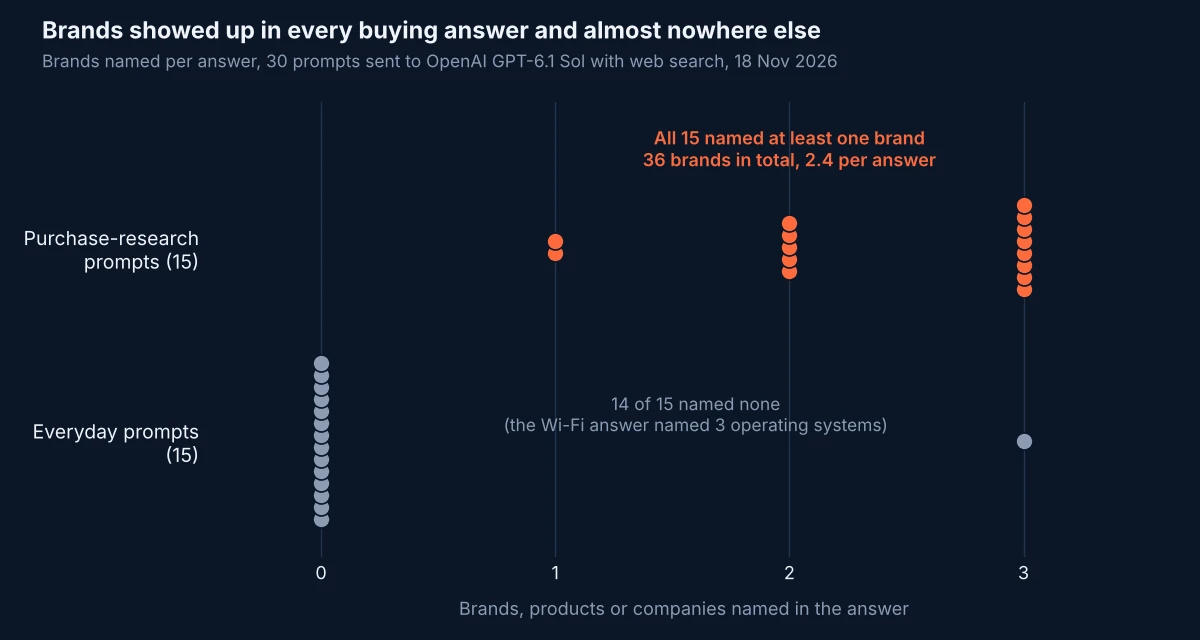
The buying answers did not hedge. Thirteen of the 15 named one product first, usually followed by one or two alternatives: the Roborock Q7 M5 for a budget pet-hair vacuum, the Wells Fargo Autograph card for a no-fee travel card, Asana Starter for a small marketing team's project software. The two exceptions (running shoes and a cheap unlimited phone plan) split the lead between two products depending on the user's situation. Eight of the 15 answers named exactly three brands.
Where ChatGPT went for its picks
All 15 buying answers searched the web and cited pages. Counting each domain once per answer, the citations broke down like this:
| Source type | Domain citations | Share | Examples |
|---|---|---|---|
| Review publishers and media | 22 | 50% | RTINGS (3 answers), TechRadar, Good Housekeeping, Sleep Foundation |
| Brand-owned pages | 12 | 27% | Pages from Asana, ClickUp, Trello, US Mobile, Visible, Square, Wix |
| Government, medical and nonprofit | 7 | 16% | NHTSA, EPA, Mayo Clinic, American Academy of Pediatrics |
| Retailers | 3 | 7% | REI, Newegg |
| Total | 44 | 100% | 15 answers |
Source: SaaS Link Building newsroom pull, 18 November 2026. Each domain counted once per answer.
Brand-owned pages carried the software and services answers. For project management software, phone plans and website builders, every citation went to the vendors' own pages. For physical products, the model leaned on independent testers. Everyday prompts behaved differently: only 5 of the 15 cited anything, and 9 of their 10 domain citations went to government, health and medical bodies such as the IRS, CDC, FTC and NIH. The tenth was Microsoft's support site, in the Wi-Fi answer.
A quick Google comparison
We also pulled Google's US desktop results for four of the buying queries (two further requests returned server errors). Google showed an AI Overview on three of them, and in each case the overview's first brand matched ChatGPT's first pick: Roborock for the pet-hair vacuum (though Google named the Q7 L5 model rather than the Q7 M5), the Wells Fargo Autograph card, and Home Chef for a family meal kit. The headphones query showed no AI Overview in our pull. Three queries are too few to generalise, but they fit the report's argument that the same buying questions run through Google at far larger volume.
What this means for SEO teams
- Size the opportunity honestly. If roughly 7% of ChatGPT prompts carry purchase research, the brand-relevant share of ChatGPT is small. Our earlier coverage of ChatGPT's referral traffic against Google organic points the same way.
- Inside that slice, the shortlist is short. Most buying answers in our test named three brands and crowned one. Being the fourth option is close to being absent.
- Know which pages the model reads. For hardware and household products, independent review sites carried the citations; for software and services, the vendors' own pages did. Keep pricing, plan limits and feature tables current and crawlable, because the model took prices and plan details straight from them.
- Track by query type, not by platform total. Our October test of ChatGPT's searches for unbranded prompts found brand names in 77 of 82 of the searches the model ran. Monitoring a fixed set of buying prompts tells you more than an overall mention rate.
Methodology
On 18 November 2026, between about 13:20 and 13:40 UTC, we sent 30 single-turn prompts through a commercial LLM-response API to OpenAI's GPT-6.1 Sol model, with web search enabled, the search country set to the US and a 1,024-token output cap. Fifteen prompts were unbranded purchase-research questions across consumer and business categories; fifteen were everyday tasks spread across the panel's text categories (information, life admin, writing, health, money and work, schoolwork, technology, relationships and creative writing). Image requests were excluded because the API returns text only. We counted a brand when an answer named a commercial company, product or service in its text; cited sources were not counted as brand mentions, and public and nonprofit bodies (the IRS, CDC, Mayo Clinic) were not counted as brands. Citations were taken from the response annotations and counted once per domain per answer, then classed by hand. Google results came from a SERP data API for US English desktop searches on the same day; two of six requests failed and are excluded. API answers can differ from the consumer ChatGPT app, which adds personalisation, memory and its own default model, and a single run of each prompt does not capture answer-to-answer variation.
Conclusion
The panel data and our test describe two sides of the same picture. Buying research is a small share of what Americans ask ChatGPT, so the platform's total reach overstates its commercial weight. When a buying question does arrive, the answer in our test was a confident shortlist of about three brands with one favourite, built mostly from review sites and, for software, from the vendors' own pages.
For SEO teams that means a narrow but high-stakes target: the buying prompts that matter in a category, the review pages the model trusts for them, and the vendor pages it quotes.
Questions and answers
What share of ChatGPT prompts show purchase intent?
In SparkToro's analysis of 118,163 prompts from 12,321 US panel users (1 January to 29 October 2026), 6.9% of prompts showed research into a brand to buy from, and 12.1% of ChatGPT's responses named at least one brand, product or company.
How often did ChatGPT's model name brands for buying questions in your test?
All 15 unbranded purchase-research prompts we sent to OpenAI's GPT-6.1 Sol model with web search on got at least one brand, 36 in total, and 13 of the 15 answers opened with a single lead pick. Fourteen of 15 everyday prompts named no brand.
Which sources did the model cite for buying answers?
Counting each domain once per answer, 22 of 44 citations went to review publishers and media, 12 to brands' own pages, 7 to government, medical and nonprofit sites and 3 to retailers. The project software, phone plan and website builder answers cited only the vendors' own pages.
Does the API test reflect the ChatGPT app?
Not exactly. Our test used OpenAI's API model with web search, one run per prompt, on 18 November 2026. The consumer ChatGPT app adds personalisation, memory and its own default model, so answers there can differ.
More releases
-
Studies
Optimizely Hack Hit 178 Brands; 123 of 3,009 Top Sites Run a CSP That Would Block It
An attacker used an Optimizely signup flaw on 16 November to plant malicious JavaScript in customer snippets served on 178 organisations' sites. Report URI found a strict Content Security Policy stopped it. Our crawl of 3,009 top homepages found only 123 with a policy that blocks both routes the payload used.
-
Studies
Does Google Let YouTube Break Its Two-Per-Site Rule? It Took 3+ Spots in 7 of 48 SERPs
Google says it generally shows no more than two listings from one site in its top results. In 48 US searches we ran on 18 November, one site broke that line on 10 pages, YouTube on seven. A full-page recheck confirmed three cases, all YouTube. Our verdict: likely, with caveats.
-
Explainers
Mueller Warns Against 200 'Back Soon' Pages; 10 of 16 Maintenance Plugins Send One
Google's John Mueller says a site that goes down should not serve a 200 "back soon" page, because the text can be indexed and the page de-duplicated. Our source-code review of 16 popular WordPress maintenance plugins found 10 send a 200 by default and five cannot send a 503 at all.
Tell us the site and the goals.
Rankings in Google and visibility in AI answers, from one monthly plan. One call is enough to say which one fits. Email works just as well.