Mueller Warns Against 200 'Back Soon' Pages; 10 of 16 Maintenance Plugins Send One
Google's John Mueller says a site that goes down should not serve a 200 "back soon" page, because the text can be indexed and the page de-duplicated. Our source-code review of 16 popular WordPress maintenance plugins found 10 send a 200 by default and five cannot send a 503 at all.
 Vibhu Dhariwal
Cofounder & CTO, Digital Gratified
- Published
- Section
- Explainers
- Reading time
- 8 minutes
Ras Al Khaimah, United Arab Emirates, .
Google's John Mueller has explained why a site that goes down should not answer with a normal 200 status code and a "back soon" message. Replying to a question from Ty Holland in a LinkedIn thread, reported by Search Engine Roundtable on 17 November, he gave two reasons: the placeholder text can get indexed, and pages that show the same text as other sites can be de-duplicated, which can take a long time to undo. To see how often that mistake is built into common tools, we read the source code of the 16 most-installed WordPress maintenance and coming-soon plugins. Ten of them answer with a 200 when switched on with their default settings.
What Mueller said
Holland asked whether a 200 "back soon" page causes problems if the outage lasts only a few hours. Mueller's answer, as summarised in the report, set out two risks.
- The outage text can be indexed. A 200 tells Google the page is fine, so "try again later" can end up as the content Google stores. This repairs itself once the real content returns.
- The page can be folded into a duplicate cluster. If the placeholder matches text on other sites, Google may treat the URL as a duplicate. Mueller noted this is slower to reverse, because pages treated as duplicates tend to be crawled less often.
The second risk follows from how canonicalization works: Google picks one representative URL from a set of duplicate pages and shows only that version in results. A generic maintenance template served across thousands of sites is the kind of near-identical content that process exists to collapse.
What Google's documentation says about the alternative
Google's HTTP status code documentation spells out the difference. A 5xx response makes Google's crawlers slow down temporarily, and the content of a 5xx response is ignored. Pages already in the index are preserved for a while but eventually dropped if the errors persist. A 200 response, by contrast, passes the content on to indexing, and if that content looks like an error message, Search Console can report it as a soft 404.
Google's guide to pausing or disabling a website recommends a 503 with an informational error page if a site must go dark urgently for one to two days, and calls a full shutdown an extreme step for a few days at most. It also warns against returning a 503 for robots.txt, because that blocks all crawling, and suggests confirming the status code with curl. Mueller gave the same 503 advice last month on PHP patching downtime.
Our check: what maintenance plugins actually send
Most site owners do not write their own outage page. On WordPress they switch on a plugin. We pulled the WordPress.org plugin directory on 18 November, kept the 16 dedicated maintenance and coming-soon plugins with at least 5,000 active installs, downloaded the current version of each and read the code that serves the holding page. The table records what each one sends with its default settings.
| Plugin (version) | Active installs | Default status | What the code does |
|---|---|---|---|
| Maintenance (4.33) | 1,000,000+ | 200 | 503 only if the "Enable 503" box is ticked; it is off by default |
| SeedProd Website Builder, slug coming-soon (6.20.13) | 600,000+ | Depends | Coming Soon mode 200; Maintenance mode 503 with Retry-After of one day |
| Under Construction (5.83) | 500,000+ | 200 | Always 200, plus a Retry-After header; no 503 setting |
| LightStart, slug wp-maintenance-mode (2.6.26) | 400,000+ | 503 | 503 with Retry-After |
| CMP Coming Soon and Maintenance (4.1.22) | 200,000+ | 200 | Coming Soon is the default mode; Maintenance mode sends 503 with a one-day Retry-After |
| Minimal Coming Soon (2.45) | 100,000+ | 200 | The 503 option is shown but limited to the Pro version |
| WP Maintenance (6.1.10.1) | 60,000+ | 503 | 503 option on by default, Retry-After of one day |
| Slim Maintenance Mode (1.4.6) | 10,000+ | 503 | 503, no Retry-After |
| Under Construction, Coming Soon and Maintenance Mode (3.1.0) | 10,000+ | 503 | 503 with Retry-After |
| Maintenance Redirect (2.2.1) | 10,000+ | 200 | 200 by default; 503 is a setting |
| Nifty Coming Soon (3.0.18) | 10,000+ | 200 | Sets no status code of its own |
| Ultimate Coming Soon (2.0.2) | 9,000+ | 200 | Sets no status code of its own |
| Maintenance Mode by HKdev (3.2.1) | 8,000+ | 200 | 200 by default; 503 is a setting |
| Coming soon and Maintenance mode (3.8.8) | 8,000+ | 200 | Sets no status code of its own |
| Coming Soon Maintenance Mode (1.3.0) | 6,000+ | Depends | Coming Soon mode 200; Maintenance mode 503 with a one-hour Retry-After |
| Coming Soon and Maintenance Mode by Colorlib (1.4.1) | 5,000+ | 200 | Coming Soon is the default mode; Maintenance mode sends 503 with a one-hour Retry-After |
Key findings
- 10 of 16 plugins answer with a 200 when switched on as installed, including the most-installed one.
- Only 4 of 16 send a 503 by default.
- 5 plugins cannot send a 503 at all in their free versions: Under Construction, Minimal Coming Soon, Nifty Coming Soon, Ultimate Coming Soon and Coming soon and Maintenance mode.
- Two plugins split the choice into modes. SeedProd and Coming Soon Maintenance Mode send 503 only if you choose their maintenance mode rather than coming soon.
Weighted by active installs, the picture tilts further, because the largest plugin in the group defaults to a 200.
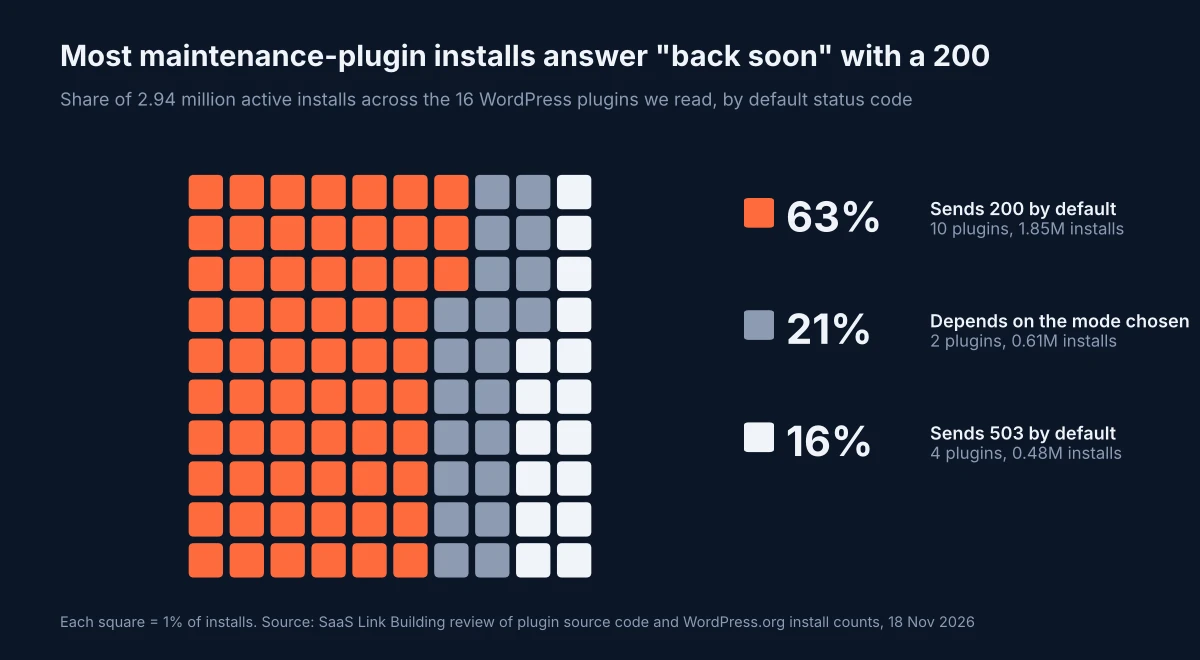
The labels explain part of the split. Several plugins treat "coming soon" as a launch page for a site that has never been indexed, where a 200 is a reasonable choice, and keep the 503 for "maintenance". Colorlib's settings screen says so directly. The trouble starts when an owner of an established site picks the default mode for a few hours of work, which is the scenario Holland asked about.
One oddity stands out: Under Construction sends a 200 together with a Retry-After header. Google's crawl rate documentation describes Retry-After as a header to include when returning a 503 or 429, telling its crawlers when to try again.
WordPress core is changing how it handles this
WordPress's own maintenance screen, the one shown during updates, already does what Google asks. In the 7.1.4 release code, the built-in "Briefly unavailable for scheduled maintenance" message goes out with a 503 and a 600-second Retry-After. If a site uses a custom maintenance.php drop-in, though, core hands over to that file without setting a status, so the drop-in decides.
That gap is closed in the development branch, where a code comment marked for version 7.2.0 says core now sends the status, no-cache and Retry-After headers before loading a custom drop-in. If it ships as written, sites that update quickly, as many did after the 7.1.4 security release, will get the fix with that version. The database failure screen, "Error establishing a database connection", is served through wp_die, which returns a 500 by default.
What SEO teams should do
- Test the status, not the page. Switch on maintenance mode on a staging copy and run
curl -Iagainst the home page and a deep URL while logged out. Google's own guide recommends the same check. - Pick the maintenance mode, not coming soon, on any site that is already indexed. In the Maintenance plugin, tick the 503 box; in Maintenance Redirect and HKdev, change the header setting from 200 to 503.
- Swap plugins that cannot send a 503 if the site will ever go down for work, or set the status in server configuration instead.
- Keep robots.txt at 200 during the outage. A 503 on robots.txt stops crawling of the whole site.
- Use a Retry-After value that matches reality. The plugins above range from 600 seconds to a full day. Google's guidance on Retry-After and crawl rate explains how Googlebot reads it.
- Keep outages short. Past a few days, persistent 5xx errors lead to URLs dropping from the index, a different problem from the soft 404s a 200 error page can trigger.
Methodology
On 18 November 2026 we queried the WordPress.org plugin directory API for the terms "maintenance mode", "coming soon", "maintenance" and "under construction", and kept every plugin whose main purpose is a maintenance or coming-soon page and that reports at least 5,000 active installs. General tools with a maintenance switch, such as caching or hosting plugins, were excluded. We downloaded each current release and searched the code for status headers, status_header() calls, wp_die() response codes and Retry-After headers, then read the surrounding logic and default settings. "Default status" means the code path taken when the plugin is switched on without changing other settings. We did not install or run the plugins, so caching layers, hosting rules or Pro add-ons could change what a live site returns. Install counts are the rounded figures WordPress.org publishes. WordPress core behaviour was read from the 7.1.4 release tag and the development trunk on GitHub.
Conclusion
Mueller's answer turns a common shortcut into a measurable risk: a few hours of "back soon" on a 200 can put placeholder text in the index, and any duplicate clustering that follows is slower to clear. The tools most site owners reach for do not protect them by default. Ten of the 16 plugins we read send a 200 out of the box, and five cannot send a 503 at all in their free versions.
The fix is cheap. Choose the maintenance setting that returns a 503, confirm it with curl before the work starts, leave robots.txt alone, and bring the site back within a day or two.
Questions and answers
Why shouldn't a site serve a 200 status code while it is down?
According to Google's John Mueller, a 200 tells Google the page is fine, so a "try again later" message can be indexed as the page's content, and pages that show the same text as other sites can be de-duplicated, which can take a long time to reverse.
What status code does Google recommend during a short outage?
Google's guide to pausing or disabling a website recommends returning a 503 with an informational error page if the site must be disabled urgently for one to two days, and warns against returning a 503 for robots.txt.
How many WordPress maintenance plugins send a 200 by default?
Of the 16 dedicated maintenance and coming-soon plugins with at least 5,000 active installs that we reviewed on 18 November 2026, 10 send a 200 by default, 4 send a 503, and 2 depend on which mode the owner chooses.
Does WordPress core send a 503 during updates?
Yes. In WordPress 7.1.4 the built-in maintenance message is sent with a 503 and a 600-second Retry-After header. A custom maintenance.php drop-in sets its own status; the development branch adds the 503 headers for drop-ins too, marked for version 7.2.0.
More releases
-
Studies
Optimizely Hack Hit 178 Brands; 123 of 3,009 Top Sites Run a CSP That Would Block It
An attacker used an Optimizely signup flaw on 16 November to plant malicious JavaScript in customer snippets served on 178 organisations' sites. Report URI found a strict Content Security Policy stopped it. Our crawl of 3,009 top homepages found only 123 with a policy that blocks both routes the payload used.
-
Studies
Only 6.9% of ChatGPT Prompts Show Buying Intent; Our Test Found Brands in 15 of 15
Only 6.9% of prompts in a SparkToro panel of 12,321 US ChatGPT users showed purchase research. Our own 30-prompt test of OpenAI's GPT-6.1 Sol found the other side: all 15 buying questions got brand picks, usually three with one favourite, while 14 of 15 everyday tasks named no brand.
-
Studies
Does Google Let YouTube Break Its Two-Per-Site Rule? It Took 3+ Spots in 7 of 48 SERPs
Google says it generally shows no more than two listings from one site in its top results. In 48 US searches we ran on 18 November, one site broke that line on 10 pages, YouTube on seven. A full-page recheck confirmed three cases, all YouTube. Our verdict: likely, with caveats.
Tell us the site and the goals.
Rankings in Google and visibility in AI answers, from one monthly plan. One call is enough to say which one fits. Email works just as well.