FBI Ties SEO Poisoning to $28M in Ransomware; WordPress Holds 30 of 189 Lure-Term Results
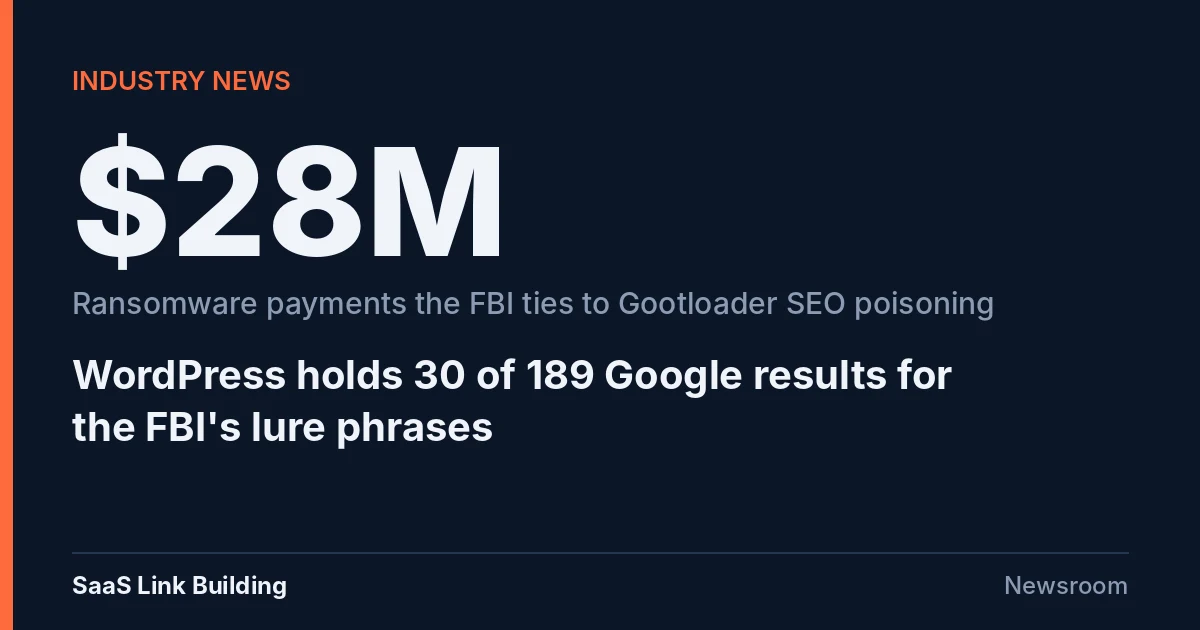
The FBI says Gootloader ranked lure pages on more than 1,000 hijacked WordPress sites, leading to over $28 million in ransomware payments. We searched the 20 phrases it listed: WordPress sites hold 30 of 189 page-one results, and 5 still answer XML-RPC.
 Vibhu Dhariwal
Cofounder & CTO, Digital Gratified
- Published
- Section
- Industry news
- Reading time
- 8 minutes
Ras Al Khaimah, United Arab Emirates, .
The FBI says a malware operation called Gootloader used search engine optimisation on hijacked WordPress sites to reach victims, and that the campaign led to more than $28 million in ransomware payments. The figures come from FLASH CC-111626-MW, a TLP:CLEAR alert the FBI published on 16 November 2026 and coordinated with DHS and CISA. By October 2026, the Bureau had counted more than 1,000 infected WordPress sites and 216 domains controlled by the Gootloader administrator.
The alert is written for security teams, but most of it describes SEO work: picking low-competition long-tail phrases, publishing pages to match them, adding hidden keyword links and arranging backlinks so the lure pages rank. To see what the search results for those phrases look like now, we ran the 20 example keywords the FBI printed through Google and checked every page-one site for WordPress and for the XML-RPC endpoint the FBI says the operators scanned for.
What the FBI found
- Scale: more than 1,000 infected WordPress sites, 216 attacker-controlled domains and more than $28 million in ransomware payments, all counted by October 2026.
- Targeting: search phrases with low search volume and low competition, such as a jurisdiction-specific contract clause, so that attacker pages appeared next to legitimate resources. The current focus is US legal professionals, from in-house counsel to legal technology buyers.
- Access: the administrator scanned WordPress sites for xmlrpc.php, then used compromised credentials, vulnerable plugins and themes, injected posts, REST routes and modified JavaScript.
- Ranking tactics: compromised sites served as lure pages, redirectors, traffic filters or relays, and hidden keyword links plus arranged backlinks pushed the lures up.
- Cloaking: a traffic distribution system filtered visitors by country, referrer, cookie or IP address.
The FLASH also prints one of the hidden link strings: an unordered list linking to a date-based path ending in zoning-government-definition/index.html, a pattern a site owner can search for in their own HTML.
How the campaign changed, 2020 to 2026
The FBI splits Gootloader's history into three phases. From 2020 to 2021 it relied on SEO-poisoned document searches, fake forum pages and JavaScript delivered in ZIP files. From 2022 to 2024 it moved to trojanised JavaScript libraries and PowerShell-based persistence while keeping the poisoned searches. In 2025 and 2026 it added abuse of WordPress comment paths, geofencing and traffic distribution services. The search layer is the one constant across all three phases.
The alert places Gootloader alongside other WordPress abuse campaigns. The scale figures below are the FBI's own.
| Campaign (as named by the FBI) | Scale reported in the FLASH | How sites were used |
|---|---|---|
| SocGholish, TA2726, Parrot TDS and other traffic brokers | Operation Endgame took down 106 servers and cleaned 14,971 WordPress sites (June 2026); 1,509 sites still active April to July 2026 | Injected JavaScript, fake plugin with a REST route |
| DollyWay | 20,000+ sites since 2016; 10,000+ active in February 2025 | Malicious must-use plugins, hidden admin users |
| StopAndProtect | Thousands of sites, found mid-May 2026 | Hidden must-use plugins, concealed upload endpoint |
| "DoubleDonut" stealer operation | 250+ sites in 12 countries | Remote and inline scripts via admin-ajax |
Our check: who ranks for the FBI's example lure phrases
The FLASH lists 20 keywords Gootloader targeted, typos included ("Wyoming Bule Sky Laws", "Where can I LIegally Bet on the Super Bowl"). We searched each one on Google US and logged the page-one organic results: 189 in total, across 147 distinct hosts.
- 30 of the 189 results (15.9%) were on sites showing WordPress signatures, and 15 of the 20 search results pages had at least one.
- Forums, Q&A sites and video took 42 results; government and .edu sites took 39, three of them running WordPress.
- Google showed "No information is available for this page" on 5 results, the label its help page ties to pages blocked from crawling by robots.txt.
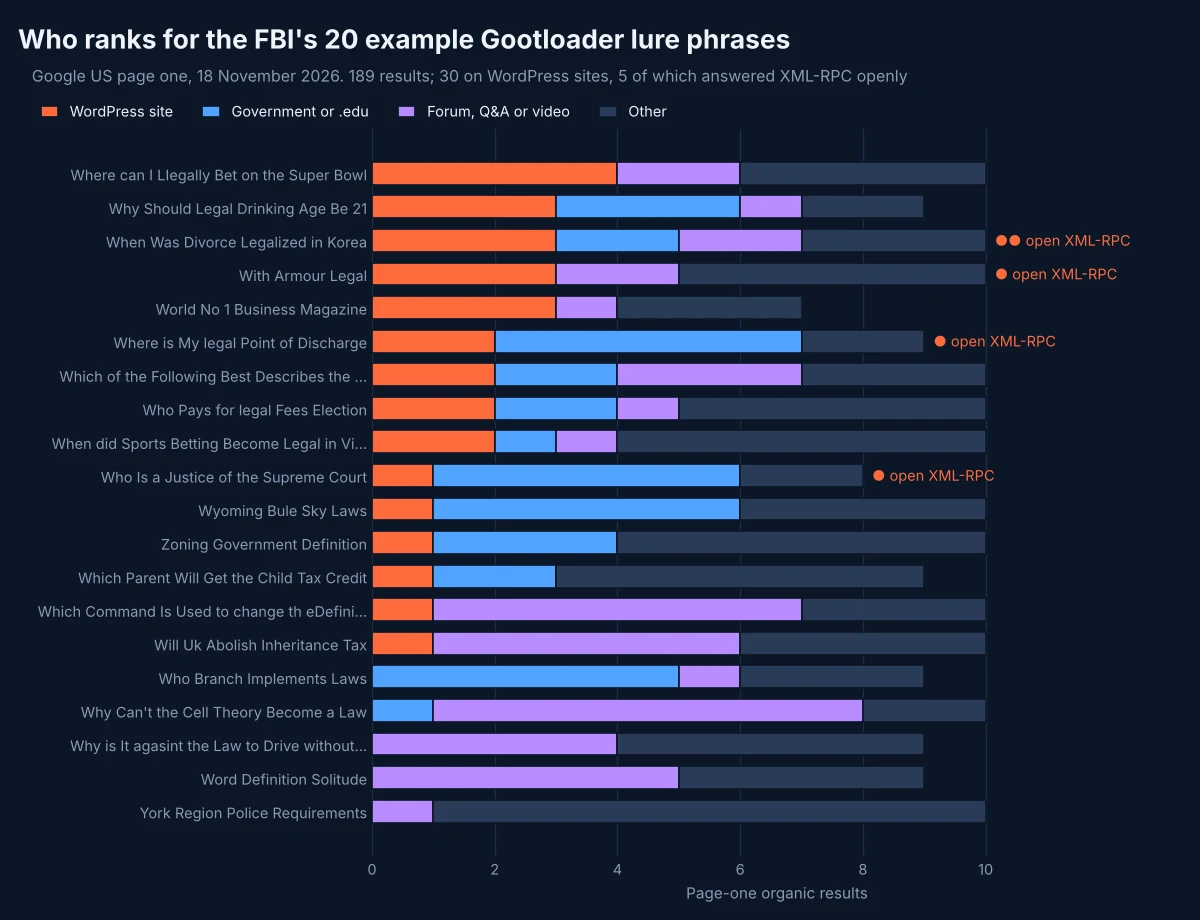
We then sent one GET request to /xmlrpc.php on each of the 30 WordPress sites. WordPress answers an open endpoint with a fixed line saying the server accepts POST requests only. The XML-RPC API it exposes includes methods for creating and editing posts, which matches the FBI's description of injected posts.
| Response from /xmlrpc.php | WordPress results |
|---|---|
| Open: WordPress's standard XML-RPC reply | 5 |
| Refused with 403 while the homepage loaded | 20 |
| Server or CDN error (520) | 3 |
| 405 without the WordPress reply | 1 |
| Not found (404) | 1 |
| Total | 30 |
Two thirds of the WordPress sites ranking for these phrases refused requests to the endpoint, in line with the FBI's advice to restrict it. Five still answer it. An open endpoint is not proof of compromise, and nothing in our pull identifies any result as a Gootloader page. Our reading, which is not a finding: because the operators filtered visitors by referrer and IP, an automated check like ours would likely see clean pages even where a lure existed. The FBI's recommendations point site owners to their own logs, file integrity checks and Search Console data instead.
Why SEO teams should care
Google's spam policies class pages added to a site without permission as hacked content, and list page injection, where attackers create new spammy pages on a site, as one form. The Search Console Security issues report is where Google says it will flag hacked content and malware, and affected pages can carry warnings in results or in the browser. A site used as a Gootloader lure risks its own rankings as well as its visitors.
The attack also leans on the same long-tail logic many content teams use: pick phrases where the results are thin and publish a page that matches the wording exactly. The FBI's own list shows the misspellings were deliberate targets. This is a different problem from the altered results Google has served to rank trackers, which we covered in our report on poisoned SERPs for rank trackers; here the poisoning comes from attackers, not Google.
What to do
- Check Search Console for queries you never targeted. The FBI's advice is to look for "unrelated legal or business queries" in Search Console and other webmaster tools, plus sudden jumps in indexed pages, manual actions and security warnings. In the Performance report, filter queries for legal terms your site has never covered.
- Disable XML-RPC if nothing uses it. If an integration needs it, the FBI says to rate-limit it, allow only the required methods and watch authentication and POST volume.
- Patch fast and trim plugins. The FLASH recommends automatic updates for core and trusted plugins and removing unused plugins, themes, accounts and staging sites. Our study of how quickly top WordPress sites applied the 7.1.4 security release found 45% patched within 12 hours; the rest took longer.
- Look for the injection patterns. Search your HTML for hidden lists of keyword links, new date-based paths you did not create, unknown must-use plugins and new REST routes. Deny PHP execution under
wp-content/uploads. - If you find something, preserve before you clean. The FBI says to restrict public access, keep a forensic copy, reset hosting, database, API and CDN credentials from a clean device, revoke sessions and application passwords, and restore from backup only after closing the entry point.
- Keep user-created pages out of the index. Google's guidance on noindexing link-shared and user-created pages covers the platform side of the same abuse.
Methodology
On 18 November 2026 (IST) we entered each of the 20 keywords listed in the FLASH, verbatim and with the FBI's spelling, into Google through a SERP API (US location, English, basic HTML results) and recorded the host of every page-one organic result. Pages returned 7 to 10 organic results each, 189 in total across 147 hosts. A host counted as WordPress if its homepage HTML referenced /wp-content/ or /wp-includes/, or if /wp-json/ returned the WordPress REST index. Government and .edu covered .gov, .edu and equivalent national domains; the forum, Q&A and video group covered Reddit, Quora, Facebook, YouTube, Medium, Stack Exchange sites, homework Q&A sites and two topic forums. For XML-RPC we sent one GET per WordPress host and counted it as open only when the body contained WordPress's standard reply. Three hosts did not respond and 21 refused our homepage request, so the WordPress count is a minimum. We did not open any page we suspected of being malicious and do not name individual sites.
Conclusion
The FBI's alert puts a dollar figure on SEO poisoning: more than $28 million in ransomware payments traced to lure pages that ranked for obscure legal phrases on hijacked WordPress sites. On page one for those phrases today, WordPress sites hold 30 of 189 results, and five of them still answer XML-RPC requests. For site owners, the most practical takeaway is the FBI's own: read Search Console as a security log, because unexplained legal queries may be the first sign that someone else is publishing on your domain.
Questions and answers
What is Gootloader?
The FBI describes Gootloader as an initial access framework that combines a JavaScript malware loader, compromised websites and SEO techniques. Cyber actors used it as a precursor to ransomware attacks across many sectors, according to FBI FLASH CC-111626-MW, published on 16 November 2026.
How much damage does the FBI attribute to Gootloader?
By October 2026, the FBI had identified more than 1,000 infected WordPress sites and 216 domains controlled by the Gootloader administrator, which it says led to more than $28 million in ransomware payments.
Which search terms did Gootloader target?
The FBI says the operators chose low-volume, low-competition phrases, often jurisdiction-specific legal wording, aimed at attorneys, in-house counsel, legal operations staff and legal technology buyers. The FLASH lists 20 example keywords, including misspelled ones.
How can site owners spot this kind of abuse in Search Console?
The FBI recommends reviewing Search Console and other webmaster tools for unrelated legal or business queries, sudden increases in indexed pages, manual actions and security warnings. Google's Security issues report in Search Console flags hacked content and malware it detects.
Should WordPress sites disable XML-RPC?
The FBI recommends disabling xmlrpc.php if it is unused. If an integration needs it, the FBI advises rate-limiting it, allowing only the necessary methods or trusted integrations, and monitoring authentication and POST volume.
More releases
-
Studies
Meta Paused Its Crawling Terms; Only 2 of 485 Top Sites Block Its Ads Crawler
Meta has paused the business terms that would have let it crawl advertisers' websites from 20 November. Our repeat robots.txt crawl of the top 1,000 domains finds little change: 12.8% of 485 sites now block Meta's AI training crawler, up from 12.0% in October, and only 2 block Meta-ExternalAds.
-
Updates
Google Details How to Allow Google-Agent; 24 Top Sites Block a Name Google Never Listed
Google published a guide on 17 November explaining how to let Google-Agent through CDNs, firewalls and bot managers. Our crawl of 1,159 top-site robots.txt files the same day found 24 naming an undocumented GoogleAgent-Mariner token, against 14 naming Google-Agent, which Google says generally ignores robots.txt.
-
Studies
Are AI Overviews Cutting Clicks More Than Google Admits? The Evidence Says Likely
A pre-registered experiment with 1,065 US users found AI Overviews cut organic clicks by about 38% on the searches where they appear, while Google speaks only of stable totals and higher quality clicks. Our pull of 24 mobile results pages found the AI Overview on top of all 22 that showed one.
Tell us the site and the goals.
Rankings in Google and visibility in AI answers, from one monthly plan. One call is enough to say which one fits. Email works just as well.