Are AI Overviews Cutting Clicks More Than Google Admits? The Evidence Says Likely
A pre-registered experiment with 1,065 US users found AI Overviews cut organic clicks by about 38% on the searches where they appear, while Google speaks only of stable totals and higher quality clicks. Our pull of 24 mobile results pages found the AI Overview on top of all 22 that showed one.
 Vibhu Dhariwal
Cofounder & CTO, Digital Gratified
- Published
- Section
- Studies
- Reading time
- 13 minutes
Ras Al Khaimah, United Arab Emirates, .
Google has said for more than a year that AI Overviews are not draining traffic from the open web. In an August 2025 post on Google's blog, Head of Search Liz Reid wrote that total organic click volume from Google Search was "relatively stable year-over-year", and that the company was sending slightly more quality clicks than a year earlier. Publishers, SEO consultants and a growing number of academics say their numbers tell a different story. This investigation sets Google's statements against the strongest independent evidence available, including a randomized field experiment published this year, and adds our own pull of 24 US mobile results pages collected on 17 November 2026.
The theory: Google is understating the click loss
The claim circulating among publishers and SEOs is simple. When an AI Overview answers the query at the top of the page, fewer people click through to a website, and Google's public language about stable totals, higher quality clicks and bounce clicks is chosen to describe the change without ever giving a number for it.
The people who hold the theory are not fringe voices. News publishers have cited AI summaries in competition complaints, including the French complaint to Brussels we covered in our report on publishers taking AI Overviews to the EU. Publisher analytics firm Chartbeat's data showed search falling from 21% to 12% of North American publisher pageviews in a year, which we set out in our breakdown of Chartbeat's Q3 2026 regional figures. And site owners can see impressions holding while clicks fall in their own Search Console data.
The suspicion rests on one structural fact: Google holds the only complete dataset, and it has not published one.
What Google has said on the record
Google's position has been consistent, and it is worth stating precisely, because the precise wording matters to the verdict.
- Aggregate clicks are stable. Reid's August 2025 post said organic click volume to websites was relatively stable year over year and that Google still sends billions of clicks to the web every day. It gave no percentages.
- The clicks that remain are better. Google's own documentation on AI features and your website, last updated on 10 December 2025, says "these clicks are higher quality" and that users are more likely to spend more time on the site.
- The lost clicks were bounce clicks. In a Bloomberg Odd Lots interview on 23 April 2026, Reid argued that AI Overviews mainly remove quick click-and-return visits that did not serve the user. Search Engine Journal's account of the interview notes she cited no figures.
- AI feature traffic is counted, but not separated. The same documentation says sites appearing in AI features are included in overall search traffic in Search Console, under the Web search type.
Two things are missing from every one of these statements: a click-through rate for queries with an AI Overview, and a comparison with the same queries without one. That gap is the core of the dispute.
Evidence for the theory
1. A randomized experiment found about 38% fewer organic clicks
The strongest piece of evidence is a field experiment by Saharsh Agarwal of the Indian School of Business and Ananya Sen of Carnegie Mellon University, circulated as a preliminary draft dated April 2026 and pre-registered in the AEA RCT Registry. It is the first study we have seen that randomly hides AI Overviews from real users during their normal searching, which is what makes it causal rather than correlational.
The design: 1,065 US participants who used Google in Chrome on desktop installed a browser extension between 7 and 27 January 2026 and were observed for up to two weeks. One group saw Google as normal. A second group had AI Overviews hidden. A third was routed to AI Mode. The study logged 70,132 unique searches across the control and hidden-AIO groups.
The headline results for queries where an AI Overview appeared, or would have:
- Outbound organic clicks per search were 0.38 with the AI Overview and 0.61 without it, roughly 38% fewer clicks.
- The probability of a zero-click search was 0.72 with the AI Overview against 0.54 without it.
- On queries that never triggered an AI Overview, there was no significant difference between groups, which suggests the effect is the AI Overview itself and not the participants.
- Sponsored clicks showed no significant change.
That last point deserves attention. In this sample, AI Overviews took clicks away from organic results while leaving clicks on ads statistically unchanged. The authors note those ad effects are less precisely measured, so it is a finding to watch rather than a settled one.
2. Placement is the mechanism, and the AI Overview almost always sits on top
The experiment found more than 80% of AI Overviews appeared at the top of the page. For those, organic clicks per search were 0.32 with the overview and 0.60 without it. When the AI Overview appeared lower down, there was no measurable effect (0.68 against 0.69).
That is where our own data comes in. We wanted to know how often the AI Overview occupies that top position on a phone today, and how far it pushes the first organic link down the screen.
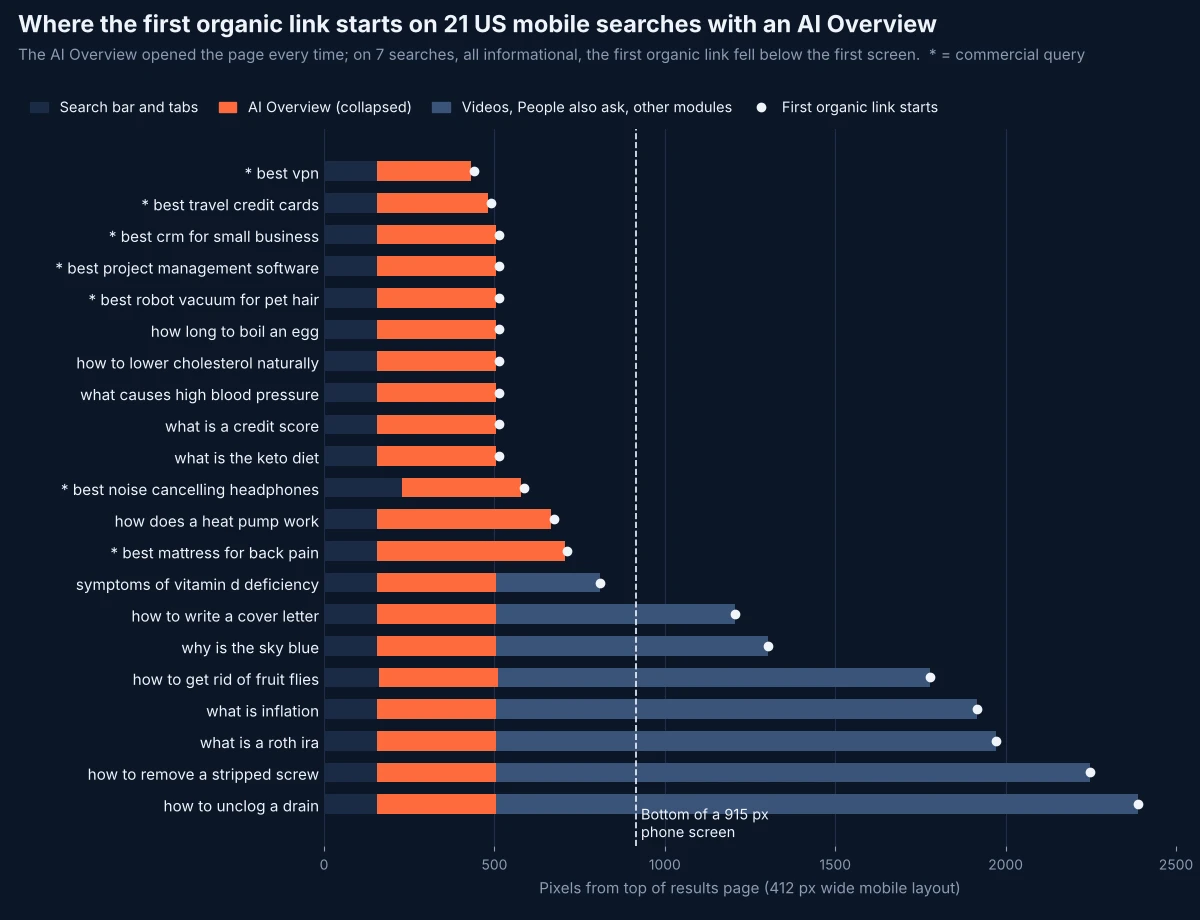
Across 24 queries pulled on 17 November 2026, 22 returned an AI Overview. On all 22, the AI Overview was the first results module on the page. In its collapsed default state it was a median 350 pixels tall, about 38% of the 915-pixel screen we emulated.
The split between query types was sharp:
| Query type (mobile, US) | Searches | With AI Overview | AI Overview first on page | Median start of first organic link | First organic link below the first screen |
|---|---|---|---|---|---|
| Informational (how, what, why) | 16 | 15 | 15 of 15 | 1,009 px (14 measured) | 7 of 14 |
| Commercial ("best" queries) | 8 | 7 | 7 of 7 | 514 px (7 measured) | 0 of 7 |
| All | 24 | 22 | 22 of 22 | 586 px (21 measured) | 7 of 21 |
Source: SaaS Link Building pull of Google US mobile results, 17 November 2026. See Methodology.
On the seven informational searches where the first organic link fell below the first screen, the AI Overview was followed by video carousels, short-video rows, image packs, People also ask boxes or forum modules. For "how to unclog a drain", the first organic result started at about 2,390 pixels, more than two and a half screens down. For commercial queries, by contrast, the first organic link sat directly under the AI Overview every time.
This does not measure clicks. It does show that the condition the experiment identified as driving the click loss, an AI Overview at the very top, was present on every AI Overview page we checked.
3. Independent behaviour panels point the same way
Before the experiment, the best independent evidence came from the Pew Research Center's analysis of the browsing of 900 US adults in March 2025. Users clicked a traditional result on 8% of visits to a results page with an AI summary, against 15% without one. They clicked a link inside the summary on 1% of visits, and 26% of pages with a summary ended the browsing session, against 16% without.
Industry datasets with larger samples report similar direction and scale. One industry study of 963 of the top 1,000 French domains, published on 16 September 2026, found that domains where more than 20% of queries triggered AI Overviews saw median click-through rate fall from 2.29% to 1.76% in the nine days after the 22 July launch in France, compared with the 28 days before, while a low-exposure control group rose 2.3%. A separate agency analysis of 3,119 informational queries, published in November 2025, reported organic click-through rate down 61% on queries with AI Overviews.
4. Google has the data and has not released it
Google's Generative AI performance report in Search Console counts impressions: how many times links to a site were shown in a generative AI feature. The help page describes no click, click-through rate or query data for those features. Site owners can see that they appear in AI Overviews, but not whether anyone clicked.
Regulators have noticed. The UK Competition and Markets Authority's publisher conduct requirement lists impressions, clicks and click-through rate for AI features such as AI Overviews and AI Mode among the transparency metrics Google must provide, and gives Google until 3 December 2026 to comply. We reported in our story on the CMA deadline that Google's Gary Illyes said the team had nothing to announce about additional data, though John Mueller pushed back on reading that as ruling out click data.
Evidence against the theory
The case against is weaker on the central point, but it is not empty, and some of it comes from the same sources.
- Google's claim and the experiment measure different things. Reid's statement is about total clicks across the web over a year. The experiment measures clicks per search on AI Overview queries. If people search more often, total clicks could hold steady even while each AI Overview search produces fewer clicks. Google has said AI features drive more queries, though it has not published the counts. Notably, the experiment found no statistically significant change in total searches per user when AI Overviews were hidden, among the 713 participants active for the full period (98.06 per user in the control group, with a difference of minus 5.05 that was not significant), so it offers no support for that offsetting effect either.
- Users did not report being worse off. In the same experiment, satisfaction, perceived quality and ease of finding information showed no meaningful differences between the normal and hidden-AIO groups. That is consistent with Google's argument that some of the lost clicks were visits users did not need.
- Being cited may help. A one-site opt-out test reported by Search Engine Roundtable on 30 October found that when a consultant blocked his site from AI features, regular organic clicks fell too, not just AI impressions. He estimated AI impressions made up about 8% of the site's total and estimated their click-through rate at about 0.9%. We covered that test in our report on the opt-out test. A single site is anecdote, not proof, but it cuts against the idea that AI Overviews only take.
- The effect is not universal. One consultant's review of five French sites after the July launch found three with sharp drops in clicks or click-through rate and two with little or no change. Our own pull found commercial "best" queries kept the first organic link on the first screen in 7 of 7 cases.
- Older panels reflect an older product. Pew's data is from March 2025, more than a year and a half before our pull, and AI Overviews have launched in new markets such as France since then. Its 8% figure should not be read as a current rate.
Verdict: likely
On the narrow question, whether an AI Overview reduces organic clicks on the search where it appears, the evidence is now strong. A pre-registered randomized experiment found about 38% fewer organic clicks per AI Overview search, with no effect on searches without one, and the effect concentrated where the overview sits at the top of the page. Our pull found it at the top on every one of 22 mobile results pages that had one.
On the broader question in our headline, whether the loss is bigger than Google admits, we rate the theory likely, not confirmed. Google has never given a per-query figure to compare against, so it cannot be caught contradicting one. Its aggregate claim about stable total clicks is, strictly, a different measurement. But Google's public framing, with its talk of higher quality clicks and fewer bounce clicks, describes a click loss of meaningful size without ever quantifying it, while its own Search Console report withholds the click data that would settle the matter. The speculation here, and it is speculation, is that the number would not help Google's case. The CMA deadline on 3 December may be the first chance to test that.
What this means for SEO teams
- Segment by AI Overview exposure. Tag your tracked queries by whether they trigger an AI Overview, then compare click-through rate over time for each group in Search Console. A falling rate with steady impressions on the exposed group is the pattern every study above describes.
- Treat informational and commercial pages differently. Our pull suggests informational queries face both an AI Overview and a stack of video and question modules before the first link. Commercial queries kept the first organic link near the top. Forecasts built on pre-2025 click curves will overstate informational traffic.
- Think twice before opting out. The only public opt-out test we know of saw organic clicks fall as well. Run a controlled test on a section of the site before applying the Search Console control sitewide.
- Watch for the UK metrics. If Google provides AI feature click data to UK publishers from December, compare it with your own segmented numbers and with the experiment's 0.38 against 0.61.
Methodology
On 17 November 2026, between 09:20 and 09:26 UTC, we pulled live Google results for 24 queries through a commercial SERP API, using google.com with a United States location, English language, Android mobile emulation at a 412 by 915 pixel screen, the top 10 organic results, asynchronous AI Overview loading enabled, and pixel coordinates for each page module. Sixteen queries were informational ("how", "what", "why" and "symptoms of" questions) and eight were commercial "best" queries. We recorded whether an AI Overview appeared, its position and collapsed height, and the vertical pixel coordinate at which the first organic result began. One informational query ("how does compound interest work") returned an AI Overview in first position but no coordinates for organic results; it counts toward the 22 AI Overview pages but is excluded from pixel figures. "Below the first screen" means the first organic result began beyond 915 pixels. Each query was pulled once, logged out and without personalization. Results vary by location, device, time and test bucket, and pixel positions do not measure clicks.
Conclusion
Google's statements about AI Overviews and clicks are carefully bounded: stable totals, better quality, fewer bounces. None of them is directly contradicted by the evidence, because none of them gives a number that could be. What the independent evidence now shows is a sizeable, causal drop in organic clicks on the searches where an AI Overview appears at the top, and our data shows that is where it appears on mobile. Until Google publishes AI Overview click data, the burden of proof sits with the company that holds it.
What do you think?
If you have segmented your own Search Console queries by AI Overview exposure, how does the click-through rate on exposed queries compare with the 38% gap the field experiment found? Send us your numbers and we will include the most complete datasets in a follow-up.
Questions and answers
How much do AI Overviews reduce organic clicks?
In a pre-registered field experiment by researchers at the Indian School of Business and Carnegie Mellon University, US users made 0.38 outbound organic clicks per search when an AI Overview appeared, against 0.61 when it was hidden, about 38% fewer. Searches without an AI Overview showed no significant difference.
What has Google said about AI Overviews and clicks?
In August 2025 Liz Reid wrote that total organic click volume was relatively stable year over year and that Google sends slightly more quality clicks than a year earlier. Google's AI features documentation says clicks from pages with AI Overviews are higher quality. Google has not published a click-through rate for AI Overview queries.
Does Search Console show clicks from AI Overviews?
Google's Generative AI performance report counts impressions, meaning how often links to a site were shown in a generative AI feature. Its help page describes no click or click-through rate data. Google's documentation says AI feature traffic is included in overall Web search traffic in the Performance report.
When will UK publishers get AI Overview click data?
The UK Competition and Markets Authority's publisher conduct requirement lists impressions, clicks and click-through rate for AI features among the transparency metrics Google must provide, and gives Google until 3 December 2026 to comply.
Do AI Overviews always appear at the top of the page?
In the field experiment, more than 80% of AI Overviews appeared at the top, and the click loss was concentrated there. In our pull of 24 US mobile searches on 17 November 2026, all 22 AI Overviews were the first results module on the page.
More releases
-
Studies
Meta Paused Its Crawling Terms; Only 2 of 485 Top Sites Block Its Ads Crawler
Meta has paused the business terms that would have let it crawl advertisers' websites from 20 November. Our repeat robots.txt crawl of the top 1,000 domains finds little change: 12.8% of 485 sites now block Meta's AI training crawler, up from 12.0% in October, and only 2 block Meta-ExternalAds.
-
Updates
Google Details How to Allow Google-Agent; 24 Top Sites Block a Name Google Never Listed
Google published a guide on 17 November explaining how to let Google-Agent through CDNs, firewalls and bot managers. Our crawl of 1,159 top-site robots.txt files the same day found 24 naming an undocumented GoogleAgent-Mariner token, against 14 naming Google-Agent, which Google says generally ignores robots.txt.
-
Explainers
Ask Maps Will Phone Local Businesses; 52 of 80 Listings We Pulled Were Phone-Only
Google's Ask Maps can now find beauty, pet care, auto and home repair appointments in the US and call local businesses for the user. In our pull of 80 Google Maps listings across those four categories, 52 offered no online booking link, only a phone number. Google's help pages explain how owners can opt out.
Tell us the site and the goals.
Rankings in Google and visibility in AI answers, from one monthly plan. One call is enough to say which one fits. Email works just as well.