Ask Maps Will Phone Local Businesses; 52 of 80 Listings We Pulled Were Phone-Only
Google's Ask Maps can now find beauty, pet care, auto and home repair appointments in the US and call local businesses for the user. In our pull of 80 Google Maps listings across those four categories, 52 offered no online booking link, only a phone number. Google's help pages explain how owners can opt out.
 Vibhu Dhariwal
Cofounder & CTO, Digital Gratified
- Published
- Section
- Explainers
- Reading time
- 7 minutes
Ras Al Khaimah, United Arab Emirates, .
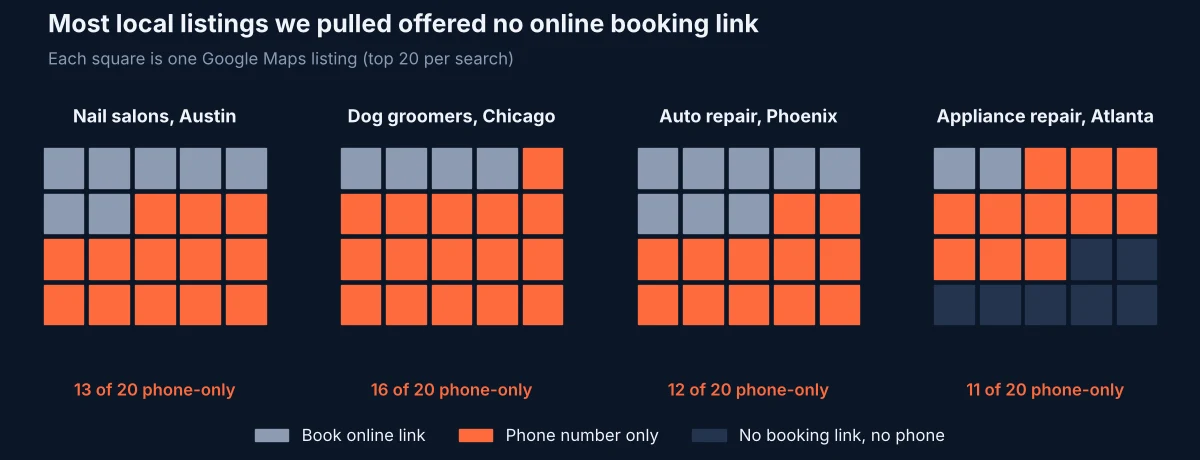
Google Maps' conversational assistant, Ask Maps, can now look for beauty, pet care, auto and home repair appointments and, in Google's words, "call local businesses for you". Maz Khorasani, Product Director at Google Maps, announced the feature on 16 November in a post on Google's blog, alongside trip itineraries and saved-list search. Appointment finding is rolling out first in the US on Android and iOS. To see how many businesses are likely to get those calls, we pulled the top 20 Google Maps results for one search in each of the four categories and checked which listings take bookings online and which offer only a phone number.
What changed
- Ask Maps now searches for appointments on a user's behalf. Google's example is "Find me a 4 p.m. nail appointment near me", after which Ask Maps shows open slots across nearby businesses.
- It does this online and by phone. The blog post says Ask Maps can find appointments online and call businesses. It does not say how many calls a business can expect or whether Ask Maps completes the booking itself.
- US only for now. Appointment finding and route tips launch first in the US, "with more regions coming soon". Itineraries and list search work everywhere Ask Maps is offered, and the post says Ask Maps is starting to expand to 30 countries in Europe.
- The opt-out already exists. PPC Land noted that the announcement does not say how businesses can opt out. Google's Business Profile help pages do: the switch sits in a profile's advanced settings, and owners can also refuse on the call itself.
Our check: most listings are phone-only
Of the 80 listings we pulled, 21 (26%) showed a "Book online" link, the Reserve with Google style button that hands a booking to a scheduling provider. Another 52 (65%) listed a phone number but no booking link, which leaves the phone as the likely route for Google's assistant to check a slot. The remaining 7, all appliance repair listings in Atlanta, showed neither a booking link nor a phone number.
| Search (city) | Listings | Book online link | Phone only | Neither |
|---|---|---|---|---|
| Nail salon (Austin, TX) | 20 | 7 | 13 | 0 |
| Dog groomer (Chicago, IL) | 20 | 4 | 16 | 0 |
| Auto repair shop (Phoenix, AZ) | 20 | 8 | 12 | 0 |
| Appliance repair (Atlanta, GA) | 20 | 2 | 11 | 7 |
| Total | 80 | 21 | 52 | 7 |
Dog groomers were the least likely to take bookings online (4 of 20) and auto repair shops the most likely (8 of 20). The appliance repair results looked different from the other three: 16 of the 20 listings had five reviews or fewer, and 7 showed no phone number. Whether Google's assistant would call or skip those listings is not documented, so we count them separately rather than guess.
A booking link does not guarantee that a business avoids calls. Google's help page says that if a business works with online booking providers, Google "may book through the partner or by calling your business directly".
How Google's automated calls work
Google already makes automated calls to businesses, and its help page on automated calls and texts sets out the rules that apply. It does not mention Ask Maps by name. It describes calls made on behalf of customers for three kinds of request: booking appointments, checking restaurant wait times, and confirming the price and availability of products and services. It also covers calls Google makes to confirm business hours or the status of in-demand inventory.
- Calls are recorded. The page says these calls are monitored and recorded for quality assurance. Google's fraud guidance adds that callers say they are from Google and why they are calling.
- Google limits repeat calls. It says it limits the number of calls for the same information and avoids late night and early morning hours.
- Five states are excluded. In the US, calls on behalf of customers are available in every state except Indiana, Louisiana, Minnesota, Montana and Nebraska. Using the Census Bureau's 2025 state population estimates, those five states hold about 20.6 million people, or 6.0% of the US population.
- Merchant Center data replaces some calls. If a store already shares in-store product details through Merchant Center, Google says it will use that data and will not call to ask about inventory.
- Answers can change your profile. Updates gathered from calls to confirm business details are marked "Pending" and can take up to five business days to review, and Google may post to a verified profile on the owner's behalf.
Google's guidance on fraudulent calls adds that its automated calls come from designated numbers, never ask for payment, and only go to businesses whose public phone numbers are meant for calls from the public.
How to opt out, step by step
Google gives two routes. The first is to say so on the call, for example "Please stop calling my business." The second is the profile setting, which needs a verified Business Profile:
- Open your Business Profile and select More, then Business Profile settings, then Advanced settings.
- Under "Google automated calls and text messages", find the three switches: Bookings and inquiries from customers, Keep your profile up to date, and Post to your profile on your behalf.
- Turn off "Bookings and inquiries from customers" to stop calls made for customers, such as appointment requests. Leave "Keep your profile up to date" on if you want Google to keep confirming hours by phone.
- Expect occasional manual calls. Google says an opt-out may not stop calls from a human operator confirming business information.
The advanced settings help page describes the same control as turning automated calls and texts on or off "to accept bookings, keep information up to date, or confirm price and availability".
What this means for local SEO teams
- Decide whether calls are welcome before the holidays. For a busy salon, an automated caller during peak hours costs staff time. For a groomer with gaps in the diary, it is a free lead. Make the choice in advanced settings rather than leaving the default.
- Add a booking provider if you want fewer calls. Google's bookings help page explains how to connect a scheduling provider through the Bookings section of a profile. Listings with live availability give Google a route that does not need the phone, though Google does not promise it will use it.
- Brief whoever answers the phone. Staff should know that a recorded voice saying it is calling from Google on behalf of a customer is legitimate, and that anyone asking for payment to stay on Google is not.
- Watch your profile for "Pending" edits. Answers given on these calls can update hours and other details. Check the profile after the call and correct anything that changed.
- Keep service and hours data current. Google says Ask Maps checks details such as whether a place is open and its live availability. Earlier tests of booking cards in AI Mode found home service categories handled unevenly, and Google keeps adding profile features, such as Messenger chat on Business Profiles and controls over which ordering providers appear.
Methodology
On 17 November 2026 we collected Google Maps search results through a commercial SERP data API, with US English settings, for four searches centred on four cities at map zoom level 13: "nail salon" in Austin, Texas; "dog groomer" in Chicago, Illinois; "auto repair shop" in Phoenix, Arizona; and "appliance repair" in Atlanta, Georgia. None of the four states is on Google's list of excluded states. For each search we took the first 20 local results (80 listings) and recorded whether the listing carried a "book online" link and whether it listed a phone number. 20 of the 21 booking links in the sample carried the rwg_token parameter used by Reserve with Google. A listing counted as phone-only if it had a phone number and no booking link. We did not place calls or use Ask Maps, so the results show which listings lack an online route, not how often Google actually calls them. Results vary by location, time and user. Population figures are the Census Bureau's Vintage 2025 estimates for 1 July 2025.
Conclusion
Ask Maps turns Google's existing automated calling service into something US Maps users can trigger by asking for an appointment, starting with beauty, pet care, auto and home repair. In our sample, about two in three listings in those categories had no online booking link, so the phone is likely the main way the assistant can check their availability. Owners who want to control that can do it today in their profile's advanced settings, or reduce the need for calls by connecting a booking provider.
Questions and answers
What did Google announce for Ask Maps on 16 November?
Google said Ask Maps can now find beauty, pet care, auto and home repair appointments online and call local businesses for the user, starting in the US on Android and iOS. The same post added trip itineraries, route tips and search across saved lists.
Can a business stop Google's automated calls?
Yes. Google's Business Profile help says owners can ask the caller to stop, or open Advanced settings in a verified Business Profile and turn off the switches under "Google automated calls and text messages". Google says occasional manual calls may still happen.
Which US states do not get Google's automated calls on behalf of customers?
Google's help page lists Indiana, Louisiana, Minnesota, Montana and Nebraska as the states where the feature is not available. Together they held about 6.0% of the US population in the Census Bureau's 2025 estimates.
How many local listings rely on phone calls rather than online booking?
In our 17 November pull of 80 Google Maps listings across nail salons, dog groomers, auto repair and appliance repair, 52 listed a phone number but no online booking link, 21 had a booking link and 7 had neither.
How can I tell a real Google call from a scam?
Google says its automated calls come from designated numbers, state that they are from Google and why, and never ask for payment, card details or passwords. Anyone asking for money to keep a business on Google is not calling from Google.
More releases
-
Studies
Meta Paused Its Crawling Terms; Only 2 of 485 Top Sites Block Its Ads Crawler
Meta has paused the business terms that would have let it crawl advertisers' websites from 20 November. Our repeat robots.txt crawl of the top 1,000 domains finds little change: 12.8% of 485 sites now block Meta's AI training crawler, up from 12.0% in October, and only 2 block Meta-ExternalAds.
-
Updates
Google Details How to Allow Google-Agent; 24 Top Sites Block a Name Google Never Listed
Google published a guide on 17 November explaining how to let Google-Agent through CDNs, firewalls and bot managers. Our crawl of 1,159 top-site robots.txt files the same day found 24 naming an undocumented GoogleAgent-Mariner token, against 14 naming Google-Agent, which Google says generally ignores robots.txt.
-
Studies
Are AI Overviews Cutting Clicks More Than Google Admits? The Evidence Says Likely
A pre-registered experiment with 1,065 US users found AI Overviews cut organic clicks by about 38% on the searches where they appear, while Google speaks only of stable totals and higher quality clicks. Our pull of 24 mobile results pages found the AI Overview on top of all 22 that showed one.
Tell us the site and the goals.
Rankings in Google and visibility in AI answers, from one monthly plan. One call is enough to say which one fits. Email works just as well.