Google's AI Mode Temporary Threads Last 24 Hours; Repeat Answers Shared 11 of 28 Sources
Google's new AI Mode temporary threads skip history and personalization, and its help page, not the launch post, says they disappear after 24 hours and still leave site and analytics tracking in place. Our signed-out repeat test found only 11 of 28 cited domains survived a second pass.
 Vibhu Dhariwal
Cofounder & CTO, Digital Gratified
- Published
- Section
- Updates
- Reading time
- 8 minutes
Ras Al Khaimah, United Arab Emirates, .
Google has added temporary threads to AI Mode in Search, a way to ask questions that are not saved to a signed-in user's history or used for personalization. Google announced the feature in a Keyword blog post dated 17 November, and TechCrunch reported the rollout on 18 November as an incognito mode for AI Mode. The launch post is short. Google's separate help page for temporary threads carries the operating details, and some of them differ from the way the announcement reads.
We compared the two documents line by line, checked the help page in 10 languages, and ran eight gift queries (Google's own example use) through signed-out AI Mode twice to see how stable a non-personalized answer is before any personal history enters the picture.
What changed
- A new thread type in AI Mode. Users open a temporary thread from an icon at the top right of AI Mode. No settings change is needed, according to Google's post.
- No personalization in either direction. Responses in the thread are not shaped by past activity, and the thread is not used to personalize later responses.
- No history entry. Temporary threads do not appear in Search or AI Mode history, and the help page says users lose access the moment they leave the thread.
- Global rollout. Google's post says the feature is rolling out globally on desktop and mobile browsers, in every language AI Mode supports.
What the help page adds to the announcement
The launch post tells users that "Once you close the thread, it's gone." The help page is more precise: temporary threads are not saved to the Google account and "disappear after 24 hours." It also lists limits and data handling that the post does not mention.
| Topic | Keyword blog post (17 November) | Help page |
|---|---|---|
| When the thread is deleted | Gone once the user closes it | Not saved to the account; disappears after 24 hours; user loses access on leaving |
| AI model training | Not mentioned | Not used to train Google's generative AI models, unless the user submits feedback or it is needed for safety |
| Data Google still collects | Not mentioned | Google still collects and uses data not associated with the account, including to run services and support business operations |
| Connected Apps and account services | Not mentioned | Not available in a temporary thread |
| Sharing and image generation | Not mentioned | Threads and responses cannot be shared; images cannot be generated |
| Websites the user clicks through to | Not mentioned | Sites and the services they use, including Google Analytics, still collect data; the browser may keep history |
Source: Google's temporary threads announcement and help page, compared by SaaS Link Building on 23 November 2026.
We loaded the help page in English, German, French, Spanish, Japanese, Hindi, Brazilian Portuguese, Italian, Korean and Indonesian. All 10 versions were translated and all 10 state the 24-hour window, so the detail is not limited to the English page. By contrast, the older help page for the AI Mode experiment in Search Labs did not mention temporary threads at all when we checked it, and still tells users that AI Mode personalizes responses for signed-in US users aged 18 and over who have Web and App Activity and Search personalization turned on.
Why personalization matters to SEO teams
Temporary threads only make sense because standard AI Mode is increasingly personal. Google's Personal Intelligence help page says AI Mode can draw on previous searches and activity saved in Search Services history, can remember details users ask it to keep (in the US, in English), and can use connected Gmail, Calendar and Google Photos content when users opt in. We covered how that personal layer is already feeding AI Mode ad tests built on Personal Intelligence, and how Google keeps adding partners to the connected apps that plug into Search.
For anyone tracking brand or product visibility in AI Mode, that creates a measurement gap. Rank tracking and AI visibility tools query AI Mode without a user's history. A temporary thread is, on Google's description, the signed-in user's way of getting an answer with that history switched off. The help page does not say the result is identical to a signed-out answer, so treat the comparison as an approximation, but it gives practitioners a defined, non-personalized state that real users can now choose.
Our test: how stable is a non-personalized AI Mode answer?
Before personalization adds variation, AI Mode answers already vary on their own. To measure that baseline, we ran eight gift-buying queries through Google AI Mode signed out, with US and English settings, in two passes a few minutes apart on 23 November, and compared the domains each answer listed as references.
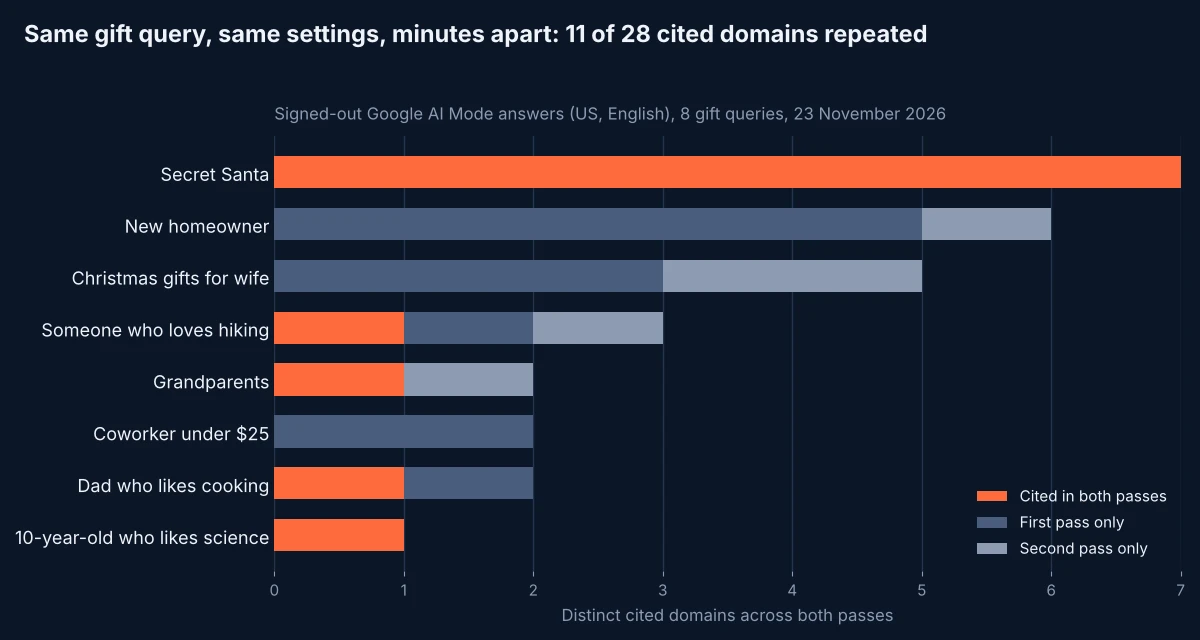
- 11 of 28 domains repeated. Across the eight queries, 28 distinct domains appeared as references in at least one pass, and 11 of them (39%) appeared in both.
- 3 of 8 queries shared no source at all. The "new homeowner" answer cited five domains in the first pass and one different domain in the second. The "Christmas gifts for wife" and "coworker under $25" answers also had no reference in common between passes; the second coworker answer listed no references.
- 2 of 8 answers were stable. The Secret Santa answer was identical across passes, with the same nine references from seven domains, and the science-gift answer cited the same single retailer both times.
- The answer often asks for the context personalization would supply. 14 of the 16 answers ended by asking the user for more detail, and 11 of those 14 asked for a budget. Only the new homeowner query produced no follow-up question, in either pass.
That last pattern is the practical link to temporary threads. Without stored preferences, AI Mode tends to ask for the budget, the recipient or the use case. With Personal Intelligence on, Google says AI Mode tailors suggestions using saved history and memory, which could supply some of that context, so a signed-in user's answer may drift further from what a tracking tool records. A sample of eight queries cannot tell us how far, and we did not test signed-in or temporary-thread answers directly.
One smaller observation: 15 of the 44 reference links in our pulls were wrapped in Google's /goto redirect rather than pointing straight at the publisher, a format we examined when Google began cloaking result links.
What this means for SEO teams
- Read AI Mode visibility as a range, not a position. In our sample, fewer than half of cited domains survived a repeat query minutes later. Track citation share over several pulls per query rather than a single snapshot.
- Separate signed-out data from what customers see. Tool data reflects a non-personalized state. Signed-in users with Personal Intelligence may see different sources, and those using temporary threads may see something closer to the tool view.
- Answer the follow-up questions on the page. AI Mode repeatedly asked for budget and recipient details. Gift guides and product roundups that segment clearly by price band and audience give the model material for those follow-ups.
- Do not expect temporary threads to hide traffic from analytics. Google's help page states that sites a user visits from a temporary thread, and services such as Google Analytics, still collect data. Clicks should still register; what is lost is the user's own AI Mode record. Our earlier report on how AI Mode and AI Overviews links changed has more on outbound links from AI Mode.
- Watch the older help pages. The Search Labs AI Mode page still describes personalization without mentioning the new thread type, so check the dedicated temporary threads page when advising clients.
Methodology
On 23 November 2026, between 01:16 and 01:20 UTC, we queried Google AI Mode through a SERP API with no Google account, using US location and English language settings. We ran eight gift-related queries twice each: gifts for a dad who likes cooking, for a 10-year-old who likes science, for a coworker under $25, Christmas gifts for a wife, gifts for someone who loves hiking, for a new homeowner, Secret Santa ideas, and gifts for grandparents. The second pass requested fresh, uncached results. For each answer we recorded the reference list, reduced each reference to its registrable domain (Google redirect links were matched by the source the reference named), and counted domains shared between passes. A domain counted once per answer even when several references pointed to it. We also recorded whether each answer ended by asking the user a question, and whether that question mentioned budget or spending. Shopping cards and inline links outside the reference list were not counted. The help page language check loaded the temporary threads help page with ten language parameters on the same date and searched each version for the 24-hour statement. This is a small sample of one query category and should be read as an indication, not a measurement of AI Mode as a whole.
Conclusion
Temporary threads give signed-in users an AI Mode session without history or personalization, and Google's help page, not its announcement, sets out the terms: threads disappear after 24 hours, are excluded from model training except for feedback or safety, and do not stop websites or analytics services from collecting data. For SEO teams the bigger lesson is in the baseline. Even without personalization, repeat AI Mode answers in our test shared only 39% of their cited domains, so visibility in AI Mode needs to be measured over repeated pulls rather than read from one result.
Questions and answers
What are temporary threads in Google AI Mode?
They are AI Mode conversations that are not saved to Search or AI Mode history, are not personalized from past activity, and are not used to personalize future responses. Users start one from an icon at the top right of AI Mode, according to Google's announcement of 17 November 2026.
How long does Google keep a temporary thread?
Google's help page says temporary threads are not saved to the Google account and disappear after 24 hours. Users lose access to a thread as soon as they leave it.
Are temporary threads used to train Google's AI models?
Google's help page says they are not used to train its generative AI models unless the user submits feedback or it is necessary for safety purposes. Google still collects data not associated with the account.
Do clicks from a temporary thread still show up in analytics?
Google's help page says websites a user visits from a temporary thread, and the services they use, including Google Analytics, still collect data.
What features are missing in a temporary thread?
According to Google's help page, users cannot use Connected Apps and other account services, get personalized responses, share a thread or response, generate images, or reopen the thread from history.
More releases
-
Studies
Does Buying Google Ads Lift Organic Rankings? Advertisers Held 63% of Top-3 Spots
Google says ad spend has no effect on organic results. Our pull of 323 organic results for 40 US commercial searches found Google Ads advertisers held 63% of top-three spots against 51% of positions 7 to 10, but the biggest spender ranked first on only 7 of 38 pages. Verdict: unproven.
-
Industry news
Google Search Profiles Reportedly Reach Spain; 12 of 16 Google Pages Still Say US Only
Google Search profiles appear to be opening in Spain, Australia and other markets without an announcement, according to weekend reports. Our check of Google's own pages on 23 November found all 43 help centre translations list only Canada, India and the US, and 12 of 16 creators.google editions still say profiles are US only.
-
Studies
Google Site Kit Adds Newsletter Sign-Ups; 119 of 231 Top Sites Updated Within 6 Days
Google's Site Kit 1.192.0, released on 16 November, lets WordPress sites set up Reader Revenue Manager newsletter sign-ups. Our crawl of the top 50,000 domains six days later found 251 Site Kit sites: 51.5% of those showing a version had updated, against 39.4% of all installs, and just 6 load Reader Revenue Manager.
Tell us the site and the goals.
Rankings in Google and visibility in AI answers, from one monthly plan. One call is enough to say which one fits. Email works just as well.