Does Google Score Whole Sites? Trial Notes Suggest So; Page Links Won 21 of 24 SERPs
Google says it has no website authority score, yet its ranking guide cites site-wide signals and a Google engineer's trial notes call its quality score largely site-level. In our pull of 60 live searches and 24 snapshots, page-level link scores tracked rankings far better than domain scores, winning 21 of 24 head to head.
 Vibhu Dhariwal
Cofounder & CTO, Digital Gratified
- Published
- Section
- Studies
- Reading time
- 15 minutes
Ras Al Khaimah, United Arab Emirates, .
For a decade, Google's public answer to "does Google have a site authority score?" has been no. Yet a Google engineer's description of the company's quality signal, entered into the record of United States v. Google, says that signal is largely about the site, and the Content Warehouse documentation that leaked in 2024 lists a field called siteAuthority feeding it. To test what that score could be, we pulled 60 live Google searches on 15 November 2026 and compared page-level and domain-level link scores across 24 more. The short answer: a site-level quality score likely exists, but it does not behave like the link-based "domain authority" numbers SEO teams track.
Key findings
- In notes of an 18 February 2025 call filed as a trial exhibit, Google engineer Hyung-Jin (HJ) Kim described the quality signal Q* as largely static across queries and tied mainly to the site, and said PageRank is one input to it.
- The leaked
CompressedQualitySignalsrecord describessiteAuthorityas applied in Qstar, the quality score, alongside site-level Panda and unauthoritative scores. - Google's own ranking systems guide says site-wide signals and classifiers are used, which sits awkwardly beside John Mueller's 2016 line that Google has no website authority score.
- Across 24 searches, a page's own link score lined up with its position far better than its domain's score did: the page-level score was the stronger predictor in 21 of the 24.
- In today's 60 live searches, the domain-level score pointed the right way (higher score, better position) in only 28, and the number one result had the highest domain score in its top 10 on just 8 of 59.
- Over a third of the top 10 results in our page-level sample (85 of 240) had no measurable links to the page at all, and close to half of those sat on YouTube, Reddit, Facebook, Instagram or Quora.
The theory: Google grades whole sites, and denies it
The belief is old and widely held. SEO teams buy links to "raise domain authority", pick guest post targets by domain scores, and assume a strong site can rank a thin page that a weak site could not. Third-party tools sell site-level link scores on that assumption. Google has spent years saying the premise is wrong.
In October 2016, Mueller said Google does not have "anything like a website authority score," as Search Engine Roundtable reported at the time. A week later, Gary Illyes added that Google does not really have an overall domain authority, according to the same publication. In a June 2019 Webmaster Central hangout, Mueller said Google does not, in general, evaluate a site's authority, as Search Engine Journal reported. The repeated message: rankings are worked out for pages, and the domain scores in SEO tools are not Google's.
Those who hold the theory point to core updates that, in their experience, lift or sink whole sites at once, and to Google's own spam rules, which assume a host's standing carries over to pages placed on it. The question for this investigation is narrower than "do domains matter": does Google compute a site-level authority or quality score, and if it does, is it anything like the link-based domain scores SEO teams use as a stand-in?
Evidence for: what Google's own records say
The trial exhibit
The clearest primary source is a set of notes from an 18 February 2025 call with Kim, published by the Justice Department as trial exhibit PXR0356. Google's in-house counsel was on the call, along with an expert, Professor James Allan, and representatives of the firms Williams and Connolly and Cornerstone. Kim, who the notes say started Google's page quality team 17 years earlier as content farms took off, splits the final ranking score into high-level buckets: topicality (the "ABC" signals of anchors, body text and clicks), Navboost, and quality.
The notes describe quality in terms that match the theory closely. The signal is generally static across queries rather than tied to any one search, although it can use the query in some cases, for instance to send a narrow technical question to a more technical site. Kim calls Q*, the page quality or trustworthiness score, very important, and warns that if competitors saw Google's logs they would get a notion of authority for a given site. The notes then say Q* could be reverse engineered because it is "largely related to the site rather than the query." PageRank appears separately, described as a signal based on distance from a known good source and used as an input to the quality score.
That is a Google engineer, with Google's own counsel on the call, describing a mostly site-level quality score with an authority component. It is not a document that leaked; it is part of the court record.
The leaked documentation
The Content Warehouse API documentation that leaked in May 2024 points the same way. Google acknowledged the documents were internal, and spokesperson Davis Thompson told The Verge to avoid assumptions built on "out-of-context, outdated, or incomplete" information, as TweakTown reported.
The CompressedQualitySignals model is the relevant record. Its field descriptions include:
siteAuthority, described as converted fromquality_nsr.SiteAuthorityand applied in Qstar, which reads as the same Q* named in the trial notes.unauthoritativeScore, listed as one of the web page quality Qstar signals.pandaDemotion, an encoding of Panda fields stored in a proto calledSiteQualityFeatures, plus a newerbabyPandaV2Demotionapplied on top of it.authorityPromotion, converted from an authority boost.
Field names do not show weights, and the documentation does not say how often any field is used. But a field literally named site authority, wired into the quality score that a Google engineer later described as mostly site-level, is hard to square with Mueller's 2016 denial.
Google's documentation, read closely
Google's public guidance has also moved. Its guide to Search ranking systems says the systems work at the page level but that "site-wide signals and classifiers are also used" to understand pages, and adds that good site-wide signals do not guarantee every page ranks well. The same guide records that the helpful content system, announced in 2022, became part of the core ranking systems in March 2024.
Google's spam policies go further. The site reputation policy targets third-party content placed on a host mainly to borrow the "host's already-established ranking signals," which the policy says the host earned mainly through its own content. That wording only works if ranking signals attach to the host as well as to individual pages.
| When | What Google or its staff said | Source type |
|---|---|---|
| October 2016 | Mueller: no website authority score; Illyes: no overall domain authority | Public statements, trade press |
| June 2019 | Mueller: Google does not, in general, evaluate a site's authority | Webmaster hangout, trade press |
| March 2024 | Helpful content system folded into core ranking | Google ranking systems guide |
| May 2024 | Leaked docs list siteAuthority applied in Qstar; Google acknowledges documents are internal | Leak, Google spokesperson |
| February 2025 | Kim: quality score largely tied to the site; PageRank feeds it | DOJ trial exhibit |
| Current docs | Site-wide signals and classifiers are used alongside page-level ranking; hosts carry their own ranking signals | Google ranking systems guide, spam policies |
Table: SaaS Link Building timeline compiled from the sources linked in this section.
Evidence for and against: what our data shows
If Google's site-level score were essentially a link popularity score, third-party domain link scores (built from the same kind of link graph) should line up with rankings. We tested that in two ways. Methods are in full below.
Page links against domain links, head to head
For 24 queries across health, finance, travel, tech, home and SaaS topics, we took the top 10 Google results from the most recent stored SERP snapshot (which keeps the real destination URLs) and scored each page and each page's domain on the same 0 to 1,000 link scale from a commercial backlink index. We then measured, search by search, how well each score tracked position.
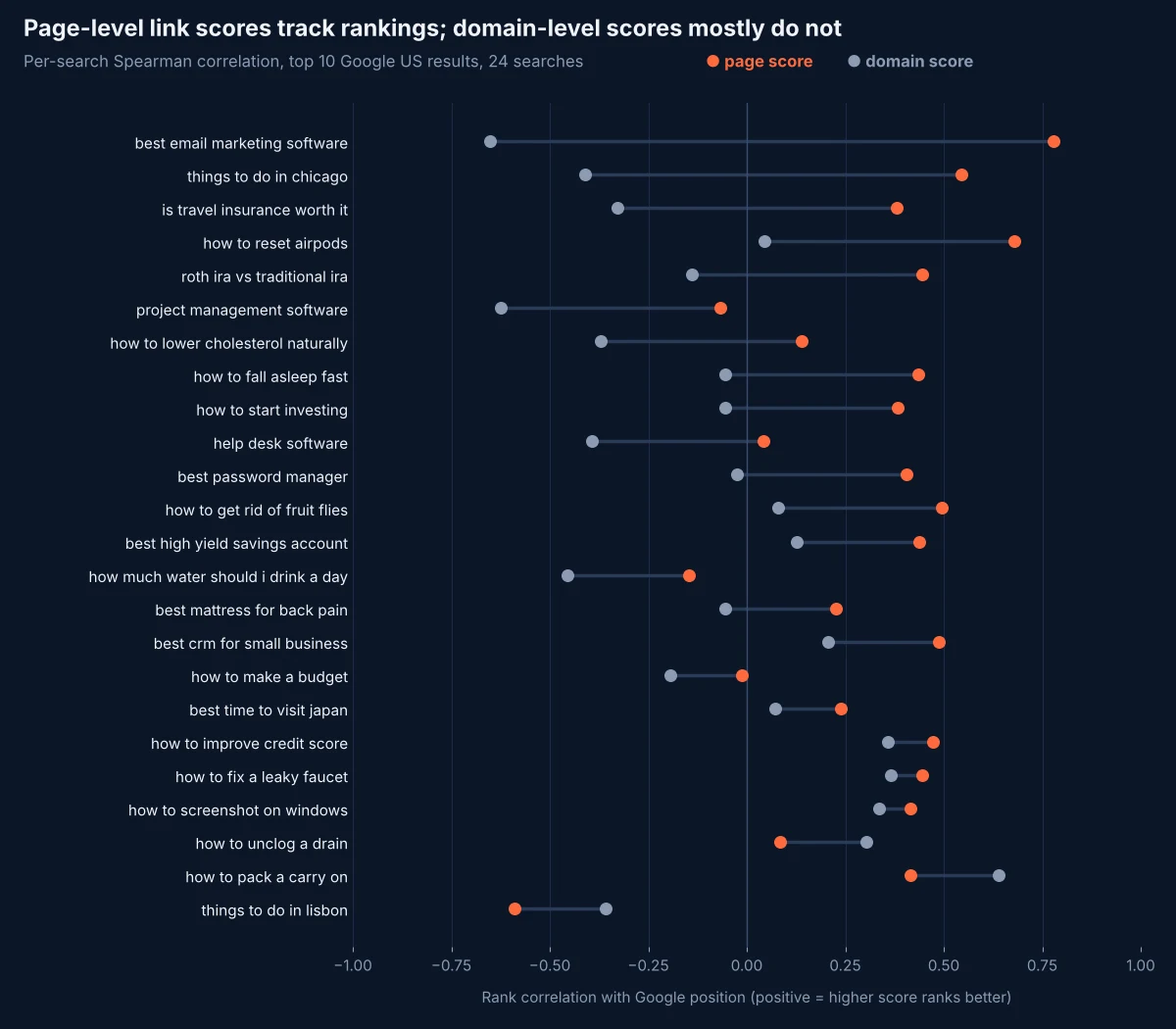
The page-level score won clearly. Its median correlation with ranking was 0.41, against -0.05 for the domain score, and it was the better predictor in 21 of the 24 searches. The top three results had a median page score of 112.5 against 49 for positions four to ten, while their domains scored almost identically (502 and 509). Inside a page of results, links to the specific page separated winners from the rest; the strength of the whole domain did not.
That matches the finding of an October test showing referring domains to the ranking page tracked position in 16 of 21 searches while a domain score did not. Today's sample is larger, adds a direct page-versus-domain comparison, and asks a different question: whether Google has its own site score at all.
Today's live results
Google's live result pages now hide destination URLs behind redirect links, so our live pull on 15 November could identify domains but not pages. We collected the top 30 organic results for 60 queries (1,665 results) and scored every domain on the same link scale.
| Position | Results scored | Median domain score, all results | Median domain score, excluding YouTube, Reddit and other platforms |
|---|---|---|---|
| 1 | 59 | 350 | 314 |
| 2 to 3 | 120 | 438.5 | 378 |
| 4 to 10 | 418 | 455 | 358.5 |
| 11 to 20 | 598 | 458.5 | 353 |
| 21 to 30 | 464 | 451 | 354 |
Table: median third-party domain link score (0 to 1,000) by Google US desktop position, 60 queries pulled 15 November 2026. Source: SaaS Link Building analysis.
There is no gradient. Number one results had, if anything, slightly weaker domains than the results below them, and the pattern holds with platforms removed. Within each search, the correlation between domain score and position was a coin toss: higher domain scores lined up with better positions in 28 of the 60 searches and worse positions in the other 32, with a median correlation close to zero. The page in first place had the highest domain score in its top 10 on only 8 of 59 searches.
Many of today's number one results came from domains with modest link scores, such as a credit union for "how much house can i afford" and a physical therapy practice for "how to treat a sprained ankle". This pull fell during the rollout of the November 2026 core update, which began on 10 November and had no end date on the Search Status Dashboard when we checked, so individual positions may still move.
Where a site-level signal may show
One pattern in the page-level sample is consistent with a site-level effect. Of the 240 top 10 results, 85 pages had a page score of zero in the backlink index, meaning no measurable links pointed at them, and four of those ranked first. Forty of the 85 sat on YouTube, Reddit, Facebook, Instagram or Quora. In the live sample, those five platforms held 132 of the 600 top 10 slots, with YouTube alone appearing in the top 10 for 35 of the 60 queries.
Speculation, clearly labelled: pages with no links of their own that still reach page one, mostly on very large platforms, are what you would expect if a site-level quality or trust score lets a host's pages compete before they earn links. It is also what you would expect if Google relies on clicks for those pages, which the trial record says it does through Navboost, the system at the centre of Google's use of clicks in ranking. And backlink indexes miss links, especially to social posts. Our data cannot separate these explanations.
Evidence against
The case against the theory deserves a fair hearing.
- The denials may be narrowly accurate. Mueller and Illyes may have had third-party style link metrics in mind, and a narrowly worded denial can be true of those while leaving site-level quality scores untouched. Nothing in the trial notes or the leak says Google computes a single link-based score per domain. Q* as described is about quality and trustworthiness, with PageRank as only one input.
- Our data says link-based domain scores do not explain order. If Google's site score were mostly link popularity, domain scores should have tracked position. In both samples they did not.
- Google says page-level ranking comes first. Its ranking guide describes site-wide signals as contributing to its understanding of pages, not overriding them, and says a strong site can still have pages that rank poorly.
- The leak is a schema, not a recipe. The documentation lists fields; it does not show weights, whether a field is still used, or for which queries. Google's spokesperson made the same point when the documents surfaced.
- The trial notes are a summary. PXR0356 is a note of a conversation, partly redacted, not Kim's sworn testimony, and the passage explaining what Q* is about is blacked out.
Verdict: likely
Our verdict on the claim "Google uses a site-level authority score" is likely. Google's own guide confirms site-wide signals, a Google engineer described the central quality score as mostly a property of the site, and leaked documentation names a site authority field feeding that score. Read against that record, the 2016 and 2019 denials look like statements about third-party style link metrics rather than proof that no site-level quality score exists.
The popular version of the theory, that Google keeps something like the domain authority numbers in SEO tools and ranks by it, is unproven, and our data leans against it. Link scores at domain level did not predict order in 60 live searches or in 24 snapshot searches, while page-level link scores did in most of them. Whatever Google's site score measures, our sample suggests link popularity is at most one part of it, consistent with Kim's description of PageRank as a single input. It also fits earlier evidence that Google does not simply favor big brands by default.
What this means for SEO teams
- Stop using domain scores as a ranking forecast. In our data they said almost nothing about who ranks first. Use them, at most, to screen out obviously weak or spammy sites.
- Judge link targets and wins by the page. A link to the page you want ranked lined up with position far more often than general site strength did. Internal links that pass equity to priority pages matter for the same reason.
- Treat site quality as a separate project. If Q* is largely site-level and static, thin or unhelpful sections can weigh on strong pages. Pruning or improving weak content is the lever the trial notes point to, not raising a tool's domain number.
- Read core update swings as site-level events. Site-wide gains or drops after an update are consistent with a site-level quality signal being recalculated, which is a reason to review content quality across the domain rather than chase individual keywords.
Methodology
Live sample. On 15 November 2026 we collected Google US English desktop results (top 30 organic) for 60 non-branded queries, 10 each in health, personal finance, travel, consumer tech, home and garden, and B2B software, using a SERP API. Because Google's results now route links through redirect URLs, we identified each result's domain from the displayed URL or site name (YouTube, Reddit, Quora, Facebook, Instagram, Medium and Substack results from the site name). This gave 1,665 organic results on 1,027 distinct hosts; 1,659 results received a score.
Page-level sample. For 27 of the same queries we requested the most recent stored SERP snapshot from a SERP history database, which keeps destination URLs. 24 returned a snapshot. Snapshot dates ran from 15 March to 7 November 2026, with 13 of the 24 collected on 30 July. We kept the top 10 organic results (240 pages on 170 hosts).
Scores. Every host and every page was scored on 15 November 2026 with the bulk rank endpoint of a commercial backlink index, which returns a 0 to 1,000 link-based score for a domain, subdomain or URL. We report Spearman rank correlations per search (sign set so that a positive value means a higher score ranks better in the chart) and medians by position band.
Limits. Third-party link scores are not Google's signals, and backlink indexes miss links. Every result we studied already ranks, so the comparison is among winners, not between ranking and non-ranking sites. The live pull fell during a core update. The page-level snapshots predate it and come from different dates. Correlation does not show cause. Sources for Google statements are the documents linked above; the 2016 and 2019 quotes come from contemporary trade press reports because the original posts and video could not be opened from our environment.
Conclusion
Google's public line that it has no website authority score is hard to reconcile with its own record. Its ranking guide says site-wide signals are used, its engineer described the core quality score as mostly about the site, and its leaked schema names a site authority field feeding that score. What the record does not support is the idea that this site score is a hidden version of the link-based domain metrics SEO teams watch. Across 60 live searches and 24 snapshot searches, page-level links tracked rankings and domain-level link scores did not.
The practical reading is that two things are true at once: sites are graded, and pages still compete one by one. Build quality across the site, and earn links to the pages that need to rank.
What do you think?
Have you seen a page with no links of its own rank quickly on a strong site, or a well-linked page stall on a weak one? Send us your before and after data, especially from the November 2026 core update, and we will include the most useful cases in a follow-up.
Questions and answers
Does Google have a domain authority score?
Google staff have said it does not: in 2016 John Mueller said Google has no website authority score, as Search Engine Roundtable reported. But Google's ranking systems guide says site-wide signals and classifiers are used, and notes of a February 2025 call filed in United States v. Google describe its Q* quality score as largely related to the site. No source shows Google uses the third-party domain scores sold by SEO tools.
What is Q* in Google ranking?
In trial exhibit PXR0356, Google engineer HJ Kim described Q* as a page quality or trustworthiness score that is largely static across queries and largely related to the site rather than the query. The notes say PageRank is used as an input to the quality score.
What does siteAuthority mean in the Google leak?
siteAuthority is a field in the CompressedQualitySignals record of the Content Warehouse documentation that leaked in 2024. Its description says it is converted from quality_nsr.SiteAuthority and applied in Qstar. The documentation does not show how much weight it carries.
Do third-party domain authority scores predict Google rankings?
Not in our data. Across 60 live Google US searches pulled on 15 November 2026, a higher domain link score lined up with a better position in only 28. In 24 searches where we could score individual pages, the page-level link score was the better predictor of position in 21.
More releases
-
Studies
Reddit Visits Fell 13% in October; Our Repeat Test Found It in 19 of 36 Top 10s, From 30
Reddit's global web visits fell 13% year on year in October, Similarweb data shows. Our repeat check of 36 US Google searches on 15 November found a Reddit thread in the top 10 on 19, down from 30 on 4 November, while AI Overviews kept citing Reddit at about 6%.
-
Studies
Top Million Sites Lost 12% of Visits; 5 Platforms Now Hold 77% of Our Google Estimate
Similarweb data shared by SparkToro shows browser visits to the top million websites fell 12.2% from Q1 2022 to Q3 2026. Our pull of Google organic estimates for 198 of those domains found the median site flat, while five platforms grew from 69.7% to 77.1% of estimated traffic.
-
Studies
United Bars AI Agents by Contract; Only 3 of 41 Airline Robots.txt Files Name AI Bots
United Airlines restricted third-party AI agents on 11 November through its terms, not its robots.txt. Our request to 75 airline websites found that only 3 of the 41 robots.txt files we could read name any AI bot, none blocks user-initiated agents, and 34 sites returned no readable file.
Tell us the site and the goals.
Rankings in Google and visibility in AI answers, from one monthly plan. One call is enough to say which one fits. Email works just as well.