AI Overviews Gave Full Recipes for 33 of 40 Thanksgiving Searches; YouTube Led Citations
Google answered 33 of 40 US Thanksgiving recipe searches on 25 November with an AI Overview laid out as a complete recipe, with measured ingredients and step-by-step instructions. YouTube was the most cited source, with 53 of 294 citations, and 55% of citations came from domains outside the visible results.
 Vibhu Dhariwal
Cofounder & CTO, Digital Gratified
- Published
- Section
- Studies
- Reading time
- 8 minutes
Ras Al Khaimah, United Arab Emirates, .
Google answered 33 of 40 common Thanksgiving recipe searches with an AI Overview laid out as a complete recipe, with an ingredients list and step-by-step instructions, according to our pull of US Google results on 25 November 2026, the day before Thanksgiving. YouTube was the most cited source in those overviews, with 53 of 294 citations, more than three times as many as any recipe site. The pull comes a year after food creators told Bloomberg that AI summaries were eating their holiday traffic, and a day after Google published a ranking principles page saying AI Overviews and web listings are judged by the same criteria.
Key findings
- AI Overviews almost always triggered. 38 of the 40 searches showed one. Only "cranberry sauce recipe" and "apple crisp recipe" returned none.
- Most overviews were a recipe in their own right. 33 of the 38 had both an ingredients heading and an instructions or steps heading. 31 had at least three list items with measured quantities, and 27 named a cooking temperature in degrees Fahrenheit.
- Video and social posts were cited heavily. 23 of the 38 overviews cited at least one YouTube, Facebook, Instagram or Reddit post. YouTube alone supplied 53 citations; the most cited recipe site supplied 15.
- Most citations came from outside the visible results. 163 of the 294 citations (55%) pointed to a domain that did not appear among the organic results on the same page.
- Recipe cards survived. All 40 pages still showed Google's three-card recipe carousel, and 72 of the 120 cards came from a site the AI Overview on that page also cited.
What a Thanksgiving recipe search looks like now
The typical result followed one template. A one-paragraph summary opened the overview, followed by an "Ingredients" heading with quantities (for the turkey brine search: salt, sugar, hot water and cold water, each measured), then an "Instructions" or "Steps" heading with a list of actions, and sometimes a tips section. Some overviews closed with a sentence naming two recipe sites "for more variations" with in-text links. 37 of the 38 overviews carried at least one in-text link, 93 in all, on top of the source cards.
The five overviews that did not follow the recipe template were for broader or technique searches: dry brining, spatchcocking, make-ahead mashed potatoes, leftover turkey soup and vegan main dishes. Those returned a list of options or methods instead of a single recipe.
That pattern runs against how Google describes the feature. Its AI features guide for site owners says AI Overviews appear only when Google's systems judge them to be additive to classic Search and, as a result, "often don't trigger". On these 40 searches they triggered 95% of the time, and in most cases the overview reproduced the core content of a recipe page.
Where the citations came from
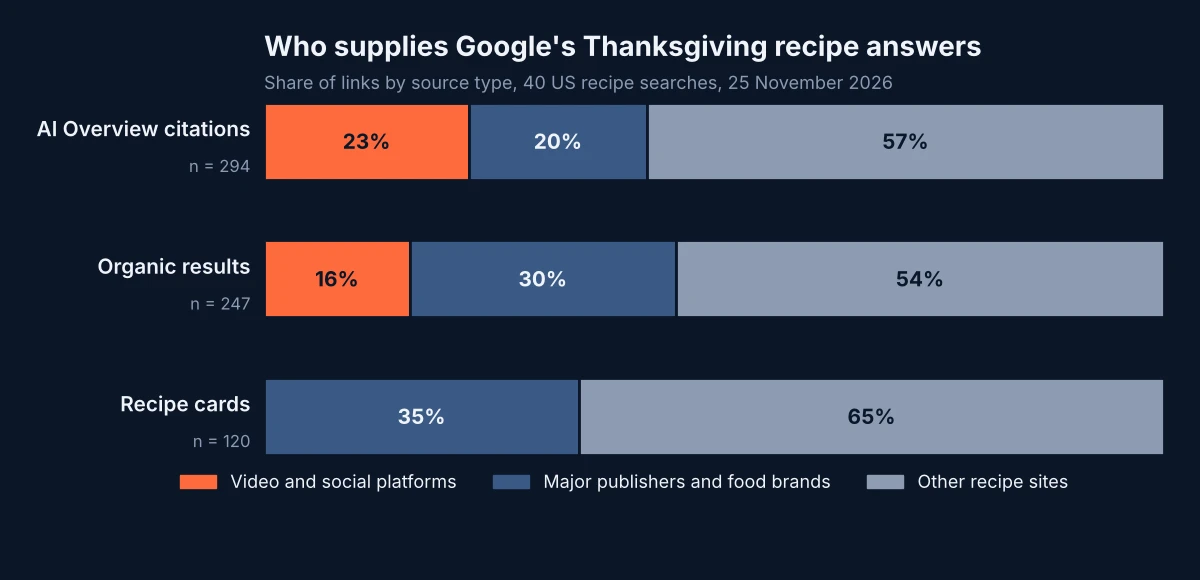
The overviews leaned more on video and social posts than the organic results below them did, and the recipe carousel used none. The candied yams overview cited 11 sources, 8 of them video or social posts. For the mac and cheese search, three of the five cited sources were Facebook videos, and a Facebook video also held the first organic position.
The split varied by course. Desserts drew almost entirely on recipe sites, while sides and leftovers leaned hardest on video.
| Course | Searches | With AI Overview | Full recipe layout | Citations | Video or social share |
|---|---|---|---|---|---|
| Turkey and mains | 10 | 10 | 7 | 77 | 21% |
| Gravy, stuffing and breads | 8 | 7 | 7 | 56 | 23% |
| Sides | 13 | 13 | 12 | 100 | 28% |
| Desserts | 7 | 6 | 6 | 41 | 5% |
| Leftovers | 2 | 2 | 1 | 20 | 40% |
| All | 40 | 38 | 33 | 294 | 23% |
Source: our pull of US Google results for 40 Thanksgiving recipe searches, 25 November 2026. "Full recipe layout" means the overview had both an ingredients heading and an instructions or steps heading.
The heavy YouTube presence matches what we found in other categories: YouTube was cited in all 30 overviews in our earlier YouTube citation study. Recipe queries show the same tilt, with a practical twist: a cook following the overview's steps may have little reason to open the video at all.
Context: a year of complaints and a change in AI Mode
Recipe creators have complained publicly about this since last year. In a Bloomberg report republished by Fortune on 26 November 2025, 22 independent food creators described AI summaries and copied recipes cutting their traffic; one blogger said visits to her turkey recipe were down 40% year on year. Google told Bloomberg that AI Overviews are "a helpful starting point" and that people still want original recipes from creators.
The recipe change from Google that we could verify this year was in AI Mode. On 1 July 2026, Android Authority reported that Robby Stein, Google's VP of Product for Search, had announced a carousel of recipe links at the top of AI Mode answers, each showing the creator's name, ratings, ingredient count and a photo. Our pull shows the standard results page still carries the AI Overview's own version of the recipe alongside the recipe carousel.
Google's new ranking principles page, published on 24 November, says web listings and results such as AI Overviews, carousels, images and videos "are evaluated using the same criteria" and that no result receives preferential treatment. It gives no data to test that against. Our numbers do not settle it either way, but they show what the outcome looks like on one of the year's busiest recipe days: the overview appeared on 38 of 40 searches. We explained how Google says it picks the sources inside those overviews in our report on Google's AI Overviews source selection documentation.
What this means for recipe and food publishers
- Measure the holiday against last year's holiday. Compare Search Console clicks and impressions for your top seasonal recipes against the same week in 2025, not against October. Impressions that hold while clicks fall can suggest the answer is being given on the results page.
- Keep Recipe structured data complete. The recipe carousel appeared on all 40 pages, and 72 of its 120 cards came from sites the overview also cited. Complete markup (ratings, total time, ingredients, image) keeps you eligible for a recipe feature that links straight to the source.
- Make the page worth the click. An overview can give the quantities and steps. It cannot easily give tested variations, step photos, troubleshooting or make-ahead timing. Put those near the top of the page, where a visitor who clicked through for more will see them.
- Publish video alongside the written recipe. YouTube was the single most cited source. A video of your own recipe gives the overview a version of your work to cite that still carries your name.
- Decide on preview controls deliberately. Google's AI features guide says nosnippet, data-nosnippet, max-snippet and noindex limit how content appears in AI features. These also limit your regular snippet, and none of 799 top-site pages used nosnippet in our snippet controls study. Test on a few pages before applying site-wide.
Methodology
On 25 November 2026, between about 17:19 and 17:23 UTC, we pulled Google desktop results in English for the United States through a SERP API for 40 Thanksgiving recipe searches covering turkey and mains (10), gravy, stuffing and breads (8), sides (13), desserts (7) and leftovers (2). One search ("roast turkey recipe") returned an overview that loaded separately, so we pulled it again at 17:22 UTC and used the second result. For each page we recorded whether an AI Overview appeared, its section headings, list items with measured quantities, temperatures, its cited sources and in-text links, the organic results returned (up to 10 per page) and the recipe carousel.
We counted an overview as a full recipe layout when it had a heading containing "ingredients" and a heading containing "instructions", "steps", "method" or "directions". We grouped each cited or ranking domain into three types: video and social platforms (YouTube, Facebook, Instagram, Reddit), major publishers and food brands (a fixed list of national food media, newspapers, retailers and food companies), and other recipe sites. The grouping is ours and is meant to show the broad mix, not to judge any site. Results are a single snapshot from one location and device; AI Overviews vary between pulls, users and locations.
Conclusion
On the day before Thanksgiving, Google's answer to most US recipe searches was a recipe of its own: ingredients, quantities, temperatures and steps, citing 7.7 sources on average, with YouTube cited more than any recipe site. The recipe change we could verify from Google this year was in AI Mode, while the standard results page still shows the overview on almost every recipe search we ran.
For food publishers, the recipe carousel and the overview's cited sources are the most visible places for a recipe site on these pages. Both reward complete, well-marked-up pages, and the overview rewards video. We covered a similar seasonal pattern in shopping searches in our study of stale Black Friday deal pages.
Questions and answers
How often did Google show AI Overviews on Thanksgiving recipe searches?
In our pull of 40 US recipe searches on 25 November 2026, 38 showed an AI Overview. Only "cranberry sauce recipe" and "apple crisp recipe" returned none.
Do AI Overviews show the whole recipe?
Mostly, in our sample. 33 of the 38 overviews had both an ingredients heading and an instructions or steps heading, 31 had at least three list items with measured quantities, and 27 named a cooking temperature.
Which sources did the recipe AI Overviews cite most?
YouTube, with 53 of the 294 citations we recorded. The most cited recipe site had 15. In all, 23 of the 38 overviews cited at least one YouTube, Facebook, Instagram or Reddit post.
Does Google still show recipe cards on these searches?
Yes. All 40 pages showed a carousel of three recipe cards, and 72 of the 120 cards came from a site that the AI Overview on the same page also cited.
Can recipe sites keep their content out of AI Overviews?
Google's AI features guide says the nosnippet, data-nosnippet, max-snippet and noindex controls limit how content appears in AI features in Search. These controls also limit regular search snippets.
More releases
-
Industry news
WebMCP Rewrites Its Tool Objects; 3 of 21 Top Sites Using It Still Call the Old API
The WebMCP draft specification dated 24 November now returns AI agent tools as objects with a hidden ID and renames their window field to source, a change Chrome's docs already reflect. Our crawl of the top 3,000 domains found WebMCP signals on 21 sites, and 3 still call only the older navigator entry point.
-
Studies
Is Google Rewriting More Titles Than It Admits? 72.5% of 182 We Checked Were Altered
Google last said in 2021 that it uses the HTML title element around 87% of the time. Our 25 November check of 182 US results found 72.5% of title links differed from the title tag, but most were trims, and the title's own text survived in 86.3%. Verdict: unproven.
-
Studies
A Test Says Googlebot Renders Only 249 Files; 13 of 365 Top Homepages Load More
An SEO consultant's tests suggest Google's renderer loads at most 249 files per page and drops the rest, a limit Google has not documented. Our crawl of 365 top homepages found 13 that request more than 249 files, and six once images, fonts and media are excluded.
Tell us the site and the goals.
Rankings in Google and visibility in AI answers, from one monthly plan. One call is enough to say which one fits. Email works just as well.