Google Explains How AI Overviews Pick Sources; 60% of Cited Links Weren't on Page One
Google published pages on 24 November explaining that AI Overviews start from ranked results, then widen through related searches, and listing every generative AI control in one table. In our pull of 23 US searches, 135 of 224 citation links were not linked anywhere on page one, though the top result was cited 18 times.
 Vibhu Dhariwal
Cofounder & CTO, Digital Gratified
- Published
- Section
- Explainers
- Reading time
- 8 minutes
Ras Al Khaimah, United Arab Emirates, .
Google published two new Search Central pages on 24 November 2026 that explain, for the first time in one place, how AI Overviews and AI Mode choose the pages they link to and which controls decide whether your content is used. The attribution and factuality page says that for AI Overviews on web searches, "the first step is to examine the ranked results returned", with snippets from those pages passed to a customized Gemini model. To see how that plays out, we pulled 23 live US Google searches that all showed an AI Overview: 135 of the 224 citation links (60%) did not appear anywhere as a link on the first page of results.
The pages were listed in Google's documentation changelog on the same day as the new ranking section we covered in our report on the preannounced December core update. The second page, Control how your content is used for generative AI at Google, gathers every opt-out into a single table of goals and settings.
What Google now says about source selection
The attribution page breaks the process into four steps. None of them is new as a concept, but this is the most specific description Google has published.
- Ranked results first. For AI Overviews on web searches, the system checks the ranked results for relevance to the query and gives snippets from those pages to the model as a basis for the response.
- Related searches. The model may run one or more related searches (query fan-out) across the index to find pages that cover other parts of the question.
- Grounding and corroboration. The model writes the response from the pages it found, then cites and links to the pages that support each part.
- Display. Links can appear as inline link icons, grouped source cards or expandable carousels. Google says it balances relevance and quality signals from ranking with a clear layout and a diverse set of sources.
Before a response is shown, Google says it applies safety and policy guardrails, with a higher bar for sensitive Your Money or Your Life topics and thin breaking news, and checks claims against web results, data feeds and the Knowledge Graph. Model changes also go through automated claim checks, benchmarks and live A/B tests.
What changed compared with the older pages
Google's existing AI features page already mentioned query fan-out and the rule that a supporting link must be indexed and eligible to show with a snippet. It did not say that the ranked results for the original query are the starting point, did not describe any pre-display checks, and did not tell site owners what to do when a response credits the wrong site. The new page adds all three, plus a line that matters for anyone who refreshes dates for freshness: Google advises against changing a page's date unless the content has substantially changed.
Our check: where the cited links actually sat
If ranked results are step one, the pages on page one should supply a large share of citations. They supplied a third. Of the 224 citation links, 76 (34%) matched an organic result on page one, 13 (6%) matched a video in the page's video carousel, and 135 (60%) were not linked anywhere on page one. YouTube alone supplied 72 of the 224 links, and 57 of those 135 off-page links were YouTube videos.
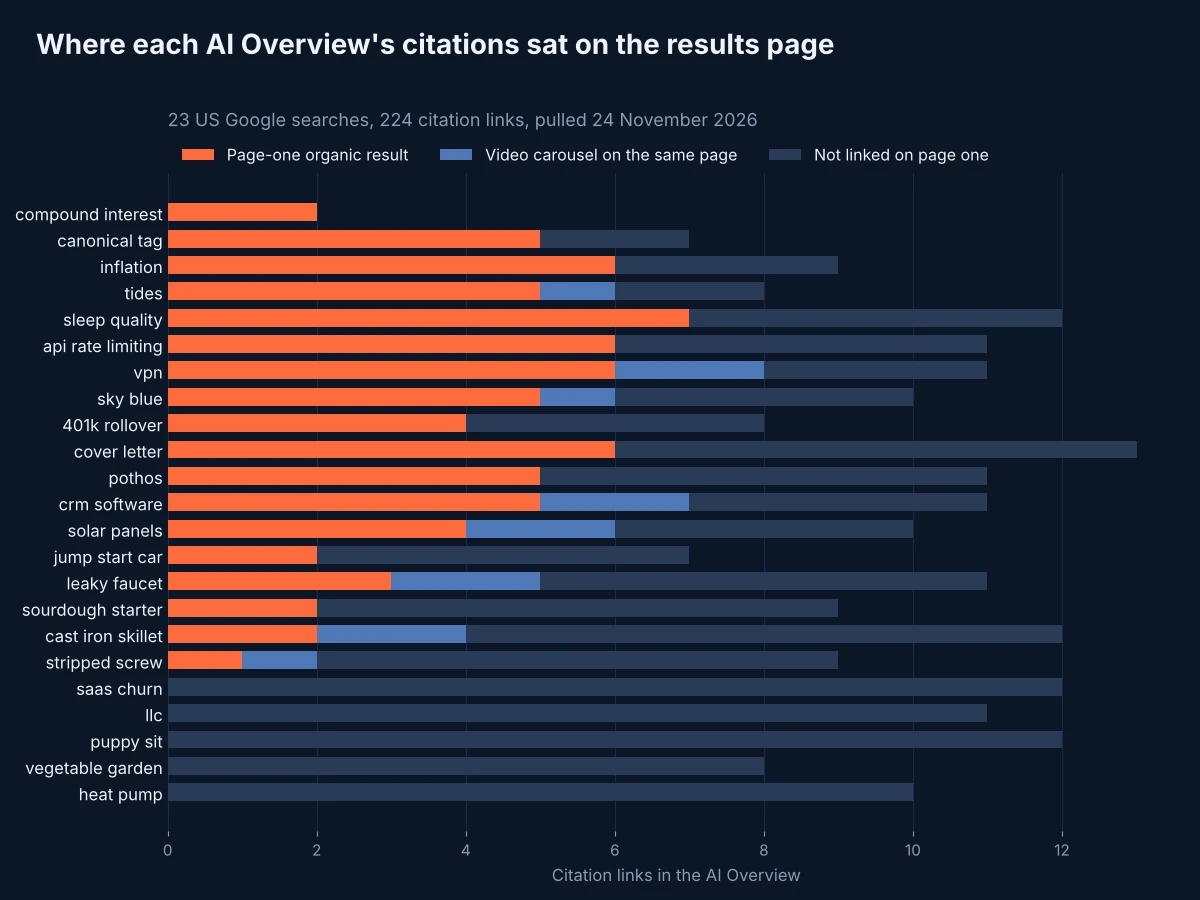
The split varied widely by query. Five of the 23 AI Overviews (heat pump, vegetable garden, puppy training, LLC and SaaS churn) cited no page-one organic result at all. In the LLC search, for example, the overview cited the IRS, Investopedia and Chase, and none of the three appeared among the nine organic results. At the other end, the compound interest overview had two readable citation links, and both were among the top two organic results.
Position still predicts citation
Ranking well did raise the odds of being cited. The first organic result was cited in 18 of 23 overviews, and the citation rate fell with position.
| Organic position on page one | Searches with a result at that position | Cited in the AI Overview | Rate |
|---|---|---|---|
| 1 | 23 | 18 | 78% |
| 2 | 23 | 14 | 61% |
| 3 | 23 | 10 | 43% |
| 4 to 5 | 46 | 22 | 48% |
| 6 to 9 | 47 | 12 | 26% |
Source: our pull of 23 US Google results pages, 24 November 2026. Pages showed between 5 and 9 organic results because other features took the remaining slots.
Both findings fit Google's own description: ranked results feed the response, and fan-out searches bring in pages that never rank for the original query. Our earlier test of whether AEO formatting wins AI Overview citations also found most citations came from beyond page one.
How this compares with independent research
A Washington University in St. Louis team that audited 55,393 Google searches on trending topics between 13 March and 21 April 2026 found that 29.8% of cited domains did not appear in the first-page results. Measured the same way (distinct domains per overview), our sample was higher: 84 of 167 cited domains (50%) were absent from the page-one organic results. Our queries were how-to and definition searches rather than trending topics, and our sample is far smaller, so the two figures are not directly comparable. The same study found about 89% of verifiable claims were clearly or broadly supported by the cited sources, and that only 41.9% of overviews were fully grounded.
The controls, in one table
The controls page separates three uses of crawled content: foundation model training, grounding in non-Search products such as the Gemini app, and grounding in Search generative AI features. Google's own examples map goals to settings like this:
| Goal | Setting Google names |
|---|---|
| Stay in Search, opt out of AI Overviews and AI Mode, allow training | Search generative AI control in Search Console set to exclude your site; do not disallow Google-Extended |
| Stay in Search and AI features, limit training and non-Search grounding | Disallow Google-Extended in robots.txt |
| Opt out of Search AI features and limit training | Both of the above |
| Limit snippet length or keep a passage out of grounding | data-nosnippet, max-snippet or nosnippet |
| Show paywalled content in AI features with a snippet | Paywalled content structured data plus data-nosnippet or max-snippet |
| Leave Search entirely, AI features included | noindex |
Source: Google Search Central, Control how your content is used for generative AI at Google, published 24 November 2026.
Google says the Search Console control is not used as a ranking or inclusion signal for other parts of Search, and that Google-Extended is not a Search ranking signal. Our earlier report covers how the Search generative AI control works, and our crawl of top sites found almost none use nosnippet on their pages.
What to do when an AI Overview gets you wrong
The attribution page includes a troubleshooting table. In summary:
- Wrong source credited in the response: use the Feedback link directly below the AI response on the results page.
- Your page is wrong or ambiguous: fix the page, then ask Google to recrawl it. If it is urgent, the Removals tool hides the page for about six months, but from all of Google Search, not only AI features.
- Another site is credited for your content: if you syndicate, ask partners to block indexing of your copy; if a site copied you without permission, Google points to a DMCA request.
- Part of a page should not be shown: use nosnippet, data-nosnippet or max-snippet.
What this means for SEO teams
- Rank for the query and its sub-questions. Ranking first gave a 78% citation rate in our sample, but 60% of links came from pages not linked on page one. Cover the related questions a fan-out search would ask, with clear answers in text.
- Check video. YouTube supplied nearly a third of all citation links. For how-to queries, a video on the topic can earn a citation when your article does not.
- Run your own spot check. Search your top 20 queries, list every link in the AI Overview, and mark whether it ranks on page one. Pages that are cited without ranking show where fan-out is pulling in competitors.
- Pick controls by goal, not by habit. Blocking Google-Extended does not remove you from AI Overviews; only the Search Console control, snippet rules or noindex do.
Methodology
On 24 November 2026 (UTC) we ran 23 informational searches through a SERP API using google.com with English language settings and a United States location. The queries covered how-to, definition and explainer topics across home, finance, tech, gardening, pets, science and software. All 23 returned an AI Overview. For each, we collected the AI Overview's reference links, the organic results and the video carousel items. One reference link was returned in an unreadable form and was excluded, leaving 224. We normalized URLs (removing protocol, www, query strings, trailing slashes and fragments, and reducing YouTube links to their video ID) and counted a citation as matching page one only when the same URL appeared as an organic result or video carousel item. The domain comparison counted each distinct domain once per overview against the organic result domains. Results reflect one fetch per query and will vary by user, device and time.
Conclusion
Google's new pages confirm the basic model SEO teams have worked from: AI Overviews start with ranked results, widen the net with related searches, and link to pages that support each claim. The new detail is in the process around that model, from pre-display checks to a troubleshooting route for misattribution and a single table of controls.
Our pull shows how wide the net is. Ranking first still made a citation likely, but most of the links in our sample pointed to pages that were not on page one at all, and nearly a third of all the links were YouTube videos.
Questions and answers
How does Google choose the links shown in AI Overviews?
Google's attribution and factuality page, published on 24 November 2026, says the system first examines the ranked results for the query and passes snippets to a customized Gemini model, may run related searches (query fan-out), then cites the pages that support the response.
Do AI Overviews only cite pages that rank on page one?
No. In our pull of 23 US searches on 24 November 2026, 76 of 224 citation links matched a page-one organic result, 13 matched a video carousel item, and 135 were not linked on page one.
Does blocking Google-Extended remove my site from AI Overviews?
No. Google's controls page says disallowing Google-Extended limits training and grounding in other Google generative AI products while the site stays in Search, including AI Overviews and AI Mode. To opt out of Search AI features, Google points to the Search generative AI control in Search Console.
What should I do if an AI Overview credits another site for my content?
Google says to ask syndication partners to block indexing of your content on their sites, or, if a site copied your content without permission, to consider a DMCA request. For inaccurate attribution in a response, use the Feedback link below the AI response.
Is the Search generative AI control a ranking signal?
Google says the control is not used as a ranking or inclusion signal for other parts of Google Search, and that Google-Extended is not a Search ranking signal either.
More releases
-
Updates
Google Preannounces Its December Core Update; Its Last 9 Ranking Posts Came at Rollout
Google posted the December 2026 core update to its Search Status Dashboard on 24 November with no start date, an hour after the November core update finished. Every earlier ranking update in the dashboard feed was posted within 19 minutes of rollout, and a new ranking hub now explains notice and feedback.
-
Studies
Google Said Links Would Move Up; 22 of 35 AI Overviews Put the First in the Final Third
A SaaS Link Building newsroom pull of 36 Google AI Overviews on 24 November found citation chips near the top of every answer, but the first hyperlink inside the answer text sat in the final third in 22 of the 35 that had one, a median 85% of the way down.
-
Studies
Does Linking Out Help You Rank? 58% of Top-3 Google Results Link to No Other Site
Google says outbound links are not a ranking factor, while its documentation says they can help build trust. We read 158 pages ranking for 41 US searches: 58% of top-3 results had no editorial link to another website, against 34% in positions 4 to 9. Our verdict on the authority-link theory: unproven.
Tell us the site and the goals.
Rankings in Google and visibility in AI answers, from one monthly plan. One call is enough to say which one fits. Email works just as well.