Can AEO Formatting Win AI Overview Citations? 89% of 306 Came From Beyond Page One
Google says AI Overviews need no special formatting. We tested the AEO checklist on 31 live searches: FAQ schema and summary boxes showed no benefit, question headings helped only in pooled numbers, and 272 of 306 citations went to pages that did not rank on page one for the query.
 Vibhu Dhariwal
Cofounder & CTO, Digital Gratified
- Published
- Section
- Studies
- Reading time
- 12 minutes
Ras Al Khaimah, United Arab Emirates, .
A growing market of "answer engine optimization" (AEO) and "generative engine optimization" (GEO) advice says pages can be engineered into Google's AI Overviews: add FAQ schema, rewrite subheadings as questions, break text into short chunks, put a key takeaways box at the top. Google's position, set out in a guide to optimizing for generative AI features that John Mueller announced on 15 May 2026, is that tactics like these are not needed. To test the two claims against live results, we pulled 31 Google searches on 14 November 2026, resolved every AI Overview citation and all but 3 page-one organic results, and scored 118 ranking article pages for the formats AEO advice recommends.
The short version: whether a page-one article was cited depended far more on which search it ranked for than on how it was formatted. In 23 of the 31 searches, the AI Overview cited none of the page-one articles we could read, whatever their structure. And 89% of the citations came from pages that were not page-one organic results at all.
The theory: AI Overviews reward a specific page format
The AEO and GEO pitch rests on a reasonable idea. AI Overviews are written by a language model that pulls passages from web pages, so pages that are easy to extract from (question headings that mirror the query, short self-contained answers, lists, FAQ markup, a summary near the top) should be quoted more often. Agencies and tool vendors sell audits built on that checklist, and "chunking" content for AI retrieval has become common advice.
The theory also has an academic anchor. The 2023 paper GEO: Generative Engine Optimization, by researchers including Pranjal Aggarwal and Karthik Narasimhan and later presented at the KDD 2024 conference, tested nine ways of rewriting source pages. The authors report that methods such as adding statistics, citing sources and adding quotations raised a page's visibility in generative engine answers by up to 40% on their benchmark, and by up to 37% in tests on Perplexity. That paper studied rewritten text in controlled experiments, not Google's AI Overviews, but it is the most cited evidence that content changes can move generative citations.
What Google says
Google's documentation rejects the idea that AI Overviews need special formatting. Its AI features page says there are "no additional requirements to appear in AI Overviews or AI Mode", and adds that no other special optimizations are necessary. The May 2026 guide goes further, with a section that lists AEO and GEO tactics site owners can ignore:
- Chunking: the guide says there is no requirement to split content into small pieces and that Google can find the relevant part of a long page.
- Rewriting for AI: it says AI systems understand synonyms and general meaning, so pages do not need to be written in a special way.
- Structured data: it says structured data is not required for generative AI search and no special schema.org markup is needed, though it still helps with rich result eligibility.
- Special files: it says Google Search does not use llms.txt or similar AI text files.
Google also describes how the feature retrieves pages. The guide says its generative AI features rely on core Search ranking systems through retrieval-augmented generation and on "query fan-out", where the model issues related searches to gather more results. The AI features page says both AI Overviews and AI Mode may use fan-out to find a wider set of supporting pages.
FAQ markup has its own history. In August 2023 Google cut back FAQ rich results so they would only show for well-known, authoritative government and health sites, and it later deprecated How-to rich results. Our own crawl found that many sites still ship markup for rich results Google has retired, which helps explain why FAQ schema is now pitched for AI visibility instead.
Evidence for the theory
Taken at face value, part of our data looks like support for AEO formatting. Across all 118 article pages, those with three or more question-style headings (headings that end in a question mark or start with words like what, how or why) were cited at about twice the rate of pages without them. Pages with more lists, and pages with a higher density of numbers in the text, also had higher pooled citation rates.
| Signal on the ranking page | Pages with it | Cited | Pages without it | Cited |
|---|---|---|---|---|
| FAQPage structured data | 8 | 1 (12.5%) | 110 | 23 (20.9%) |
| Any JSON-LD structured data | 96 | 19 (19.8%) | 22 | 5 (22.7%) |
| Summary or key takeaways heading | 10 | 2 (20.0%) | 108 | 22 (20.4%) |
| 3 or more question-style headings | 41 | 13 (31.7%) | 77 | 11 (14.3%) |
| 3 or more lists | 51 | 13 (25.5%) | 67 | 11 (16.4%) |
| Numbers per 1,000 words at or above the median (5.8) | 59 | 15 (25.4%) | 59 | 9 (15.3%) |
Source: SaaS Link Building analysis of 118 page-one article pages across 31 Google searches (US, desktop, English), collected 14 November 2026. "Cited" means the AI Overview linked that exact URL.
The number-density result lines up with the GEO paper's finding that adding statistics raised visibility. In the four searches where the AI Overview cited some page-one articles but not others, the cited pages had more numbers per 1,000 words than the uncited ones in all four. That is the strongest pro-theory signal in our data, and it is also the thinnest: four searches is far too few to separate a real effect from chance.
Evidence against the theory
Citations cluster by query, not by page
The pooled numbers above hide where the citations actually landed. All 24 cited article pages came from just 8 of the 31 searches. In those 8 searches, 24 of 33 page-one articles were cited. In the other 23 searches, 0 of 85 page-one articles were cited, including pages with FAQ markup, question headings and summary boxes.
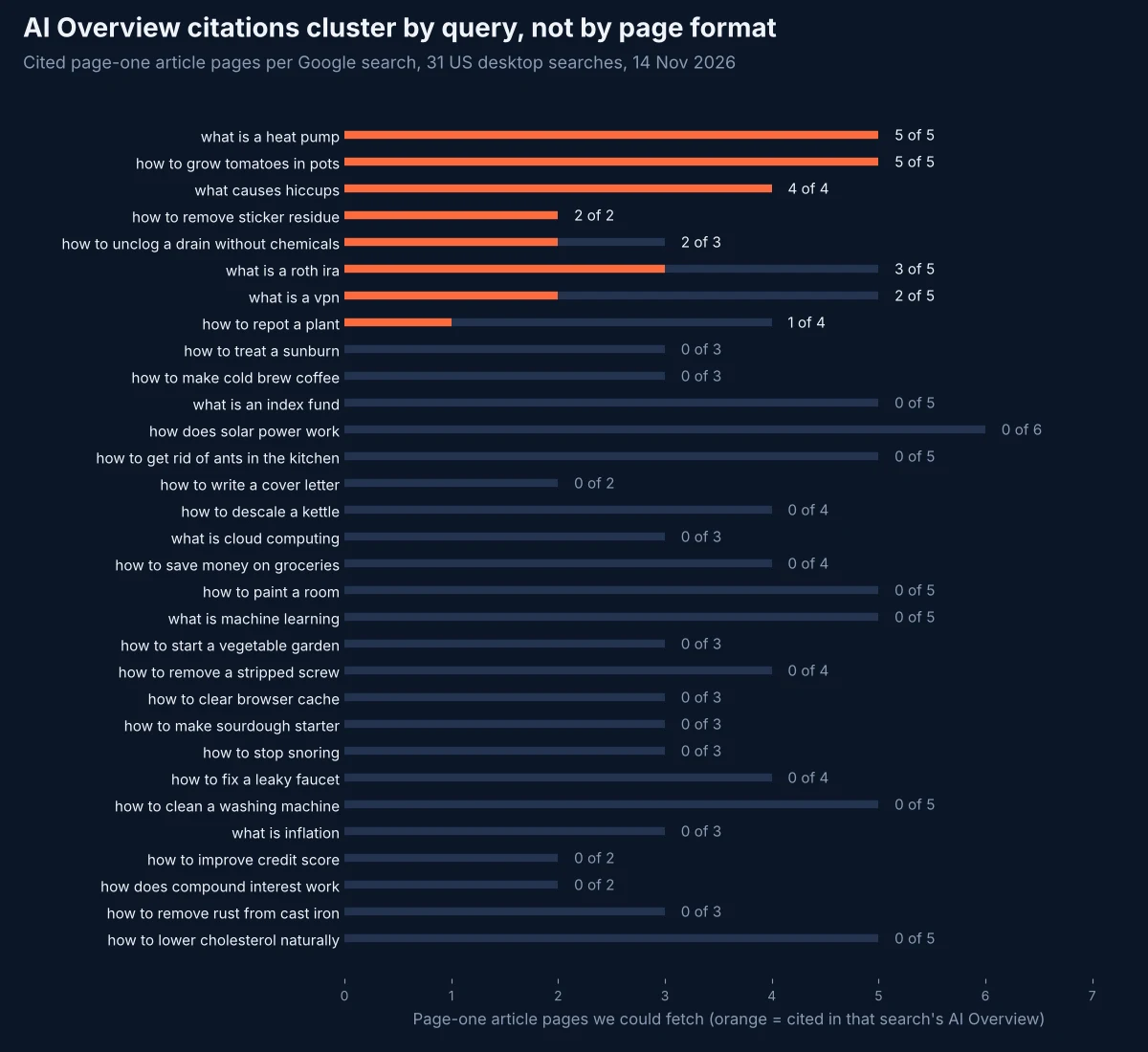
That pattern is what makes the pooled question-heading gap misleading. Some of the searches whose AI Overviews cited page-one articles, such as "what causes hiccups" and "what is a vpn", happened to have ranking pages full of question headings. Others did not: for "how to grow tomatoes in pots", the AI Overview cited all five page-one articles we could read, and four of them had no question-style headings at all. When we compared cited and uncited pages inside the same search (the only fair test, since it holds the query constant), cited pages had more question headings in two searches and fewer in two. FAQPage markup did no better: 1 of the 8 pages carrying it was cited, a lower rate than pages without it.
Most citations never came from page one
The second problem for format-first advice is that the AI Overviews mostly cited pages that were not in the organic results we pulled. Across the 31 searches, the AI Overviews carried 306 unique citation links. Only 34 of them pointed to a page-one organic result. YouTube supplied 107 citations from outside the organic list, matching the pattern in our earlier YouTube citation study, and the remaining 165 went to other pages that did not rank on page one for the original query.
That fits Google's own description of query fan-out: if the model runs several related searches, many cited pages would rank for those sub-queries rather than the one the user typed. A page cannot be formatted into a citation for a search whose underlying retrieval never surfaces it.
Position mattered more than any format signal
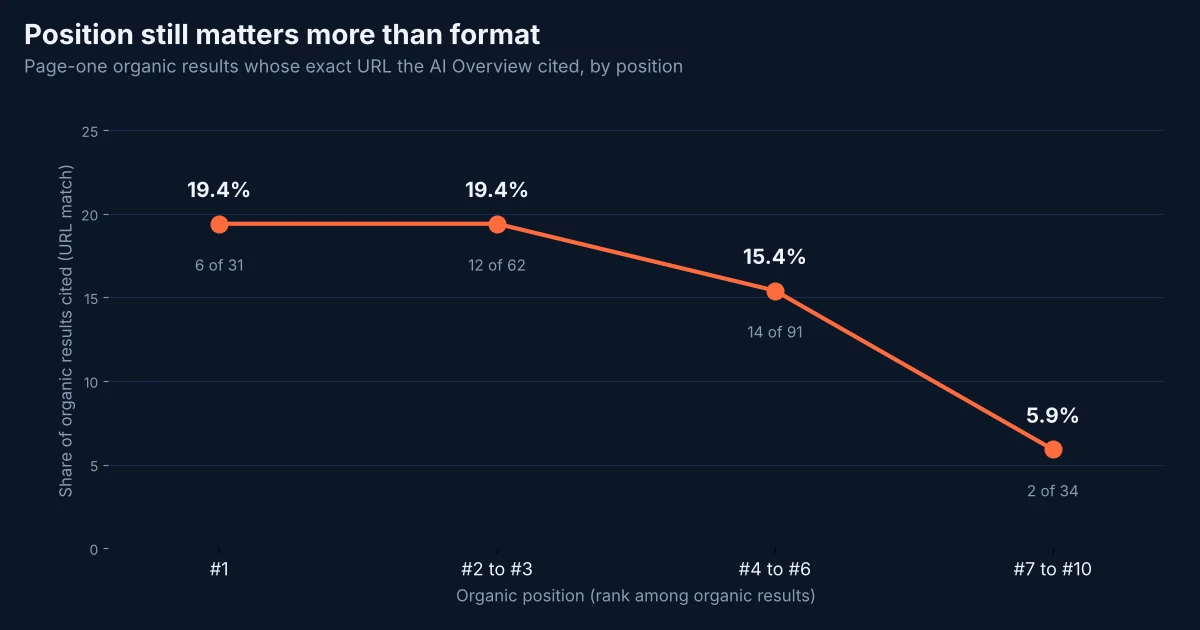
Among page-one results, rank behaved the way Google's description of AI features as rooted in its core ranking systems would predict: the citation rate held steady across the top three organic positions, dipped slightly at positions 4 to 6 and fell sharply at 7 and below. Only two results below position 6 were cited, so treat the tail with caution.
What the court record adds
The remedies opinion in the US antitrust case against Google, issued by Judge Amit Mehta on 2 September 2025, offers a possible further reason to doubt that page formatting is the main lever. The memorandum opinion records testimony that Google grounds its Gemini models with a system called FastSearch, which is based on RankEmbed ranking signals and returns abbreviated ranked results drawn from fewer documents than full Search. The same opinion states that AI Overviews is built on a branch of the Gemini model family.
Speculation: the opinion does not say that AI Overviews use FastSearch, and Google has not confirmed it. If they do, a separate, lighter retrieval layer would be another reason AI Overview citations diverge from the organic top results, and it would put the deciding step in ranking signals, not in how a page's headings are worded.
Verdict: unproven
We rate the claim that AEO formatting wins AI Overview citations as unproven, leaning against.
- FAQ schema and summary boxes: no support in our sample. FAQ-marked pages were cited less often than others, and summary boxes made no difference. Google says neither is needed, and our data does not contradict it.
- Question-style headings: the pooled advantage disappears when the query is held constant. It appears to reflect which searches cite page-one content, not a format effect.
- Number density: a consistent direction in four searches and an echo of the GEO paper, but far too small a sample to call. This is the claim most worth testing further.
- The bigger factors: the query itself and organic position mattered more than any format signal we measured; fan-out retrieval, which Google describes but we did not measure, may explain why most citations came from outside page one.
Our test cannot rule out small format effects. With 118 article pages, only 24 of them cited, and citations concentrated in 8 searches, a modest real effect could be hidden. What it does show is that format is not the lever many AEO checklists present it as.
What this means for SEO teams
- Audit where citations come from before reformatting. Pull the AI Overview for your target queries and check whether it cites page-one articles at all. If it cites only video, forums or pages from other searches, restructuring your headings will not change that.
- Treat fan-out queries as the real target list. Most citations in our sample were not page-one results for the typed query. Map the sub-questions an AI Overview answers and check where you rank for each, while heeding Google's warning that mass-producing pages for fan-out variations counts as scaled content abuse.
- Keep structure for readers, not for extraction. Clear headings and lists are good practice, and Google's guide endorses clear headings and sections for readability. Do not expect them, or FAQ markup, to buy citations on their own.
- Add specific data where it is real. The one signal with some support here is concrete numbers in the text. Use sourced figures where they help the reader; inventing statistics would undercut the quality systems Google says AI features depend on.
- Measure inside Search Console. Google points site owners to its generative AI performance report and warns against third-party tools that promise ranking success, and our earlier tests of how AI Overviews rewrite citation snippets show how much changes between what a page says and what the overview shows.
Methodology
On 14 November 2026, between 09:17 and 09:24 UTC, we used a SERP data API to collect Google results for 31 English informational queries (how-to, what-is and why questions across health, money, home, garden, tech and food), with location set to the United States, desktop device, and AI Overview loading enabled. All 31 searches returned an AI Overview.
Google now wraps result links in /goto redirects, so we followed each redirect to its destination URL. This gave 218 page-one organic results (5 to 9 per search) and 313 AI Overview reference links, or 306 unique links once duplicates within each search were removed. We matched organic results to citations by normalised URL (host without www, path without trailing slash, query string dropped except YouTube video IDs). A domain-level match, counted separately, found 61 of the 218 organic results on a domain the AI Overview cited.
We fetched each page-one URL with a desktop browser user agent. We excluded video and forum results, pages that returned errors (mostly 403 and 429 responses), and pages with under 150 words of main text, leaving 118 article pages. For each, we parsed the main content area (the article or main element where present) and recorded: JSON-LD types, including FAQPage; the number of h2 and h3 headings and how many were question-style; whether any heading named a summary, key takeaways or similar block; the number of lists and tables; word count; and the count of numeric figures (percentages, currency amounts and numbers of two or more digits) per 1,000 words.
Limitations: 31 queries is a small sample, and the results reflect one location, one device and one moment. Pages blocked to our fetcher are missing. URL matching can miss citations to a different URL on the same site, which is why we report the domain-level count as well. Our heading and number counts are rough proxies for the formats AEO advice describes, not a full content-quality assessment.
Conclusion
Google says AI Overviews need no special formatting, and a 31-search test gives little reason to doubt it. Whether page-one articles were cited depended mainly on the search: in 23 of 31 searches none were, and 89% of all citations went to pages that did not rank on page one for the query. FAQ markup and summary boxes showed no benefit, and the apparent question-heading advantage vanished when compared within the same search. The one signal worth a closer look is concrete, numeric content, which matches the academic GEO research but rests on too few searches here to confirm.
For now, the evidence points SEO teams back to ranking for the questions an AI Overview fans out to, and away from reformatting pages to fit a checklist. Our llms.txt crawl reached a similar conclusion for another AEO staple: one in five top sites publish the file, even though Google Search ignores it.
What do you think?
If you have restructured pages for AI Overviews (question headings, FAQ markup or added statistics), did your citations in Search Console's generative AI report change afterwards, and by how much compared with pages you left alone?
Questions and answers
Does FAQ schema help a page get cited in AI Overviews?
Google's guide to generative AI features says structured data is not required and there is no special schema.org markup to add. In our 31-search test, 1 of 8 page-one article pages with FAQPage markup was cited, compared with 23 of 110 pages without it.
What does Google say about AEO and GEO?
Google's May 2026 guide says that, from Google Search's perspective, optimizing for generative AI search is still SEO. It lists chunking content, rewriting pages for AI, llms.txt files and overfocusing on structured data among tactics site owners can ignore.
Do AI Overviews only cite pages that rank on page one?
No. In our test, 34 of 306 unique AI Overview citation links pointed to a page-one organic result for the query. Google says AI Overviews and AI Mode may use query fan-out, issuing related searches to find more supporting pages.
What is Google's FastSearch?
According to the September 2025 remedies opinion in the US antitrust case, FastSearch is a Google system based on RankEmbed signals that returns abbreviated ranked web results to ground Gemini models. It retrieves fewer documents than Search and is not used for the results page. The opinion does not say whether AI Overviews use it.
More releases
-
Studies
November Core Update, Day 1 to 4: 75% of Top-10 URLs Held vs 64% the Week Before
Google's November 2026 core update has so far moved page one less than the week before it. Across 19 high-volume US keywords, 75.4% of top-10 URLs held their place in the first snapshot after the 10 November start, against 64.2% in the prior week, with recipes, video and health sources moving most.
-
Explainers
Merchant Center Bans Dates in Promotion Titles; 36 of 38 Translations Still List Them
Google's Merchant Center editorial requirements now say promotion titles must not include dates in any format, leaving dates to the promotion date fields. Our check of the help page in 48 language settings found only US English carries the new rule; 36 of 38 served versions still list date formats.
-
Studies
Mueller Points to AI Image Metadata Rule; Shopify JPEGs Dropped XMP on 36 of 36 Images
Google's John Mueller says Merchant Center's metadata rule is the only Google guidance he knows of for AI product images. Our download of 144 images from 48 Shopify stores found none carried the AI label, and every XMP packet present in WebP versions vanished when the same URL served JPEG or PNG.
Tell us the site and the goals.
Rankings in Google and visibility in AI answers, from one monthly plan. One call is enough to say which one fits. Email works just as well.