November Core Update, Day 1 to 4: 75% of Top-10 URLs Held vs 64% the Week Before
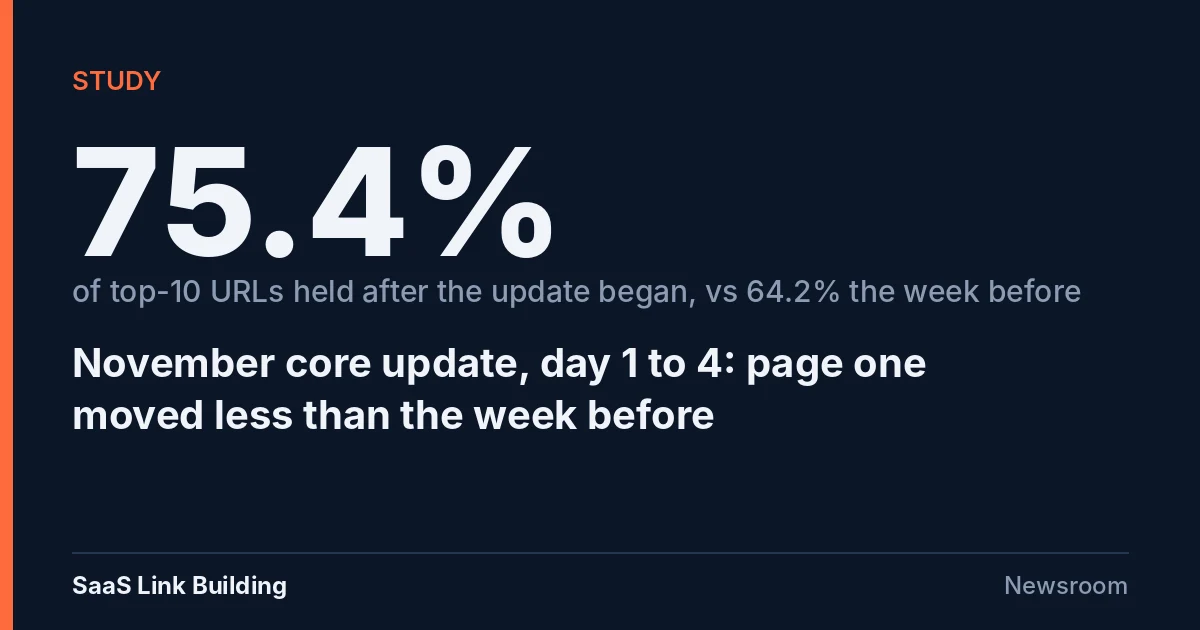
Google's November 2026 core update has so far moved page one less than the week before it. Across 19 high-volume US keywords, 75.4% of top-10 URLs held their place in the first snapshot after the 10 November start, against 64.2% in the prior week, with recipes, video and health sources moving most.
 Vibhu Dhariwal
Cofounder & CTO, Digital Gratified
- Published
- Section
- Studies
- Reading time
- 8 minutes
Ras Al Khaimah, United Arab Emirates, .
Google's November 2026 core update has not shaken up the top of its US results in its first days, at least not on the keywords we tracked. We compared stored weekly Google snapshots for 19 high-volume US keywords across finance, health, shopping, software, travel and how-to searches. In the first snapshot taken after the update began on 10 November, 98 of the 130 organic URLs that ranked in the top 10 beforehand were still there, a hold rate of 75.4%. In the equivalent week before the update, only 86 of 134 URLs held on, or 64.2%.
Google logged the start of the update at 18:06 UTC on 10 November on its Search Status Dashboard, which says it applies globally and to all languages and may take up to two weeks to roll out. The entry had not been updated when we checked on 14 November, so the rollout is still in progress. We covered the launch and the 173-day wait that preceded it in our first report on the November core update. This follow-up asks a narrower question: how much did page one actually move in the first days of the rollout?
Key findings
- Less churn, not more: 75.4% of pre-update top-10 URLs held in the first post-update snapshot, against 64.2% in the week before the update. New URLs entering the top 10 fell from 44 to 36.
- 11 of 19 keywords churned less after the update began than in the week before it. Six churned more and two were unchanged.
- Later snapshots moved more: keywords re-checked on 11 November held 81% of their URLs; those re-checked on 12 to 14 November held 70%. Both figures were still above the matching pre-update weeks (68% and 61%).
- One clear outlier: "chicken breast recipes" took in five new URLs, the biggest change in the set, and its page also carried more organic results than before.
- Video gained ground: a YouTube result sat in the top 10 for 9 of the 19 keywords after the update began, up from 5 in the snapshot before it.
Before and after, side by side
Each keyword in our set had a stored snapshot roughly every six days. That gave us three snapshots per keyword: one from late October or early November (the baseline), the last one before 10 November (pre-update), and the first one after the update began (post-update). The median gap between snapshots was 6.4 days for the baseline window and 6.2 days for the post-update window, so the two comparisons cover similar spans of time.
| Measure | Week before the update | First snapshot after it began |
|---|---|---|
| Top-10 URLs carried over | 86 of 134 (64.2%) | 98 of 130 (75.4%) |
| New URLs entering the top 10 | 44 | 36 |
| Keywords with at least two new URLs | 12 of 19 | 9 of 19 |
| Keywords with at least one new domain | 16 of 19 | 17 of 19 |
| Keywords with a YouTube result in the top 10 | 5 of 19 (pre-update snapshot) | 9 of 19 |
| Keywords with a Reddit result in the top 10 | 9 of 19 (pre-update snapshot) | 11 of 19 |
Source: SaaS Link Building analysis of stored US Google SERP snapshots for 19 keywords, pulled 14 November 2026. Organic results in positions 1 to 10 only.
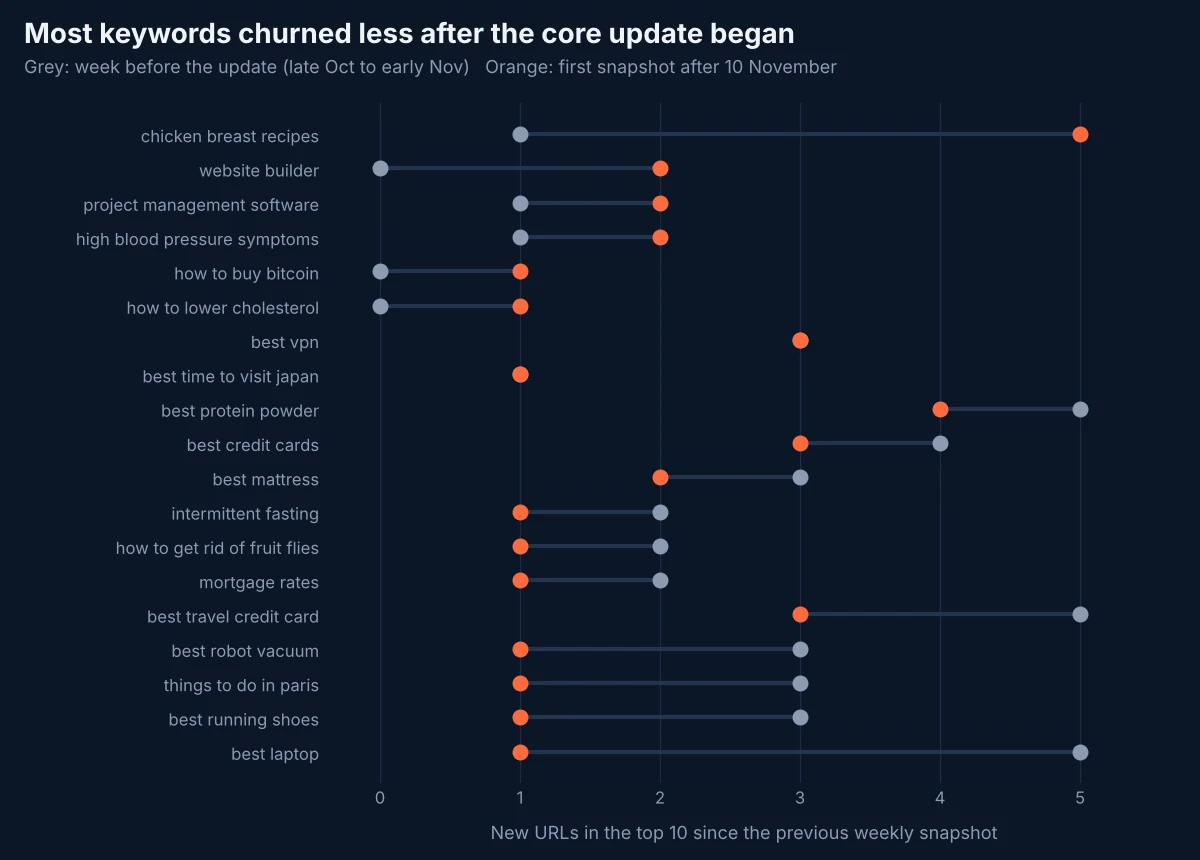
The keyword-level picture is uneven. Shopping terms, which churned heavily in the baseline week, settled down: "best laptop" went from five new URLs to one, and "best robot vacuum" and "best running shoes" each fell from three to one, as did the travel query "things to do in paris". A handful of quieter pages moved more after 10 November, led by recipes and software.
Where the update did show up
Grouping the keywords by sector shows where the early movement sits.
| Sector | Keywords | New URLs, week before | New URLs, after update start |
|---|---|---|---|
| Shopping | 4 | 14 | 5 |
| Finance | 4 | 11 | 8 |
| Health | 4 | 8 | 8 |
| Software | 3 | 4 | 7 |
| How-to and recipes | 2 | 3 | 6 |
| Travel | 2 | 4 | 2 |
Source: SaaS Link Building analysis of 19 keywords. "best air fryer" is left out of this table because its baseline snapshot was incomplete.
Recipes. "chicken breast recipes" showed the sharpest change. The pre-update snapshot held only four organic URLs in the top 10 positions, with search features taking the rest. The post-update snapshot held seven, and five of them were new, including a YouTube video and several food blogs. A New York Times Cooking roundup dropped out. One keyword cannot show a sector trend on its own.
Health. The swaps on health queries ran toward non-profit and public bodies. On "high blood pressure symptoms", an insurer's Medicare article and a regional hospital blog dropped out, and pages from the American Heart Association and the National Council on Aging came in. On "how to lower cholesterol", CDC and Mass General Brigham pages left the top 10 and a page from New Zealand's Heart Foundation entered.
Finance. On "mortgage rates", three commercial rate pages (Bankrate, Credit Karma and Rocket Mortgage) fell out and the St. Louis Fed's FRED chart of the 30-year rate came in. On both credit card terms, CNN Underscored had one of its own pages replaced by another, while a Reddit thread and a YouTube video entered the top 10 for "best credit cards".
Software. "website builder" lost nothing but gained two URLs, while "project management software" swapped a Wikipedia entry for a Reddit thread and a review site. "best vpn" saw a vendor comparison page and a second Reddit thread enter, and one YouTube video replace another.
What this means, and what it does not
The data does not say the update is mild. Core updates roll out over days, and our post-update snapshots were taken between about seven hours and four days after the logged start. The split by date points the same way: keywords captured on 12 to 14 November had already moved more than those captured on 11 November. The real test comes after the rollout ends.
The data also sits awkwardly beside the chatter. Search Engine Roundtable reported big movements in third-party rank-tracking tools in the days before 10 November, and the publication's author said he did not fully trust some of those readings because of possible blocking issues. Our baseline week, which ends just before the update, was indeed the more volatile of the two windows in this set. Google's dashboard gives 10 November as the start. We have reported before on altered results served to rank trackers and on tracker spikes that matched no confirmed update, so tool readings on their own are a weak guide to what a core update is doing.
What SEO teams should do now
- Do not read early ranking moves as the final result. Google's core updates guidance says to wait at least a full week after an update completes, then compare that week with the week before the rollout started.
- Check your own churn baseline. Pull a few weeks of your tracked keywords from before 10 November. If your pages moved this much in a normal week, a similar move now is not evidence of an update hit.
- Watch who replaced you, not only your position. In our set the swaps often went to video, Reddit threads or institutional sources. If a YouTube video or forum thread took your slot, a page rewrite alone may not answer the query the way Google now reads it.
- Separate layout changes from ranking changes. On the recipe query, the number of organic results in the top 10 positions rose from four to seven. Search features coming and going can change click share without any change to your rank.
Methodology
On 14 November 2026 we pulled stored Google US SERP snapshots from a commercial SEO tool's SERP database for 29 high-volume keywords chosen to cover finance, health, shopping, software, travel and how-to searches. We kept the 20 keywords whose newest snapshot was taken after the update's logged start (18:06 UTC on 10 November). For each, we also pulled the last snapshot before that time and the snapshot before that one. We counted organic results recorded in SERP positions 1 to 10, which means search features such as AI Overviews and video packs could take some of those positions. URLs were normalised for letter case, trailing slashes and tracking parameters. "Held" means the same URL appeared in both snapshots; "new" means a URL appeared in the later snapshot but not the earlier one. One keyword, "best air fryer", was dropped from the before and after comparison because its baseline snapshot was incomplete, leaving 19. This is a small sample of head terms in one country, so it describes direction, not the size of the update across all of Google.
Conclusion
In the first four days of the November 2026 core update, the top 10 for our 19 keywords moved less than it had in the week before the rollout began, with 75.4% of URLs holding their place against 64.2%. The movement that did occur leaned toward recipes, software, video results and institutional health sources, and it grew in the snapshots taken later in the week.
The update is still rolling out, and Google's own advice is to wait until a week after it ends before drawing conclusions. We will rerun this comparison once the dashboard marks the rollout complete. For the longer view of how this update fits Google's 2026 schedule, see our 2026 update calendar analysis.
Questions and answers
When did the November 2026 core update start?
Google's Search Status Dashboard logs the start at 18:06 UTC on 10 November 2026. The entry says the update applies globally and to all languages and that the rollout may take up to two weeks.
Has the November 2026 core update finished rolling out?
No. When we checked the Search Status Dashboard on 14 November 2026, the incident had no end time and no update beyond the launch notice.
How much did top-10 results change in the first days of the update?
In our check of 19 US keywords, 98 of 130 pre-update top-10 URLs (75.4%) were still in the top 10 in the first snapshot after the update began. In the week before the update, 86 of 134 URLs (64.2%) held.
When should I analyse the core update's effect on my site?
Google's core updates guidance recommends waiting at least a full week after the update completes, then comparing that week with a week before the rollout started.
More releases
-
Explainers
Merchant Center Bans Dates in Promotion Titles; 36 of 38 Translations Still List Them
Google's Merchant Center editorial requirements now say promotion titles must not include dates in any format, leaving dates to the promotion date fields. Our check of the help page in 48 language settings found only US English carries the new rule; 36 of 38 served versions still list date formats.
-
Studies
Can AEO Formatting Win AI Overview Citations? 89% of 306 Came From Beyond Page One
Google says AI Overviews need no special formatting. We tested the AEO checklist on 31 live searches: FAQ schema and summary boxes showed no benefit, question headings helped only in pooled numbers, and 272 of 306 citations went to pages that did not rank on page one for the query.
-
Studies
Mueller Points to AI Image Metadata Rule; Shopify JPEGs Dropped XMP on 36 of 36 Images
Google's John Mueller says Merchant Center's metadata rule is the only Google guidance he knows of for AI product images. Our download of 144 images from 48 Shopify stores found none carried the AI label, and every XMP packet present in WebP versions vanished when the same URL served JPEG or PNG.
Tell us the site and the goals.
Rankings in Google and visibility in AI answers, from one monthly plan. One call is enough to say which one fits. Email works just as well.