Merchant Center Bans Dates in Promotion Titles; 36 of 38 Translations Still List Them
Google's Merchant Center editorial requirements now say promotion titles must not include dates in any format, leaving dates to the promotion date fields. Our check of the help page in 48 language settings found only US English carries the new rule; 36 of 38 served versions still list date formats.
 Vibhu Dhariwal
Cofounder & CTO, Digital Gratified
- Published
- Section
- Explainers
- Reading time
- 7 minutes
Ras Al Khaimah, United Arab Emirates, .
Google's Merchant Center editorial requirements for promotions now tell merchants: "Don't include dates in any format" in a promotion title. Redemption dates belong only in their designated fields, and the one exception is a short month abbreviation such as "Jan". Search Engine Roundtable reported the change on 13 November, comparing the live page with an archived copy from September that listed date formats instead.
We fetched the same help page in 48 language variants on 14 November. Google served 38 distinct language versions, and only one of them, US English, carries the new sentence. Thirty-six still show the old wording, which reads as an instruction to put dates in titles in formats such as 'M/D/YYYY' or 'Ends in YYYY'. With Black Friday on 27 November, merchants who write promotion titles from a translated page, or from memory, are working from a rule Google has rewritten in English.
What changed
The rule sits in the section that says promotion titles must not carry specific redemption details, next to the long-standing line that codes go in their own fields, not in the title. The table below sets the UK English version, which still carries the old wording, against the US English version served on the same day.
| Rule on the help page | English (UK) version, old wording | English (US) version, new wording |
|---|---|---|
| Redemption dates in titles | "Include dates in any of these formats", followed by 'M/D/YYYY', 'Ends in YYYY', 'MM/DD', 'D January YYYY' | Don't include dates in any format; dates go only in their designated fields |
| Month names | Not addressed | The date rule allows a short month abbreviation (for example "Jan"), but the abbreviations table on the same page puts abbreviated month names, with Jan and Dec as examples, in the not-allowed column |
| Titles with only numbers or symbols | Not addressed | Not allowed (for example "20%" or "$10+"), disapproved as "Unclear title", with exceptions for Japanese, Korean, Thai, Chinese and promotions targeting France |
| Abbreviations | BOGO, B1G1 and MRP named as acceptable | A closed list: only the listed abbreviations are allowed (including BOGO, MSRP, w/, Thru, Qty), and Purch, Int, Ship used alone and GWP are named as not allowed |
| All caps | Excessive capitalisation not allowed | Titles in all caps aren't allowed |
| COVID-19 | Not addressed | Titles that mention COVID-19 or variations are not allowed |
| Title attribute and length | [title], 60 characters | [long_title], 60 characters; longer titles aren't allowed |
Three points matter here. First, the old wording sat under a heading that says titles must not include redemption details, so the "include dates" line contradicted its own heading. Search Engine Roundtable read the old text as allowing those formats; the new text removes any doubt. Second, the US page keeps a note that Google may edit promotion title text, and removing redemption details from a title is one of the edits it lists. The page does not say whether a dated title is disapproved or simply trimmed, so treat both outcomes as possible. Third, the new page contradicts itself on month names: the date rule says "Jan" is fine, while the abbreviations table further down puts abbreviated month names in the not-allowed column. Until Google reconciles the two, spelling the month out, or leaving it out, is the only option that satisfies both lines.
Our check: 36 of 38 translations still show the old rule
Google's help centre serves translated copies of each page through the hl parameter. Translations often trail English, and this page is a clear case. Every non-US version we could classify still tells merchants to include dates, including the copies served for UK, Australian, Indian, New Zealand and South African English, which all resolve to the same UK English page. The German version, for example, still gives "T/M/JJJJ" and "Endet JJJJ" as formats.
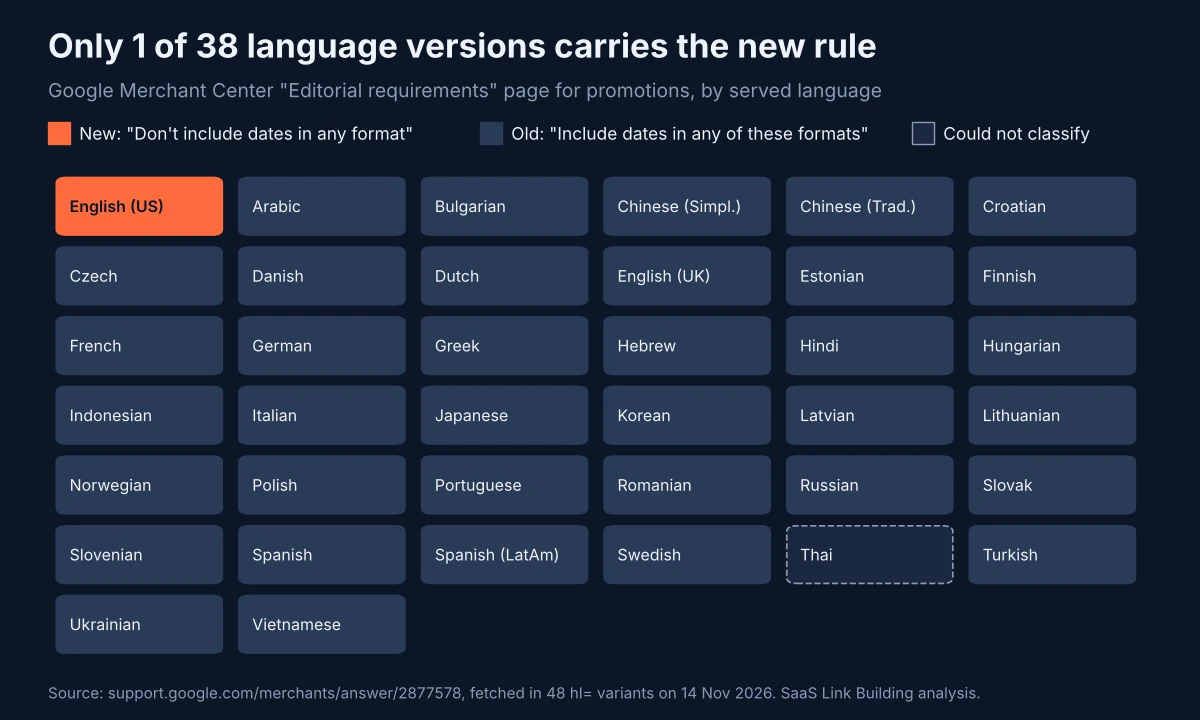
The gap reaches beyond dates. None of the 36 translations still carrying the old date wording contain the term "COVID", which the US English page uses for its COVID-19 title ban. A merchant in Canada who reads the French page, or a team in India working from the UK English copy, sees a shorter and older rulebook than the one Google publishes in US English.
What this means for merchants and SEO teams
Merchant promotions appear as a "special offer" link in Shopping ads and free product listings, and the page says approved promotions show under a "Coupons from store" section. Free listings are an organic channel, so promotion titles are part of the same product-data hygiene that covers warranty attributes and, as of this week, AI image metadata. With Google pushing more shopping journeys through its own surfaces, from Universal Cart to AI Mode product cards, the data in the feed is often the only copy a shopper sees.
Worked examples
The rewrites below apply the US English rules. They are our illustrations, not examples from Google.
- "20% off winter coats, ends 12/31" becomes "20% off winter coats". The end date moves to [promotion_effective_dates].
- "Black Friday: $15 off orders of $75+ until 11/30" becomes "$15 off orders of $75+". We would also drop the event label, since the page treats extra text such as "Save today" as unnecessary and not allowed.
- "Jan clearance: 30% off select sweaters" becomes "30% off wool sweaters". "Jan" is allowed by the date rule but banned by the abbreviations table, and the page rejects "20% off on select products" as too vague, so name the product type.
- "Free GWP w/ purch over $50" becomes "Free tote bag with purchase over $50". "GWP" and "Purch" are on the not-allowed abbreviation list, and free items should be named.
Where the dates go instead
The promotions data specification makes [promotion_effective_dates] required. It takes a start and end separated by a forward slash, each in YYYY-MM-DD form followed by "T", a time and a time zone offset, for example 2026-11-27T00:00:00-05:00/2026-11-30T23:59:00-05:00 for an Eastern Standard Time sale. The optional [promotion_display_dates] attribute uses the same syntax and, according to the specification, lets you validate a promotion before it starts. Promotions have a 183-day limit. If you use the promotion builder, only the effective dates are supported and the time zone defaults to your Merchant Center account setting.
What to do now
- Export your active and scheduled promotions and search titles for digits followed by a slash, four-digit years, and words such as "ends", "until" or "thru". "Thru" is on the allowed list, but a date after it is not.
- Read the US English page with
?hl=en, even if your team works in another language, until the translations catch up. - Check that every end date in a title also exists in [promotion_effective_dates] before you strip it, so the promotion does not run past the real offer.
- Schedule holiday promotions now and set [promotion_display_dates] so you can confirm approval before Black Friday.
Methodology
On 14 November 2026 we requested https://support.google.com/merchants/answer/2877578 with 48 different hl language values. We grouped the responses by the language declared in each page's HTML lang attribute, which gave 38 distinct served versions (several codes, such as en-AU and en-IN, return the UK English page; en-CA and fil return US English). We classified a version as new when its text contained the "any format" or "short month" wording and as old when its redemption dates line listed date formats such as M/D/YYYY or a local equivalent. We checked the Hungarian, Ukrainian and Hebrew versions by reading the redemption date line directly. The Thai version returned a page whose redemption date line we could not locate, so it is counted as unclassified. We compared the US and UK English versions sentence by sentence and searched all versions for "COVID". We could not open the archived September copy cited by Search Engine Roundtable, so the dating of the change relies on its report.
Conclusion
Google has tightened one line of its promotion title rules: no dates in any format, with a short month abbreviation as the stated exception, an exception another table on the same page contradicts. The change is live in US English only, and 36 of the 38 language versions we checked still describe date formats instead. For the holiday sales period, the safe reading is the US English one: keep titles to the offer and the product, and put every date in the date fields.
Questions and answers
Can I put dates in a Google Merchant Center promotion title?
No. The US English version of Google's promotion editorial requirements says not to include dates in any format and to put redemption dates only in their designated fields.
Where do promotion dates go instead?
In the required promotion_effective_dates attribute, written as a start and end date in YYYY-MM-DD form with a time and time zone, separated by a forward slash. The optional promotion_display_dates attribute uses the same syntax.
Are month abbreviations like Jan allowed?
The page is inconsistent. The redemption dates rule allows a short month abbreviation such as Jan, but the abbreviations table on the same page lists abbreviated month names as not allowed. Leaving month names out avoids both problems.
Why do translated help pages show a different rule?
When we fetched the page in 48 language settings on 14 November 2026, only the US English version carried the new wording. Thirty-six of the 38 served versions still listed date formats such as M/D/YYYY, and the Thai version could not be classified.
More releases
-
Studies
November Core Update, Day 1 to 4: 75% of Top-10 URLs Held vs 64% the Week Before
Google's November 2026 core update has so far moved page one less than the week before it. Across 19 high-volume US keywords, 75.4% of top-10 URLs held their place in the first snapshot after the 10 November start, against 64.2% in the prior week, with recipes, video and health sources moving most.
-
Studies
Can AEO Formatting Win AI Overview Citations? 89% of 306 Came From Beyond Page One
Google says AI Overviews need no special formatting. We tested the AEO checklist on 31 live searches: FAQ schema and summary boxes showed no benefit, question headings helped only in pooled numbers, and 272 of 306 citations went to pages that did not rank on page one for the query.
-
Studies
Mueller Points to AI Image Metadata Rule; Shopify JPEGs Dropped XMP on 36 of 36 Images
Google's John Mueller says Merchant Center's metadata rule is the only Google guidance he knows of for AI product images. Our download of 144 images from 48 Shopify stores found none carried the AI label, and every XMP packet present in WebP versions vanished when the same URL served JPEG or PNG.
Tell us the site and the goals.
Rankings in Google and visibility in AI answers, from one monthly plan. One call is enough to say which one fits. Email works just as well.