Mueller Points to AI Image Metadata Rule; Shopify JPEGs Dropped XMP on 36 of 36 Images
Google's John Mueller says Merchant Center's metadata rule is the only Google guidance he knows of for AI product images. Our download of 144 images from 48 Shopify stores found none carried the AI label, and every XMP packet present in WebP versions vanished when the same URL served JPEG or PNG.
 Vibhu Dhariwal
Cofounder & CTO, Digital Gratified
- Published
- Section
- Studies
- Reading time
- 7 minutes
Ras Al Khaimah, United Arab Emirates, .
Google's John Mueller said on 13 November that the only Google guidance he knows of for AI-generated product images comes from Merchant Center, and that it boils down to embedding metadata that marks the image as AI-generated. He was answering a question on Bluesky about whether product photos regenerated with AI, for example to remove a background or fix lighting, could hurt rankings. To see whether that metadata survives the trip from a store to a fetcher, we downloaded 144 product images from 48 Shopify stores in four ways each. The result: the same image URL returned metadata to one kind of request and stripped it for another.
Key findings
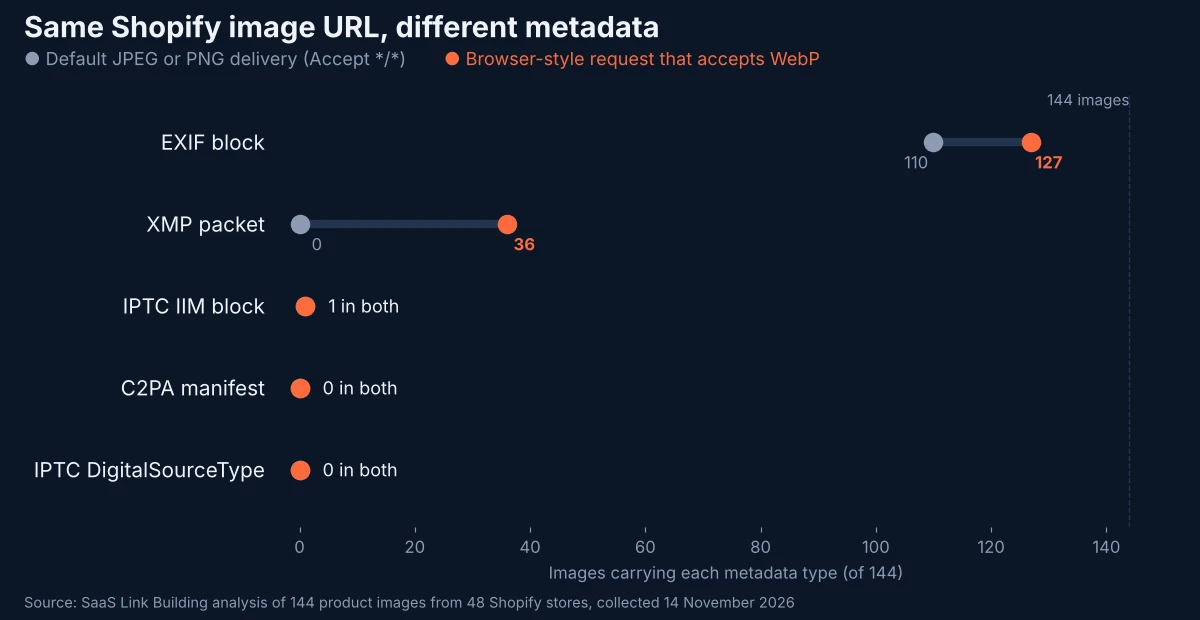
- None of the 144 images carried the IPTC DigitalSourceType property or a C2PA manifest, in any of the versions we downloaded.
- Requested the way a plain fetcher asks (Accept: */*), the images came back as JPEG or PNG with no XMP packet at all: 0 of 144.
- Requested the way a browser asks, with WebP in the Accept header, 36 of the same 144 images (25%) carried an XMP packet, from 19 of the 48 stores.
- All 36 images that had XMP in their WebP version lost it in the JPEG or PNG version served from the identical URL.
- Every image already meets Merchant Center's 500 x 500 pixel minimum (the smallest side we saw was 650 pixels), and 89 of 144 (62%) meet the roughly 1500 x 1500 pixel size Google recommends.
What Google actually asks for
The page Mueller linked, Merchant Center's AI-generated content requirements, says images created with generative AI "must contain meta data indicating that the image was AI-generated." It names the IPTC DigitalSourceType property, tells merchants not to remove such embedded tags, and lists three recognised values: TrainedAlgorithmicMedia, CompositeSynthetic and AlgorithmicMedia. The rule covers the image link, additional image link and lifestyle image link attributes. AI-written titles and descriptions have their own route, through the structured_title and structured_description attributes with a digital_source_type of trained_algorithmic_media.
The page does not say whether AI editing of a real photo, such as background removal, counts as "created using generative AI", and it lists no penalty for missing labels. That leaves the question Mueller was asked partly open: Google has not published a ranking rule for AI product images in organic Search.
On the Search side, Google's image metadata documentation lists Digital Source Type among the embedded IPTC fields Google extracts, with four supported values (it adds compositeWithTrainedAlgorithmicMedia). The same page says C2PA data can feed the "About this image" feature when the manifest comes from a signer on the C2PA Trust List.
The detail that matters for delivery is where the label lives. The IPTC Photo Metadata standard defines Digital Source Type as an XMP property (Iptc4xmpExt:DigitalSourceType) and gives it no field in the older IIM format. If a delivery pipeline drops XMP, the AI label goes with it.
Same URL, two different files
Shopify's image CDN picks a format from the request's Accept header. A request that accepts WebP gets WebP; one that sends */* or image/jpeg gets the original format. In our pull, that choice also decided what metadata came back.
| Request type | Formats returned | EXIF | XMP | IPTC IIM | C2PA | DigitalSourceType |
|---|---|---|---|---|---|---|
| Default (Accept */*), full size | 110 JPEG, 34 PNG | 110 | 0 | 1 | 0 | 0 |
| Browser-style (accepts WebP), full size | 132 WebP, 12 JPEG | 127 | 36 | 1 | 0 | 0 |
| Default, resized to 1000px wide | 110 JPEG, 34 PNG | 110 | 0 | 0 | 0 | 0 |
| Browser-style, resized to 1000px wide | 141 WebP, 3 JPEG | 140 | 38 | n/a | n/a | n/a |
The XMP that did survive was not trivial. In one apparel store's image the WebP version still carried the camera lens, the editing software history and Photoshop document IDs, while the JPEG served from the same address had none of it. Since the WebP files are generated from the same stored upload, the XMP appears to exist in that upload; the JPEG and PNG responses remove it. Resizing did not change the pattern: 35 of the 36 images kept their XMP in the 1000px WebP version.
We repeated the test on one image with a Googlebot-Image user agent. With a generic */* Accept header it received the JPEG without XMP; with WebP in the Accept header it received the WebP with XMP. On that image, the Accept header decided the outcome, not the user agent.
What we could not confirm
Google does not document which Accept header Merchant Center's image crawler or Googlebot-Image sends, so we cannot say which version Google receives from a Shopify store. If it is offered the JPEG or PNG version, our data suggests an XMP-based AI label would not reach it. If it accepts WebP, the label would likely survive, at least on stores like the 19 we saw serving XMP. Treat this as an open question to test, not a confirmed failure.
We also cannot tell which of the 144 images, if any, were made or edited with generative AI. Zero DigitalSourceType tags means only that no store in the sample labelled an image this way in a form we could see. It is not evidence that the stores avoid AI imagery.
Context: an image rule set that is tightening
Merchant Center's image link specification now sets one minimum of 500 x 500 pixels for all products from 31 January 2027, recommends images of around 1500 x 1500 pixels or more, and caps files at 64 megapixels and 16MB. Our sample clears the minimum easily, which fits stores of this size, but 55 of the 144 images fall short of the recommended size on at least one side. Product data rules keep accumulating in Merchant Center, as with the warranty attribute added in October, and they matter more now that AI Mode builds its own shopping units; in our earlier test, AI Mode linked every product card to Google's own pages.
The finding also echoes our earlier look at markup that top sites still ship: what a site intends to tell Google and what Google actually receives are often two different things.
What this means for SEO teams
- Test your own image URLs twice. Request each feed image once with
Accept: */*and once withAccept: image/webp,*/*, then check both files with ExifTool forXMP-iptcExt:DigitalSourceType. If the label appears in only one, your CDN is the variable. - Label AI images at the source, then verify downstream. Merchant Center asks you not to strip the tag. That instruction covers your image pipeline and CDN, not only your editing software.
- Consider a separate feed host for AI images. If your platform strips XMP from the default format, serving labelled images from storage that returns the file unchanged removes the guesswork. This is our suggestion, not Google guidance.
- Use the structured_title and structured_description attributes for AI-written product text, since the label for text lives in the feed rather than the file.
- Audit sizes before 31 January 2027. The 500 x 500 minimum is the floor; the 1500 x 1500 recommendation is where most of our sample's gaps were.
Methodology
On 14 November 2026 we requested the public products.json endpoint of 70 consumer brand storefronts we expected to run on Shopify; 48 returned product data. For each of the 48 stores we took the first image of the first three products that had one, giving 144 image URLs, all on Shopify's image CDN. Each URL was downloaded four ways: with Accept: */*; with a Chrome-style Accept header listing AVIF and WebP; and both of those again with a width=1000 resize parameter. For each file we recorded the format and pixel dimensions and searched the bytes for an EXIF block, an XMP packet, a Photoshop IPTC IIM block, a C2PA manifest (JUMBF boxes labelled c2pa) and any DigitalSourceType property or value. The resized browser-style pass recorded only format, XMP and EXIF. One image was also requested with a Googlebot-Image user agent, with and without WebP in the Accept header. The sample covers mid-size and large direct-to-consumer brands on one platform; results for other platforms, CDNs and smaller stores may differ.
Conclusion
The only Google guidance Mueller points to for AI product images is a metadata label. In our sample nobody used that label, and the platform delivery we tested removed all XMP, where the label lives, whenever an image was requested in its default format. Until Google says which version its crawlers fetch, merchants who label AI images should check that the label reaches every version of the file, not just the one their browser shows them.
Questions and answers
What does Google require for AI-generated product images?
Merchant Center's AI-generated content page says all images created using generative AI must contain metadata indicating they are AI-generated, using the IPTC DigitalSourceType property, and that merchants must not remove such embedded tags.
Did John Mueller say AI product images hurt rankings?
No. On 13 November he said on Bluesky that the only Google guidelines he knows of for AI images and products come from Merchant Center, which require metadata marking images as AI-generated.
Where is the DigitalSourceType label stored in an image file?
The IPTC Photo Metadata standard defines Digital Source Type as an XMP property (Iptc4xmpExt:DigitalSourceType) with no field in the older IIM format, so removing XMP removes the label.
What did the Shopify image test find?
Across 144 product images from 48 Shopify stores, none carried DigitalSourceType or C2PA data. 36 images had XMP when requested as WebP, but all 36 lost it when the same URL was requested as default JPEG or PNG.
What is Merchant Center's new image size minimum?
Merchant Center's image link specification sets a minimum of 500 x 500 pixels for all products from 31 January 2027 and recommends images of around 1500 x 1500 pixels or more.
More releases
-
Industry news
Google Tests Hiding AI Mode; Its Tab Was Missing on 2 of 14 Mobile SERPs We Pulled
Google is testing Search pages without the AI Mode tab and the "Ask anything" box under AI Overviews, and has not commented. Our pull of 51 logged-out results pages on 14 November found the tab missing on 2 of 14 mobile pages, and on none of 37 desktop pages.
-
Industry news
Brave Copies Google's /goto Link Cloaking; Our Pull Finds Google Now Hides All 164 Links
Brave Search said on 11 November it will route result clicks through encrypted search.brave.com/go/ links after scrapers pushed out by Google's /goto redirects flooded its servers. Our pull of 20 Google result pages on 13 November found all 164 page-one organic links wrapped in /goto, up from 74% on 31 October.
-
Industry news
ChatGPT Business Hub Counts Your Clicks; 36 of 479 Top Sites Block the Bot Behind Them
OpenAI opened a beta on 10 November that lets businesses claim ChatGPT profiles and see 28 days of mentions and website clicks. Those numbers depend on OAI-SearchBot, which our crawl found fully blocked by 36 of 479 top sites with a readable robots.txt, including Amazon and Yelp.
Tell us the site and the goals.
Rankings in Google and visibility in AI answers, from one monthly plan. One call is enough to say which one fits. Email works just as well.