Google Preannounces Its December Core Update; Its Last 9 Ranking Posts Came at Rollout
Google posted the December 2026 core update to its Search Status Dashboard on 24 November with no start date, an hour after the November core update finished. Every earlier ranking update in the dashboard feed was posted within 19 minutes of rollout, and a new ranking hub now explains notice and feedback.
 Vibhu Dhariwal
Cofounder & CTO, Digital Gratified
- Published
- Section
- Updates
- Reading time
- 8 minutes
Ras Al Khaimah, United Arab Emirates, .
Google posted the December 2026 core update to its Search Status Dashboard at 15:03 UTC on 24 November, without a start date, saying only that it "is scheduled to be released in December 2026". The post went up 60 minutes after Google marked the November 2026 core update complete, and on the same day Google published a new Google Search ranking hub that explains when it will give advance notice of ranking changes. Our pull of the dashboard's incident feed shows that every earlier ranking update listed there was posted within 19 minutes of its rollout starting.
What changed
- A core update announced before it runs. Google says the December update brings several improvements to how its systems understand and rank content, including for longer and more complex questions, and to personalized results for people who have personalization turned on. It applies to all locations and languages where Google Search is available.
- November is done. The November 2026 core update started at 18:06 UTC on 10 November and was marked complete at 14:03 UTC on 24 November, a rollout of 13 days and 20 hours, inside Google's "up to 2 weeks" estimate.
- A new ranking section in the documentation. The Search Central changelog lists three new pages for 24 November: ranking principles, a page on staying informed about updates, and a page on submitting feedback. Two pages on generative AI controls and attribution were added the same day.
- A UK appeal route with a date. The feedback page says UK sites that have been manually excluded from the index as a whole can use an indexing appeal form starting on 17 December 2026.
Not live yet, despite how the dashboard looks
The December entry sits on the dashboard like a rollout in progress: it has a begin time (15:02 UTC on 24 November) and no end time, and the dashboard's Atom feed labels it "UPDATE", the same label it gave the November update while that was rolling out. A Google spokesperson told Search Engine Roundtable that the update is not live, that "We don't have a date yet", and that Google will announce the start on the day it begins.
Our check of the feed explains the confusion. For every other ranking incident in it, the begin time is the moment the rollout started. For December, the begin time is the moment of the announcement. Tools and scripts that read the dashboard and treat an open incident as an active update will report the December core update as running when Google says it is not.
How much notice this actually is
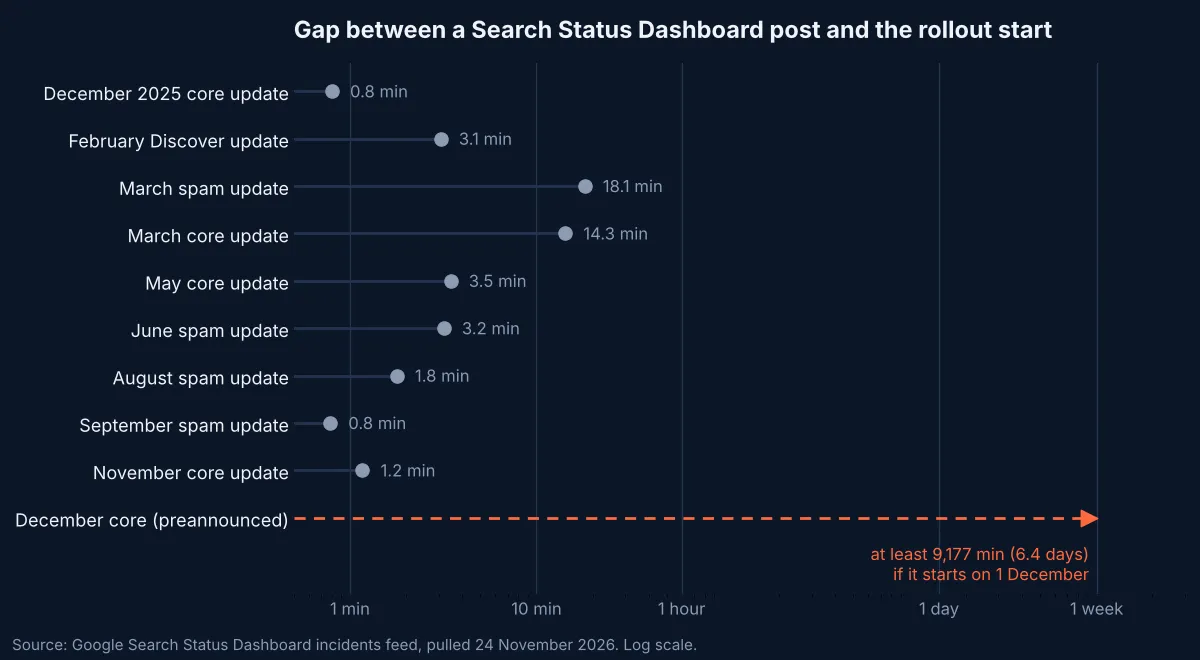
Until now the dashboard worked as a same-day log. Across the nine ranking incidents in the feed, from the December 2025 core update to the November 2026 core update, the first post arrived between 0.8 and 18.1 minutes after the rollout began. If the December update starts on the first day of the month, site owners will have had at least 6 days and 9 hours of warning. Google has not said how far ahead it will announce the next one.
That gap matters because Google's new stay informed page says it explains Google's "advance notice timelines" but does not give a number of days for any type of change. It sets out two categories that trigger notice: actionable policy changes (content policies, technical guidelines or eligibility criteria that may require site changes) and broad algorithmic updates such as core updates that may cause noticeable ranking shifts across many queries and sites. It adds that, for changes where UK users may see a significant ranking shift, Google gives advance notice under the UK Competition and Markets Authority's fair ranking conduct requirement, which the CMA imposed on 17 June 2026 and which asks Google to give publishers sufficient notice of material changes. We have covered Google's other CMA obligations in our report on the deadline for AI engagement metrics for UK publishers.
Google's long-standing core updates guide has not caught up. It was last updated on 10 December 2025 and still says Google gives notice of core updates "when they happen".
2026 core update rollouts, by the dashboard's clock
| Update | Rollout start (UTC) | Marked complete (UTC) | Length |
|---|---|---|---|
| December 2025 core update | 11 Dec 2025, 17:25 | 29 Dec 2025, 19:00 | 18 days, 2 hours |
| March 2026 core update | 27 Mar, 09:00 | 8 Apr, 13:00 | 12 days, 4 hours |
| May 2026 core update | 21 May, 15:40 | 2 Jun, 12:40 | 11 days, 21 hours |
| November 2026 core update | 10 Nov, 18:06 | 24 Nov, 14:03 | 13 days, 20 hours |
| December 2026 core update | Not started | Not started | Preannounced 24 Nov, 15:03 |
Source: Google Search Status Dashboard incidents feed, pulled 24 November 2026. Lengths rounded to the nearest hour.
If December's update starts in the first half of the month and runs as long as November's, the two rollouts will be only a few weeks apart. Rankings measured over the coming weeks will mix the tail of one update with the start of the next, a pattern we tracked through the November rollout in our day 12 SERP churn study.
The new feedback route
The submit feedback page says verified site owners can use the Submit Feedback button in Search Console when a significant ranking change or policy update is on the dashboard, and should tag the submission with a hashtag for the update. Google's own example is #NovemberCoreUpdate2026. It asks for a Performance report snapshot, exact queries with country and language, affected URLs beside competing URLs that seem to rank wrongly, the timing of the impact, and, for UK sites, how the change affected a UK market.
Google is clear about the limits: engineering teams review submissions in aggregate to find systemic issues, and feedback does not lead to manual ranking changes for individual URLs. The same page gathers the existing appeal routes in one place: manual action reconsideration, counterfeit goods appeals, SafeSearch reviews, DMCA counter notices, the EU Digital Markets Act appeal and the new UK indexing appeal.
What Google says about how it ranks
The principles page names three principles: users come first, consistent systems across all types of results, and rigorous testing. Two statements stand out for site owners. Google says web listings and features such as AI Overviews, carousels, images and videos are evaluated using the same criteria, with no result receiving preferential treatment. It also says it makes no manual adjustments to rankings except to meet legal obligations or apply its content policies. Neither statement comes with data, so site owners cannot test them from the page itself.
What this means for SEO teams
- Do not read November's results yet. Google's stay informed page and core updates guide both say to wait until an update is complete plus at least a week of data. For November, that means comparing Search Console data from 1 December onwards with the week before 10 November.
- Expect a short clean window. With December's update coming, the clean read on November may last only days. Save a Performance report export now so you have a baseline before the next rollout starts.
- Fix dashboard monitoring. If you alert on open dashboard incidents, treat entries whose text says "Preannounced" as notices, not rollouts, until Google posts a start.
- Check long-query and personalized traffic. Google named longer, more complex questions and personalized results as December's focus. Segment Search Console queries by length now so you can compare after the update.
- Prepare feedback with evidence. If November hurt you, gather the items Google lists (queries, locales, your URL and the competing URL) and submit through Search Console with the update's hashtag.
Methodology
On 24 November 2026 we downloaded Google's Search Status Dashboard incidents feed (incidents.json) and Atom feed. We kept the 10 incidents filed under the Ranking product, from the December 2025 core update to the December 2026 core update. For each, we subtracted the incident's begin time from the time of its first update to get the posting lag, and the begin time from the end time to get the rollout length. We also downloaded the four new ranking pages on Search Central (the hub, principles, stay informed and submit feedback pages), the documentation changelog and the core updates guide, and compared their text.
Conclusion
For the first time in the dashboard's recent history, Google has told site owners about a core update before it runs. The notice is open ended, with no date and no stated notice period, and the dashboard entry looks like an active rollout when it is not. The new ranking hub collects Google's notice, feedback and appeal routes in one place. Whether the notice turns into planning time depends on how far ahead Google posts the start date.
Our earlier coverage of the November 2026 core update launch has the background on the 173-day gap before it.
Questions and answers
When will the December 2026 core update start?
Google has not given a date. Its Search Status Dashboard post of 24 November says the update is scheduled to be released in December 2026, and Google told Search Engine Roundtable it will announce the start on the day it begins rolling out.
Is the December 2026 core update live now?
No. Google says it is not live, although the dashboard entry has a begin time and no end time, which makes it look like an active rollout.
What will the December 2026 core update change?
Google says it focuses on how its systems understand and rank relevant content, including for longer and more complex questions, and on personalized results for people who have personalization turned on. It applies to all locations and languages where Google Search is available.
How long did the November 2026 core update take?
It started at 18:06 UTC on 10 November and was marked complete at 14:03 UTC on 24 November, a rollout of 13 days and 20 hours.
How do I send Google feedback about a core update?
Google's new submit feedback page says verified site owners can use the Submit Feedback button in Search Console and include the update's hashtag, such as #NovemberCoreUpdate2026, with queries, locales and example URLs. Google says feedback is reviewed in aggregate and does not lead to manual ranking changes for individual URLs.
More releases
-
Studies
Google Said Links Would Move Up; 22 of 35 AI Overviews Put the First in the Final Third
A SaaS Link Building newsroom pull of 36 Google AI Overviews on 24 November found citation chips near the top of every answer, but the first hyperlink inside the answer text sat in the final third in 22 of the 35 that had one, a median 85% of the way down.
-
Studies
Does Linking Out Help You Rank? 58% of Top-3 Google Results Link to No Other Site
Google says outbound links are not a ranking factor, while its documentation says they can help build trust. We read 158 pages ranking for 41 US searches: 58% of top-3 results had no editorial link to another website, against 34% in positions 4 to 9. Our verdict on the authority-link theory: unproven.
-
Explainers
OpenAI Cuts ChatGPT Shopping's Partnership Disclaimer; 67 of 68 Help Pages Changed
OpenAI has removed the statement that ChatGPT shopping results are not influenced by its partnerships from its Shopping with ChatGPT Search help page. The edit was made between 4 and 15 November; our check found 67 of 68 language versions updated, while the Hebrew edition still carries the old assurance.
Tell us the site and the goals.
Rankings in Google and visibility in AI answers, from one monthly plan. One call is enough to say which one fits. Email works just as well.