OpenAI Cuts ChatGPT Shopping's Partnership Disclaimer; 67 of 68 Help Pages Changed
OpenAI has removed the statement that ChatGPT shopping results are not influenced by its partnerships from its Shopping with ChatGPT Search help page. The edit was made between 4 and 15 November; our check found 67 of 68 language versions updated, while the Hebrew edition still carries the old assurance.
 Vibhu Dhariwal
Cofounder & CTO, Digital Gratified
- Published
- Section
- Explainers
- Reading time
- 7 minutes
Ras Al Khaimah, United Arab Emirates, .
OpenAI has removed the line from its ChatGPT shopping help page that said product results were not influenced by any OpenAI partnerships. The Shopping with ChatGPT Search article now says only: "Product results are not ads; how products and merchants are selected is described below." The edit was first reported by Search Engine Roundtable on 23 November, after marketplace analyst Juozas Kaziukėnas flagged it on X. We fetched every language edition of the page on 24 November to see how far the change has travelled, and read OpenAI's merchant documentation to set out what the page now says actually decides which products and sellers appear.
What changed
- The English page no longer says product results are chosen independently by ChatGPT, and no longer says they are free of partnership influence. It keeps the statement that product results are not ads and points readers to its selection section.
- OpenAI's help centre lists the article's last update as 15 November 2026 at 23:58 UTC. An archived copy from 4 November, cited by Search Engine Roundtable, still carried the old wording, so the edit was made between those two dates.
- Of 68 distinct translations, 67 carry the new wording. The Hebrew edition still says results are selected independently by ChatGPT and are not influenced by any OpenAI partnerships. The Serbian address serves the English text.
- The Hebrew page is an older version throughout: it still describes an option to pay inside ChatGPT for some products, and it has no "Check details before you buy" section. The English page no longer mentions checkout at all.
The wording, before and after
| Version | What the opening disclaimer says | Partnership claim |
|---|---|---|
| English, archived 4 November (as reported) | Results selected independently by ChatGPT, not ads, "nor influenced by any OpenAI partnerships" | Yes |
| English, current page | Results are not ads; selection is described further down the page | No |
| 66 other translations, current pages | Same as current English (checked in each edition) | No |
| Hebrew, current page | Results selected independently by ChatGPT, not ads, not influenced by any OpenAI partnerships | Yes |
Source: SaaS Link Building fetch of all 69 language addresses of OpenAI help article 11128490, 24 November 2026; archived wording as quoted by Search Engine Roundtable.
OpenAI has not explained the edit, and the page does not say that partnerships now shape results. Removing a denial is not the same as admitting influence. What it does mean is that the help page no longer gives merchants or shoppers a written assurance on the point. That stands in contrast to OpenAI's Ads in ChatGPT help page, which still states that ads do not influence ChatGPT's answers and that advertisers cannot shape or rank its responses.
How OpenAI now says products are picked
The selection section is unchanged in substance and is now the only explanation the page offers. ChatGPT may surface products when it judges them relevant to the user's intent, using the query plus context such as Memory and Custom instructions. When deciding which products to show, OpenAI lists three inputs:
- Structured metadata from first-party and third-party providers, such as price and product description, plus other third-party content.
- The model's own responses, generated before it considers any new search results.
- OpenAI safety standards and product policies.
The page adds that ChatGPT may rewrite product titles and descriptions, generate labels such as "Budget-friendly" from information that can include third-party data, and summarise reviews from public websites. OpenAI says those reviews and ratings are not verified by OpenAI.
How merchants are ranked
When a user opens a product, ChatGPT may list several sellers. According to the page, the list is built from merchant and product metadata supplied by third parties or by merchants directly, and sellers are ranked on availability, price, quality and whether they are the maker or primary seller of the item. OpenAI says it expects to personalise merchant rankings further. Two supply routes are named: Shopify merchants are already integrated through Shopify Catalog with no extra work, and other merchants can apply for direct feed access.
That Shopify paragraph is the one commercial relationship the page describes by name, and the Hebrew edition carries it too.
What the product feed asks for
Direct feeds follow OpenAI's product feed schema. We counted 53 fields in it. Only 11 are always required: nine basic fields (item_id, title, description, url, brand, seller_name, image_url, availability and price) and two market fields (target_countries and store_country). Ten more become required for a specific use, such as variants, ads or checkout.
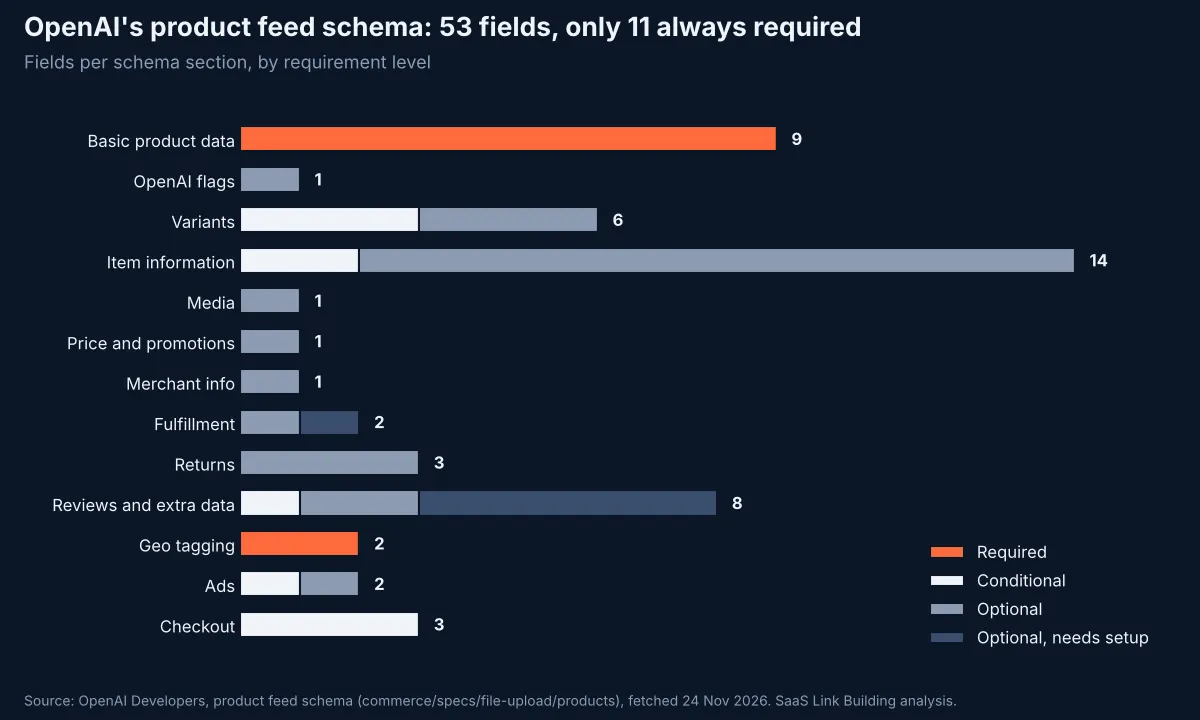
Three details in the schema bear on the partnership question. First, one feed serves both organic discovery and ads: the ads section says ads feeds use the same product data, and an is_ads_eligible flag works independently of search eligibility. Second, search eligibility is on by default, and OpenAI notes that eligibility does not guarantee display. Third, the standard upload currently targets the US only, whatever a row's country columns say.
OpenAI's feed submission guide routes merchants through Business Hub, where identity verification is required before products can be uploaded. We covered how that hub reports clicks in our piece on ChatGPT Business Hub and the OAI-SearchBot crawler.
Context
The edit lands as OpenAI builds out paid placements alongside shopping. ChatGPT ads expanded to 89 markets in October, and according to Search Engine Roundtable, Business Hub now offers a button to connect a ChatGPT ads account. Commercial prompts are a small share of ChatGPT use, but our own testing found that brands appeared in all 15 buying-intent answers we ran. With that much brand exposure at stake, how products are chosen matters to anyone selling online.
The translation result also contrasts with Google, whose localised help pages often trail product changes, as with Search Profiles market lists. OpenAI updated 67 of 68 editions; the one exception still makes the claim the English page dropped.
What to do
- Do not quote the old assurance. If client decks or internal guidance say ChatGPT shopping results are independent of OpenAI partnerships, update them. The English page no longer says so.
- Fill the feed beyond the minimum. Merchant ranking names availability, price and quality, and product selection names structured metadata. The optional fields for returns, shipping, reviews and GTINs are where that information is carried in structured form.
- Decide ads eligibility on purpose. Because ads and discovery share one feed, check how is_ads_eligible is set rather than relying on a feed-level default.
- Check the maker or primary seller signal. Resellers compete against brands on a factor OpenAI names explicitly, so accurate brand and seller_name values matter.
- Watch the page. OpenAI says merchant rankings will become more personalised. Save a dated copy of the help article so later changes can be compared.
Methodology
On 24 November 2026 we fetched help.openai.com article 11128490 in English and at the 68 other language addresses linked from the page, 69 addresses in all. The Serbian address returned the English text, leaving 68 distinct translations. For each, we extracted the overview paragraph that holds the disclaimer and checked whether it names OpenAI, as the old partnership sentence did; we then read the flagged Hebrew text and a sample of other editions in full. The last-update time comes from the timestamp embedded in the page, which was identical across editions. We did not open the archived 4 November copy ourselves; the old English wording is as quoted by Search Engine Roundtable. Feed field counts come from the Markdown version of OpenAI's product feed schema, counting each attribute row once and classing it by its stated requirement level.
Conclusion
OpenAI's shopping help page still says ChatGPT's product results are not ads, but it no longer says they are free of partnership influence. The change happened between 4 and 15 November, reached 67 of 68 translations, and leaves the Hebrew page as the last place the old assurance survives. For merchants, the practical guide to visibility is the selection and merchant ranking section and the 53-field feed schema behind it, both of which OpenAI still documents in detail.
Questions and answers
What did OpenAI remove from its ChatGPT shopping help page?
The statement that product results are selected independently by ChatGPT and are not influenced by any OpenAI partnerships. The English page now says only that product results are not ads and that selection is described further down the page.
When did OpenAI change the wording?
Between 4 and 15 November 2026. An archived copy from 4 November still carried the old line, according to Search Engine Roundtable, and the help centre gives the article's last update as 15 November 2026.
Do all language versions of the page show the new wording?
No. In our check of 69 language addresses (68 distinct translations), 67 carried the new wording. The Hebrew edition still says results are not influenced by any OpenAI partnerships.
How does ChatGPT rank merchants for a product?
OpenAI's help page says merchants are ranked on factors such as availability, price, quality and whether they are the maker or primary seller of the item, using metadata from third-party providers or from merchants directly.
How many fields does OpenAI's product feed require?
OpenAI's product feed schema lists 53 fields in our count. Eleven are always required: nine basic product fields plus target_countries and store_country. Ten more are required only for specific uses such as variants, ads or checkout.
More releases
-
Studies
Google Said Links Would Move Up; 22 of 35 AI Overviews Put the First in the Final Third
A SaaS Link Building newsroom pull of 36 Google AI Overviews on 24 November found citation chips near the top of every answer, but the first hyperlink inside the answer text sat in the final third in 22 of the 35 that had one, a median 85% of the way down.
-
Studies
Does Linking Out Help You Rank? 58% of Top-3 Google Results Link to No Other Site
Google says outbound links are not a ranking factor, while its documentation says they can help build trust. We read 158 pages ranking for 41 US searches: 58% of top-3 results had no editorial link to another website, against 34% in positions 4 to 9. Our verdict on the authority-link theory: unproven.
-
Industry news
Google Ends Funding for 25 Small Australian Outlets; Councils Took 37 of 170 News Results
Google will stop funding the Public Interest Publishers Alliance, a group of small Australian publishers, from 31 December, citing the country's new news bargaining law. Our pull of 170 Google News results for 17 council searches found councils' own sites took 37 spots, more than any publisher group.
Tell us the site and the goals.
Rankings in Google and visibility in AI answers, from one monthly plan. One call is enough to say which one fits. Email works just as well.