Google Ends Funding for 25 Small Australian Outlets; Councils Took 37 of 170 News Results
Google will stop funding the Public Interest Publishers Alliance, a group of small Australian publishers, from 31 December, citing the country's new news bargaining law. Our pull of 170 Google News results for 17 council searches found councils' own sites took 37 spots, more than any publisher group.
 Vibhu Dhariwal
Cofounder & CTO, Digital Gratified
- Published
- Section
- Industry news
- Reading time
- 7 minutes
Ras Al Khaimah, United Arab Emirates, .
Google has told the Public Interest Publishers Alliance (PIPA), a collective of small and independent Australian publishers, that it will stop funding its members from 31 December 2026. According to Mediaweek, which cited a report in the Australian Financial Review on 22 November, the deal covers 25 outlets, and Google gave at least 30 days' written notice. Google linked the decision to the News Media Bargaining Incentive, the levy on large platforms that Australia passed in August.
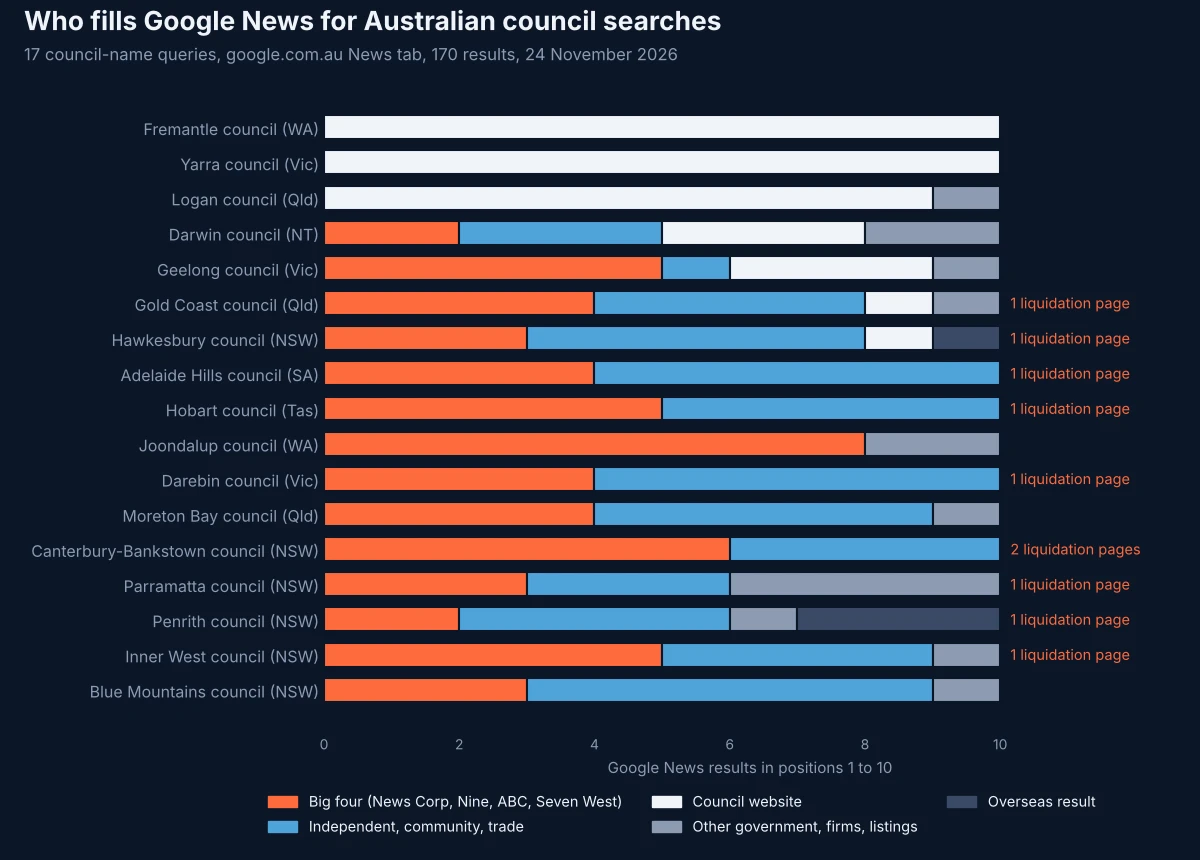
The cut lands on the publishers with the least reach in search. To see who actually fills Google's news results for local Australian searches, we pulled the Google News tab for 17 council-name queries across seven of Australia's eight states and territories. Of the 170 results, councils' own websites held 37, the ABC held 18, and News Corp held 18, of which 10 were near-identical daily "liquidator appointments" pages.
What changed
- The deal: Google is ending its commercial agreement with PIPA, effective 31 December 2026, B&T reported on 23 November. In its letter to PIPA, Google said it had "reached the difficult decision" to terminate.
- The money: reports disagree. Mediaweek, citing the AFR, put the deal at about $3 million. B&T described a $15 million arrangement that was due to run until 2027. Neither figure has been confirmed by Google on the record.
- The reason given: Google said the new law, in force since late August, led it to reassess its commercial position. A Google spokesperson told B&T it had warned during consultation that the scheme would not encourage commercial deals.
- Who is affected: B&T describes PIPA as around 24 media companies, naming Australian Jewish News, Australian Chinese Daily and Hills to Hawkesbury Community News among them.
How the bargaining incentive works
The Australian Taxation Office says the incentive applies to companies running significant social media or search services with more than $250 million a year in Australian digital advertising revenue. It is made up of a charge and a non-refundable offset, it is not deductible for income tax, and it applies from the 2025-26 financial year. The ATO lists its commencement as 27 August 2026.
Trade reports fill in the rest. B&T says liable platforms pay 2.75% of that revenue unless they strike deals with at least eight different news businesses, a threshold the government raised from four. PIPA has argued that this lets a platform meet its obligation with a handful of large publishers, and it wants at least 25% of deals reserved for small and medium outlets with revenue under $50 million. On that reading, a small-publisher collective is the easiest deal for a platform to drop.
Google's own record shows how broad its spending had been. In a November 2025 post, Google Australia said it had signed agreements with 88 publishers covering 226 outlets since 2020, and had renewed 60 of them in the previous year. That list included small titles such as QNews and Australian Jewish News.
Our check: who fills Google News for local searches
Deals aside, small publishers depend on whether Google surfaces them. We searched the Google News tab on google.com.au for "[name] council" in 17 local government areas, from Hawkesbury and Penrith in New South Wales to Fremantle, Hobart and Darwin, and classified the first 10 results for each.
| Publisher group | Results (of 170) | Share | Queries where present (of 17) |
|---|---|---|---|
| Independent, regional, community and trade outlets | 56 | 32.9% | 13 |
| Council websites | 37 | 21.8% | 7 |
| ABC | 18 | 10.6% | 11 |
| News Corp mastheads | 18 | 10.6% | 11 |
| Nine mastheads | 13 | 7.6% | 8 |
| Seven West Media | 9 | 5.3% | 3 |
| Other government, firms and property listings | 15 | 8.8% | 10 |
| Overseas results | 4 | 2.4% | 2 |
Table: SaaS Link Building analysis of 170 Google News results, collected 24 November 2026.
Key findings
- Councils outrank the press on their own names. Yarra City Council and the City of Fremantle filled all 10 News results for their queries, and Logan City Council filled 9. In those three areas, no newspaper appeared at all.
- Templated pages win spots. Ten of News Corp's 18 results were pages headlined "REVEALED: Liquidator appointments for businesses in the [council] area", found on 9 of the 17 queries and ranked first on 4 (Penrith, Darebin, Canterbury-Bankstown and Adelaide Hills). Each reports a count of company liquidation notices in that area.
- Small outlets are visible but thin. The independent group held a third of results, but they were spread across 34 domains. The most frequent were trade title Inside Local Government (7) and Australasian Leisure Management (4), then Mirage News, Oz Arab Media and Pulse Tasmania (3 each). Few were dedicated local newsrooms.
- Geo leakage. Even on google.com.au with an Australian location, "Penrith council" returned three UK results and "Hawkesbury council" one from Canada.
Context
Under Australia's earlier News Media Bargaining Code, Google and Meta struck publisher deals rather than be designated under it, Mumbrella noted. The incentive replaces that pressure with a charge that deals can offset. In its April objections, as summarised by B&T, Google argued that news makes up less than 1% of its search revenue and that the scheme leaves out platforms such as Microsoft and OpenAI.
Publisher pressure on Google is rising elsewhere too. We covered French publishers taking AI Overviews to Brussels and the UK regulator's deadline for Google to share AI engagement data with publishers. Our earlier test of Top Stories inside AI Overviews showed how few slots news gets in AI features.
What this means for SEO teams
- Local publishers: if a funding line is ending, search is the replacement channel. Our pull shows councils' press release pages beat newspapers on council names, so original reporting needs headlines and pages that say something a council media release cannot.
- Check your News tab presence: search your own coverage area by council and suburb name on the News tab, with an Australian location set, and record who holds the 10 slots. That is a quicker benchmark than sitewide traffic.
- Watch templated competition: daily data pages, such as the liquidation listings we found, can occupy top News slots for place names. A smaller outlet can answer with its own recurring, sourced data pages, as long as each adds real local information.
- Councils and agencies: your newsroom pages already rank. Clear dates, specific headlines and one topic per page help them keep doing so.
Methodology
On 24 November 2026, between about 01:15 and 01:30 UTC, we ran 17 queries in the form "[name] council" through a SERP API, using the Google News tab (tbm=nws) on google.com.au with gl=au, hl=en and a location set to the relevant state or territory capital. We recorded the first 10 results for each query (170 in total) and classified each by domain. News Corp mastheads were the Daily Telegraph, Herald Sun, Courier Mail, Gold Coast Bulletin, Adelaide Now, The Mercury, Geelong Advertiser and news.com.au; Nine covers SMH, The Age, WAtoday and nine.com.au; Seven West Media covers 7NEWS, PerthNow and The West Australian. The independent group includes ACM regional titles (3 results), Yahoo News Australia (2), news24.com.au (2) and press-release and trade sites. Property listings from realestate.com.au (5) sit with government and firms. "Liquidator appointments" pages were counted by their headline. One run per query from one location is a snapshot, not a ranking average.
Conclusion
Google's exit from the PIPA deal removes money from some of the smallest outlets in the market, and our pull suggests search will not easily make up the gap: on council searches, Google News leaned on councils' own pages, the ABC and News Corp's templated data pages more than on any single small publisher.
The bigger question is whether other platforms follow. PIPA argues that an eight-deal threshold makes small publishers the easiest contracts to drop, and its push for a 25% small-publisher quota is now the policy fight to watch.
Questions and answers
When does Google's funding for PIPA publishers end?
Google's termination takes effect on 31 December 2026, after at least 30 days' written notice, according to reports in Mediaweek and B&T citing Google's letter to the Public Interest Publishers Alliance.
How much was Google's deal with PIPA worth?
Reports differ. Mediaweek, citing the Australian Financial Review, put it at about $3 million, while B&T described a $15 million arrangement due to run until 2027. Google has not published a figure.
Who has to pay the News Bargaining Incentive?
The ATO says it applies to companies running significant social media or search services with more than $250 million a year in Australian digital advertising revenue. B&T reports the charge is 2.75% of that revenue unless the platform has deals with at least eight news businesses.
Who filled Google News results for Australian council searches?
In our pull of 170 Google News results for 17 council-name queries on 24 November 2026, independent, regional, community and trade outlets held 56, council websites 37, the ABC 18, News Corp 18, Nine 13 and Seven West Media 9.
More releases
-
Studies
Google Said Links Would Move Up; 22 of 35 AI Overviews Put the First in the Final Third
A SaaS Link Building newsroom pull of 36 Google AI Overviews on 24 November found citation chips near the top of every answer, but the first hyperlink inside the answer text sat in the final third in 22 of the 35 that had one, a median 85% of the way down.
-
Studies
Does Linking Out Help You Rank? 58% of Top-3 Google Results Link to No Other Site
Google says outbound links are not a ranking factor, while its documentation says they can help build trust. We read 158 pages ranking for 41 US searches: 58% of top-3 results had no editorial link to another website, against 34% in positions 4 to 9. Our verdict on the authority-link theory: unproven.
-
Explainers
OpenAI Cuts ChatGPT Shopping's Partnership Disclaimer; 67 of 68 Help Pages Changed
OpenAI has removed the statement that ChatGPT shopping results are not influenced by its partnerships from its Shopping with ChatGPT Search help page. The edit was made between 4 and 15 November; our check found 67 of 68 language versions updated, while the Hebrew edition still carries the old assurance.
Tell us the site and the goals.
Rankings in Google and visibility in AI answers, from one monthly plan. One call is enough to say which one fits. Email works just as well.