Does Linking Out Help You Rank? 58% of Top-3 Google Results Link to No Other Site
Google says outbound links are not a ranking factor, while its documentation says they can help build trust. We read 158 pages ranking for 41 US searches: 58% of top-3 results had no editorial link to another website, against 34% in positions 4 to 9. Our verdict on the authority-link theory: unproven.
 Vibhu Dhariwal
Cofounder & CTO, Digital Gratified
- Published
- Section
- Studies
- Reading time
- 13 minutes
Ras Al Khaimah, United Arab Emirates, .
Few SEO beliefs are as durable as this one: link out to authoritative sources, and Google will reward the page that does it. It is why so many posts carry a dutiful link to Wikipedia, a university or a .gov page. Google has said for at least a decade that linking out is not a ranking factor. Yet Google's own documentation says external links can help establish trustworthiness. On 24 November 2026 we pulled the US Google results for 41 everyday informational searches and read the main content of 158 ranking pages to test which side the evidence supports.
The short answer: the pages at the top of Google link out less, not more. In our sample, 58% of results in positions 1 to 3 had no editorial link to another website in their main content, against 35% in positions 4 to 6 and 29% in positions 7 to 9. That does not prove linking out hurts. It does mean the "authority links help you rank" claim gets no support from what Google actually ranks.
Key findings
- Top results cite fewer sites. 38 of 66 pages in positions 1 to 3 (58%) had no editorial link to another website. In positions 4 to 9, 31 of 92 pages (34%) had none.
- Fourteen of 22 number-one results linked out to nobody. They included Cleveland Clinic, Fidelity, Vanguard, Investor.gov, NASA, MedlinePlus, the World Health Organization, Apple and Google.
- The correlation runs the wrong way for the theory. Across all 158 pages, the number of outside sites a page linked to rose slightly as ranking position fell (Spearman rho 0.24, p = 0.003). In 15 of the 20 SERPs that showed any trend, lower-ranked pages linked out more; in 5 the higher-ranked pages did.
- Authority links show the same pattern. 23% of top-3 pages linked to at least one .gov, .edu, academic, journal or Wikipedia source, against 37% in positions 4 to 6 and 33% in positions 7 to 9.
- Nofollow is rare. Only 16 of 158 pages marked any outside link nofollow, sponsored or ugc, and five Wikipedia pages accounted for 1,905 of the 1,952 qualified links we found.
The theory, and why people believe it
The idea has two parts. The mild version says citing good sources signals a careful, trustworthy page, and Google rewards trustworthy pages. The strong version says the link itself is a signal: point at Harvard, the CDC or a peer-reviewed journal and some of their authority reflects back on you, or at least places you in a "good neighbourhood" of the link graph.
It is easy to see where it comes from. Google built its business on links, and our investigation into how much Google still ranks on links found court records describing PageRank as a key quality signal, more weight than Google's public messaging suggests. If inbound links matter that much, it feels natural that outbound links should count for something too. Content teams also like the rule because it is easy to check: a writer can always add two links, while "be more trustworthy" is harder to audit.
Evidence for the theory
Google's own documentation praises external links
Google's link best practices page tells site owners not to be afraid of linking to other sites and says "using external links can help establish trustworthiness", with citing sources as its example. Its worked example is a sentence that cites a study and links to its findings. The page does not say trustworthiness established this way affects rankings, but it is the closest Google comes, in writing, to endorsing the practice.
The rater guidelines reward citations
Google's Search Quality Rater Guidelines (the September 2025 edition, 182 pages) use citations as a quality cue in their examples. A Low-quality example on PDF page 64 is marked down partly because the article "fails to cite sources". A High-quality encyclopedia example on PDF page 76 says its citations support the E-E-A-T of the article. The guidelines state that no single rating directly changes how a page appears in Google Search; ratings are used to measure and improve how well the search engine works. Speculation: if raters reward cited pages and Google tunes its systems toward what raters prefer, a link to a good source could matter indirectly.
Old Google statements and a paper by a future Googler
In a June 2008 post on his own blog, Matt Cutts, then at Google, summarised an interview in which he gave a "good rule of thumb" for linking out: do it when it is good for your users. In a 2019 Google video, now on the Search Central channel and titled "Linking Out: Good for SEO?", John Mueller made a similar user-value case, according to Search Engine Roundtable's report at the time, while not saying linking out helps rankings.
Theory holders also point to Hilltop, a research paper by Krishna Bharat (then at Compaq's research lab, later at Google) and George Mihaila of the University of Toronto. It ranks results using "expert documents", defined as pages that link to many non-affiliated sources on a topic, and was tested on an AltaVista crawl from April 1999. Speculation: if Google used a Hilltop-like system, pages that link out well could be treated as hubs. There is no public evidence that Google uses Hilltop today, and in Hilltop the benefit flows to the pages being linked to, not to the page doing the linking.
An agency experiment
The most-cited test comes from a UK SEO agency. It registered 10 new .co.uk domains, published similar 300-word articles built around an invented word, and added links to authoritative sites (the write-up names Oxford University, Cambridge University and a genome research institute) on five of them. After tracking rankings daily for five months, ending on 21 February 2016, it concluded that relevant outgoing links had a positive effect. The agency says a repeat in April 2020 with fresh domains produced the same result. Its published write-up presents results as charts and gives no numeric ranking figures in the text, so the size of the effect cannot be checked. Ten sites ranking for a made-up word is also a long way from a competitive SERP.
Evidence against the theory
Google has denied it repeatedly, on the record
In a January 2016 Webmaster Central office-hours hangout, John Mueller said outbound links are not a ranking factor, as Search Engine Roundtable reported. He added that anchor text is part of a page's content, and content is used. In a Reddit thread reported by Search Engine Journal in July 2023, he answered a question about whether a small site gains anything from linking to Wikipedia or CNN with "Nothing happens. Why should it?" In LinkedIn comments that Search Engine Journal reported in August 2024, replying to a question about how many internal and external links a blog post needs, he said nobody at Google counts the links or the words in a post.
The mechanics point the other way
Google's guide to qualifying outbound links and its spam policies treat outbound links mainly as something a site can get wrong: paid links that pass ranking credit, excessive link exchanges, and links required by a contract or terms of service without letting the other party qualify them all count as link spam. Neither page describes a ranking benefit to the linking site. Hilltop, the paper most often cited for the theory, rewards the pages that receive links.
Our SERP data: the top results cite the least
If linking out to good sources helped, top results should link out at least as often as the pages below them. They do the opposite.
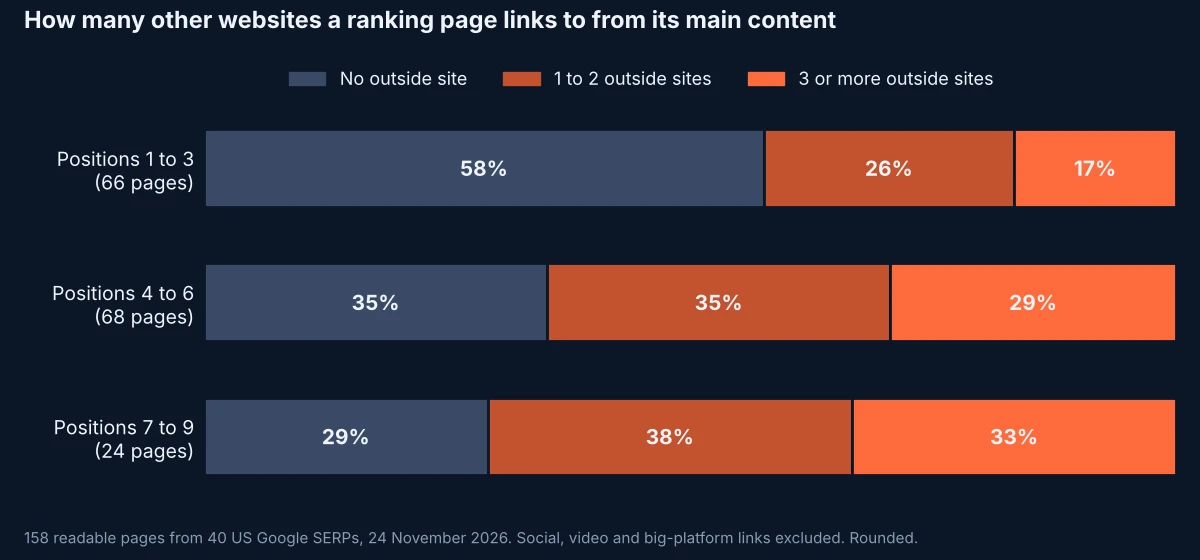
The gap holds in every one of the five topic areas we tested. In each, a smaller share of top-3 pages linked out than of pages ranked 4 to 9.
| Topic area | Queries | Pages read | Top-3 pages that link out | Positions 4 to 9 that link out | Pages citing a .gov, .edu, academic or Wikipedia source |
|---|---|---|---|---|---|
| Health | 8 | 37 | 5 of 12 | 16 of 25 | 17 |
| Personal finance | 8 | 36 | 3 of 14 | 13 of 22 | 10 |
| Consumer tech | 9 | 32 | 6 of 14 | 12 of 18 | 3 |
| Science | 8 | 33 | 9 of 15 | 14 of 18 | 16 |
| Home and garden | 8 | 20 | 5 of 11 | 6 of 9 | 2 |
| All | 41 | 158 | 28 of 66 | 61 of 92 | 48 |
The result is not driven by Wikipedia. Its five pages in our sample link out heavily, so we reran the numbers without them: 40% of the remaining top-3 pages linked out, against 65% in positions 4 to 6 and 68% in positions 7 to 9, with the same correlation (rho 0.24).
It is not a length effect either. Longer pages did link to more sites (rho 0.30 between word count and outside domains), but word count had little or no relationship with position in this sample (rho -0.04), in line with what our earlier word count test found.
Why the top results link out less
Look at who holds position one. Fourteen of the 22 number-one pages we could read had no outside links, and most were the primary source on their topic: Investor.gov on compound interest, NASA on black holes, MedlinePlus on DNA, Apple on backing up an iPhone, Google on resetting an Android phone, Fidelity and Vanguard on investing terms, Cleveland Clinic on heart rate and vitamin D. Our reading, which the data cannot prove: a government agency or a manufacturer explaining its own product has little reason to cite anyone, while pages further down are more likely to be secondary explanations that link back to sources like these.
That is the main limit of our test. It is correlational, and the top of the SERP is dominated by organisations whose authority comes from what they are, not from what they link to. Our data cannot show that linking out hurts a given page. What it shows is that in these 40 SERPs, Google placed pages with no outside links at the top far more often than pages that cited others. A ranking boost large enough for SEOs to rely on would be hard to square with that, though a small effect could still be hidden under the brand and authority signals that decide who ranks first. Other trust-signal advice deserves the same caution: our test of author bylines on health and money pages found that only 27% of 77 top-ranking pages named an author.
Verdict: unproven, and the ranking data leans against it
We rate the claim that adding links to authoritative sites lifts your rankings as unproven. On the record, Google has denied it at least three times across eight years. The supporting evidence is either indirect (documentation and rater guidelines that value citations for trust, without saying trust from links feeds rankings), speculative (a 1999-era research system nobody has shown Google uses), or small and not independently checkable (a 10-site agency test on an invented keyword). Our own pull of 158 ranking pages found that the pages Google puts first cite other sites less often than those below them.
The milder version of the claim survives. Google's documentation and rater guidelines both treat citing sources as part of what makes content trustworthy, and a page that backs up its claims is more useful to readers. That is a reason to link to sources when it helps the reader, not a reason to add a quota of "authority links" to every page.
What this means for SEO teams
- Drop link quotas from content briefs. A fixed quota of links to high-authority sites has no support in Google's statements or in our data. Cite where a claim needs a source.
- Link to the primary source, not a summary of it. If you mention a study, a regulation or a product change, link the original. This matches Google's own example in its link best practices page.
- Keep paid and partner links qualified. The real outbound-link risk in Google's documentation is link spam. Mark sponsored placements with rel="sponsored" and user-submitted links with rel="ugc".
- Do not strip useful citations out of fear. Our reading of Mueller's comments is that they cut both ways: if linking out does not lift a page, there is little reason to think refusing to cite anyone helps it either.
- Test on your own pages before you generalise. If you have a page that gained or lost citations without other changes, its Search Console history is better evidence than any industry rule of thumb.
Methodology
On 24 November 2026 we pulled Google's US English desktop results for 41 informational queries through a SERP API: eight each on health, personal finance, science and home and garden, and nine on consumer tech. The 41 SERPs returned 294 organic results (the deepest any SERP reached was position 9, so our lowest bucket covers positions 7 to 9). We excluded 55 results hosted on YouTube, Reddit, Facebook, Quora and LinkedIn, where outbound links reflect the platform rather than an editorial choice.
We fetched the remaining 239 pages at about 09:20 UTC with a standard HTTP client. 60 could not be read (mostly 403 responses from bot protection, including several Mayo Clinic and PubMed Central pages, which skews the blocked set toward health), and 21 returned under 150 words of readable text to our client, often a sign that the text loads with JavaScript. That left 158 pages from 40 SERPs.
For each page we removed navigation, header, footer, sidebar, form, share and related-content blocks, then took the largest article or main element as the main content (or the page body if no such element held 150 words). An outside link is a link from that content to a different registrable domain. We counted distinct outside domains, excluding social, video and big-platform domains (YouTube, Reddit, Facebook, Quora, TikTok, Instagram, X, LinkedIn, Pinterest, Threads, Bluesky, Apple, Google and Spotify). "Authority" links are those to .gov, .edu, .mil or .int domains, academic country domains, Wikipedia, doi.org, PubMed or NCBI and major journals. Correlations are Spearman's rank correlation; the top-3 versus rest comparison also passed a Mann-Whitney test (p = 0.001). The sample is small and US-only, results are personalised and change daily, and correlation does not show cause.
Conclusion
Google says outbound links are not a ranking factor, and the SERPs we pulled give no reason to doubt it: the pages Google ranks first cite other sites less often than the pages beneath them, most likely because many top spots went to primary sources such as agencies, manufacturers and big financial firms. The case for citing sources is a reader-trust case, which Google's documentation and rater guidelines both make. The case for adding authority links to climb rankings rests on a small 2016 experiment and a lot of repetition.
What do you think?
Have you ever added or removed outbound links on a page without changing anything else, and seen its Google position move? Tell us what changed and by how much, and we will include reader data in a follow-up.
Questions and answers
Are outbound links a Google ranking factor?
Google's John Mueller has said no on the record several times: in a January 2016 office-hours hangout, in a Reddit reply reported in July 2023 and in LinkedIn comments reported in August 2024. Google's link best practices page does say external links can help establish trustworthiness, for example when citing sources.
Do top-ranking Google pages link to authoritative sites?
Less often than lower-ranked pages, in our sample. On 24 November 2026, 38 of 66 pages in positions 1 to 3 (58%) had no editorial link to another website, against 31 of 92 pages (34%) in positions 4 to 9. Only 23% of top-3 pages linked to a .gov, .edu, academic, journal or Wikipedia source.
Should I add nofollow to all outbound links?
Google's guide to qualifying outbound links says regular links you expect Google to follow need no rel attribute. It asks for rel="sponsored" on paid links and rel="ugc" on user-generated links, with nofollow for other links you do not want associated with your site. In our sample only 16 of 158 ranking pages qualified any outside link.
Do Google's rater guidelines mention citing sources?
Yes. In the September 2025 edition, a Low-quality example is marked down partly because it fails to cite sources, and a High-quality encyclopedia example says its citations support the page's E-E-A-T. The guidelines also state that no single rating directly changes how a page appears in Google Search.
More releases
-
Studies
Google Said Links Would Move Up; 22 of 35 AI Overviews Put the First in the Final Third
A SaaS Link Building newsroom pull of 36 Google AI Overviews on 24 November found citation chips near the top of every answer, but the first hyperlink inside the answer text sat in the final third in 22 of the 35 that had one, a median 85% of the way down.
-
Explainers
OpenAI Cuts ChatGPT Shopping's Partnership Disclaimer; 67 of 68 Help Pages Changed
OpenAI has removed the statement that ChatGPT shopping results are not influenced by its partnerships from its Shopping with ChatGPT Search help page. The edit was made between 4 and 15 November; our check found 67 of 68 language versions updated, while the Hebrew edition still carries the old assurance.
-
Industry news
Google Ends Funding for 25 Small Australian Outlets; Councils Took 37 of 170 News Results
Google will stop funding the Public Interest Publishers Alliance, a group of small Australian publishers, from 31 December, citing the country's new news bargaining law. Our pull of 170 Google News results for 17 council searches found councils' own sites took 37 spots, more than any publisher group.
Tell us the site and the goals.
Rankings in Google and visibility in AI answers, from one monthly plan. One call is enough to say which one fits. Email works just as well.