Do Author Bylines Help You Rank? Only 27% of 77 Top Health and Money Pages Had One
Google says bylines do not help pages rank. We checked 213 top-10 results for 24 queries: only 21 of 77 readable health and money pages named an author, top positions were about as likely to have one as lower ones, and none of 15 government, .edu or NHS pages did.
 Vibhu Dhariwal
Cofounder & CTO, Digital Gratified
- Published
- Section
- Studies
- Reading time
- 13 minutes
Ras Al Khaimah, United Arab Emirates, .
Google says author bylines do not help pages rank. A large part of the SEO industry still treats them as a ranking lever, especially on health and finance content. To test the claim, SaaS Link Building pulled Google's top 10 US results for 24 informational queries on 1 November 2026 and checked every readable page for a named author. Only 21 of the 77 health and money pages we could read (27%) named a person as author. Pages at positions 1 to 3 were about as likely to carry one as pages at positions 7 to 10 (29% against 26%). None of the 15 government, .edu and NHS pages in the sample named an author, and they still ranked.
This investigation sets Google's public statements against its own documentation, a 2005 Google patent, the 2024 Content Warehouse leak and our SERP data. The question is narrow: does putting a person's name on a page help it rank, as many SEO checklists assume?
Key findings
- 27% of readable YMYL results named an author. On 12 health and personal finance queries, 21 of 77 pages carried a named author byline. Add the pages that named only a medical or expert reviewer and the figure rises to 24 of 77 (31%).
- No position gradient. Among YMYL pages, 29% of results in positions 1 to 3 had a named author, against 27% in positions 4 to 6 and 26% in positions 7 to 10.
- Hobby results were more likely to name an author than health and money results. On 12 hobby and how-to queries, 21 of 48 readable pages (44%) named an author.
- Institutions ranked without names. MedlinePlus, the NIH Office of Dietary Supplements, the NHS, the CFPB, the IRS and US Courts pages all ranked in the top 10 without a named author. One of those 15 pages (Harvard Health) named a medical reviewer.
- On hobby queries, half the top 10 had no conventional byline at all. 50 of 104 hobby results were YouTube, Reddit, Facebook and similar platform pages, where the creator is a channel or username.
The theory, and why people hold it
The theory runs like this: Google assesses who wrote a page, rewards content from identifiable experts, and does so most heavily on "Your Money or Your Life" (YMYL) topics. In practice it shows up in SEO audits and site templates as author boxes, author pages, "medically reviewed by" lines and Person schema, often added to existing pages in the hope of a ranking lift.
It is not an unreasonable belief. Google's own guidance talks about authors repeatedly, Google once ran a program that showed authors in search results, Google patented a way to score authors, and the leaked ranking documentation contains author fields. The case against rests on Google's direct denials and on what actually ranks. We take each side in turn.
Evidence for the theory
1. Google's helpful content guidance asks about bylines
Google's page on creating helpful, reliable, people-first content tells site owners to ask who created their content, how and why. Under "Who" it asks whether it is self-evident who authored a page and whether bylines lead to more information about the author. One of its questions reads: "Do pages carry a byline, where one might be expected?" The same page says Google strongly encourages accurate authorship information where readers might expect it and warns that fabricated creator profiles, such as AI-generated headshots or false credentials, are a form of deception. We covered other recent changes to this page in our report on Google's four new rater tests for effort, originality, skill and accuracy.
The page also says Google's systems give additional weight to content with strong E-E-A-T on topics that could significantly affect health, financial stability or safety. Read quickly, that sounds like a direct instruction to add bylines on YMYL content.
2. Google says it disambiguates authors
Google's Article structured data documentation has a section on author markup best practices. It tells publishers to list every author in their own author field and to add an author.url pointing to a page that uniquely identifies the author, and it says Google can use either url or sameAs when disambiguating authors. That is an explicit statement that Google tries to work out which real-world person an author name refers to. It does not say what Google does with that knowledge.
3. A Google patent describes ranking by author reputation
Google's "Agent rank" patent (US 7,565,358), filed in August 2005 and issued in July 2009, describes scoring "agents" such as authors, reviewers and publishers based on content they have digitally signed, and using that reputation to influence how search results are ordered. The score is recursive: an agent's standing rises when highly rated agents reference its signed content. A patent shows what Google engineers designed, not what Google Search runs today.
4. Google once displayed authors in search results
From 2011 Google ran Authorship, which linked articles to writers' Google+ profiles and showed author photos in results. Google stopped showing author photos in June 2014 and ended the program in August 2014, when John Mueller announced it on Google+, Engadget reported at the time. The reasons Google gave included low usage, frequent setup errors and a wish to unify the mobile and desktop results. For many SEOs, the program was proof that Google had built the plumbing to connect content to people.
5. The leaked documentation stores author identities
The Content Warehouse API documentation that leaked in 2024 includes a per-document record, PerDocData, with a field called authorObfuscatedGaiaStr and a deprecated predecessor described as the obfuscated Google profile ID of a document's authors. A Gaia ID is a Google account identifier. The field shows that Google has stored author identity at the document level. The documentation gives no weight for it and does not say whether any ranking system reads it, and, in our reading (an interpretation, not something the documentation states), an account-based ID fits the Authorship era better than byline text on a page. We looked at what other leaked fields do and do not prove in our investigation of whether Google uses clicks to rank pages.
6. Google News does require bylines
Google's news content policies say news sources should provide clear dates and bylines, information about authors and the publisher, and contact details, and that violating sites may be removed from news surfaces. The same page says these policies apply only to news surfaces. This is the one place where a Google surface formally requires bylines, and it is an eligibility rule rather than a ranking signal.
Evidence against the theory
1. Google has denied it on the record
In January 2024, replying to criticism of SEO practices in an article by The Verge, Google's Search Liaison account wrote on X that bylines are not something publishers do for Google and that "they don't help you rank better." In follow-up posts, as reported at the time by Search Engine Roundtable, the account said Google does not check writers' credentials, and that bylines are required for Google News eligibility without improving rankings in News or Search. The Search Liaison account was run by Google's Danny Sullivan.
2. The rater guidelines accept organisations and usernames as creators
Google's Search Quality Rater Guidelines (version dated 11 September 2025) tell raters to work out who is responsible for a website and who created the content. They define a content creator as an individual or an entity such as a business or organisation, and they say an alias or username is an acceptable way to identify a creator on forums and social platforms. The guidelines also state that no single rating can directly affect how a page appears in Search. Under Google's own framework, then, a hospital's name or a forum username can answer the question of who created a page.
3. What ranks: our SERP data
If named authors were a meaningful ranking input on YMYL topics, we would expect them to be common among top results on those topics and more common near the top. Neither held in our sample.
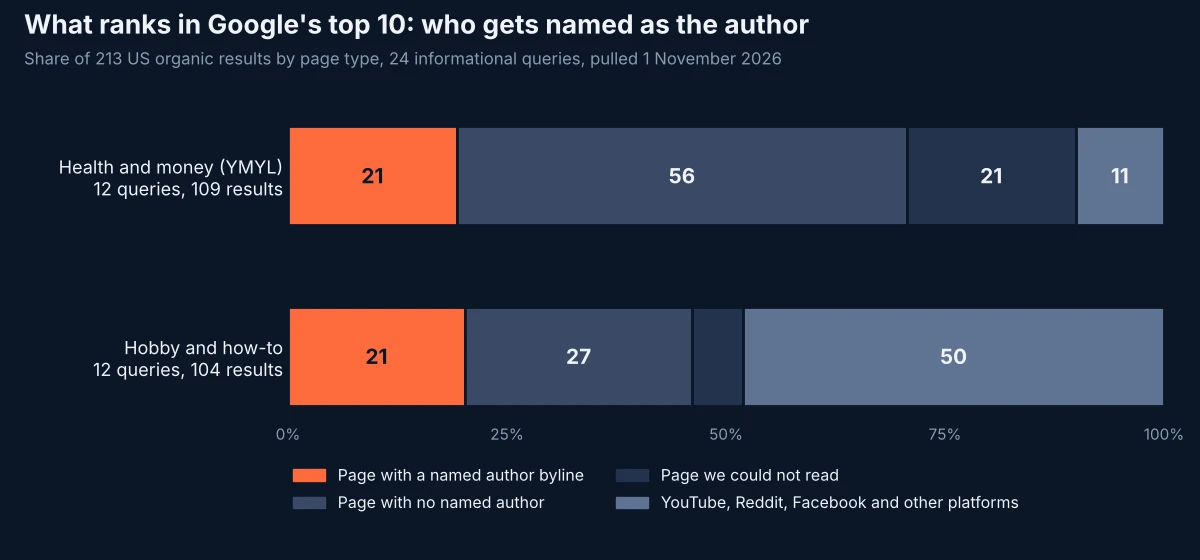
Across the 12 health and money queries, 77 pages were readable and 21 named an author. The pattern by position was flat:
| Positions | YMYL pages read | Named author | Hobby pages read | Named author |
|---|---|---|---|---|
| 1 to 3 | 28 | 8 (29%) | 16 | 8 (50%) |
| 4 to 6 | 26 | 7 (27%) | 19 | 6 (32%) |
| 7 to 10 | 23 | 6 (26%) | 13 | 7 (54%) |
| All | 77 | 21 (27%) | 48 | 21 (44%) |
Source: SaaS Link Building analysis of Google US results pulled 1 November 2026. Pages we could not fetch and platform pages are excluded.
Of the eight number-one YMYL results we could read, one named an author: a credit union's blog post on paying off credit card debt. The other seven number-one results included MedlinePlus, womenshealth.gov, the NIH Office of Dietary Supplements, the CFPB and US Courts, none of which carried a personal byline. Of the 15 .gov, .edu and NHS pages in the YMYL sample, none named an author and one (a Harvard Health article on ankle sprains) named a medical reviewer. The remaining 62 YMYL pages, from hospitals, banks, insurers and publishers, named an author 34% of the time.
Expert review lines, often treated as a YMYL requirement, were rare. Eight of 77 YMYL pages (10%) named a reviewer; none of the 48 hobby pages did. Across the 12 YMYL queries, the count of pages with a named author ranged from zero (cholesterol, sprained ankle and sleep) to four of seven (credit card debt).
The hobby queries tell a different story. Half of their top-10 results (50 of 104) were YouTube videos, Reddit threads, Facebook posts and similar platform pages, against 11 of 109 on the YMYL queries. On those platforms the creator is a channel or account name, which the rater guidelines treat as acceptable. Our earlier test of whether Google favours big brands found the same pull towards YouTube and Reddit.
Where the two sides meet
The evidence is less contradictory than it looks. Google's documentation describes bylines as something readers expect and as one way of showing who stands behind content. Its ranking statements say bylines themselves are not a signal. Our data fits that reading: on the YMYL queries, trust appeared to attach to the publisher rather than the individual. A government health page with no named author ranked first for three of the 12 queries, and hospital and university health libraries took many of the other health slots.
Two caveats point the other way. First, Google says it disambiguates authors, and the leak shows it has stored author identities, so it is possible that some system uses author entities in ways a byline count cannot detect. That is speculation: no document we found says such a system affects ranking. Second, correlation cuts both ways. A byline on a page that ranks does not show the byline helped, and a missing byline on a page that ranks does not prove bylines are useless for a site with less institutional authority. Our sample of 24 queries and one day cannot settle that.
Verdict: debunked as a direct ranking factor, unproven beyond that
The narrow claim, that adding a named byline makes a page rank better, is debunked on the evidence available. Google has denied it on the record, its rater guidelines accept organisations and usernames as creators, and in our sample named authors were less common on YMYL results than on hobby results and showed no link to position. The broader claim, that Google identifies authors as entities and uses their reputation somewhere in ranking, is unproven. A 2005 patent, a leaked account-ID field and Google's structured data guidance show the capability existed or exists. None of them shows it is used to order results today.
What this means for SEO teams
- Do not expect a ranking lift from adding author boxes. Treat bylines as a trust and transparency feature for readers, which is how Google's documentation frames them.
- Keep bylines where readers expect them. Google's helpful content guidance encourages accurate authorship information on content where readers might look for it. For news publishers, bylines are also a Google News eligibility requirement.
- Never fake an author. Google's guidance names made-up names, AI-generated headshots and false credentials as deception. A fabricated expert is a bigger risk than no byline.
- If you mark up authors, do it properly. Follow the Article structured data rules: one author per field, and an
author.urlorsameAsthat points to a real profile page. - Put YMYL effort into the publisher. In our sample the pages that won health queries came from organisations with clear institutional identity. About pages, editorial policies, contact details and accurate, consensus-aligned content are what the rater guidelines ask raters to check.
- Measure before you roll out sitewide. If you add bylines and reviewer lines to a set of pages, keep a comparable control set and compare Search Console clicks and positions over several weeks before claiming an effect.
Methodology
On 1 November 2026 we pulled Google's US English organic results (google_light engine, gl=us, hl=en) through a SERP API for 24 informational queries: 12 YMYL queries on health and personal finance (for example "how to lower cholesterol naturally", "symptoms of iron deficiency", "roth ira vs traditional ira", "how does chapter 7 bankruptcy work") and 12 hobby and how-to queries (for example "how to clean a cast iron skillet", "how to make a sourdough starter", "how to remove wallpaper"). The API returned 8 to 10 organic results per query, 213 in total. Tracking parameters were removed from URLs.
We classed 61 results on YouTube, Facebook, Reddit, Quora and Stack Exchange as platform pages and one Federal Reserve PDF separately. We fetched the HTML of the other 151 pages with a desktop Chrome user agent. 125 returned HTTP 200; 24 returned 403 and 2 failed, and we excluded them rather than work around the blocks. For each readable page we recorded JSON-LD author and reviewedBy values typed as Person, the author meta tag, visible "By" or "Written by" lines followed by a name, and visible "Reviewed by" lines followed by a name. We then checked every positive by hand and removed 13 where the "author" was an organisation, a CMS username or a text fragment, plus one reviewer credit that named an organisation. "Named author" means at least one remaining signal identified a person.
Limitations: bylines rendered only by JavaScript could be missed. The 20 blocked YMYL pages include journal articles, which list authors, so the YMYL figure is a floor: if every blocked YMYL page had a named author, the share would be 41 of 97 (42%), still below the hobby share on the same basis (27 of 54, 50%). Results come from one location on one day, and a 24-query sample shows association, not cause.
Conclusion
Google's line on bylines has been consistent: show readers who wrote your content, do not expect the byline itself to move rankings. Our check of 213 results found nothing that contradicts it. On health and money searches, the pages that ranked were mostly institutional pages with no personal name attached, and the share of named authors did not rise towards the top of the page.
What remains open is whether Google uses author identity in less visible ways. The patent, the leaked field and the structured data guidance keep that question alive, but none of them is evidence that it happens in ranking today.
What do you think?
Have you added author bylines or expert reviewer lines to an existing set of pages and tracked a control group in Search Console? Tell us what changed in clicks and average position, and over what period.
Questions and answers
Are author bylines a Google ranking factor?
No, according to Google. In January 2024 Google's Search Liaison account said on X that bylines are not something publishers do for Google and do not help pages rank. Google's helpful content guidance still encourages accurate bylines where readers might expect them.
How many top-ranking health and finance pages had a named author in this test?
21 of the 77 readable top-10 pages (27%) across 12 health and personal finance queries pulled on 1 November 2026 named a person as author. Including pages that named only a reviewer, the figure was 24 of 77 (31%).
Does Google require bylines anywhere?
Yes, for Google News. Google's news content policies say news sources should provide clear dates and bylines and information about authors, and that these policies apply only to news surfaces.
What do Google's quality rater guidelines say about content creators?
The guidelines dated 11 September 2025 define a content creator as an individual or an entity such as a business or organisation, and accept an alias or username on forums and social platforms. They also say no single rating can directly affect how a page appears in Search.
Does Google track author identities at all?
Google's Article structured data documentation says it can use author url and sameAs properties when disambiguating authors, and the 2024 Content Warehouse leak includes an author account ID field. Neither source shows that author identity is used to rank pages.
More releases
-
Industry news
Bing Tests Ads in AI Overviews; Our 36-Search Check Found 12 Overviews and No Ads Inside
Microsoft Bing appears to be testing sponsored results inside its Copilot AI Overviews, after a screenshot surfaced on 30 October. Our check of 36 US Bing results pages found AI Overviews on 12, none with an ad inside, though 10 of those 12 pages already carried ads.
-
Industry news
AI Shoppers Convert 90% Better, Adobe Says; 40 of 43 Retailers Don't Block AI Bots
AI-referred shoppers converted 90% better than other visitors on US retail sites in September 2026 and were worth 83% more per visit, Adobe data published on 29 October shows. Our robots.txt check of 43 large US retailers found 40 place no homepage block on nine AI crawlers, while Amazon blocks all of them.
-
Studies
YouTube Was Cited in All 30 AI Overviews We Pulled, Supplying 34% of 271 Citations
YouTube was cited in every one of 30 US Google AI Overviews we pulled on 31 October, supplying 92 of 271 unique citations (34%). Nearly half of those links pointed to a timestamp inside a video, and half the queries had no YouTube result in the organic top 10.
Tell us the site and the goals.
Rankings in Google and visibility in AI answers, from one monthly plan. One call is enough to say which one fits. Email works just as well.